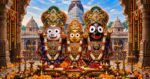

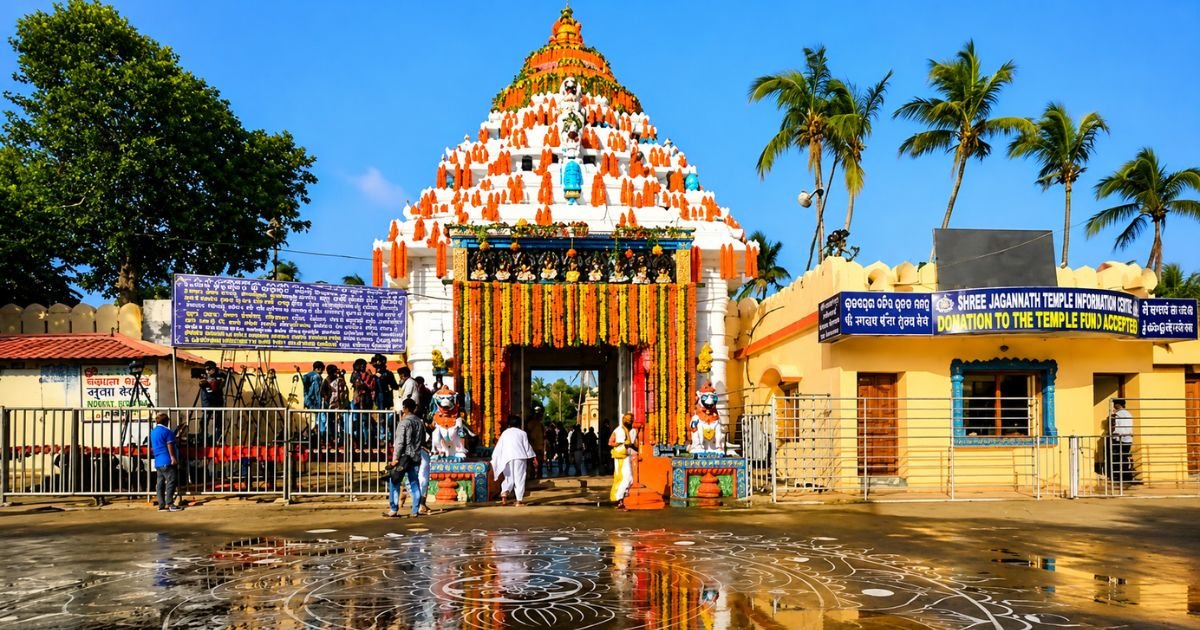
Lord Jagannath visits Gundicha Temple Puri every year because of a divine promise made to Queen Gundicha, the deeply devoted wife of King Indradyumna. The Lord pledged to visit her home for seven days every year during the Rath Yatra. The temple is also considered the birthplace of the deities and the home of Lord Jagannath’s aunt. This annual visit has happened for centuries without interruption.
Every year, as the grand chariots roll through the streets of Puri, millions of devotees celebrate Lord Jagannath’s sacred journey to Gundicha Temple. It is the heart of Jagannath Rath Yatra and one of the most cherished traditions in Sanatan Dharma.
But behind this beautiful journey lies a question many devotees have wondered about.
Why does Lord Jagannath visit Gundicha Temple every year? Is it because of a promise made to Queen Gundicha? Is the temple truly considered His aunt’s home? Or does this annual visit carry an even deeper spiritual meaning?
In this blog, we’ll explore the fascinating legends, temple traditions, and spiritual significance behind Lord Jagannath’s annual visit to Gundicha Temple, helping you understand why this journey continues to inspire millions of devotees across the world.
What Is Gundicha Temple Puri?
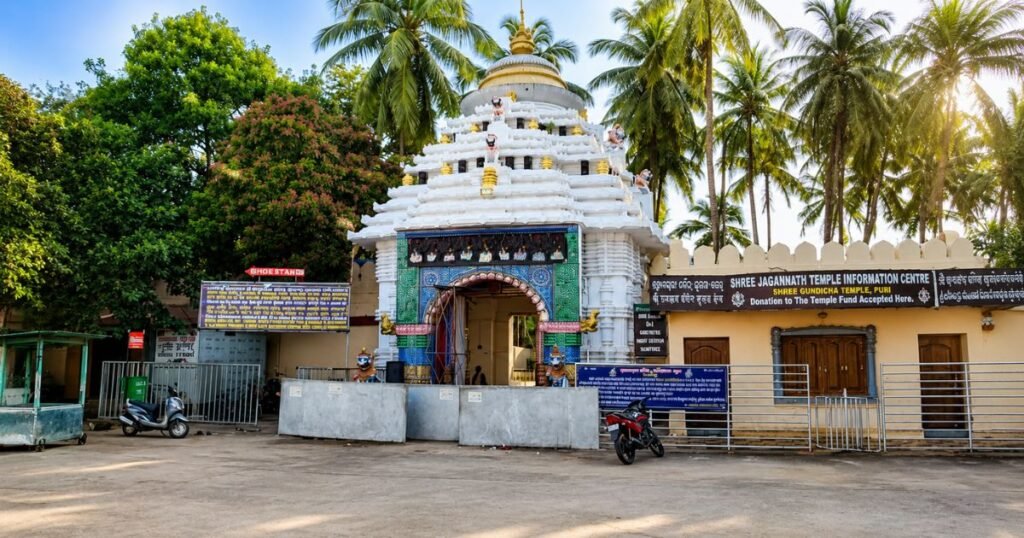
Gundicha Temple is a sacred Hindu temple in Puri, Odisha. It sits exactly 2,688 metres (about 3 km) from the main Jagannath Temple, at the far end of Bada Danda, the Grand Road. It is the destination of the annual Jagannath Rath Yatra, where Lord Jagannath, Balabhadra, and Subhadra stay for seven days every year.
The temple is built in the Kalinga architectural style using grey sandstone. It has four main sections:
- the Vimana (tower)
- the Jagamohana (prayer hall)
- the Natamandapa (dance hall)
- the Bhogamandapa (offering hall).
A simple raised platform called the Ratnavedi sits at the centre of the sanctum. This is where the three deities rest during their annual visit. Unlike the ornate Jagannath Temple, Gundicha Temple is intentionally simple and humble in appearance.
The temple is surrounded by a beautiful garden and enclosed by a 20-foot high wall, giving it the feel of a peaceful private retreat rather than a grand royal temple.
Who Is Gundicha? The Name Behind the Temple
Gundicha is most widely understood as the aunt of Lord Jagannath. In the tradition of Puri, Odisha, she is also identified as Queen Gundicha, the wife of King Indradyumna, the legendary founder of the first Jagannath Temple. Her name in Odia also connects to the word “Gundi,” which means smallpox, and local tradition links her to a goddess worshipped to cure this illness.
Different traditions offer slightly different answers to who Gundicha was. The most popular view, supported by temple tradition and the Incredible India official portal, is that she was Lord Krishna’s adoring aunt, and the temple is her home.
Each year, she eagerly waits for her divine nephew and his siblings to arrive. According to legend, she prepares a special treat for them: the traditional rice cake called Poda Pitha. Another tradition, documented at Shreekhetra.com, describes her as Queen Gundicha, whose deep personal devotion earned the Lord’s annual promise to visit her home.
Why Is Gundicha Temple Called the Garden House of Jagannath?
Gundicha Temple is called the Garden House of Jagannath because it stands in the middle of a beautiful green garden, enclosed by high compound walls on all four sides. The garden setting gives the temple a calm, private quality, more like a home than a grand shrine. It is the Lord’s personal retreat, not his official abode.
The green garden around the temple is unlike anything else in Puri. Tall coconut trees, flowering plants, and shaded pathways surround the sandstone structure. When the three deities arrive here after the chariot procession, devotees say the Lord is stepping out of his palace and into his garden home.
The simplicity is deliberate. It reflects the idea that true devotion does not need grandeur, and that the Lord is most himself when he is among the humble and the devoted.
Who Was Queen Gundicha? Her Story and Her Faith
Queen Gundicha was the wife of King Indradyumna. She was a devoted worshipper of Lord Jagannath. According to Puranic tradition, her faith was so deep and so sincere that Lord Jagannath himself made a divine promise: he would visit her home personally every year for seven days.
The Story: King Indradyumna and Queen Gundicha were devoted believers in Lord Jagannath. The Puranas record that the Lord surrenders himself near his true devotees. Gundicha’s faith was of that rare quality.
It is said that she entered the room where Vishwakarma was carving the idols of Lord Jagannath, breaking the condition of complete privacy. Though the carving was left unfinished, Gundicha’s devotion was not forgotten.
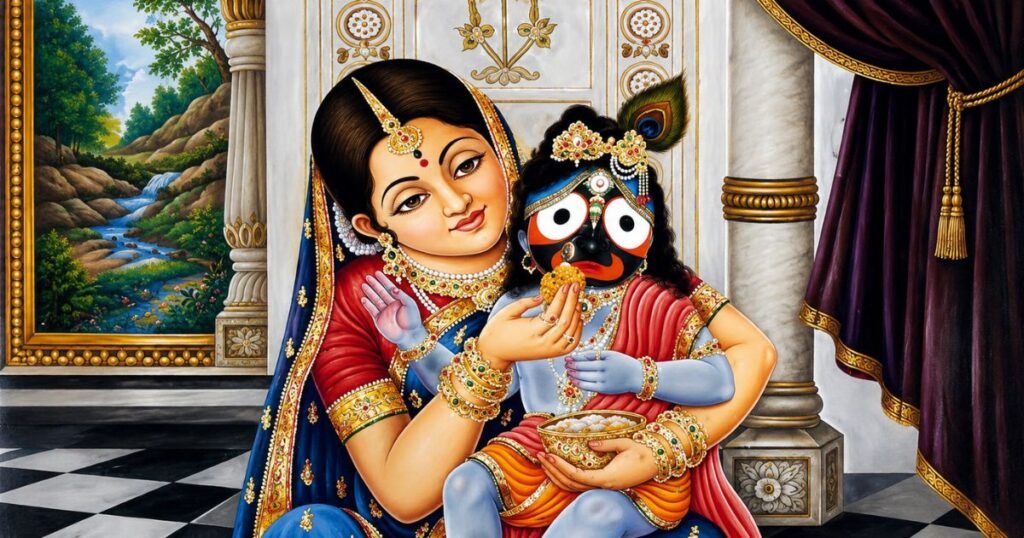
Lord Jagannath honoured her with a divine promise: every year, during the Rath Yatra, he would leave his great temple and come to her home for seven days. That promise became the Rath Yatra as it is known today.
Source: Skanda Purana, Purushottama Kshetra Mahatmya; Madala Panji (the Jagannath Temple’s own historical and ritual chronicle, maintained by hereditary temple record-keepers).
Why Does Lord Jagannath Visit Gundicha Temple Every Year?
Lord Jagannath visits Gundicha Temple every year for three reasons that tradition and scripture offer together. First, it fulfills his divine promise to Queen Gundicha. Second, it honors Subhadra’s wish to visit her aunt. Third, the temple is considered the birthplace and sacred ground of the deities themselves, making the visit a return to their own origin.
The three reasons together form a complete picture:
- The divine promise: Lord Jagannath promised Queen Gundicha that he would visit her home for seven days every year. He never breaks this promise. The Puranas record that the Lord yields completely to true devotion. Queen Gundicha represents that devotion.
- Subhadra’s wish: The Skanda Purana also connects the journey to Subhadra’s wish to visit her aunt’s home. Her brothers agreed to take her by chariot. That single sibling gesture became the annual Rath Yatra.
- The birthplace visit: A third tradition, recorded in the Madala Panji, the Jagannath Temple’s own ritual chronicle, calls Gundicha Temple the Yagnya Vedi, the sacred ground where the four deities were first born into their divine forms. Every year, the visit is also a return to the place of their origin.
Together, these three reasons explain why the Gundicha Yatra has never stopped across centuries of history. It is at once a family visit, a fulfillment of a sacred promise, and a homecoming to the place of divine birth.
Is Gundicha Temple the Birthplace of Lord Jagannath?
Yes, according to one important tradition. Gundicha Temple is considered the Yagnya Vedi, the sacred fire altar ground where the four deities (Lord Jagannath, Lord Balabhadra, Goddess Subhadra, and Lord Sudarshan) were first manifest in their divine forms. This makes the annual visit also a return to their place of origin.
This is one of the least-known facts about Gundicha Temple Puri. Most people know the temple as the destination of the chariot procession. But the Madala Panji, the temple’s own ritual chronicle maintained by hereditary record-keepers for centuries. It specifically names Gundicha Temple as the Yagnya Vedi, meaning the sacred ceremonial space where the first divine manifestation of Chaturddha Murti (the four deity forms) took place.
In this sense, the Rath Yatra is not just a trip to an aunt’s home. It is the Lord going back to where it all began.
How Long Does Lord Jagannath Stay at Gundicha Temple?
Lord Jagannath stays at Gundicha Temple for exactly seven full days. Including the day of arrival and the day of departure, the total stay is nine days. This is why the journey is also called Nava Dina Yatra, meaning the nine-day journey.
| Day | Event |
| Day 1 (July 16, 2026) | Chariots arrive at Gundicha Temple. Deities rest inside the chariots overnight. |
| Day 2 | Deities enter the Gundicha Temple sanctum and are placed on the Ratnavedi. |
| Days 2 to 8 | Daily rituals and puja inside Gundicha Temple. Special Adapa Darshana for devotees. |
| Day 5 (Hera Panchami, July 20, 2026) | Goddess Lakshmi visits the temple in a palanquin to see Lord Jagannath. |
| Day 9 (July 24, 2026) | Bahuda Yatra begins. Deities exit through the eastern Nakachana gate and return to the Jagannath Temple. |
Dates for Jagannath Rath Yatra 2026. Source: SJTA official schedule at shreejagannatha.in.
What Rituals Happen at Gundicha Temple During Rath Yatra?
The main Gundicha Temple Rath Yatra rituals are Gundicha Marjana (ritual cleaning), Adapa Darshana (sacred viewing), Hera Panchami (Lakshmi’s visit), and daily Brahmin puja. One important feature: inside Gundicha Temple, it is Brahmin priests who serve the deities, not the Daitapatis who serve them in the main temple. This is a unique and significant ritual distinction.
- Gundicha Marjana: The ritual deep cleaning of the temple on the day before Rath Yatra.
- Entry through the western gate: The deities enter Gundicha Temple through the main western gate.
- Placement on the Ratnavedi: The deities are placed on the plain raised seat at the centre of the sanctum.
- Adapa Darshana: The special auspicious viewing of the deities at Gundicha Temple, considered the most spiritually powerful darshan of the Rath Yatra cycle.
- Brahmin puja (not Daitapati): Unlike at the Jagannath Temple where hereditary non-Brahmin Daitapati servitors perform key rituals, inside Gundicha Temple only Brahmin priests offer puja. This distinction is recorded in the Madala Panji and is documented in academic studies of the Jagannath cult and temple servitor system, including the scholarly work of G.C. Tripathi on Jagannath ritual structure.
- Hera Panchami: On the fifth day, Goddess Lakshmi is carried to Gundicha Temple in a decorated palanquin. Thousands gather to witness this ritual meeting of the Lord and his consort.
- Exit through the eastern Nakachana gate: The deities leave Gundicha Temple on the ninth day through this specific eastern gate for the return journey.
What Is Gundicha Marjana?
Gundicha Marjana is the ritual cleaning of Gundicha Temple Puri performed on the day before Rath Yatra. Temple servitors, priests, and devotees clean the entire temple by hand to prepare it for the arrival of the deities. In 2026, Gundicha Marjana falls on Wednesday, July 15, 2026.
The most famous account of Gundicha Marjana comes from Chaitanya Mahaprabhu himself. When he lived in Puri, he personally led his devotees to Gundicha Temple to clean it with great devotion.
He did not simply supervise. He gathered the dust and dirt himself, packed it into his own cloth, and threw it outside the temple walls. His approach to this cleaning was treated as a deep act of worship, not labour. Devotees who practice this ritual today follow his example.
What Is Adapa Darshana?
Adapa Darshana is the sacred viewing of the deities at Gundicha Temple during their seven-day stay. “Adapa” refers to the simple Ratnavedi seat on which the deities rest. This darshan is considered the most auspicious of the entire Rath Yatra cycle. Scriptures and temple tradition both say it cleanses the soul and fulfills the deepest spiritual wishes of the devotee.
The significance of Adapa Darshana rests on temple tradition recorded in the Madala Panji and on the broader Vaishnava theology of accessibility, the belief that the divine draws nearer to the devotee during specific sacred windows.
One reason this darshan is considered so special: the deities are seated in a simpler, more accessible setting than inside the main Jagannath Temple. They are closer to the devotee, on a plain seat, in a humble room. There is no royal grandeur between the Lord and the worshipper here. That closeness is exactly what Adapa Darshana offers.
Spiritual note: The Skanda Purana’s Purushottama Mahatmya states that seeing Lord Jagannath on his chariot frees a soul from rebirth. Temple tradition extends this to Adapa Darshana at Gundicha Temple: the seven-day window when the Lord is more accessible to all devotees than at any other point of the year.
Chaitanya Mahaprabhu’s Deep Connection to Gundicha Temple
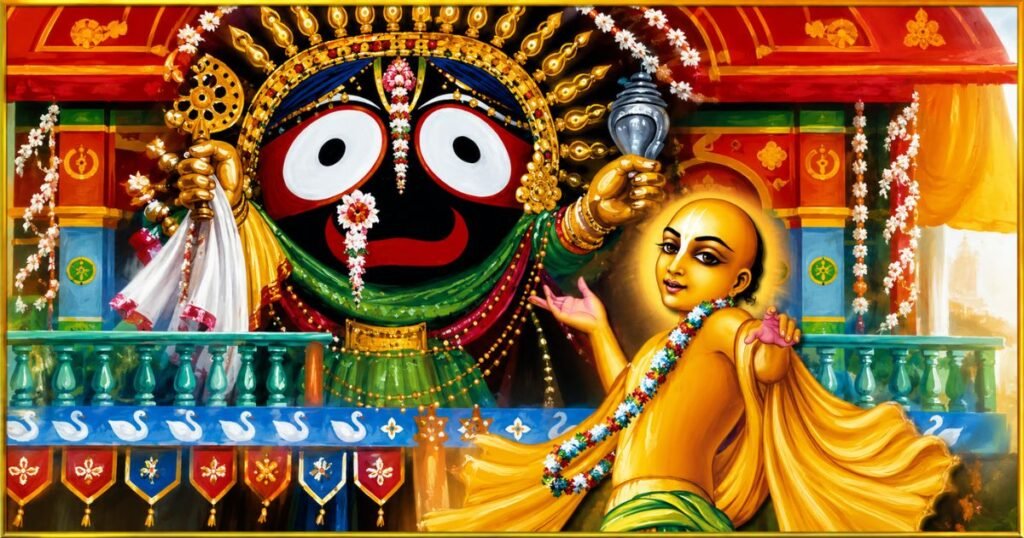
Saint Chaitanya Mahaprabhu (1486–1534) lived in Puri for many years and had a profound personal relationship with Gundicha Temple. He personally led the Gundicha Marjana cleaning every year.
He led sankirtan yatras in front of the deities during Rath Yatra. He composed the Jagannath Ashtakam in Puri. And he regularly went into deep spiritual ecstasy while watching Lord Jagannath at Gundicha Temple.
The Chaitanya Charitamrita records Chaitanya Mahaprabhu’s experiences at Gundicha Temple in detail. He is described as standing in tears before the deities, overwhelmed by the vision of the Lord in his garden home. He fainted multiple times from the intensity of his devotion.
He prayed daily to Jagannath at the Garudastamba pillar in the main temple and treated the Rath Yatra journey as a reunion between the Lord and his devotees in the most personal sense possible.
The Story of Babana Bhuta: The Guardian of Gundicha Temple
Babana Bhuta is adivine guardian spirit believed to protect Gundicha Temple Puri when it is empty for the rest of the year. He never appears in any visible form. But devotees who eat Mahaprasad inside the temple grounds always leave a small portion on a leaf for him before eating themselves. This tradition continues today.
The Babana Bhuta legend belongs to local Odia folk tradition rather than to the Puranas or the temple’s formal scriptural record. It is one of the most distinctive and least-known aspects of Gundicha Temple, passed down orally among devotees and temple-area residents rather than recorded in Sanskrit scripture.
On the day before Rath Yatra, as temple servitors begin the Gundicha Marjana cleaning, Babana Bhuta is said to temporarily leave his post inside. Folk tradition places him at the corner of the western compound wall, waiting for the cleaning to finish and the deities to arrive.
He is described not as a threatening spirit but as a devoted, faithful one, a guardian who watches over the empty temple for eleven months of the year so that when the Lord arrives, the temple is ready to receive him.
Note: This account reflects living Odia folk tradition around the temple, distinct from Puranic or Madala Panji sources. We note this distinction so you as reader can tell scripture-grounded fact from local belief.
Why Is Gundicha Temple Empty Most of the Year?
Gundicha Temple is empty for eleven months of the year because it only exists as the Lord’s annual guest house. No permanent deity is installed inside it. The temple has no resident god. It belongs entirely to Lord Jagannath’s once-a-year visit. A small group of temple servitors maintain it year-round under the Jagannath Temple Administration.
This emptiness is itself meaningful. Most Hindu temples are built around a permanent deity who lives there. Gundicha Temple is different. It waits. It was built for one purpose: to receive the Lord when he comes to fulfill his promise.
The rest of the year, it is clean, maintained, and quietly guarded. Babana Bhuta watches over it. The garden grows around it. And every year, on Ashadha Shukla Dwitiya, the chariots arrive and the waiting ends for nine days.
Can Non-Hindus Visit Gundicha Temple?
Yes. Gundicha Temple Puri is open to everyone, including non-Hindus and foreign nationals. This is a direct contrast to the main Jagannath Temple, which restricts non-Hindus from entering the sanctum. Entry to Gundicha Temple is also completely free. This openness is one of the most important expressions of Lord Jagannath’s universal message.
During Rath Yatra, non-Hindu devotees who cannot enter the Jagannath Temple can visit Gundicha Temple and receive the Adapa Darshana of the deities freely. This open-access policy is maintained by the Shree Jagannath Temple Administration (SJTA), the official body governing both temples, and reflects long-standing temple practice during the festival period.
Practical Visitor Information for Gundicha Temple Puri
| Detail | Information |
| Location | Balagandi, Basanta Road, Puri, Odisha 752002 |
| Distance from Jagannath Temple | Approximately 3 km along Bada Danda |
| Entry fee | Completely free for everyone |
| Open to non-Hindus | Yes |
| Temple timings | 6:00 AM to 9:00 PM daily (closed 3:00 PM to 4:00 PM) |
| Best time to visit | During Rath Yatra (July 16 to July 24, 2026) for Adapa Darshana |
| Architecture | Kalinga style, grey sandstone, four sections |
| Gates | Western gate (deities enter), eastern Nakachana gate (deities exit) |
| Governing body | Shree Jagannath Temple Administration (SJTA), shreejagannatha.in |
One useful fact: The roughly 3-kilometre stretch of Bada Danda between the Jagannath Temple’s Lion’s Gate and Gundicha Temple is the same fixed route the chariots travel every single year, both on the outward Rath Yatra and the return Bahuda Yatra.
Final Thought
Every year, Lord Jagannath’s visit to Gundicha Temple reminds devotees that some promises are never forgotten. For centuries, this sacred journey has brought together faith, tradition, and devotion, making it one of the most meaningful moments of Jagannath Rath Yatra.
Now that you know why Lord Jagannath visits Gundicha Temple every year, the Rath Yatra tells a different story. The chariots are no longer just carrying the deities through the streets of Puri. They are carrying a centuries-old promise, a cherished family tradition, and a spiritual message that continues to inspire millions of devotees.
Jai Jagannath!
Frequently Asked Questions About Gundicha Temple Puri
He fulfills a divine promise to Queen Gundicha, honors Subhadra’s wish to visit her aunt, and returns to the Yagnya Vedi, the sacred ground considered his birthplace.
Gundicha is Lord Jagannath’s aunt. She is also identified as Queen Gundicha, the devoted wife of King Indradyumna, who founded the first Jagannath Temple in Puri.
Adapa Darshana is the sacred viewing of the deities at Gundicha Temple during their seven-day stay. It is considered the most auspicious darshan of the entire Rath Yatra cycle.
Because it stands in the middle of a beautiful garden enclosed by high walls. It is the Lord’s humble, personal retreat, not a grand official temple.
Yes, according to temple tradition. It is called the Yagnya Vedi, the sacred ground where all four deities (Jagannath, Balabhadra, Subhadra, Sudarshan) were first manifest in their divine forms.
Gundicha Marjana is the ritual deep cleaning of Gundicha Temple on the day before Rath Yatra. Saint Chaitanya Mahaprabhu personally led this cleaning every year when he lived in Puri.
Seven full days. Including arrival and departure days, the total is nine days. This is why the journey is also called Nava Dina Yatra (the nine-day journey).
Babana Bhuta is the divine guardian spirit who protects Gundicha Temple when it is empty. He never appears visibly but devotees leave a portion of Mahaprasad on a leaf for him before eating inside the temple grounds.
Yes. Gundicha Temple is open to everyone including non-Hindus and foreigners. Entry is free. This is different from the main Jagannath Temple, which restricts non-Hindu entry into the sanctum.
Because it was built only for Lord Jagannath’s annual visit. No permanent deity lives there. It waits quietly for nine days every year and stays maintained by temple servitors the rest of the time.
Nava Dina Yatra means the nine-day journey. It is another name for the Gundicha Yatra that describes the complete nine-day period from the main Rath Yatra to Bahuda Yatra.
Approximately 3 kilometres along Bada Danda, the Grand Road of Puri. This is the fixed route the chariots travel every year.
He lived in Puri for many years, personally led the Gundicha Marjana cleaning each year, composed the Jagannath Ashtakam, and regularly experienced deep spiritual ecstasy while watching Lord Jagannath at Gundicha Temple.
Gundicha Marjana, daily Brahmin puja (unlike the Daitapati service at the main temple), Adapa Darshana, Hera Panchami, and the Bahuda Yatra exit through the Nakachana gate.