
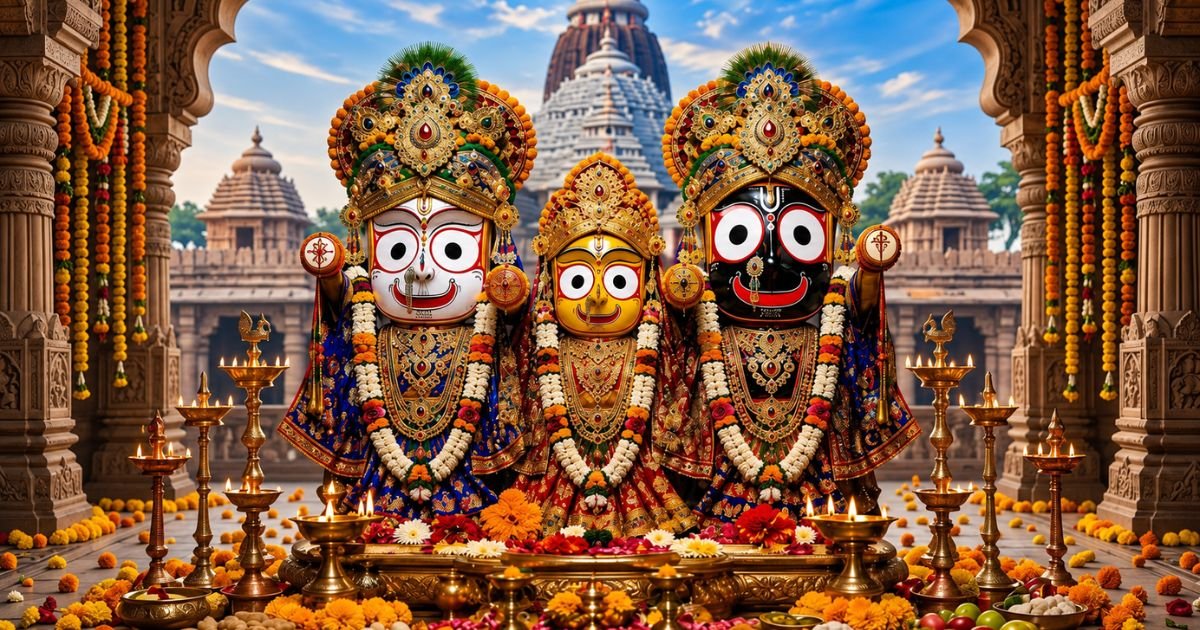
Lord Jagannath is the Lord of the Universe, a supreme form of Vishnu worshipped in Puri, Odisha. His wooden idol has large round eyes, no hands, and no legs. These features carry profound spiritual meaning rooted in ancient Vaishnava theology and sacred legend. He is not a regional deity. He is the Supreme Being worshipped across all Hindu traditions.
Most Hindu deities are easy to recognize. Lord Shiva carries a trident. Lord Ganesha has an elephant head. Lord Krishna holds a flute.
But Lord Jagannath looks completely different.
He has large round eyes, no visible hands or feet, and a wooden body unlike any other Hindu deity. If you’ve ever wondered who Lord Jagannath is and why He looks this way, you’re not alone. Millions of devotees have asked the same questions for centuries.
The answer, however, goes far beyond His appearance.
Every part of Lord Jagannath’s unique form tells a story. His big eyes, unfinished limbs, wooden idol, and even His name carry deep spiritual meaning rooted in Hindu scriptures, sacred traditions, and centuries of devotion.
So, who is Lord Jagannath? Why does He have such large eyes? Why is His idol made of wood? And what is the deeper meaning behind His unique form?
Let’s uncover the remarkable story behind one of Hinduism’s most beloved deities.
What Does Jagannath Mean?
Jagannath meaning is “Lord of the Universe.” It comes from two Sanskrit words. “Jagat” means the world or universe. “Nath” means lord or master.
This name alone tells you who he is. He belongs to the whole universe, not to one place or one group of people. He is also called Purushottama, which means the Supreme Being above all others. The Skanda Purana uses this name in its 28th chapter. The city of Puri itself gets its name from this title.
Who Is Lord Jagannath?
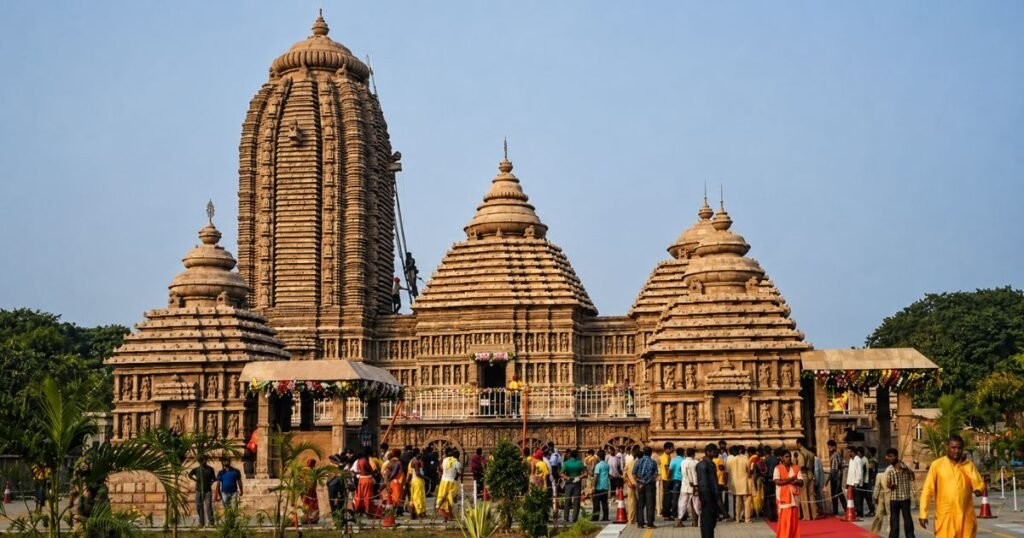
Lord Jagannath is a form of Lord Vishnu. He is worshipped as the Supreme God of all creation. He lives in his famous temple in Puri, Odisha. He is always seen together with his brother Balabhadra and his sister Subhadra.
He is one of the most loved deities in Hinduism. Millions of people travel to Puri every year to see him. His temple is one of India’s four most sacred pilgrimage sites, known as the Char Dham. He is special because he welcomes every person, from every background and faith. During the Jagannath Rath Yatra, he even steps outside the temple to bless everyone on the street.
Is Lord Jagannath the Same as Krishna?
Yes, Lord Jagannath is widely seen as a form of Lord Krishna. But he is not the Krishna who plays the flute and dances in Vrindavan. He is Krishna in his highest state of divine love and joy. That state is called Maha Bhava.
He is also identified with Lord Vishnu and called Purushottama in the Bhagavad Gita. The Skanda Purana records that Lord Brahma told King Indradyumna that Jagannath is Lord Janardana, a direct name for Vishnu, now manifested in wooden form. That’s why Lord Jagannath sits at the centre of multiple devotional traditions simultaneously.
Why Does Lord Jagannath Look Different from Other Hindu Deities?
Lord Jagannath looks different because his idol is not fully carved. He has a large round face, huge eyes without eyelids, no hands, and no legs. His body is a short, flat piece of wood. Most Hindu idols are made of stone or metal with full human shapes. His form is unique and carries deep meaning in every single feature.
He is also made from neem wood, not stone or metal. This is another thing that makes him unlike any other major Hindu deity. His unique look comes from a combination of two things: the story of how he was carved, and a deep spiritual idea about the nature of God. Both are explained in detail below.
The Story Behind Lord Jagannath’s Idol
This story comes from the Skanda Purana and the Brahma Purana. It has two parts. The first is the carving story. The second is a deeper spiritual story that explains the eyes, face, and missing limbs together.
Part 1: The Carving Story
A king named Indradyumna ruled the kingdom of Avanti. He wanted to see God with his own eyes. A traveler told him about a form called Neel Madhava, hidden in a forest. The king sent his priest Vidyapati to find it. A tribal king named Vishvavasu was secretly worshipping Neel Madhava. Vidyapati found him and saw the divine form. He rushed back to tell King Indradyumna.
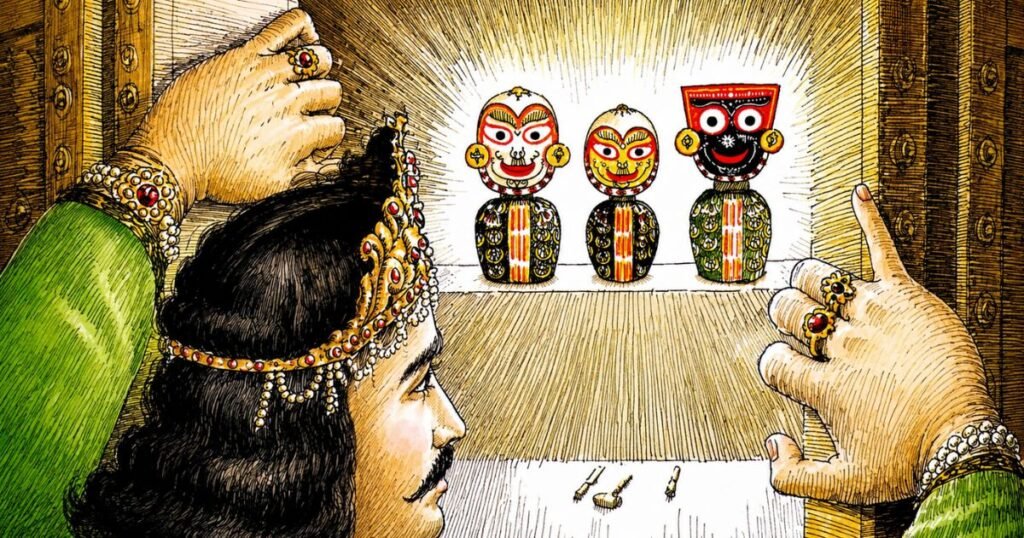
But when the king’s men reached the spot, the deity was gone. A divine voice spoke from the sky. It told the king to find a holy log floating near the sea. This log is called the Daru Brahma. It would carry the marks of Vishnu: a conch, a wheel, a club, and a lotus. The king found it exactly as described.
An old carpenter appeared. He said he would carve the idols. But he had one rule: a closed room, 21 days, and no one could open the door until he was done. The king agreed. Days passed without a sound. The queen grew worried. She thought the carpenter had died. She opened the door before the 21 days were over.
The carpenter had vanished. The three idols were unfinished. They had no hands and no feet. A divine voice then told the king to install them exactly as they were. The Lord had already entered the wood. The unfinished form was his chosen form.
Part 2: The Maha Bhava Story
This story comes from the Mahabhava-prakasam by Sikhi Mahiti, a text connected to the teachings of Saint Chaitanya Mahaprabhu at Puri.
Once, Krishna’s wives asked Mother Yashoda to tell them stories about Krishna’s life in Vrindavan. Subhadra, Krishna’s sister, stood outside and listened. When Krishna and his brother Balarama arrived and heard the same stories, something happened to all three of them. They entered a state of pure, overwhelming divine love. This state is called Maha Bhava.
In this state, their eyes grew wide and round. Their arms and legs pulled inward into their bodies. They were completely lost in divine joy. The sage Narada arrived at that moment. He was amazed by what he saw. He asked the Lord to hold this form so that future generations could see it. The Lord agreed. That form became the idol of Lord Jagannath, Balabhadra, and Subhadra.
Source: Mahabhava-prakasam by Sikhi Mahiti, referenced inChaitanya Mahaprabhu’s teachings at Gambhira, Puri.
What Every Feature of Lord Jagannath’s Idol Means?
Each part of Lord Jagannath’s idol teaches something. The table below covers all eight features with their plain meaning.
| Feature | What it means? |
| Large round eyes | He sees everything, always. He watches over all people at all times, with no limits. |
| No eyelids | He never blinks. He never sleeps. His care for you never stops. |
| Circular face | A circle has no beginning and no end. His face shows that God has no start and no finish. |
| Gentle smile | He welcomes every soul. His smile says: no one is too broken, too sinful, or too far away. |
| No hands or arms | In the Maha Bhava story, his arms pulled inward. It also means God does not need hands to reach you. He is already inside you. |
| Short, flat torso | He has no full human body. This shows that God is beyond all human shape and form. |
| Neem wood | Wood is alive, grows, and dies. Just like a human body. But the soul inside is eternal. His wooden body teaches this truth. |
| Dark black color | This is Krishna’s color. Dark like a rain cloud. It also stands for the vastness of space and the infinite nature of God. |
Why Does Lord Jagannath Have Big Round Eyes ⭕!⭕ ?
Lord Jagannath’s big eyes represent two things. First, he sees everything and everyone always. Second, the Maha Bhava story says Krishna’s eyes grew wide open in divine joy. The idol captured that moment. His eyes have no eyelids, meaning he never stops watching over his devotees.
Devotees call these eyes Chaka Akhi or Chaka Dola, which means round eyes. They also stand for the sun and the moon. Just as the sun and moon never stop watching the earth, the Lord never looks away from his devotees. The moment of receiving his gaze during darshan is called Chakshu-dana, meaning the gift of sight. Many devotees say this single moment brings deep peace.
Why Does Lord Jagannath Have No Hands or Legs?
Lord Jagannath has no hands or legs for two reasons. First, Vishwakarma left the idol unfinished when the door was opened early. Second, in the Maha Bhava state, Krishna and Balarama’s arms and legs pulled into their bodies in divine love. The idol shows that state forever.
There is also a deeper idea here. God does not need hands to help you or feet to walk to you. He is already everywhere. His “incomplete” body actually shows the most complete truth about God: he is beyond all physical form.
Why Is Lord Jagannath Made of Neem Wood?
Lord Jagannath is made of neem wood because neem is considered the purest tree in Hindu tradition. His wooden form is called Daru Brahma, which means the Supreme God in wood. According to the Skanda Purana, the wood itself is Brahman, meaning God.
The Rig Veda mentions a divine wooden form floating near the eastern sea. Later scholars linked this directly to Jagannath. The specific neem tree used for each new idol must pass strict conditions. It must carry the four marks of Vishnu on its bark. No bird should have ever rested on its branches. This tree is treated as a living form of the Lord before any carving begins.
Wood is also different from stone or metal because it is living and it perishes. This teaches the same truth as the Bhagavad Gita: the body is temporary, but the soul inside is forever.
Why Is Lord Jagannath Black in Color?
Lord Jagannath is black because he is a form of Lord Krishna, whose color is described as dark like a rain cloud. His dark color also stands for the endless depth of space and the infinite nature of God.
The four deities on the altar in Puri each have a different color. Jagannath is dark. Balabhadra, his brother, is white. Subhadra, his sister, is yellow. Sudarshana is red. Together, these four colors represent all of humanity. It shows that the Lord belongs to every kind of person, across every background and race.
What Is the Secret Inside Lord Jagannath’s Idol?
Inside the wooden idol of Lord Jagannath is a hidden sacred object called Brahma Padartha. Devotees believe this is the divine soul of the Lord itself. No one outside a small circle of senior priests ever sees or touches it.
When the old idol is replaced with a new one, priests carefully transfer this Brahma Padartha into the new form. This happens at night, in complete darkness, with the priests blindfolded and their hands wrapped in cloth. The Bhagavad Gita teaches the same idea: the physical body grows old and dies, but the soul inside it never does. The Brahma Padartha is that eternal soul, living inside a wooden body.
Why Is Lord Jagannath’s Idol Replaced Every Few Years?
The wooden idol of Lord Jagannath is replaced in a ritual called Nabakalebara, which means “new body.” It happens once every 8, 12, or 19 years. The last one was in 2015. The next is expected around 2034.
Wood does not last forever. When the time comes, priests from a specific hereditary family go into the forests of Odisha. They search for a special neem tree. The tree must show the four symbols of Vishnu on its bark. It must have grown without any bird ever sitting on it. No metal touches the tree during the search or the carving.
New idols are carved in total secrecy. Then the Brahma Padartha is moved from the old idol to the new one. The old idols are buried with full respect at Koili Baikuntha, a sacred ground inside the temple premises. This entire ritual teaches the same truth as the Gita: the body changes, but the soul is forever.
What Do Hindu Scriptures Say About Lord Jagannath?
Ancient Hindu texts across thousands of years mention Lord Jagannath by name. This is one of the reasons why he is not just a local deity. His presence reaches the oldest layers of Hindu literature.
| Scripture | What it says about Lord Jagannath |
| Rig Veda | A verse mentions a sacred wooden form floating near the eastern sea. The 14th century scholar Sayanacharya linked this to Purushottama, another name for Jagannath. |
| Atharvaveda (Paippalada Samhita, VI-8/7) | Praises the Lord of Purushottama Kshetra, the sacred land of Puri. |
| Skanda Purana, Chapter 28 | Lord Brahma directly tells King Indradyumna: “Do not think this is a mere wooden image. This is the Supreme God himself, in the form of wood.” |
| Brahma Purana | Says Puri is the eternal home of Vishnu and describes how he appeared as Daru Brahma, the God in wood. |
| Padma Purana | Sage Narada tells the devotee Prahlada: anyone who sees Lord Jagannath at Nilachala hill will reach Lord Vishnu’s eternal home. |
| Narada Purana | Describes the Rath Yatra. Says that simply watching the chariot procession gives great spiritual good to the viewer. |
| Kapila Samhita | Calls Puri a direct copy of Vaikuntha, Vishnu’s heaven. Uses the words “sakshat vaikuntha rupam,” meaning “a true form of Vaikuntha itself.” |
| Chaitanya Charitamrita | Records how Saint Chaitanya Mahaprabhu personally joined the Rath Yatra in Puri. Describes his deep spiritual joy before Lord Jagannath. |
How Different Traditions See Lord Jagannath?
One of the most remarkable things about Lord Jagannath is that many different spiritual traditions claim him as their own. This is not a dispute. It shows how wide his reach truly is.
| Tradition | How they see Lord Jagannath |
| Vaishnavism | He is Lord Vishnu or Lord Krishna in the Maha Bhava state of divine love. This is the mainstream view across most of India. |
| Advaita Vedanta | Adi Shankaracharya himself visited the Jagannath Temple. Followers of this path see Jagannath as the formless God who took a visible form just for the sake of his devotees. |
| Shakta tradition | Some devotees of the Divine Goddess also worship him, seeing his three deities as a representation of the divine family. |
| Buddhist scholars | Some historians point out that Jagannath’s rounded, simple form and his tribal origins show possible connections to early Buddhist art. This is a scholarly view, not a worship claim. |
| Tribal and Savara tradition | Before any temple, the Savara tribal community worshipped him as Neel Madhava in a forest. This origin is mentioned in the Skanda Purana and the Brahma Purana. It is the oldest layer of his story. |
Who Are Lord Jagannath’s Family Members?
Lord Jagannath has an elder brother named Balabhadra and a younger sister named Subhadra. A fourth figure, the divine disc called Sudarshana Chakra, also stands on the main altar. All four travel together during the annual Rath Yatra.
| Name | Who they are | Color | Chariot in Rath Yatra |
| Lord Jagannath | The Lord himself | Dark (black) | Nandighosha (16 wheels) |
| Balabhadra | Elder brother, a form of Balarama | White | Taladhwaja (14 wheels) |
| Subhadra | Sister | Yellow | Darpadalana (12 wheels) |
| Sudarshana Chakra | The divine wheel of Vishnu | Red | Travels with Balabhadra |
Lord Jagannath’s Different Names and What They Mean
Lord Jagannath has 108 names in the devotional tradition. Each name comes from a different feature of his nature, his story, or his relationship with his devotees. Here are his most important and widely used names.
| Name | Simple meaning | Why this name matters |
| Jagannath | Lord of the Universe | His main name. It says he belongs to the whole world, not just Odisha or India. |
| Purushottama | The highest being of all | Used in the Bhagavad Gita. The city of Puri takes its name from this title. |
| Darubrahma | The Supreme God in wood | Explains why he is made of wood. The wood itself is treated as the living God. |
| Patitapavana | One who cleans the fallen | One of the most loved names. It means no person is too lost for his grace to reach. |
| Neel Madhava | The blue or dark divine one | His oldest name, used by the Savara tribe before any temple was built. |
| Chakaakhi | The round-eyed one | Describes his most visible feature. From “chaka” meaning circle and “akhi” meaning eyes. |
| Jagabandhu | Friend of the world | A warm, personal name. Heard in many Odia devotional songs. |
| Nilachala Bihari | The one who lives on the Blue Hill | Refers to his temple on Nilachala Hill in Puri, his home on earth. |
| Kalia | The dark one | An everyday name used with love. Refers to Krishna’s dark skin color. |
| Adikesava | The first and original Vishnu | Places Jagannath at the very root of all Vishnu worship. |
Why Is Lord Jagannath Worshipped? What Is His Significance?
Lord Jagannath is worshipped because he accepts every person equally. He does not turn anyone away based on their birth, caste, or background. He is also the Lord who steps outside his temple once a year so that everyone, including those not allowed inside the temple, can see him.
His significance goes beyond religion. He stands for equality. Even the King of Puri sweeps the ground in front of his chariot. No one is above anyone else in front of this Lord.
Scriptures say that simply seeing him, even for a moment, brings good to the soul. The Padma Purana says that seeing him at Nilachala Hill leads a person to Vishnu’s eternal home – Vaikunth. That is why people have walked hundreds of miles across India to reach Puri, for thousands of years.
Conclusion
Lord Jagannath’s unique form has inspired curiosity for centuries. His large round eyes, unfinished limbs, wooden body, and gentle smile are not imperfections. They are powerful symbols that remind us that God cannot be confined to ordinary human form.
Even if you know Him as Krishna, Vishnu, Purushottama, or the Lord of the Universe, His message remains the same. He watches over every soul with equal compassion, welcomes everyone without discrimination, and teaches that while the body may change, the soul is eternal.
Perhaps that is why millions continue to travel to Puri year after year. They do not come merely to see an unusual idol. They come to experience the boundless love, acceptance, and divine presence that Lord Jagannath represents.
Once you understand the meaning behind His form, you realize that He does not look different from other deities. He simply reveals a different way of understanding the infinite.
Frequently Asked Questions About Lord Jagannath
He is the Lord of the Universe. He is worshipped as a form of Lord Vishnu and Lord Krishna. He lives in the famous temple in Puri, Odisha.
“Jagat” means universe. “Nath” means lord. Jagannath means the Lord of the Universe.
Yes. He is Krishna in his highest state of divine love, called Maha Bhava. He is also identified with Lord Vishnu in the Skanda Purana.
His round eyes, called Chaka Akhi, show that he sees everything always. They also come from the Maha Bhava story, where Krishna’s eyes grew wide in divine joy.
Two reasons. The carpenter left before finishing the arms. Also, in the Maha Bhava state, Krishna’s arms pulled inside his body in divine love.
Same two reasons as the hands. The idol was not finished. And in Maha Bhava, the limbs retracted into the body.
His wooden form is called Daru Brahma, meaning God in wood. The Skanda Purana says the wood itself is the Supreme God. Neem is also the purest tree in Hindu tradition.
He is a form of Krishna, who is described as having a dark complexion. His color also stands for the vastness of space and the infinite nature of God.
Because the door was opened before the carpenter finished. The Lord then told the king to install the unfinished form. The incompleteness is itself a spiritual message.
Wood does not last forever. The idol is replaced in a ritual called Nabakalebara, every 8 to 19 years. The eternal soul inside is moved to the new idol.
A hidden sacred object called Brahma Padartha lives inside. It is believed to be the living soul of the Lord. Only senior hereditary priests handle it.
His elder brother is Balabhadra. His younger sister is Subhadra. A fourth deity, Sudarshana Chakra, also stands on the altar with them.
Because “Jagannath” literally means that. He is the Supreme God who governs all of creation, with no limit on who can worship him.
He is famous for his unique wooden form, the annual Rath Yatra chariot festival, and his message that every person is equal before God.
He shows that God belongs to everyone. He steps outside his temple once a year so all people, of every faith, can see him and receive his blessing.
The Skanda Purana, especially the Purushottama Mahatmya in chapter 28. Lord Brahma himself tells King Indradyumna that Jagannath is the Supreme God in wood.
His gentle smile shows that he welcomes all souls. No person is too broken or too sinful for his love and grace.
The journey does not end here. Follow MFC on Instagram and Facebook to explore more sacred places, festivals, and living traditions of Sanatan Dharma.