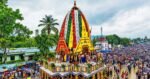

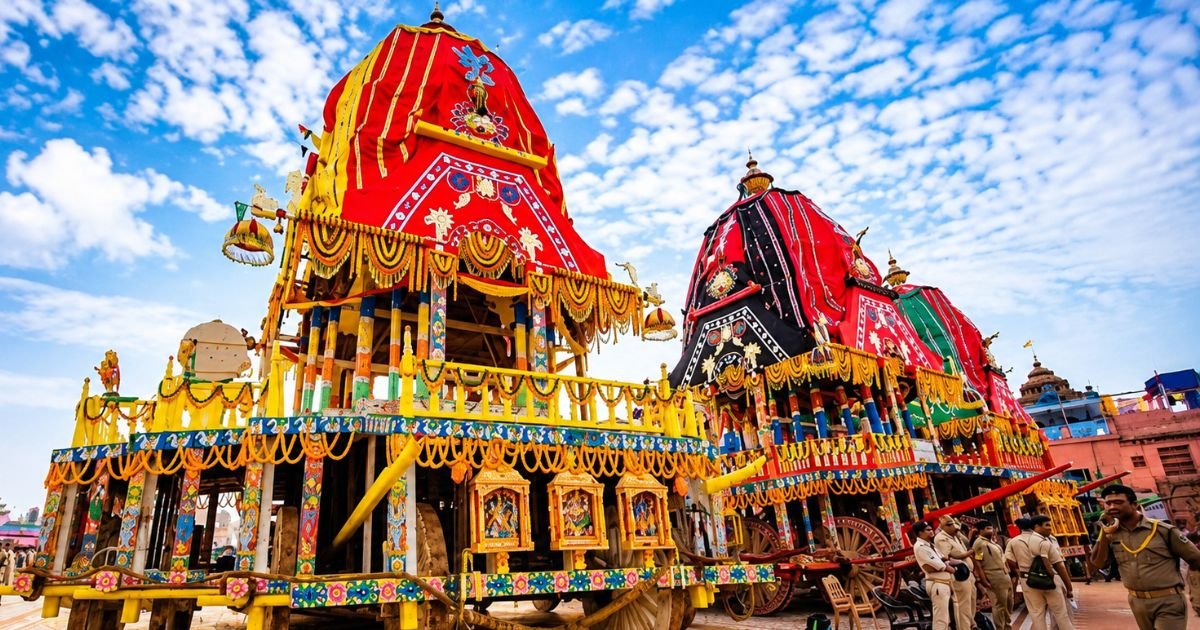
The three Jagannath Rath Yatra chariots are Nandighosha for Lord Jagannath, Taladhwaja for Balabhadra, and Darpadalana for Subhadra. Each is built fresh every year from sacred wood with no metal nails. All three together stand between 42 and 45 feet tall and run on 42 wheels total. Every single part of each chariot carries a spiritual meaning rooted in ancient Hindu scripture.
If you’ve ever watched Jagannath Rath Yatra, one question almost always comes to mind. Why are there three different Raths?
Why doesn’t Lord Jagannath travel alone? Why does each chariot have a different name, different colours, a different number of wheels, and even its own horses and flag?
The answer is not just tradition. Every Rath tells its own story. Every detail, from the wood it’s built from to the rope thousands of devotees pull together, has a meaning that has been preserved for centuries.
In this blog, we’ll explore the three Jagannath Rath Yatra chariots, Nandighosha, Taladhwaja, and Darpadalana, and uncover what makes each one unique.
Why Are There Three Separate Chariots?
There are three chariots because three deities travel during the Rath Yatra. Lord Jagannath, his elder brother Balabhadra, and his sister Subhadra each travel in their own separate chariot. Each chariot is built and decorated specifically for that one deity.
According to the Skanda Purana’s Purushottama Mahatmya, the three siblings travel together every year to visit the Gundicha Temple. The story behind this annual journey goes back to Subhadra’s wish. She asked her brothers to take her to see the city in separate chariots. Her brothers agreed. That single wish became the ritual for the Rath Yatra that millions celebrate today.
Each chariot also serves a theological purpose. The three deities represent three different aspects of the Supreme. Jagannath is Shri Krishna. Balabhadra is Balarama, the elder brother. Subhadra represents the divine feminine and the power of devotion. Their separate chariots show that the divine has many faces, all equal, all worthy of honour.
Features of All Three Jagannath Rath Yatra Chariots
Here are the complete features of all three Jagannath chariots in one table. Nandighosha is the largest. Darpadalana is the smallest. Together they use 2,188 pieces of wood and 42 wheels.
| Feature | Nandighosha (Jagannath) | Taladhwaja (Balabhadra) | Darpadalana (Subhadra) |
| Deity | Lord Jagannath | Lord Balabhadra | Goddess Subhadra |
| Other names | Garudadhwaja, Kapidhwaja | Haladhwaja, Langaladhwaja | Padmadhwaja, Devadalana |
| Height | ~44 to 45 feet | ~43 to 44 feet | ~42 to 43 feet |
| Wheels | 16 wheels | 14 wheels | 12 wheels |
| Wood pieces | 832 pieces | 763 pieces | 593 pieces |
| Base size | 34’6″ × 34’6″ | 33′ × 33′ | 31’6″ × 31’6″ |
| Cloth colours | Red and yellow | Red and blue-green | Red and black |
| Horse colour | 4 white horses | 4 black horses | 4 red horses |
| Charioteer | Daruka | Matali | Arjuna |
| Guardian deity | Garuda | Vasudeva | Jayadurga |
| Flag name | Trailokyamohini | Unnani | Nadambika |
| Rope name | Shankhachuda | Vasuki | Swarnachuda |
| Weapons on chariot | Sankha and Chakra | Hala and Musala | Padma and Kalhar |
| Wheel symbolism | 16 kalas of the divine | 14 worlds of Hindu cosmology | 12 months of the year |
Sources: Madala Panji (Jagannath Temple Chronicle), Craft Archive at Gaatha.org, Shreekhetra.com, and Charanashrita. Exact heights and wood counts vary slightly each year since all three chariots are rebuilt fresh from scratch.
Nandighosha: The Chariot of Lord Jagannath
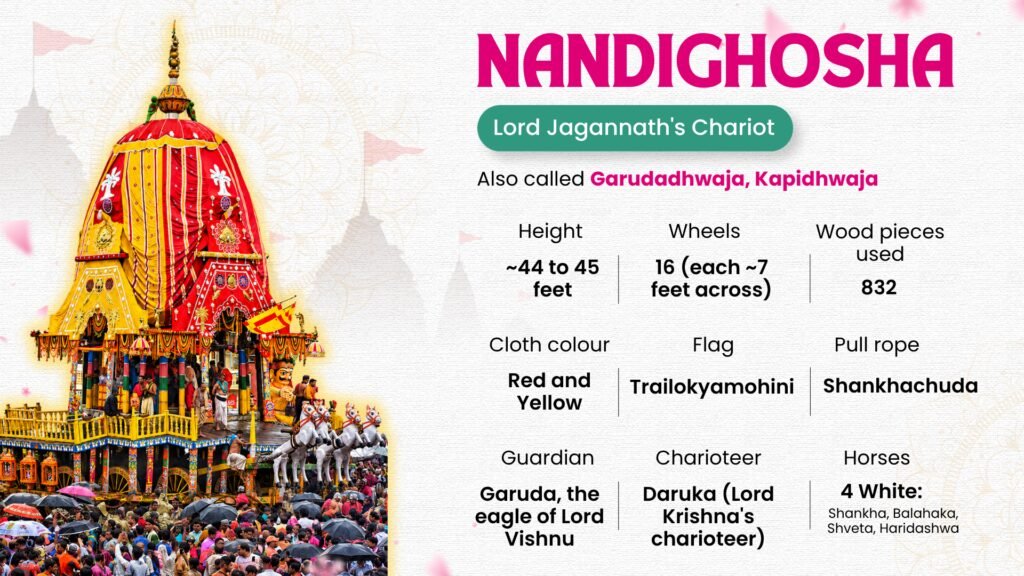
Nandighosha is the largest of the three chariots. It belongs to Lord Jagannath. It stands about 44 to 45 feet tall, has 16 wheels, and is covered in red and yellow cloth. The name Nandighosha means “the one whose sound is as powerful as Nandi’s roar.”
The Nandighosha chariot is covered in red and yellow cloth. Yellow is the colour of Krishna’s robes. He is also called Pitambara, which means “one dressed in golden-yellow cloth.” The red stands for divine cosmic power. These color choices match Lord Jagannath’s identity directly.
Garuda, the great eagle of Lord Vishnu, stands as the guardian of this chariot. The charioteer is Daruka. In Hindu scripture, Daruka was the real divine charioteer of Lord Krishna. His name on the chariot is a direct reference to that sacred relationship. The flag at the top is called Trailokyamohini, meaning “the one who enchants all three worlds.”
Why Does Nandighosha Have 16 Wheels?
According to Vaishnava philosophy, a fully complete divine being has 16 kalas, or 16 divine qualities and aspects. The 16 wheels of Nandighosha represent these 16 kalas. By giving this chariot 16 wheels, the tradition shows that Lord Jagannath is a complete and perfect divine being.
Taladhwaja: The Chariot of Balabhadra
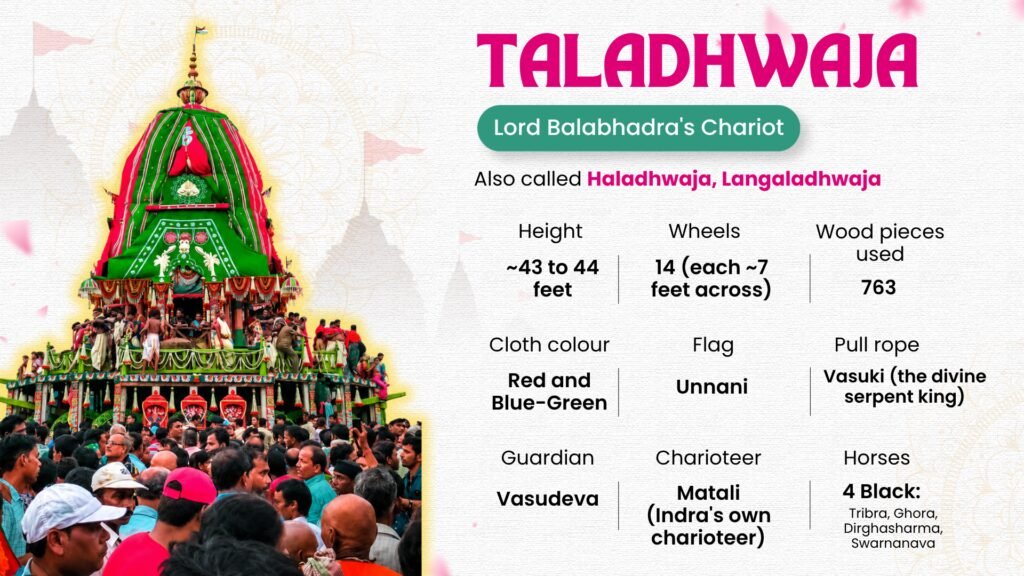
Taladhwaja is the chariot of Lord Balabhadra. It stands about 43 to 44 feet tall with 14 wheels and red and blue-green cloth covering. The name Taladhwaja means “the one with the palm tree on its flag.” It is the first chariot to move in the Rath Yatra procession.
The name Taladhwaja comes from Tala, the palm tree, which is one of Balabhadra’s personal symbols. The blue-green cloth on his chariot connects to his nature as a deity of fields, growth, and the earth. Balabhadra is also associated with the plough, which is why his chariot is also called Haladhwaja (Hala means plough).
The charioteer here is Matali. In Hindu texts, Matali is the personal charioteer of Indra, the king of the gods. His name on this chariot honours Balabhadra’s strength and royal status. The four black horses stand for power and steady determination.
Why Does Taladhwaja Have 14 Wheels?
The 14 wheels stand for the 14 worlds of Hindu cosmology. These include seven upper worlds (Sapta Loka) and seven lower worlds (Sapta Patala). Balabhadra’s chariot carries one wheel for each world, showing that his presence touches all of creation.
Darpadalana: The Chariot of Subhadra
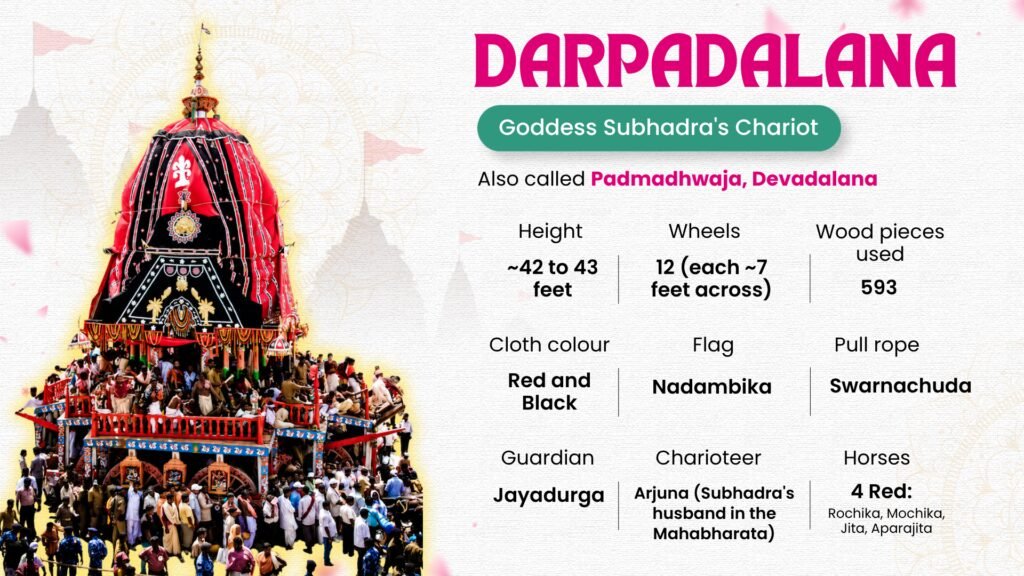
Darpadalana is the chariot of Goddess Subhadra. It stands about 42 to 43 feet tall with 12 wheels. Its cloth covering is red and black. Darpadalana means “crusher of pride.” It is the only chariot of the three where all nine subsidiary deities are female.
The black cloth on the Darpadalana chariot represents Shakti, the great primordial female divine power. In Hindu tradition, black is the colour of the Mother Goddess in her most powerful form – Maa Kali. The charioteer is Arjuna, the great warrior prince from the Mahabharata. This is deeply meaningful. In the Mahabharata, Arjuna was Subhadra’s husband. His placement as her charioteer on this float is a direct reference to their sacred bond.
Darpadalana is also called Padmadhwaja, which means “lotus-flagged.” The lotus is a symbol of purity and spiritual beauty. The four red horses on this chariot stand for energy, movement, and protection. The name Darpadalana itself carries a powerful message: pride has no place before the divine.
Why Does Darpadalana Have 12 Wheels?
The 12 wheels stand for the 12 months of the Hindu calendar year. Subhadra blesses all of her devotees across every season. Her 12 wheels show that her grace is not limited to a single time or moment.
Who Else Rides on Each Rath Yatra Chariot?
Every one of the three Jagannath Rath Yatra chariots carries nine subsidiary deities (called Paarswa Devatas) alongside the main deity. The nine deities on each chariot match the nature of the deity that chariot serves. Subhadra’s chariot is unique in that all nine of her subsidiary deities are female goddesses.
| Chariot | 9 Other Deities (Paarswa Devatas) |
| Nandighosha (Jagannath) | Varaha, Govardhana, Gopi-Krishna, Narasimha, Rama, Narayana, Trivikrama, Hanuman, Rudra |
| Taladhwaja (Balabhadra) | Ganesha, Kartikeya, Sarvamangala, Pralambari, Halayudha, Mrutyunjaya, Natamvara, Mukteshwar, Sheshadeva |
| Darpadalana (Subhadra) | Chandi, Chamunda, Ugratara, Vanadurga, Shulidurga, Varahi, Shyamakali, Mangala, Vimala |
Source: Madala Panji(Shree Jagannath Temple Chronicle), cross-referenced with Charanashrita.wordpress.com and the Craft Archive at Gaatha.org.
The nine deities on Nandighosha all relate to Lord Vishnu’s different forms and his most devoted servants. Hanuman, Narasimha, and Rama are all part of the Vaishnava devotional tradition.
On Taladhwaja, the deities include Ganesha and Kartikeya, who represent Balabhadra’s connection to the wider Hindu divine family.
On Darpadalana, every single deity is a goddess, from Chandi to Vimala, reflecting Subhadra’s identity as a divine female being.
What are The Three Chariot Ropes and What They Mean?
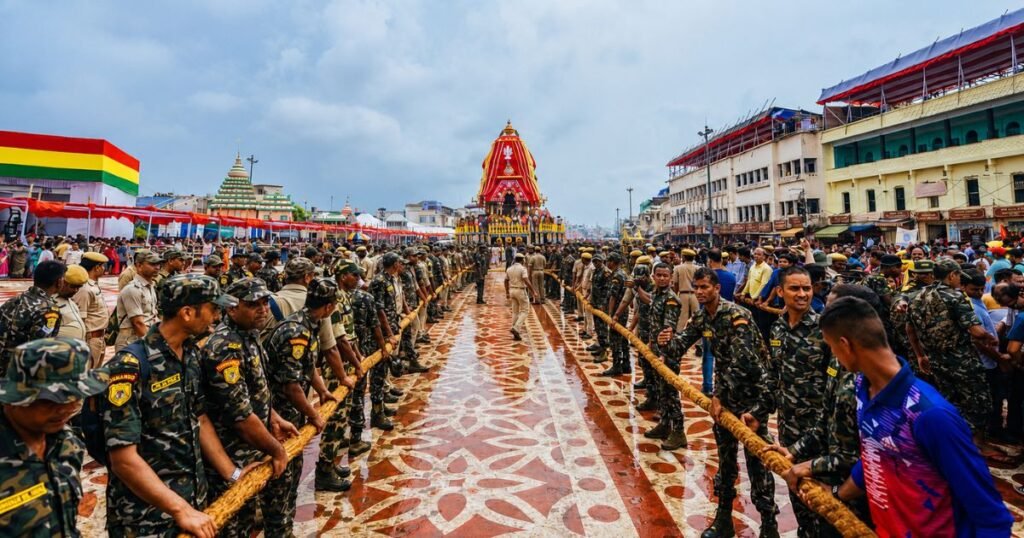
The three pull ropes are named Shankhachuda (Nandighosha), Vasuki (Taladhwaja), and Swarnachuda (Darpadalana). All three names belong to divine serpents in Hindu mythology. Serpents in this context represent divine cosmic power, protection, and the energy of the universe. Pulling any of these ropes is believed to bring direct divine connection.
It is not a coincidence that all three ropes carry serpent names. In Hindu tradition, divine serpents (Nagas) are symbols of cosmic energy and protection. Vasuki is the king of all serpents and was used to churn the ocean of milk in the famous creation story. Shankhachuda and Swarnachuda are powerful serpents mentioned in the Puranas.
When millions of devotees grip these thick ropes and pull the chariots together, they are not just moving a wooden vehicle. According to the Skanda Purana, Purushottama Mahatmya, seeing the Lord on his chariot delivers a soul from the cycle of rebirth. The act of touching and pulling the rope brings that same blessing even closer. It is the most direct physical act of devotion in the entire festival.
Spiritual fact:The Madala Panji, the official temple chronicle of the Jagannath Temple in Puri,records the names and uses of all three ropes. It lists them among the most sacred elements of the Rath Yatra. Devotees who touch the rope are said to receive the same merit as completing all four Char Dham pilgrimages.
Which Chariot Goes First in Jagannath Rath Yatra?
Taladhwaja (Balabhadra) always moves first. Darpadalana (Subhadra) follows second. Nandighosha (Lord Jagannath) comes last. This order follows the Pahandi ritual and has never changed across centuries of celebration.
The order follows a clear logic rooted in family respect. Balabhadra is the elder brother. He goes first as a sign of his seniority. Subhadra follows as the sister in the middle. Lord Jagannath, though he is the main deity, goes last. This is his own choice. The Lord steps back so his elders can go first. It teaches a value that goes beyond religion: respect for family and tradition matters, even for God himself.
This order is fixed by the Daitapatis, the hereditary servitor community of the Jagannath Temple. The Daitapatis have managed the temple’s core rituals for centuries. Their role is recorded in the Madala Panji and is considered the highest authority on all Rath Yatra ritual details.
How the Three Chariots Are Built Every Year?
The three chariots are built fresh every year starting on Akshaya Tritiya, which falls about two months before Rath Yatra. Around 125 carpenters from the Maharana Vishwakarma hereditary community work for approximately 58 days. All three chariots together use 2,188 pieces of wood from the forests of Daspalla and Ranapur in Odisha.
- Wood collection begins on Vasant Panchami, about five months before the festival. The specific trees are chosen carefully from Sal forests in Daspalla and Ranapur, Odisha.
- Wood types used include Phassi, Dhausa, and Sal. Each type is chosen based on its strength and the specific part of the chariot it will be used for.
- The construction right belongs to the Maharana Vishwakarma families, the hereditary carpenter community of Puri. This right has been passed down within specific families for hundreds of years.
- Construction starts on Akshaya Tritiya with a formal opening ritual called Ratha Khala. This is the day the first axe is laid to wood, and it is treated as a sacred ceremony in itself.
- About 125 carpenters work at Maharana Sahi, the construction ground near the Jagannath Temple.
- All three chariots use 2,188 wood pieces total: 832 for Nandighosha, 763 for Taladhwaja, and 593 for Darpadalana.
- 42 wheels total are built: 16 for Nandighosha, 14 for Taladhwaja, and 12 for Darpadalana. Each wheel is about 7 feet across.
- The construction takes approximately 58 days, finishing in time for the Rath Yatra date.
- After the festival, the chariots are taken apart. The wood is used as firewood for cooking the temple’s Mahaprasad.
What Is Ratha Khala?
Ratha Khala is the formal ritual that opens the chariot construction every year on Akshaya Tritiya. It involves prayers, offerings, and the ceremonial first cut into the sacred wood. This ritual marks the beginning of the entire Rath Yatra cycle, months before the chariot even moves.
Why No Metal Nails Are Used in the Chariots?
No metal nails, screws, or iron clamps are used in the main structure of any of the three chariots. Every piece is held together using traditional wooden joinery. Iron is considered ritually impure in Jagannath temple tradition. The chariots must remain entirely natural and clean, just like the wooden idol of the Lord himself.
The same principle that makes Lord Jagannath’s idol wooden, the idea of Daru Brahma, the Supreme God in living wood, also applies to the chariots that carry him. Using iron would break the sacred purity of the rath. The entire chariot, from its axles to its wheels to its roof framework, is held together only by traditional wooden joinery that the Maharana carpenters have used for centuries.
This rule is also recorded in the Madala Panji, the official temple chronicle. It has never been changed. Even as the world has modernised, the Rath Yatra chariots are still built the same way they were built a thousand years ago.
What Every Chariot Element Symbolizes?
Every part of the Jagannath Rath Yatra chariots represents something about the human being and the soul’s journey toward God. This comes from the Katha Upanishad and from Jagannath temple tradition. The chariot is the body. The deity is the soul. The charioteer is wisdom. The horses are the senses.
| Chariot element | What it represents? | Source |
| The chariot (Rath) | The human body | Katha Upanishad, 1.3.3 |
| The deity seated inside | The soul (Atma) that lives inside the body | Katha Upanishad, 1.3.3 |
| The charioteer | Wisdom and intellect (Buddhi) that guide all decisions | Katha Upanishad, 1.3.3 |
| The reins | The mind (Manas) that must be kept under control | Katha Upanishad, 1.3.4 |
| The horses | The five senses that pull us in different directions | Katha Upanishad, 1.3.4 |
| The road (Bada Danda) | The path of life and the journey toward liberation | Temple tradition, Madala Panji |
| The wheels | The cycles of time and existence (different for each chariot) | Vaishnava Pancharatra texts |
| The flag (Dhwaja) | The identity and ruling principle of the deity inside | Temple tradition |
| The pull ropes | The devotee’s direct link to the divine | Skanda Purana, Purushottama Mahatmya |
| The canopy colour | The spiritual nature and energy of the deity inside | Jagannath temple tradition |
| The 9 subsidiary deities | The divine family and cosmic order surrounding the main deity | Madala Panji |
The Katha Upanishad and the Chariot of Life
The Katha Upanishad, one of the most respected Upanishads in Hindu philosophy, uses the chariot as a direct teaching about the human being. It says: know the self as the passenger, the body as the chariot, wisdom as the charioteer, and the mind as the reins. The Rath Yatra makes this ancient teaching come alive every year.
| “Atmanam rathinam viddhi, shariram rathameva tu, buddhim tu sarathim viddhi, manah pragrahameva cha.” Know the Self as the passenger of the chariot. Know the body as the chariot itself. Know wisdom as the charioteer. Know the mind as the reins. |
Katha Upanishad, Adhyaya 1, Valli 3, Verses 3 to 4. This is one of the most cited verses in all of Hindu philosophy about the nature of the self.
When devotees grip the thick rope and pull the Nandighosha or Taladhwaja forward, they are physically enacting this teaching.
- The body (chariot) moves.
- The senses (horses) strain forward.
- The mind (reins) must be controlled.
The soul inside watches from the seat of the Lord. Every year, on Bada Danda, millions of people live out this Upanishadic lesson in the most direct way possible.
Sandhini Shakti: The Divine Energy Inside the Chariots
Sandhini Shakti is the name given to the divine energy that Vaishnava theology says is present in the Rath Yatra chariots. Sandhini means the “connecting power.“ It is the energy that connects God and devotees. Simply touching the chariot is said to bring this energy into contact with the devotee’s soul.
According to Gaudiya Vaishnava philosophy, which is detailed in the writings of the six Goswamis of Vrindavana, God’s existence has three primary energies:
- The first is Sandhini, the energy of existence and connection.
- The second is Samvit, the energy of consciousness.
- The third is Hladini, the energy of divine joy.
The chariots are said to be infused with Sandhini Shakti during the Rath Yatra. This is why even touching the chariot or its rope is considered spiritually powerful. The connection is not symbolic. In Vaishnava theology, the Rath Yatra chariot is not just a vehicle. It is a living spiritual object charged with divine energy.
Final Thought
At first glance, the three Rath Yatra chariots may look like magnificent wooden structures built for a grand procession. But as you look closer, you realize they are much more than that. Every wheel, every flag, every colour, and every rope carries a meaning that has been preserved through centuries of faith and tradition.
Nandighosha, Taladhwaja, and Darpadalana are not just the vehicles of Lord Jagannath, Balabhadra, and Subhadra. They remind us that every step of the Rath Yatra is filled with symbolism, devotion, and timeless wisdom.
Understanding these sacred chariots allows us to see the festival through a deeper spiritual lens, where every detail tells a story and every journey carries a purpose.
Jai Jagannath!
Frequently Asked Questions about the Three Chariots of Jagannath Rath Yatra
Nandighosha (Lord Jagannath), Taladhwaja (Lord Balabhadra), and Darpadalana (Goddess Subhadra).
Nandighosha means “the one whose sound is as powerful as Nandi’s roar.” It is also called Garudadhwaja and Kapidhwaja.
Taladhwaja means “the one with the palm tree on its flag.” The palm tree is a personal symbol of Lord Balabhadra.
Darpadalana means “crusher of pride.” It reflects Subhadra’s nature as a goddess who removes ego and arrogance.
Nandighosha is about 44 to 45 feet. Taladhwaja is about 43 to 44 feet. Darpadalana is about 42 to 43 feet. Heights vary slightly each year since they are all built fresh.
42 wheels total. Nandighosha has 16. Taladhwaja has 14. Darpadalana has 12.
Nandighosha is red and yellow. Taladhwaja is red and blue-green. Darpadalana is red and black.
Each colour matches the deity inside. Yellow for Jagannath’s link to Krishna. Blue-green for Balabhadra’s connection to nature. Black for Subhadra’s divine female energy (Shakti).
Phassi, Dhausa, and Sal wood from the forests of Daspalla and Ranapur in Odisha. Wood collection begins around Vasant Panchami, five months before the festival.
No. All three chariots are built completely fresh every single year. After Rath Yatra, they are taken apart and the wood is used as firewood in the temple kitchen.
Iron is considered ritually impure. The chariots must stay fully natural. The Madala Panji, the Jagannath Temple chronicle, records this as a fixed, unchanging rule.
The Maharana Vishwakarma hereditary carpenters of Puri. This right has passed within specific families for hundreds of years. About 125 carpenters work for approximately 58 days.
Ratha Khala is the opening ritual on Akshaya Tritiya that formally starts chariot construction each year. It is treated as a sacred ceremony before a single piece of wood is cut.
Daruka drives Nandighosha. Matali drives Taladhwaja. Arjuna drives Darpadalana. All three are wooden figures and all three names come directly from Hindu scripture and the Mahabharata.
According to the Skanda Purana’s Purushottama Mahatmya, seeing the Lord on his chariot frees a soul from rebirth. Pulling the rope is believed to be an even more direct act of devotion.
Sandhini Shakti is the divine “connecting energy” of God. Gaudiya Vaishnava theology says the Rath Yatra chariots are infused with this energy. Touching the chariot brings the devotee into contact with it.
Taladhwaja (Balabhadra) goes first. Darpadalana (Subhadra) goes second. Nandighosha (Jagannath) comes last. This order has never changed.
About 58 days of active construction, starting on Akshaya Tritiya. Wood collection and preparation begins even earlier, around Vasant Panchami.
For the full story of the festival, read our Jagannath Rath Yatra 2026 blog. To understand Lord Jagannath’s own meaning and symbolism, read our complete Lord Jagannathb log. For exact dates and timings, see our Rath Yatra 2026 date and muhuratblog.
The journey does not end here. Follow MFC on Instagram and Facebook to explore more sacred places, festivals, and living traditions of Sanatan Dharma.