
Shani Jayanti is one of the most sacred and widely observed Hindu festivals. It marks the birth anniversary of Lord Shani Dev, the god of karma, justice, and discipline. Millions of devotees across India observe this day with fasts, prayers, and temple visits.
Shani Dev is not just a planet in the solar system. In Sanatan Dharma, he is a cosmic judge who records every action of every living person. He rewards the honest and righteous. He delivers consequences to those who live without integrity. His role is not personal, it is universal
People worship Shani Dev to seek his protection and reduce the effects of bad karma. Many also fear him for his strict and unavoidable influence in life. This blog answers every important question about Shani Jayanti, from timings and rituals to mythology and astrology.
Shani Jayanti 2026: Date, Timings, Pooja Muhurat, and Tithi
Shani Jayanti falls on the Amavasya Tithi of the Jyeshtha month in the Hindu calendar. In 2026, this auspicious day falls on Saturday, May 16. The Amavasya Tithi begins on May 15 at 06:41 PM and ends on May 16 at 03:00 PM.
The best time to perform Shani Puja is during the morning hours before the Amavasya Tithi ends at 03:00 PM. Since Shani Jayanti falls on a Saturday this year, it carries extra astrological significance. Saturday is the weekly day dedicated to Lord Shani Dev.
Timings listed here are based on the Drik Panchang. They will vary by city and region, so confirm with your local pandit or panchang.
| Detail | Information |
| Festival | Shani Jayanti 2026 |
| Date | Saturday, May 16, 2026 |
| Tithi | Jyeshtha Amavasya (New Moon) |
| Amavasya Tithi Begins | May 15, 2026 at 06:41 PM |
| Amavasya Tithi Ends | May 16, 2026 at 03:00 PM |
| Best Puja Time | Pradosh Kaal (evening hours) |
| Weekly Shani Day | Every Saturday |
Important Note: Timings above are sourced from Drik Panchang. They will vary depending on your city in India. Always verify with your local panchang or a trusted Vedic astrologer before scheduling your puja
Who is Shani Dev?
Shani Dev is the Hindu deity associated with the planet Saturn. He is the son of Surya Dev, the Sun God, andChhaya, the Shadow Goddess. Shani Dev is one of the nine Navagrahas, the nine celestial planets in Vedic astrology.
He governs karma, discipline, hard work, and the law of cause and effect. Hindus believe Shani Dev watches every action of every person without exception. He distributes rewards to the righteous and consequences to the dishonest with complete impartiality. No relationship or social status can influence his decisions.
His Sanskrit name, “Shanaishchara,” means “the slow-moving one.” This refers to Saturn’s slow 29.5-year orbit around the Sun. This slowness also reflects Shani Dev’s nature. He is patient, but he never forgets.
Why Shani Jayanti is Celebrated?
Hindus celebrate Shani Jayanti to honor the birth of Lord Shani Dev and seek his blessings. Devotees believe that prayers and rituals on this day help remove accumulated bad karma and protect against future hardships.
The festival promotes key values that Shani Dev himself represents: discipline, honesty, patience, and accountability. It serves as a reminder that every action in life carries a consequence. People going through difficult astrological phases, such as Saade Sati or Dhaiya, use this day to perform remedies and seek relief.
Temples across India hold special yagnas, abhishekams, and Shani Chalisa recitations on this day. Astrologers and priests consider Shani Jayanti the most powerful day of the year to connect with Saturn’s energy and work toward karmic balance.
Iconography: How Does Shani Dev Look?
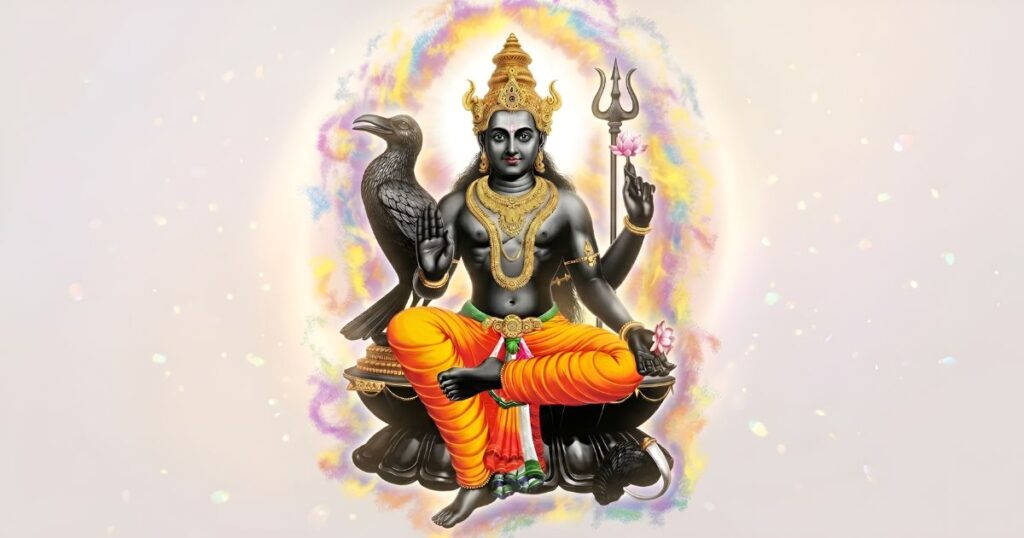
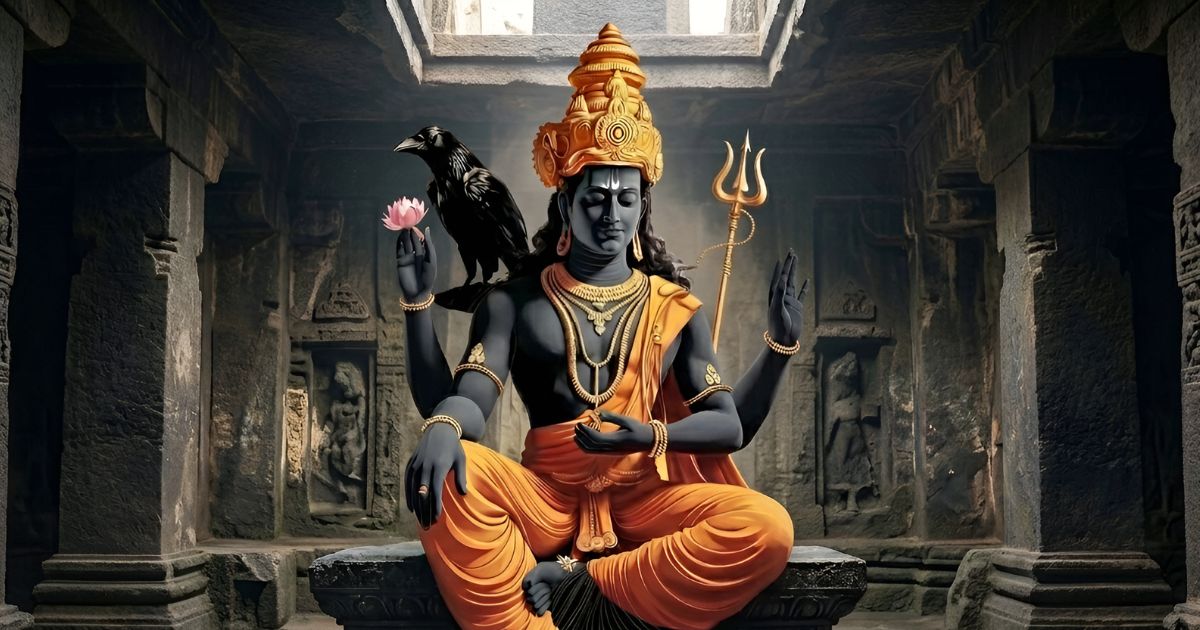
Shani Dev has a powerful and distinctive appearance in Hindu art and temple sculpture. He has a dark complexion, which symbolizes the vast and mysterious depth of the cosmos. He wears black or dark blue clothes, both colors associated with Saturn’s influence.
He typically has four arms. He carries a sword, an arrow, and a trident. Some depictions also show him holding a bow. He rides on his sacred vahana, the crow or vulture. His posture radiates authority and cosmic discipline.
His gaze is considered extremely powerful in Hindu tradition. Ancient texts say a direct glance from Shani Dev can change a person’s destiny. This belief is one key reason devotees approach him with such deep respect and caution. His dark form is not a symbol of evil. It represents profound cosmic wisdom and ultimate truth.
Importance and Significance of Shani Jayanti
Shani Jayanti carries deep religious, spiritual, and astrological significance. Shani Dev holds great importance in Hinduism as the enforcer of dharma and cosmic justice. Astrologers across India consider this day ideal for performing Saturn-related remedies and prayers.
The festival teaches a foundational truth of Hindu philosophy: karma is real and no action goes unrecorded. Every cause produces an effect, and Shani Dev is the force that ensures this law remains intact. Worshipping him on Shani Jayanti helps devotees align their actions with positive karma.
On a broader level, Shani Jayanti pushes people toward self-reflection and ethical living. It is not just a religious observance. It is a call to examine how we treat others, how honestly we live, and whether our actions reflect integrity. That message has value far beyond the boundaries of a single festival.
Benefits of Shani Jayanti Puja
Performing Shani Jayanti Puja brings significant spiritual and practical benefits. Astrologers and longtime devotees confirm these benefits across generations of practice. Here is what regular and sincere worship of Shani Dev on this day can bring:
- Relief from Sade Sati and Dhaiya, the most challenging Saturn transit periods.
- Improved mental clarity, emotional stability, and inner strength.
- Removal of long-standing obstacles from career, business, and relationships.
- Protection from sudden accidents, unexpected losses, and misfortunes.
- Financial improvement for those facing prolonged money-related difficulties.
- Stronger Saturn influence for those with a weak Saturn in their birth chart.
- Spiritual growth, patience, and a deeper understanding of life’s purpose.
Note: These benefits are not automatic. They come to those who approach Shani Dev with sincerity, honest living, and consistent devotion.
Shani Dev Step-by-Step Puja Vidhi
Performing Shani Puja correctly on Shani Jayanti maximizes its spiritual benefit. Follow this step-by-step vidhi as recommended by Vedic traditions and practiced at major Shani temples across India.
- Wake up before sunrise and take a complete bath to purify the body.
- Wear black or dark blue clothes as a mark of devotion to Shani Dev.
- Clean your puja area and place a Shani Dev idol or image on a clean surface.
- Light a sesame oil lamp (til ka diya) in front of the idol.
- Offer black sesame seeds, black flowers, and black cloth to Shani Dev.
- Recite the Shani Chalisa, Shani Mantra, or Shani Stotra with full focus.
- Read or listen to the Shani Dev Katha, the sacred story of Lord Shani.
- Pour mustard oil on the Shani idol or Shivling as a traditional offering.
- Donate black lentils (urad dal), sesame seeds, or black cloth to the needy.
- Feed crows or birds, as they are considered sacred to Shani Dev.
- Observe a fast throughout the day if your health and condition allows it.
- Visit a Shani temple in the evening for darshan and final prayers.
Key Mantras for Shani Dev Worship
Shani Beej Mantra: “Om Praam Preem Praum Sah Shanaischaraya Namah”
Shani Dev Mantra: “Om Sham Shanicharaya Namah”
Recite each mantra 108 times using a black mala (rosary) during the puja for best results.
The Story of Shani Dev
The Birth of Shani Dev
According to the Skanda Purana, Shani Dev was born to Surya Dev and Chhaya, the shadow form created by Sandhya, Surya’s wife. Unable to bear Surya’s blazing radiance, Sandhya left for penance and placed Chhaya in her place without revealing the truth. Unaware of the deception, Surya continued his life with Chhaya, and from their union, Shani Dev was born.
During her pregnancy, Chhaya remained deeply devoted to Lord Shiva, performing intense tapasya and living in austerity. It is believed that this spiritual intensity shaped Shani Dev’s nature, giving him immense power, a dark complexion, and an unwavering connection to karma and justice.
When Shani Dev was born, Surya Dev doubted the child because of his dark appearance. Hurt by the accusation, Chhaya revealed the truth and cursed Surya, whose radiance weakened under the weight of divine consequence. Even as a child, Shani Dev’s presence reflected discipline, detachment, and karmic authority, qualities that later made him the feared but impartial judge of human actions.
The Story of King Vikramaditya and Shani Dev
One of the most famous stories of Shani Dev involves the legendary King Vikramaditya. In this story, each of the nine planets took turns ruling the world for a year. When Shani Dev’s turn arrived, his influence fell on the great and just King Vikramaditya.
The king faced extreme and sudden suffering. He lost his kingdom, his wealth, his dignity, and his freedom. He worked as a slave far from his palace. Yet through every hardship, the king endured with patience, faith, and deep commitment to truth. He never abandoned his dharma-yukt-karma, no matter how difficult things became.
At the end of Shani Dev’s period, everything in Vikramaditya’s life was fully restored. His kingdom, wealth, and honor returned with even greater strength than before. This story carries a powerful message: Shani Dev’s punishment is temporary but purposeful.Endurance, honesty, and good karma always lead to redemption.
Role of Shani Dev in Birth Chart (Kundali)
Shani Dev plays a central role in Vedic astrology and birth chart readings. In a kundali, Saturn represents karma, discipline, patience, and life’s core challenges. A well-placed Saturn gives the native longevity, sharp wisdom, and strong willpower.
A weak or afflicted Saturn often brings delays, financial setbacks, and recurring health issues. Saturn rules the zodiac signs Capricorn (Makar) and Aquarius (Kumbh). Its Mahadasha, or major astrological period, lasts 19 years in the Vimshottari system. This makes it one of the longest and most transformative planetary periods a person can experience.
Astrologers study Saturn’s house position to predict career events, relationship patterns, and major turning points. Saturn placed in the 1st, 4th, 7th, or 10th house creates a particularly strong Shani influence on the native’s life. Worshipping Shani Dev on Shani Jayanti helps strengthen a weak Saturn placement over time.
What is Shani Saade Sati? The 7.5-Year Phase of Transformation
Shani Saade Sati is believed to be a 7½-year period when Lord Shani brings challenges, delays, and life tests based on a person’s karma.
Shani Saade Sati is one of the most discussed concepts in Vedic astrology. It refers to Saturn’s 7.5-year transit period over a person’s Moon sign and its two neighboring signs. This cycle covers three zodiac signs at two and a half years each.
Saade Sati is widely associated with hardship, delays, financial pressure, and major life changes. However, Vedic astrologers clarify that Saade Sati is not purely negative. It is a powerful period of internal transformation. People who live with integrity and discipline often emerge from Saade Sati stronger, wiser, and more grounded than before.
The Three Phases of Saade Sati
- Rising Phase (Dhaiya 1): Saturn enters the zodiac sign just before your Moon sign.
- Peak Phase: Saturn transits directly over your Moon sign.
- Setting Phase (Dhaiya 2): Saturn moves into the sign just after your Moon sign.
Regular Shani worship, reciting Hanuman Chalisa, and honest daily living help reduce the intensity of Saade Sati. Maintaining patience and ethical conduct during this phase consistently leads to better outcomes on the other side.
The Role of Shani Dev as The God of Karma and Justice
Shani Dev holds the title of God of Karma and Justice in Hindu theology. He observes every action a person performs throughout their entire lifetime. He does not distinguish between the rich and poor, the powerful and the weak. His judgments follow the laws of karma alone, not personal relationships or social status.
Good deeds bring rewards under Shani’s watch. Bad deeds bring inevitable consequences, no matter how much time passes. This makes Shani Dev one of the most significant and powerful deities in Hinduism. Vedic astrologers say that Saturn’s movement in your birth chart directly mirrors your karma returning to you.
Saints, sages, and scholars across Hindu history have praised Shani Dev as a protector of dharma. His role is not cruelty. It is the universe maintaining its own balance. When people understand this, they stop fearing Shani Dev and start respecting the law he represents.
The Loyal Companion: Shani Dev Vahan
Shani Dev’s primary vahan, or sacred vehicle, is the Crow. In Hindu mythology, the crow is a symbol of intelligence, patience, and deep foresight. Crows also carry significance as messengers from ancestors and the divine world. Shani Dev’s crow represents his ability to perceive truth and karma in ways others cannot.
Some ancient texts also mention a vulture as his alternate vehicle. Both the crow and the vulture are known for their sharp perception, resilience, and ability to survive in difficult conditions. These qualities mirror Shani Dev’s own nature as a patient, perceptive, and uncompromising force.
Feeding crows on Shani Jayanti and every Saturday is a widely practiced devotional act. Devotees believe this gesture pleases Shani Dev and helps reduce the weight of bad karma. The crow’s dark color also mirrors Shani Dev’s own essence: powerful, mysterious, and deeply aware.
Why Do People Fear Shani Dev?
Shani Dev is one of the most feared deities in the entire Hindu tradition. The fear stems from his reputation as a strict and unavoidable enforcer of karma. Ancient texts describe Shani Dev as the one who never lets bad karma pass without consequences. His influence is historically linked to delays, financial loss, accidents, sudden hardships, and major life disruptions.
The Saade Sati and Dhaiya periods are dreaded across Indian households for this very reason. Even great figures in Hindu mythology, including Surya Dev and King Harishchandra, felt the full weight of Shani’s power. This track record of delivering consequences to even the mightiest has made him a figure of deep fear for generations.
However, Vedic astrologers and Hindu scholars make one crucial clarification: Shani Dev does not punish innocent or righteous people. He only delivers what a person’s own karma has already earned. Fear of Shani Dev often comes from a misunderstanding of his true nature.
Those who live honestly, work hard, treat others with respect, and act with integrity have nothing to fear from Shani Dev. He is equally known for his blessings as he is for his consequences. He rewards patience, discipline, and ethical living with life-changing results. Worshipping Shani Dev with a sincere heart turns fear into deep gratitude and understanding.
Conclusion
Shani Dev is not simply a feared deity. He is the cosmic guardian of justice, truth, and the universal law of karma. Shani Jayanti is the most powerful day of the year to honor his teachings and seek his grace.
Approach him with a clean heart and honest actions. Do not perform rituals as a transaction. Perform them as a commitment to living better. The Shani Dev blessings you seek come from the karma you build every day. His role in your life reflects your own choices back at you.
This Shani Jayanti, commit to discipline, integrity, and genuine care for others. That commitment is the truest form of Shani worship.
Frequently Asked Questions (FAQs)
1. What is Shani Jayanti?
Shani Jayanti is the birth anniversary of Lord Shani Dev. It falls on Amavasya of the Jyeshtha month every year. In 2026, it is observed on Saturday, May 16.
2. When is Shani Jayanti in 2026?
Shani Jayanti 2026 falls on Saturday, May 16, 2026. The Amavasya Tithi begins on May 15 at 06:41 PM and ends on May 16 at 03:00 PM. Since it falls on a Saturday this year, it carries special astrological weight.
3. Why is Shani Dev feared?
Shani Dev is feared because he enforces karma without exception. His influence can bring delays, hardships, and major life changes when a person’s karma demands it. Ancient stories of his power over gods and kings reinforce this fear.
4. Is Shani Dev good or bad?
Shani Dev is neither good nor bad by nature. He is a fair cosmic judge. He rewards good deeds and delivers consequences for bad ones. His reputation for punishment exists because most people encounter him during difficult karmic periods.
5. What should you do on Shani Jayanti?
Light a sesame oil lamp, recite Shani mantras 108 times, offer black sesame and mustard oil, donate black lentils to the needy, feed crows, and visit a Shani temple in the evening.
6. What is Shani Saade Sati?
Shani Saade Sati is Saturn’s 7.5-year transit over your Moon sign and the two zodiac signs on either side of it. It is associated with significant life challenges and transformation. Those with good karma emerge stronger from this period.
7. Who is Shani Dev’s father?
Shani Dev’s father is Surya Dev, the Hindu Sun God. His mother is Chhaya, the Shadow Goddess.
8. What is Shani Dev’s vahan?
Shani Dev’s primary vahan is the crow. Some ancient texts also mention a vulture as his vehicle. The crow is a symbol of intelligence, foresight, and the ability to perceive what others cannot.
9. How can I reduce the effects of Shani Dev?
Worship regularly, recite Shani mantras daily, donate black items on Saturdays, feed crows, and live with honesty and discipline. Reciting Hanuman Chalisa is also widely recommended during difficult Saturn periods.
10. What is the Saturn god called in Hinduism?
In Hinduism, Saturn is called Shani Dev or Shanaishchara. He is one of the nine Navagrahas in Vedic astrology and holds one of the most significant positions among all planetary deities.
To know all the Hindu festival dates and sacred observances for 2026, explore our complete Hindu Festivals Calendar 2026.
The journey does not end here. Follow MFC on Instagram and Facebook to explore more sacred places, festivals, and living traditions of Sanatan Dharma.