
संकटनाशन गणेश स्तोत्रम्
॥ 1 ॥
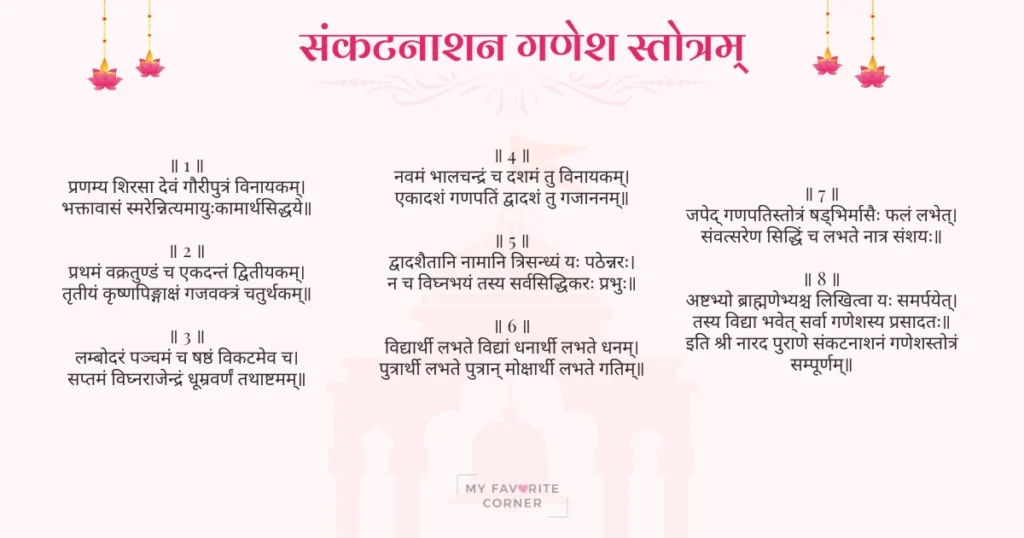
प्रणम्य शिरसा देवं गौरीपुत्रं विनायकम्।
भक्तावासं स्मरेन्नित्यमायुःकामार्थसिद्धये॥
॥ 2 ॥
प्रथमं वक्रतुण्डं च एकदन्तं द्वितीयकम्।
तृतीयं कृष्णपिङ्गाक्षं गजवक्त्रं चतुर्थकम्॥
॥ 3 ॥
लम्बोदरं पञ्चमं च षष्ठं विकटमेव च।
सप्तमं विघ्नराजेन्द्रं धूम्रवर्णं तथाष्टमम्॥
॥ 4 ॥
नवमं भालचन्द्रं च दशमं तु विनायकम्।
एकादशं गणपतिं द्वादशं तु गजाननम्॥
॥ 5 ॥
द्वादशैतानि नामानि त्रिसन्ध्यं यः पठेन्नरः।
न च विघ्नभयं तस्य सर्वसिद्धिकरः प्रभुः॥
॥ 6 ॥
विद्यार्थी लभते विद्यां धनार्थी लभते धनम्।
पुत्रार्थी लभते पुत्रान् मोक्षार्थी लभते गतिम्॥
॥ 7 ॥
जपेद् गणपतिस्तोत्रं षड्भिर्मासैः फलं लभेत्।
संवत्सरेण सिद्धिं च लभते नात्र संशयः॥
॥ 8 ॥
अष्टभ्यो ब्राह्मणेभ्यश्च लिखित्वा यः समर्पयेत्।
तस्य विद्या भवेत् सर्वा गणेशस्य प्रसादतः॥
इति श्री नारद पुराणे संकटनाशनं गणेशस्तोत्रं सम्पूर्णम्॥
Sankat Nashan Ganesh Stotram With Meaning
Verse 1
Pranamya shirasa devam Gauriputram Vinayakam.
Bhaktavasam smaren nityam ayuh kama artha siddhaye.
Meaning:
Bowing my head to the divine Vinayaka, the son of Gauri, I offer my salutation. One who remembers Ganesh, the abode of devotees, every day attains long life, fulfillment of desires, and success in all pursuits.
Verse 2
Prathamam Vakratundam cha Ekadantam dvitiyakam.
Tritiyam Krishnapingaksham Gajavaktram chaturthakam.
Meaning:
The first name is Vakratunda, the one with a curved trunk. The second is Ekadanta, the one with a single tusk. The third is Krishnapingaksha, whose eyes are dark and tawny. The fourth is Gajavaktra, the one with an elephant’s face.
Verse 3
Lambodharam panchamam cha shashtham Vikatameva cha.
Saptamam Vighnarajendram Dhumravarnam tathashtamam.
Meaning:
The fifth name is Lambodara, the one with a large belly. The sixth is Vikata, the formidable one who removes all troubles. The seventh is Vighnarajendra, the supreme lord over all obstacles. The eighth is Dhumravarna, the one whose form is the color of smoke.
Verse 4
Navamam Bhalacandram cha dashamam tu Vinayakam.
kadaśham Gaṇapatim dvadaśham tu Gajananam.
Meaning:
The ninth name is Bhalachandra, the one who bears the crescent moon on his forehead. The tenth is Vinayaka, the supreme leader. The eleventh is Ganapati, the lord of all ganas. The twelfth is Gajananam, the one with the face of an elephant.
Verse 5
Dvadashaitani namani trisandhyam yah pathan narah.
Na cha vighnabhayam tasya sarvasiddhikarah prabhuh.
Meaning:
The one who recites these twelve names at the three twilight hours, dawn, noon, and dusk, shall have no fear of obstacles. Lord Ganesha becomes the bestower of all accomplishments for such a devoted person.
Verse 6
Vidyarthi labhate vidyam dhanarthi labhate dhanam.
Putrarthi labhate putran mokshaarthi labhate gatim.
Meaning:
The student attains knowledge. The one seeking wealth attains prosperity. The one who seeks a child is blessed with children. And the one who yearns for liberation attains the path to moksha. Each devotee receives exactly what their sincere heart seeks.
Verse 7
Japed Ganapatistotram shadbhir masaih phalam labhet.
Samvatsarena siddhim cha labhate natra samshayah.
Meaning:
One who chants this Ganapati stotram with devotion receives the fruit of their prayers within six months. With a full year of dedicated practice, complete siddhi, spiritual accomplishment, is attained. Of this, there is no doubt.
Verse 8
Ashtabhyo brahmanebhyashcha likhitva yah samarpayet.
Tasya vidya bhavet sarva Ganeshsya prasadatah.
Meaning:
The one who writes this stotram and offers it to eight learned Brahmins shall receive the complete grace of Lord Ganesha. All knowledge opens before such a person through the blessings of Ganesh.
Thus ends the Sankat Nashan Ganesh Stotram from the sacred Narada Purana.
Origin of Sankat Nashan Ganesh Stotram
The Sankat Nashan Ganesh Stotram comes from the Narada Purana, one of the eighteen Mahapuranas of Sanatan Dharma. Its composition is attributed to the divine sage Narada Muni. He is the eternal devotee and celestial messenger who carries the name of Hari on his lips at every moment.
The stotram is built around the twelve sacred names of Lord Ganesha. Each name is not merely a title. Each one is a complete identity. It is a form that the devotee invokes to address Ganesha as the lord of a specific quality or cosmic function. Vakratunda, Ekadanta, Gajavaktra, Lambodara, Vikata, Vighnarajendra, Dhumravarna, Bhalachandra, Vinayaka, Ganapati, and Gajananam are not decorative names. They are keys.
The structure of the Sankat Nashan Ganesh Stotram follows a recognizable pattern in the Puranic tradition. It opens with a verse of surrender. It then moves through the twelve divine names. Finally, it delivers its promise clearly: what the devotee will receive and on what timeline. This directness is characteristic of Narada Muni, who was known for transmitting sacred knowledge without unnecessary complexity.
What makes this stotram particularly beloved among Ganesha devotees is its accessibility. Unlike longer Ganesha sahasranaamas or elaborate ritual texts, the Sankat Nashan Ganesh Stotram is compact enough to be recited at the three daily twilights. The tradition explicitly says that this is precisely what the devotee should do.
Religious and Spiritual Significance of Sankat Nashan Ganesh Stotram
In Sanatan Dharma, Ganesha holds the position of Prathamapujya. This means he is the one who must be worshipped first. Before any puja, any new beginning, or any sacred undertaking, Ganesha is invoked. He is the lord of all thresholds. Nothing auspicious begins without his sanction.
The Sankat Nashan Ganesh Stotram works on this same principle. “Sankat” means trouble, difficulty, or crisis. “Nashan” means destroyer. This stotram is specifically composed to invoke Ganesha as the one who destroys all forms of sankat. This includes not just physical obstacles but also deeper blockages of fear, confusion, and spiritual stagnation.
The stotram addresses Ganesha on multiple levels:
- As Vighnaharta, the remover of obstacles that block worldly progress
- As Buddhi Pradayak, the giver of wisdom and discernment
- As Siddhi Dayak, the bestower of accomplishment in all undertakings
- As Moksha Marg Pradayak, the one who opens the path toward liberation
- As Sarva Siddhi Karah, the supreme lord who fulfills the devotee’s deepest longing
The sixth verse is especially significant in the tradition. It speaks to four categories of seekers: the student, the one seeking wealth, the one seeking a child, and the one seeking liberation. It promises Ganesha’s grace to all four equally. This verse reflects the complete nature of Ganesha’s presence. He is not a specialist deity for one kind of prayer. He is the lord who holds all doorways.
Best Time to Chant Sankat Nashan Ganesh Stotram
The stotram itself answers this question. Verse 5 specifies trisandhyam, which refers to the three twilight junctions of the day.
- Pratah Sandhya: Early morning, just before or at sunrise
- Madhyahna Sandhya: Noon, the midpoint of the day
- Sayam Sandhya: Evening, at the time of sunset
These three moments are considered particularly potent in Vedic and Puranic tradition. The veil between the gross and subtle dimensions is thinner at these transitions. Prayers offered at these junctions carry greater spiritual force.
Beyond the three daily sandhyas, the Sankat Nashan Ganesh Stotram holds special significance on these occasions:
- Ganesh Chaturthi, the fourth day of the lunar fortnight in Bhadrapada and the most sacred day of the Ganesha calendar
- Sankashti Chaturthi, the fourth day of the Krishna Paksha each month, when Ganesha devotees observe a fast and offer dedicated worship
- Wednesday (Budhvar), traditionally considered auspicious for Ganesha worship
- Any moment of genuine sankat, such as a crisis, a difficult decision, or a new beginning that feels blocked
Verse 7 specifies that sustained practice over six months brings visible fruit. A full year of practice brings siddhi. This makes the stotram not just a crisis prayer but a long-term sadhana for those who choose to make it one.
How to Chant Sankat Nashan Ganesh Stotram?
The Sankat Nashan Ganesh Stotram calls for a grounded, steady chanting pace. It asks for presence, not urgency. A simple practice to follow:
- Light a lamp before the image or murti of Lord Ganesha. A ghee diya or til oil lamp is traditional.
- Offer red hibiscus or durva grass. Both are deeply associated with Ganesha in devotional practice.
- Sit facing east if chanting at Pratah Sandhya, or face the direction of the lamp when chanting indoors at other times.
- Begin with a mental salutation to Ganesha as described in Verse 1, bowing to Gauriputra Vinayaka.
- Chant the eight verses at a measured, comfortable pace. Allow the twelve names of Ganesha in Verses 2 to 4 to land clearly. These are the heart of the stotram.
- Complete the chanting with a moment of stillness. Hold the awareness of Ganesha’s presence before rising.
Even a single recitation done with full attention and sincerity is held to be effective in moments of genuine difficulty. The stotram does not demand elaborate preparation. What it asks for is a focused and surrendered mind.
Benefits of Chanting Sankat Nashan Ganesh Stotram
Hindu tradition, through both the Puranic text and the lived experience of Ganesha devotees across generations, describes the benefits of Sankat Nashan Ganesh Stotram as wide-reaching and deeply practical.
- Removes obstacles at the beginning of any new undertaking, whether a new business, a new job, or a new chapter of life
- Grants clarity of mind and the intelligence to navigate difficult situations without panic
- Protects from fear, as the stotram explicitly promises that fear of vighna (obstacles) will not touch the devoted chanter
- Fulfills specific desires, including knowledge for the student, prosperity for the seeker of wealth, and family blessings for those who seek children
- Opens the path to liberation for those whose prayer points toward moksha rather than material fulfillment
- Builds a sustained practice, as regular chanting across six months or a year creates a deepening bond with Ganesha’s grace that extends well beyond any single crisis
The stotram works because it does not treat Ganesha as a last resort. It places him at the beginning, as Prathamapujya, and asks the devotee to do the same. One who chants the Sankat Nashan Ganesh Stotram as a daily trisandhya practice is not running to Ganesha only when things break down. They are establishing a continuous relationship with the lord of all doorways.
That relationship, the tradition says, is what makes every threshold crossable.
Final Thought
The Sankat Nashan Ganesh Stotram is not a prayer of panic. It is a practice of trust. Composed by Narada Muni and drawn from the wisdom of the Narada Purana, this stotram is structured around the twelve names of Lord Ganesha. It offers the devotee something deeper than relief. It offers a reorientation.
Sankat, the tradition teaches, is not only what happens to us from outside. It is also the inner tightness, the blocked movement, the place where something has stopped flowing. Ganesha, as Vighnarajendra, Ganapati, and Bhalachandra, enters exactly that place. And he clears it.
Those who chant this stotram at the three sandhyas do not simply ask for the obstacle to be removed. They remind themselves, three times each day, who is truly in charge of all thresholds.
In that remembrance, the sankat begins to dissolve on its own.
ॐ गं गणपतये नमः
Frequently Asked Questions (FAQ)
1. What is the Sankat Nashan Ganesh Stotram?
The Sankat Nashan Ganesh Stotram is a sacred hymn from the Narada Purana. It contains the twelve names of Lord Ganesha and is chanted to remove obstacles, grant blessings, and fulfill the sincere wishes of devotees.
2. Who composed the Sankat Nashan Ganesh Stotram?
The Sankat Nashan Ganesh Stotram is attributed to the divine sage Narada Muni. It is found in the Narada Purana, one of the eighteen Mahapuranas of Sanatan Dharma.
3. What are the benefits of chanting Sankat Nashan Ganesh Stotram?
Chanting the Sankat Nashan Ganesh Stotram removes obstacles, grants wisdom, protects from fear, and fulfills desires related to knowledge, wealth, children, and moksha. It also builds a lasting devotional bond with Lord Ganesha.
4. When should I chant the Sankat Nashan Ganesh Stotram?
The stotram should be chanted at trisandhyam, meaning at the three daily twilights: morning (Pratah Sandhya), noon (Madhyahna Sandhya), and evening (Sayam Sandhya). It is also especially auspicious on Ganesh Chaturthi, Sankashti Chaturthi, and every Wednesday.
5. How many verses does the Sankat Nashan Ganesh Stotram have?
The Sankat Nashan Ganesh Stotram has eight verses. The first is a salutation. Verses 2 to 4 contain the twelve names of Ganesha. The remaining verses describe the rewards of sincere and consistent chanting.
6. How long does it take to see results from chanting this stotram?
According to Verse 7 of the Sankat Nashan Ganesh Stotram, visible results are received within six months of regular chanting. Complete siddhi is attained within one full year of dedicated practice.
Also Read:
- श्री हनुमान चालीसा | Shri Hanuman Chalisa Timing, Benefit & Origin
- श्री शिव तांडव स्तोत्रम् | Shiv Tandav Stotram Meaning, Origin & Benefit
- महिषासुर मर्दिनी स्तोत्रम् | Mahishasur Mardini Stotram with Meaning
Save or bookmark this page so you can return to it whenever you need Ganesha’s grace, at the start of something new, in a moment of difficulty, or simply as part of your daily sandhya. Follow us on Instagram and Facebook to stay connected, and share your thoughts or experience in the comments.
This Bhakti Corner is meant to be returned to, not just read once.