
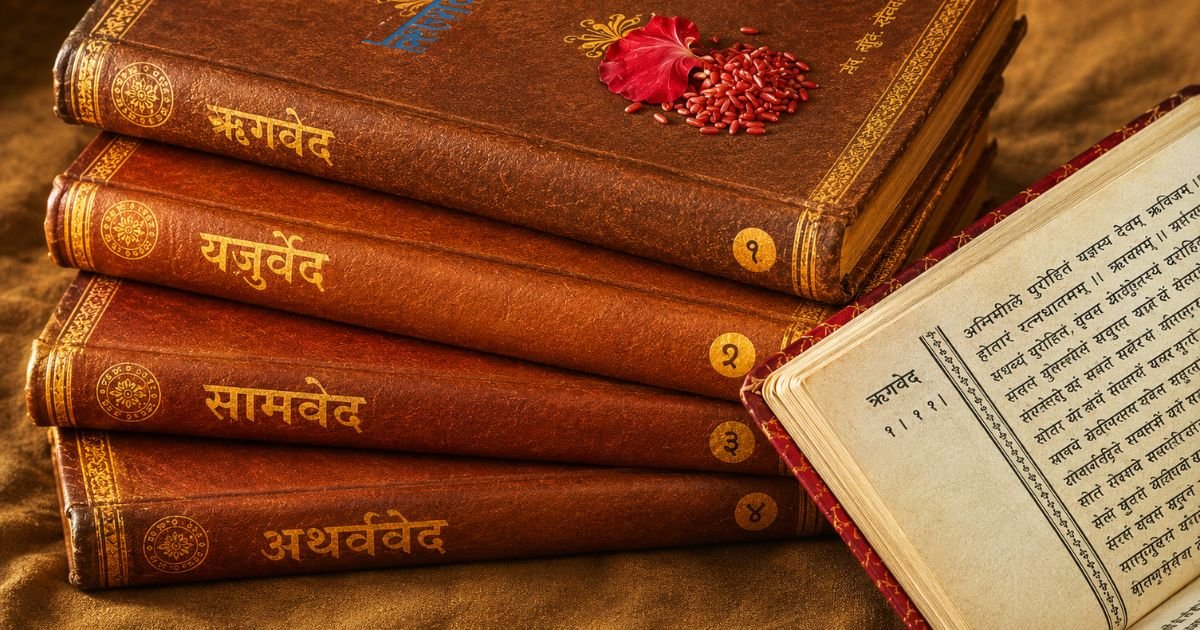
The Four Vedas are the Rigveda, Samaveda, Yajurveda, and Atharvaveda. They are the oldest sacred scriptures of Hinduism, composed in Vedic Sanskrit and classified as Shruti literature. Tradition holds that they were not written by humans but were revealed to ancient sages called Rishis. They form the foundational texts of Sanatan Dharma and the whole of Hindu philosophy.
Long before modern science and written history, ancient sages of Bharat explored the mysteries of existence through deep meditation and higher awareness. The wisdom they received became the Vedas, the oldest spiritual knowledge known to humanity.
The four Vedas, Rigveda, Samaveda, Yajurveda, and Atharvaveda, are far more than religious texts. They contain hymns, rituals, philosophy, healing practices, meditation, music, and profound insights about life and the cosmos.
Each Veda serves a different purpose. One speaks of creation and cosmic truth. Another transforms knowledge into sacred sound. One teaches rituals and discipline, while the other explores healing and daily life. Together, they became the foundation of Sanatan Dharma.
Even after thousands of years, the Vedas continue to guide humanity’s search for truth, consciousness, and inner balance. In this blog, we will explore the meaning, wisdom, and timeless relevance of the four Vedas.
Everything You Need To Know About The Four Vedas
| Sanskrit Word “Veda” | Knowledge: From the root “vid” meaning “to know” |
| Classification | Shruti literature – “that which is heard” – considered divine disclosure. |
| Language | Vedic Sanskrit, the oldest layer of Sanskrit literature. |
| Authorship | Considered Apauruseya, not authored by humans; revealed to ancient Rishis in deep meditation. |
| Number of Vedas | Four: Rigveda, Samaveda, Yajurveda, Atharvaveda |
| Each Veda’s Divisions | Samhita (mantras), Brahmana (ritual commentary), Aranyaka (forest teachings), Upanishad (philosophy) |
| Oldest Veda | Rigveda, composed approximately 1500 to 1200 BCE |
| Tradition of Transmission | Guru-shishya parampara, teacher to student, passed orally for millennia. |
| Their Spiritual Role | Foundation of Sanatan Dharma, Vedic philosophy, and Hindu ritual practice |
What Are the Vedas? Meaning in Simple Words
The word “Veda” comes from the Sanskrit root “vid.” It means to know. The Vedas are, at their core, a body of knowledge.
They are not books written by any single human author. Hindu tradition holds them as Apauruseya, meaning “not of human origin.” The ancient Rishis received these sacred hymns in deep states of meditation and inner stillness.
The Rishis did not compose the Vedas. They perceived them. This is why the Four Vedas are classified as Shruti literature, meaning “that which is heard.”
The Mundaka Upanishad calls the Vedas “the eternal breath of the Supreme Being.” They represent the cosmic intelligence that underlies all of existence.
For thousands of years, these textspassed from teacher to student entirely through memory and oral recitation. This tradition is called guru-shishya parampara. The precision with which they were preserved across generations stands as one of the greatest intellectual achievements in human history.
Who Created Vedas?
The Vedas were not created by a single person, prophet, or founder. Modern historians and Indologists widely agree that the Vedas developed gradually over many centuries through the oral tradition of ancient Indo-Aryan communities in the Indian subcontinent.
The earliest portions of the Rigveda are generally dated to around 1500–1200 BCE, though some scholars propose slightly earlier or later timelines. The remaining Vedas, Brahmanas, Aranyakas, and Upanishads developed over the following centuries during the Later Vedic period.
The hymns of the Vedas are associated with different Rishi families such as the Vishvamitras, Vasishthas, Atris, Bharadvajas, and Kashyapas. These sages are regarded as the seers and transmitters of the hymns preserved within the Vedic tradition.
Unlike many other major religious scriptures, the Vedas were preserved entirely through oral transmission for thousands of years before being written down. Specialized systems of memorisation and recitation allowed the texts to survive with extraordinary precision across generations.
Scholars classify the Vedas as the oldest surviving body of Sanskrit literature and among the oldest religious texts still preserved in continuous tradition today.
What is the Structure of Each Veda? Four Sacred Layers
Each of the Four Vedas follows the same inner structure. Every Veda is divided into four distinct layers. Each layer serves a different purpose in the seeker’s journey.
| Layer | Sanskrit Name | Content and Purpose |
| 1st Layer | Samhita | Samhita is the core collection of mantras and hymns. This is the oldest and most sacred part of each Veda. Devotees recite these during worship and ritual. |
| 2nd Layer | Brahmana | Brahmana is the commentary on rituals and sacrifices. These texts explain how to perform Yajnas and Vedic ceremonies correctly. |
| 3rd Layer | Aranyaka | Aranyaka is the “forest texts.” These explore the deeper symbolic meaning of rituals. They bridge the outer ceremony and the inner philosophy. |
| 4th Layer | Upanishad | Upanishad is the philosophical crown of the Vedas. These texts discuss the nature of Brahman (ultimate reality), Atman (the self), meditation, and moksha. The word means “sitting close to the teacher.” |
The Upanishads are especially significant because they gave birth to the school of Vedanta, one of the most influential philosophical traditions in the world.
Veda means knowledge. The Vedas are the most complete treasure of knowledge that humanity has ever produced. They are not the property of any religion. They are the heritage of all mankind.
The Complete Works of Swami Vivekananda (Volume III)
1. First Veda – Rigveda – The Veda of Hymns and Praise
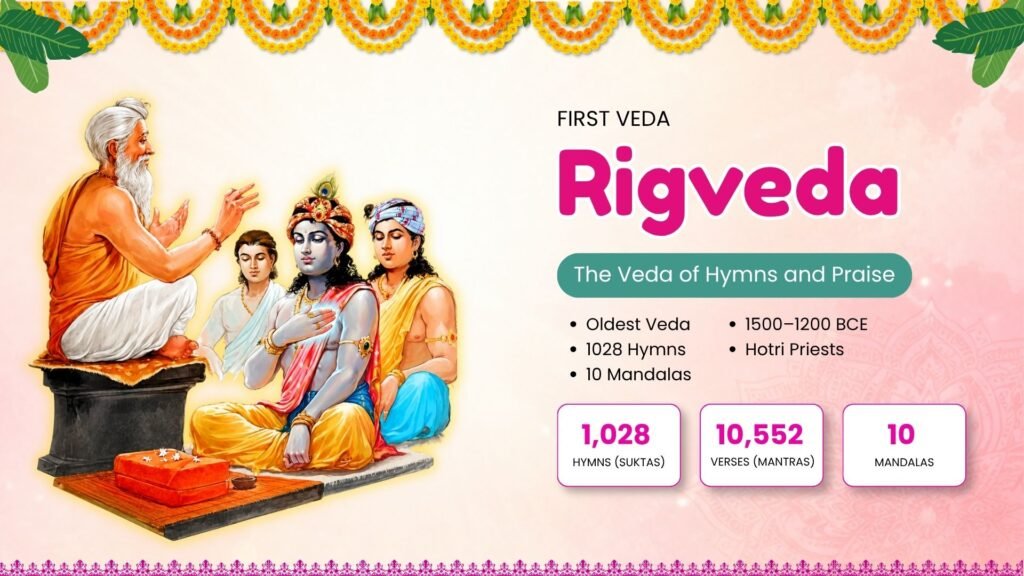
Key Details of Rigveda:
- Considered the oldest of the four Vedas
- Contains 1,028 Hymns (Suktas)
- Comprises 10,552 Verses (Mantras)
- Divided into 10 Mandalas (books)
- Composed around c. 1500–1200 BCE
- Explores creation, cosmic order, nature, and spiritual wisdom
- Recited and invoked by the Vedic priest known as the Hotri
- Forms the foundation of many later Vedic rituals and philosophies
What the Rigveda Contains?
- Hymns dedicated to Agni (fire), Indra (thunder and rain), Varuna (cosmic law), Surya (sun), and other deities.
- The Gayatri Mantra, one of the most sacred mantras in all of Sanatan Dharma, found in Mandala 3.
- The Purusha Sukta (10.90), which describes the cosmic being and the origin of the universe.
- The Nasadiya Sukta (10.129), a hymn on the mystery of creation that remains one of the most philosophically profound texts of antiquity.
From the Rigveda, all knowledge flows. It is the foundation on which the other three Vedas stand. It is the first word of the Rishi tradition.
Meaning and Message of Rigveda
The Rigveda is humanity’s earliest recorded attempt to understand the universe, the divine, and the self.
The Rigveda preserves some of humanity’s oldest spiritual, philosophical, and poetic thoughts. It forms the foundation of later Indian traditions. It is a reflection of humanity’s early curiosity, imagination, spirituality, poetry, and intellectual courage.
Its hymns ask questions that modern science and philosophy still wrestle with. The Nasadiya Sukta (Rigveda 10.129) asks: “Who can say where creation came from? Even the gods came after.” These are not primitive lines. They are among the most philosophically honest words ever written.
The Rigveda’s themes of creation, bhakti, and the search for meaning resonate universally. It offers a window into the common threads that bind early religions worldwide.
Sri Aurobindo, after years of deep yogic study, understood the Rigveda as far more than a ritual text. In his landmark work The Secret of the Veda, he wrote:
“The secret knowledge of the Veda is the seed which is evolved later on to the Vedanta. The thought around which all is centered is the seeking after Truth, Light, and Immortality.”
Several great gurus of modern India emphasised the Rigveda and its continued relevance. These include towering figures such as Swami Dayananda Sarasvati of the Arya Samaj, Sri Aurobindo, Kavyakantha Ganapati Muni (the chief disciple of Ramana Maharshi), Kapali Shastri, and Swami Veda Bharati.
Swami Dayananda Saraswati held that the four Vedas are the only true uncorrupted sources of Dharma, revealed by the Supreme Lord at the beginning of every creation. He believed they were perfectly preserved without alteration using Sanskrit prosody and different Vedic chanting techniques.
Contribution of Rigveda to Humanity
The Rigveda gave the world the Gayatri Mantra. It seeded Vedanta philosophy. It preserved the earliest known observations on astronomy, cosmology, language, and ethics. It remains, as scholars note, the foundational text of the oldest continuous civilisation on earth.
2. Second Veda – Samaveda – The Veda of Melodies and Sacred Song
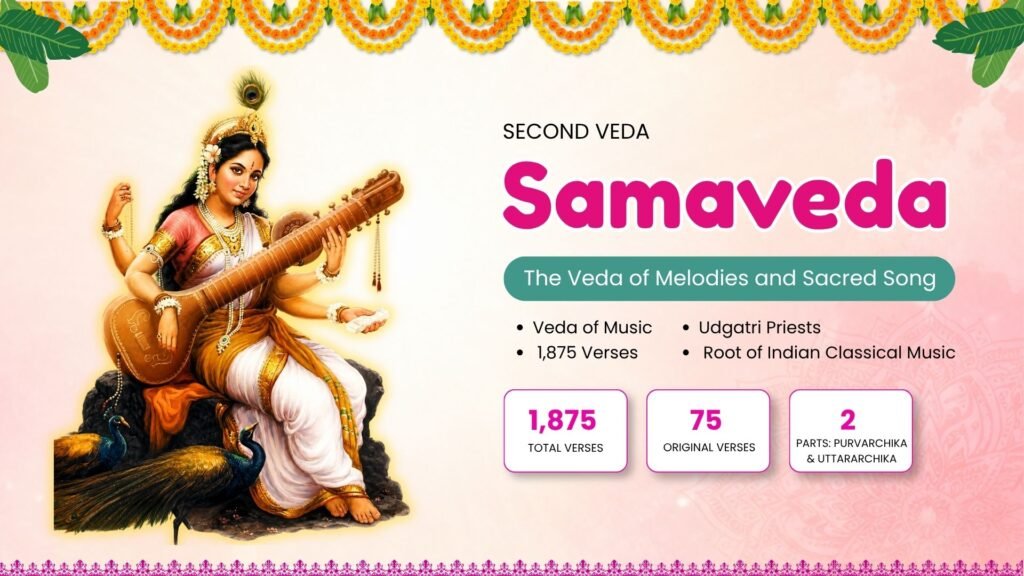
Key Details of Samaveda
- Known as the Veda of melodies, and sacred chant
- Root of Indian Classical Music
- Contains 1,875 total verses
- Only 75 of its verses are original. The rest come from the Rigveda
- Divided into two parts: Purvarchika (first part) and Uttararchika (second part)
- Sung by the Udgatri priests during Soma sacrifices and Yajnas
- Considered the direct origin of Indian classical music and the seven svaras
- In the Bhagavad Gita (10.22), Shri Krishna says: “Among the Vedas, I am the Samaveda”
- Contains the Chandogya Upanishad, one of the most important Upanishads in Vedanta
What the Samaveda Contains?
- Rigvedic verses arranged into precise melodic patterns for singing during Soma sacrifices
- Detailed musical notations that form the direct foundation of Indian classical music
- The Chandogya Upanishad, one of the most important Upanishads in all of Vedanta philosophy
- Hymns sung by the Udgatri priests during major Yajnas and sacred ceremonies
- The philosophical teaching that sacred sound itself is a path to the divine
Meaning and Message of Samaveda
The Samaveda teaches one of the most profound truths in all of human tradition. Sound is not merely communication. Sound is a path to the divine.
Most of its verses come from the Rigveda. But the Samaveda transforms those verses into melody. The same words, when sung with the correct raga, pitch, and rhythm, carry a different spiritual effect than when they are simply recited. This is its core teaching.
Shri Krishna identifies Himself with the Samaveda in the Bhagavad Gita. He does not choose the oldest Veda or the most voluminous one. He chooses the one built on melody. This places sacred sound at the very heart of divine self-expression.
The seven svaras of Indian classical music,Sa Re Ga Ma Pa Dha Ni, trace their origin to Vedic chant. Every raga ever sung in the Hindustani or Carnatic tradition carries a thread that leads back to the Samaveda’s ancient melodies.
Premanand Ji Maharaj, the widely respected contemporary Vaishnava saint whose discourses are deeply rooted in the Vedic and Upanishadic tradition, teaches that devotional sound, whether kirtan, bhajan, or the Vishnu Sahasranama, is not merely practice. It is direct communion with the divine.
Just as all leaves are supported by the stalk, all speech is supported by Om. This syllable is all this universe.
Chandogya Upanishad, 2.23.3 (Samaveda)
Contribution of Samaveda to Humanity
The Samaveda gave birth to Indian classical music. It established the philosophy that sound and vibration are not accidental features of the world but its very fabric. The Chandogya Upanishad, one of the most important philosophical texts in all of Vedanta, belongs to this Veda.
3. Third Veda – Yajurveda – The Veda of Ritual and Sacrifice
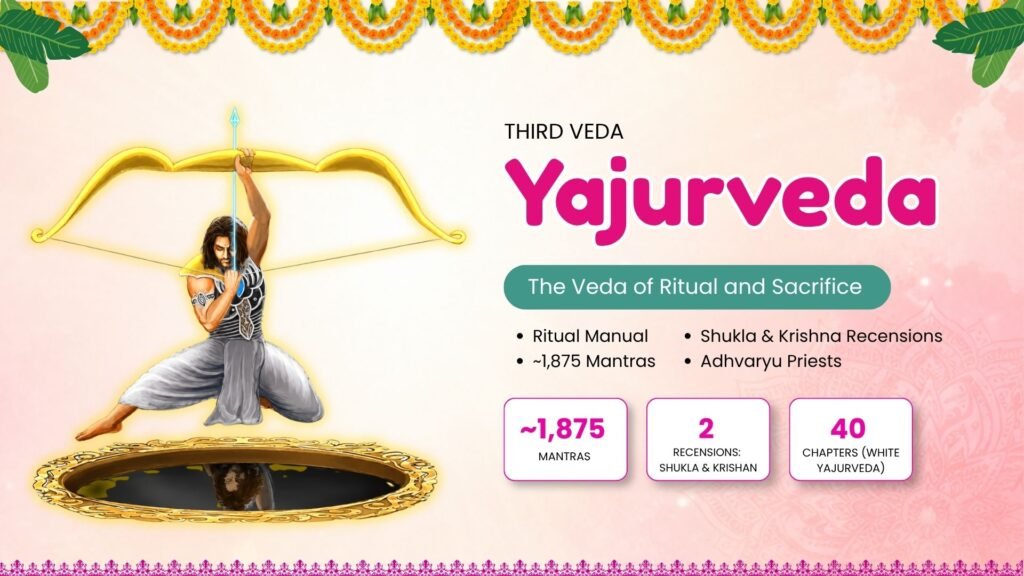
Key Details of Yajurveda
- Known as the Veda of ritual formulas and sacred sacrifice.
- Contains approximately 1,875 mantras.
- Exists in two main versions: Shukla (White) Yajurveda and Krishna (Black) Yajurveda.
- The White Yajurveda is divided into 40 chapters (Adhyayas).
- Performed and recited by the Adhvaryu priests during Yajnas.
- Provides complete procedural instructions for every major Vedic ceremony.
- Contains the Shri Rudram and Chamakam, the most revered Vedic hymns to Lord Shiva.
- Houses the Isha Upanishad and the Brihadaranyaka Upanishad.
What the Yajurveda Contains?
- Detailed mantras and prose instructions for performing Yajnas (fire sacrifices).
- Formulas for all major Vedic ceremonies including the Agnihotra, Ashwamedha, and Rajasuya.
- Two major Upanishads: Brihadaranyaka Upanishad and Isha Upanishad.
- The Shri Rudram and Chamakam, among the most revered Vedic chants and hymns to Lord Shiva.
- The concept of Rta (cosmic order) and how correct ritual performance maintains universal harmony.
Meaning and Message of Yajurveda
The Yajurveda is the handbook of sacred action. “Yajus” means sacrificial formula. Every mantra in this Veda exists for one purpose: to guide how a human being performs an act of devotion correctly.
On the surface, this is a manual for priests. But the Yajurveda teaches that there is no separation between the outer act and the inner intention. When an action is performed with complete awareness, correct knowledge, and pure intention, it becomes Yajna: a sacred offering.
This principle became the foundation of the concept of Nishkam Karma later expressed in the Bhagavad Gita. Scholars of Vedic tradition consistently trace the Gita’s teaching of action without attachment directly back to the Yajurveda’s framework.
The Isha Upanishad, which opens the White Yajurveda, contains perhaps the most radical statement in all of Vedic literature: Ishavasya midam sarvam, meaning “All this is pervaded by the Lord.” This is the Yajurveda’s ultimate teaching. Every moment of life, every act of disciplined action, is an opportunity to recognise the divine presence that fills all things.
Swami Vivekananda described the Vedas as “the accumulated treasury of spiritual laws discovered by different persons in different times.” The Yajurveda’s contribution to that treasury is the law of sacred action: how you do something matters as much as what you do.
Contribution of Yajurveda to Humanity
The Yajurveda preserved the complete science of Vedic ritual for thousands of years. It gave the world the Isha Upanishad and theBrihadaranyaka Upanishad, two cornerstones of Advaita philosophy. Its concept of action as worship directly seeded the Karma Yoga of the Bhagavad Gita.
4. Fourth Veda – Atharvaveda – The Veda of Daily Life and Healing
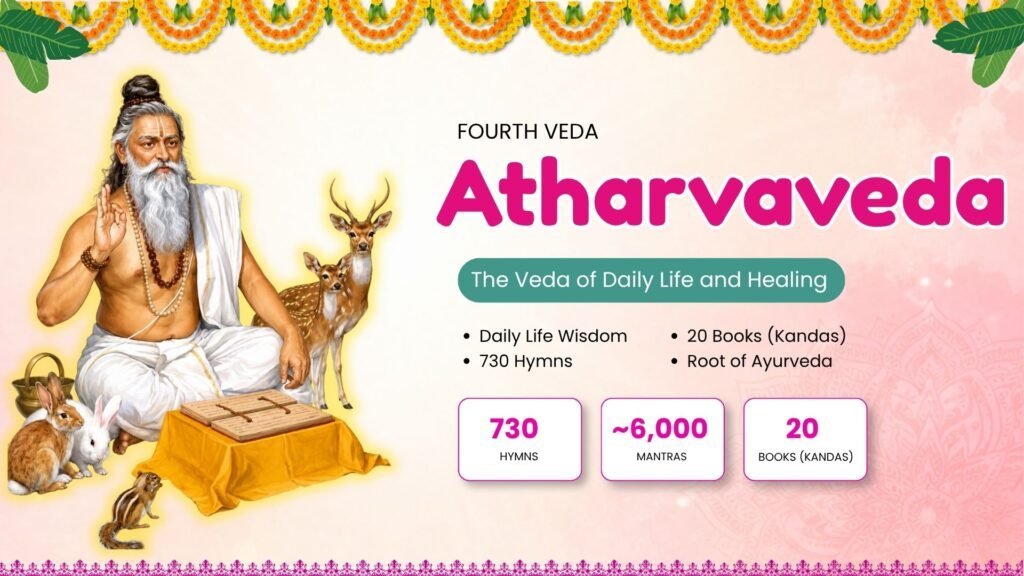
Key Details of Atharvaveda
- The most unique of the Four Vedas in both tone and content.
- Contains 730 hymns with approximately 6,000 mantras.
- Divided into 20 books called Kandas.
- About one-sixth of its text is written in prose, unlike the other three Vedas.
- For a long time, only the first three Vedas were grouped together as the Trayi (triple Vedas).
- Was later accepted as the fourth Veda as Vedic civilisation expanded and matured.
- Contains the earliest recorded Sanskrit medical and healing knowledge.
- Houses the Mundaka Upanishad and the Mandukya Upanishad.
- Considered the primary source of Ayurveda, the ancient Indian science of life.
What the Atharvaveda Contains?
- Healing mantras for fevers, wounds, and illness. These form the earliest recorded medical knowledge in Sanskrit literature.
- Prayers for protection from enemies, evil forces, and natural calamities.
- Rituals for domestic wellbeing: a healthy home, harmonious relationships, and prosperous livelihood.
- The Mundaka Upanishad and Mandukya Upanishad, two of the most philosophically significant Upanishads.
- Early principles that gave rise to Ayurveda, the ancient Indian science of life and health.
Meaning and Message of Atharvaveda
The Atharvaveda is the most human of the Four Vedas. It does not look primarily upward toward the gods or inward toward liberation. It looks around, at the living, breathing, struggling world of everyday human existence.
It speaks about healing the sick, protecting the household, prospering in work, navigating relationships, and understanding the body. It addresses the full range of what it means to be alive in the world.
For a long time, the Atharvaveda stood apart from the first three Vedas. The Trayi, the triple scripture, did not include it. Its acceptance as the fourth Veda carries a profound message: that the full range of human life, including its illness, its fear, and its longing for safety, is sacred and worthy of scripture.
The Mundaka Upanishad, which belongs to this Veda, draws one of the sharpest distinctions in all of Indian philosophy. It separates Para Vidya (higher knowledge, the knowledge of Brahman) from Apara Vidya (lower knowledge, all worldly disciplines). This places the Atharvaveda in a unique position: a text rooted in the practical world that simultaneously points beyond it entirely.
Swami Dayananda Saraswati taught that the Atharvaveda contains the foundations of what later became Ayurveda. Its healing mantras represent humanity’s earliest recorded medical knowledge in the Sanskrit language. Later Vedic scholars systematised this knowledge into the formal science of Ayurveda.
What’s the Difference Between All Four Vedas?
This table brings all four Vedas side by side for easy comparison. Use it as a reference whenever you need a quick overview.
| Feature | Rigveda | Samaveda | Yajurveda | Atharvaveda |
| Meaning | Veda of Praise | Veda of Melody | Veda of Sacrifice | Veda of Daily Life |
| Primary Focus | Hymns to gods | Musical chants | Ritual formulas | Healing and protection |
| Hymns / Verses | 1,028 hymns | 1,875 verses | ~1,875 mantras | 730 hymns |
| Associated Priest | Hotri | Udgatri | Adhvaryu | Brahma (overseer) |
| Key Upanishads | Aitareya | Chandogya, Kena | Brihadaranyaka, Isha | Mundaka, Mandukya |
| Associated Knowledge | Ayurveda (some traditions) | Gandharva Veda (music) | Dhanur Veda (martial arts) | Ayurveda (primarily) |
| Notable Content | Gayatri Mantra, Purusha Sukta | Origin of Indian classical music | Shri Rudram, Chamakam | Early medical knowledge |
Why Are the Vedas Important in Hinduism?
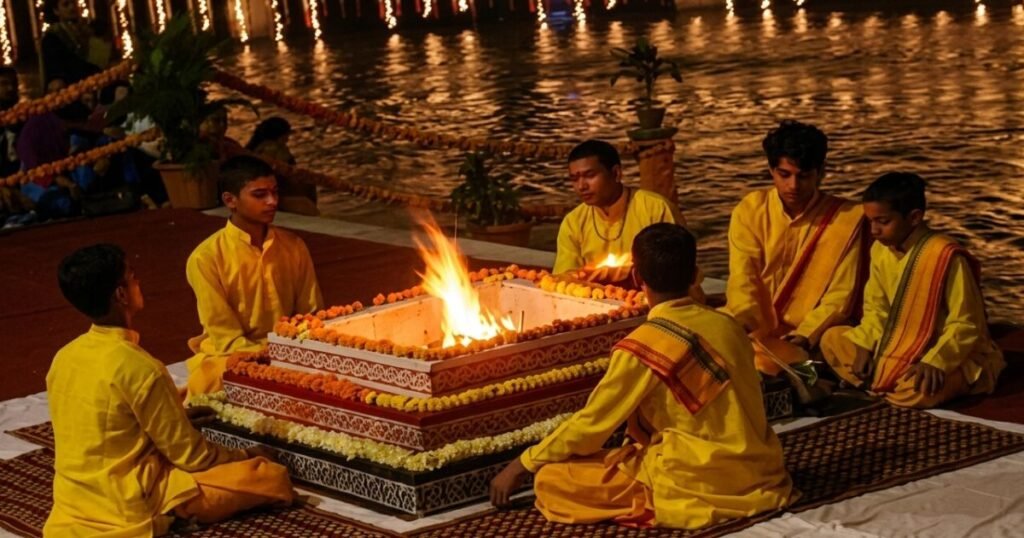
The importance of Vedas in Hindu life is difficult to overstate. They are not simply historical texts. They are living scriptures that continue to shape thought, ritual, and daily practice.
1. They Are the Foundation of Sanatan Dharma
Every major school of Hindu philosophy, including Advaita Vedanta, Vishishtadvaita, and Dvaita, traces its roots to the Vedas. The Bhagavad Gita, the Puranas, and the Dharmashastra all acknowledge Vedic authority.
2. They Preserve the Oldest Spiritual Wisdom of India
The Four Vedas are among the oldest scriptures in the world. They preserve insights into cosmology, the nature of consciousness, ethical living, and the relationship between the human being and the divine.
3. They Gave Birth to Indian Classical Music
The Samaveda’s musical tradition directly influenced the development of Indian classical music. The seven svaras (Sa, Re, Ga, Ma, Pa, Dha, Ni) trace their origin to Vedic chant.
4. They Carry the Gayatri Mantra
The Gayatri Mantra, one of the most widely chanted mantras in the world, comes from the Rigveda’s third Mandala (3.62.10). Tradition considers it the essence of all the Vedas in a single verse.
5. They Seeded Modern Sciences
The Atharvaveda’s healing hymns gave rise to Ayurveda. The Yajurveda’s mathematical content contributed to early arithmetic and geometry. The Vedas contain some of the earliest recorded observations about astronomy, linguistics, and medicine.
Just as all leaves are supported by the stalk, all speech is supported by Om. This syllable is all this universe.
~Chandogya Upanishad, 2.23.3 (Samaveda)
How the Vedas Were Preserved for Thousands of Years?
The Four Vedas were passed down orally for thousands of years before they were written. This is one of the most remarkable feats of human memory and cultural commitment in history.
The system used to preserve them is called the Guru-Shishya Parampara: teacher to student, generation by generation. Students memorised not just the words but the exact pitch, rhythm, syllable length, and musical notation of every verse.
- The Vedas were memorised using multiple recitation patterns called Pathas. These include Samhita Patha, Pada Patha, Krama Patha, and the highly complex Ghanapatha.
- Each pattern serves as a cross-check. An error in one pattern would be caught by another. This system made corruption of the text virtually impossible.
- A student of the Veda would spend years learning just one recitation pattern under a qualified teacher.
- UNESCO recognised the tradition of Vedic chanting in 2003 as part of the Intangible Cultural Heritage of Humanity.
The Rigveda was written down for the first time approximately 600 to 700 years ago, even though it had been recited perfectly for over three thousand years before that.
Why Did the Ancient Rishis Preserve the Vedas?
The ancient Rishis preserved the Vedas because they believed this knowledge helped maintain harmony between human life, nature, and the cosmos. Central to Vedic thought is the idea of Ṛta, the universal order that governs existence.
The Vedas preserved teachings on rituals, ethics, meditation, consciousness, and spiritual inquiry. Through the guru-shishya tradition, this knowledge passed orally from teacher to student for thousands of years with extraordinary precision.
For the Rishis, the Vedas were not merely religious texts. They were a way to understand reality, maintain societal harmony, and preserve humanity’s connection with the deeper order of existence.
Common Misconceptions About the Vedas
1. Are the Vedas only religious books?
No. The Vedas contain far more than prayers and rituals. They include philosophy, meditation, ethics, music, cosmology, healing traditions, and discussions about consciousness and existence.
2. Did one person write the Vedas?
No. Modern scholars believe the Vedas developed over centuries through the oral traditions of multiple Rishi families in ancient India. They were preserved through memorisation and recitation long before they were written down.
3. Are the Vedas and Hinduism the same thing?
The Vedas form the foundational scriptures of Sanatan Dharma and later Hindu traditions, but Hinduism also includes many later texts such as the Upanishads, Puranas, Ramayana, Mahabharata, and Bhagavad Gita.
4. Are the Vedas mythology?
The Vedas contain symbolic hymns and references to deities, but they are also among the oldest surviving records of human philosophy, ritual culture, sacred poetry, and spiritual inquiry.
5. Were the Vedas originally written in Sanskrit?
Yes. The Vedas were composed in Vedic Sanskrit, the oldest known form of the Sanskrit language.
6. Were the Vedas always written down?
No. For most of history, the Vedas were preserved orally through highly advanced chanting and memorisation systems within the guru-shishya tradition.
7. Are the Vedas still relevant today?
Many ideas found in the Vedas continue to influence yoga, meditation, Ayurveda, Indian philosophy, classical music, and modern spiritual traditions across the world.
Conclusion: The Vedas Are Still Speaking
The Four Vedas are not museum artefacts. They are living transmissions. Every time a family lights an Agni Hotra fire, every time a priest recites a mantra before puja, every time a student chants the Gayatri at sunrise, the Vedas speak again.
They belong to no single person, no single era, no single culture. They emerged from the deepest silence of consciousness and they point every generation back toward that same silence.
To know the Vedas is to know the roots of Sanatan Dharma. To love them is to honour the Rishis who heard them, the teachers who preserved them, and the Lord who breathed them into the world.
“Let noble thoughts come to us from every side.” –Rigveda, 1.89.1
Frequently Asked Questions About Four Vedas
What are the Four Vedas?
The Four Vedas are Rigveda, Samaveda, Yajurveda, and Atharvaveda. They are the oldest sacred scriptures of Hinduism and the foundational texts of Sanatan Dharma, Vedic philosophy, rituals, and spiritual knowledge.
Which is the oldest Veda?
The Rigveda is the oldest Veda. Scholars generally date its earliest hymns to around 1500–1200 BCE, making it one of the oldest surviving religious texts in the world.
What is the meaning of Veda?
The word “Veda” comes from the Sanskrit root vid, which means “to know.” The term Veda therefore means knowledge, wisdom, or sacred understanding.
Who created the Vedas?
The Vedas were not created by a single author. Historians believe they developed gradually through the oral traditions of ancient Rishi families in India over many centuries.
What language are the Vedas written in?
The Vedas were composed in Vedic Sanskrit, the oldest known form of Sanskrit and one of the earliest Indo-European languages preserved in written tradition.
Why are the Vedas important?
The Vedas are important because they shaped Hindu philosophy, yoga, meditation, Ayurveda, Sanskrit literature, Indian classical music, and many later spiritual traditions.
What is the difference between Rigveda, Samaveda, Yajurveda, and Atharvaveda?
The Rigveda focuses on hymns and cosmic praise, the Samaveda on sacred melodies, the Yajurveda on rituals and sacrifice, and the Atharvaveda on healing, daily life, and practical knowledge.
Which Veda contains the Gayatri Mantra?
The Gayatri Mantra is found in the Rigveda, Mandala 3, Hymn 62, Verse 10.
Which Veda is related to music?
The Samaveda is the Veda most closely associated with music and sacred chanting. It is widely regarded as the foundation of Indian classical music.
Which Veda is associated with Ayurveda?
The Atharvaveda is most closely associated with early healing traditions and the origins of Ayurveda, the ancient Indian science of life and medicine.
How were the Vedas preserved?
The Vedas were preserved through oral transmission using the guru-shishya tradition. Complex chanting systems such as Pada Patha and Ghana Patha helped preserve the texts with extraordinary accuracy.
Are the Vedas older than the Bible?
The earliest hymns of the Rigveda are generally dated by scholars to around 1500–1200 BCE. This makes them older than many books of the Bible, especially the New Testament. However, some portions of the Hebrew Bible, particularly parts of the Old Testament, were composed around a similar historical period.
Are the Upanishads part of the Vedas?
Yes. The Upanishads form the philosophical sections of the Vedas and are collectively known as Vedanta, meaning “the end of the Vedas.”
Are the Vedas still relevant today?
Yes. The Vedas continue to influence yoga, meditation, Ayurveda, Hindu rituals, Sanskrit studies, Indian philosophy, and spiritual traditions across the world.
The journey does not end here. Follow MFC on Instagram and Facebook to explore more sacred places, festivals, and living traditions of Sanatan Dharma.