
Every year, on the third Sunday of June, the world celebrates International Father’s Day. In 2026, that day falls on June 21. In homes across India and around the globe, children thank their fathers. Families get together. Social media fills with old photographs and warm messages.
But beyond the celebration, many people are sitting with a question that is not so easy to
Answer:
What actually makes a father ‘a father’ today?
The old definition, provider, protector, head of the household, does not quite fit anymore. Mothers earn. Fathers cook, do school runs, attend parent-teacher meetings. In many homes, both parents do everything. So if the roles have blurred, what is left that is uniquely a father’s?
Sanatan Dharma, one of the oldest living spiritual traditions in the world, has a clear answer to this. And that answer has nothing to do with who earns more or who does which chores.
It has everything to do with character, responsibility, and what you pass on.
Pitru Devo Bhava: Why Sanatan Dharma Calls the Father Divine
The Taittiriya Upanishad, one of the ancient Vedic texts, contains a line that most Indians have heard at least once in their lives:
“मातृ देवो भव। पितृ देवो भव।”
“Regard your mother as divine. Regard your father as divine.”
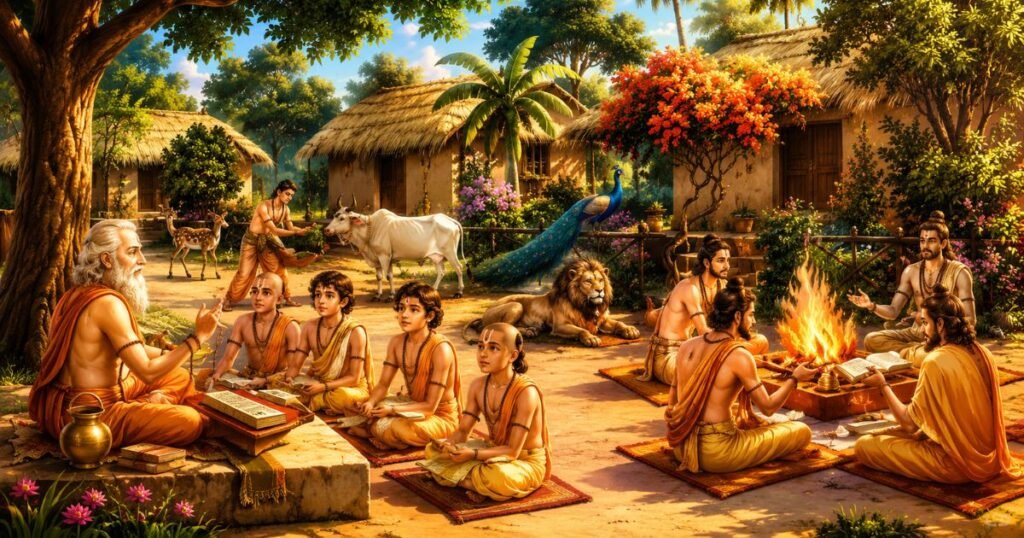
Pitru Devo Bhava means “let the father be as God to you.” It is the instruction a Guru gives to students leaving the Gurukul and returning to family life. It is one of the foundational teachings of Sanatan Dharma on the role of parents.
Notice what this teaching does not say:
- It does not say: honor your father because he earns for you.
- It does not say: respect your father because he fits a particular role.
- It simply says: regard him as divine.
The basis for that reverence is not a job description. It is the recognition of what a father represents in a child’s life. He is, in most cases, one of the first people a child observes closely. One of the first examples of how an adult human being moves through the world. One of the first teachers, whether he intends to be one or not.
That is why Sanatan Dharma places him so high. Not because of what he earns. Because of what he shapes.
What Is Pitru Dharma? The Real Duty of a Father
In Sanatan Dharma, every person carries responsibilities based on their role in life. A king has Raj Dharma. A student has Vidyarthi Dharma. And a father has Pitru Dharma, his own sacred duty.
Pitru Dharma is the responsibility a father holds toward his children and, through them, toward society. It is described across the Dharmashastra texts and the great epics. And it goes far beyond providing money or a roof.
Pitru Dharma asks a father to:
- Guide his children toward the difference between right and wrong, not just tell them what to do but help them understand why
- Protect not only their physical safety but their emotional and spiritual wellbeing
- Teach through his own behavior, because children learn far more from what they see than from what they are told
- Prepare them for real life, for difficulty, for failure, for moral choices that do not have easy answers
- Pass on the culture, values, language, and identity that connect them to something larger than themselves
The Mahabharata, in the Shanti Parva, states this with remarkable directness:
“पिता धर्मः पिता स्वर्गः पिता हि परमं तपः।”
“The father is Dharma. The father is heaven. The father is the highest form of tapas.”
Tapas means spiritual discipline. The purifying effort of sustained, sincere practice. The Mahabharata is placing engaged, responsible fatherhood on the same level as deep spiritual work. A father who raises his children with honesty, patience, and care is, according to this tradition, doing something sacred.
What the Bhagavad Gita Says About a Father’s Influence
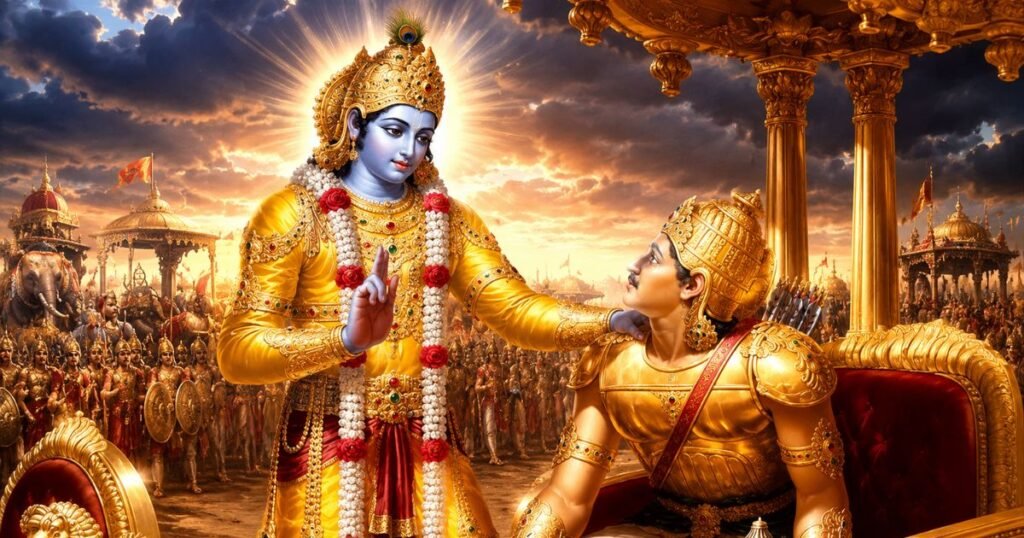
One of the most important verses in the Bhagavad Gita, spoken by Lord Krishna to Arjuna on the battlefield of Kurukshetra, is actually one of the most useful things ever said about parenting:
“यद्यदाचरति श्रेष्ठस्तत्तदेवेतरो जनः।
स यत्प्रमाणं कुरुते लोकस्तदनुवर्तते।।”
(Bhagavad Gita 3.21)
“Whatever a respected person does, others follow. Whatever standard they set, the world conforms to it.”
This verse from Bhagavad Geeta teaches that the people we look up to shape us through their actions, not their instructions. Krishna was speaking about leaders. But there is no more powerful arena of everyday leadership than a family.
For the first years of a child’s life, a father is one of the most respected people in their world. The child is not analyzing his words. They are watching his hands. They are watching how he speaks to their mother. They are watching how he reacts when something goes wrong. They are watching whether he keeps his promises.
That watching is the real curriculum.
- A father who handles failure with composure teaches resilience.
- A father who admits mistakes teaches accountability.
- A father who speaks kindly to strangers teaches his child what respect looks like.
- A father who shows up, consistently, in small ordinary moments, teaches his child that they are worth showing up for.
None of this requires a speech. It just requires presence.
The Ramayana: What Dasharatha and Rama Teach Us About Fatherhood
The Ramayana is one of the greatest stories ever told. It is also, at its heart, a story about fatherhood and what it passes down.
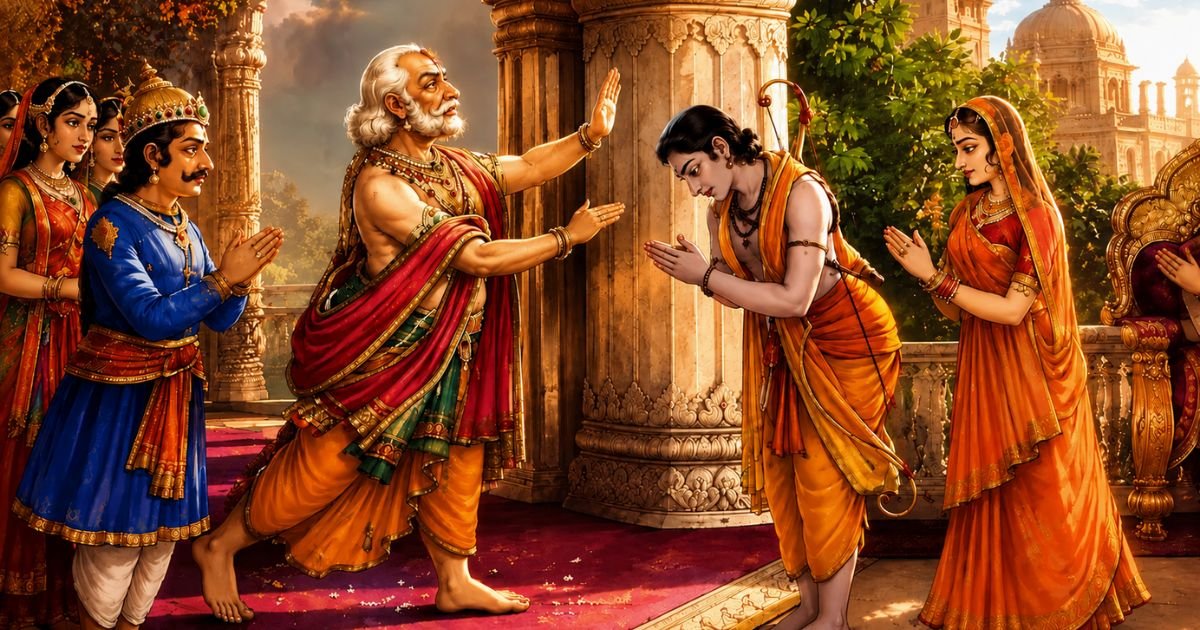
King Dasharatha was a loving father and a capable king. He also had a weakness: he could not say no to a promise he had once made to Kaikeyi. That single failure set off a chain of consequences. Shri Rama was exiled. King Dasharatha died of grief. A family was torn apart.
And yet, look at what Shri Rama became.
He was truthful even when truth cost him everything. He was committed to Dharma even when every human instinct told him to fight back. He surrendered comfort, power, and the life he had every right to, and did it without bitterness.
Valmiki describes him in the Bala Kanda as:
“रामो विग्रहवान् धर्मः साधुः सत्यपराक्रमः।”
“Rama is Dharma in human form, virtuous, of truthful valor.”
Dharma is rarely taught through lectures. It is absorbed through the environment we grow up in.
Shri Rama’s extraordinary character did not emerge in isolation. It was shaped within a household where duty, honor, respect, and righteousness were deeply valued. These principles were not merely spoken about – they were lived every day.
The story of Ayodhya reminds us that strong values are often nurtured at home. The culture of a family, the example set by parents, and the ideals upheld within a household can shape character for generations.
The Ramayana does not ask us to be perfect fathers. It asks us to be sincere. It shows us that the values we live by leave marks on our children that outlast us by generations.
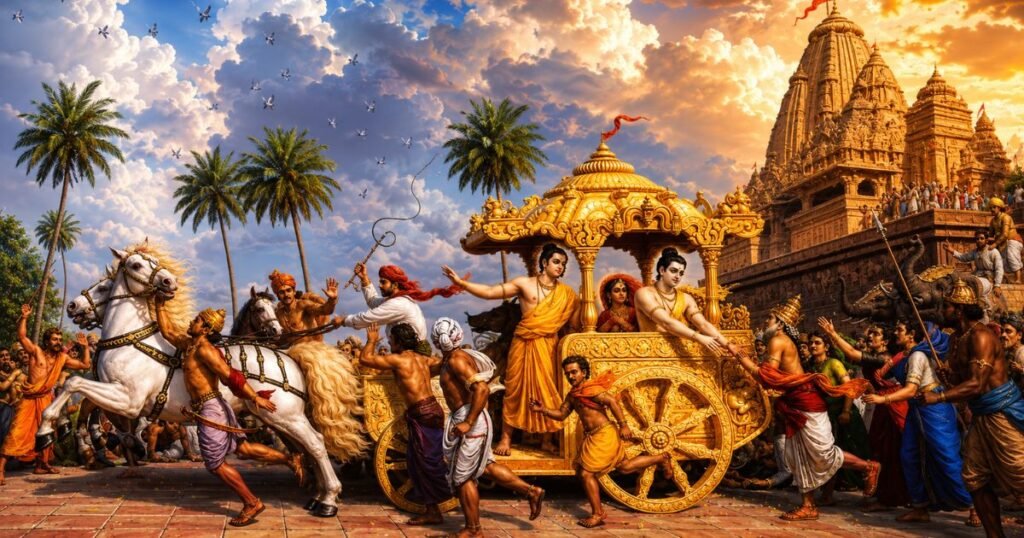
What the Srimad Bhagavatam Says About True Parental Love
The Srimad Bhagavatam, one of the eighteen Mahapuranas and the most devotional of all the Puranic texts, has something quietly challenging to say about fatherhood.
It asks: who are you really loving when you love your child?
A father who loves his child in order to feel proud, in order to secure care for himself in old age, in order to see his own identity continue, is mixing love with expectation. The Bhagavatam calls this kind of attached, conditional love a source of suffering, for the parent and for the child.
True Pitru Dharma, as the Srimad Bhagavatam frames it, is love without grasping. It is the kind of love that is oriented entirely toward the child’s freedom, capability, and flourishing, even when that means stepping back. Even when it means letting the child make choices the father would not make. Even when it means raising someone who will eventually not need you in the same way.
The highest thing a father can do, in this view, is not to raise a child who depends on him. It is to raise a human being who is rooted, capable, and free.
Pitru Rin: The Debt You Did Not Know You Were Carrying
Here is a concept from Sanatan Dharma that modern individualism barely has room for: Pitru Rin, the debt we owe to our ancestors.
Pitru Rin is the recognition that everything you are, you inherited:
- The values you hold.
- The language you think in.
- The festivals that mark your year.
- The stories that tell you who you are.
None of these started with you. They were all carried forward by a long line of people who chose, consciously or not, to pass something meaningful on.
A father is one link in that chain. His job is not only to love and provide for the children. It is to receive what was given to him with gratitude and to pass it forward with care. This matters enormously in a world that moves fast and forgets easily.
When a father tells his child a family story, marks a festival with intention, or simply explains why a tradition matters, he is not being old-fashioned. He is doing something ancient and essential. He is keeping a flame alive.
Pitru Rin reminds every father that what he does today will be felt by grandchildren he may never meet.
Sanatan Dharma and the Modern Father: Does Ancient Wisdom Still Apply?
This is where most people expect ancient scripture to run out of road. It does not.
Sanatan Dharma has never been about rigid role definitions. It has always been about Dharma: the sincere fulfillment of one’s responsibilities with wisdom, care, and integrity.
The ancient texts do not specify that a father must be the earner. They do not say a mother cannot lead the household. They do not define family by structure. They define it by the quality of Dharma being lived within it.
This is what makes Sanatan Dharma so relevant to modern families. Pitru Dharma is not defined by a specific family structure or traditional role. A father may be the primary provider, a stay-at-home parent, a single father, a co-parent, or even a stepfather who chooses to show up with sincerity and commitment. What matters is not the arrangement itself, but the responsibility, care, guidance, and presence he brings to a child’s life.
The structure of fatherhood changes. The purpose does not.
In 2026, that purpose looks like this:
- Being emotionally present, not just in the same room but actually engaged.
- Teaching children how to handle failure, not just how to pursue success.
- Modeling the relationship you want your children to have with work, with money, with other people.
- Having the uncomfortable conversations instead of leaving them for later.
- Showing your children what it looks like to make a mistake, own it, and begin again.
- Staying curious about your children’s inner world, not just their grades and achievements.
- Keeping the rituals and stories alive that connect the family to something larger than itself.
None of this is new. The Upanishads were saying it thousands of years ago. What has changed is the shape of daily life. What has not changed is what children need from their fathers.
The Five Things Only a Father Can Give, According to Hindu Wisdom
Sanatan Dharma teaches that a father’s role is not limited to providing for his family. His greatest contribution is often the values he passes on through his actions, choices, and everyday presence.
Viveka (Good Judgment)
The ability to make wise decisions and know the difference between right and wrong.
Children develop this not through rules alone, but by watching how their father thinks through problems, makes decisions, and handles difficult situations. A father who explains his reasoning teaches a child how to think, not just what to do.
Dhairya (Patience)
The strength to face challenges without giving up.
Life will always bring setbacks, failures, and uncertainty. When a father handles difficulties with honesty, resilience, and determination, he shows his children that courage is not about being fearless. It is about moving forward despite fear.
Shraddha (Commitment)
Giving your full attention and effort to what truly matters.
Whether it is work, family, relationships, or responsibilities, children notice when a father is fully present. A father who shows commitment teaches that the most important things in life deserve care, consistency, and attention.
Kshama (Forgiveness)
The ability to let go of resentment and learn from mistakes.
Every family experiences conflict. A father who can admit when he is wrong, forgive others, and move forward teaches emotional maturity. He shows that strength is not found in holding onto anger but in rising above it.
Smriti (Connection to Your Roots)
Knowing where you come from and what you stand for.
Family stories, traditions, festivals, values, and shared memories give children a sense of identity. A father who passes these on gives his children something deeply important: a feeling of belonging and a connection to something larger than themselves.
A Reflection for International Father’s Day
International Father’s Day began in 1910, started bySonora Smart Dodd in Spokane, Washington, in honor of her own father who raised six children alone after her mother died. It became a U.S. national holiday in 1972 and has since been adopted by more than a hundred countries.
In India, the occasion has resonated not as an import but as an alignment with something already deeply embedded in the culture. The reverence for fathers that the Upanishads describe. The obligations of Pitru Dharma. The stories of fathers in the Ramayana and Mahabharata whose choices echoed through generations.
Father’s Day, seen through the lens of Sanatan Dharma, is not really about gifts. It is about reflection. It is a day to ask: what did I receive from my father? What am I passing on to my children? What kind of presence am I choosing to be in the lives of the people who are watching me?
Final Thought: Income Supports a Household. Values Shape a Generation.
The world will keep changing. Families will keep evolving. The shape of a father’s day will look different in every home.
But Sanatan Dharma holds something steady through all of it.
A father is not defined by what he earns. He is defined by the Dharma he lives, the example he sets, and the thread of meaning and character he carries forward into the next generation.
As the Taittiriya Upanishad reminds us:
“पितृ देवो भव।”
Honor your father not just for what he provided. Honor him for what he passed on.
And for every father reading this: the most sacred thing you will ever build is not a career, a bank account, or a house. It is the human being who is quietly watching everything you do.
Frequently Asked Questions
1. What does Sanatan Dharma say about the role of a father?
Sanatan Dharma defines a father’s role through Pitru Dharma: the sacred duty to guide, protect, teach, and pass on values to the next generation. The Mahabharata describes the father as Dharma itself, as heaven, and as the highest form of spiritual discipline. His value is not measured by income but by the character he shapes in his children.
2. What is the meaning of Pitru Devo Bhava?
Pitru Devo Bhava (पितृ देवो भव) is a phrase from the Taittiriya Upanishad meaning “regard your father as divine.” It instructs children to honor their father not for his social role or financial contribution but for his foundational influence on their character, values, and life.
3. What does Bhagavad Gita 3.21 teach about parenting?
Bhagavad Gita 3.21 says that whatever a respected person does, others follow. For fathers, this means children are shaped far more by what they observe than by what they are told. A father’s daily behavior, how he handles difficulty, treats others, and keeps his commitments, becomes the model his children carry into their own lives.
4. What is Pitru Rin in Hinduism?
Pitru Rin (पितृ ऋण) is the concept of ancestral debt in Sanatan Dharma. It is the recognition that every person inherits values, culture, language, and identity from those who came before them, and carries the responsibility to honor and transmit that inheritance to the next generation.
5. When is International Father’s Day in India?
International Father’s Day is celebrated in India on the third Sunday of June each year. In 2025, it falls on June 15. In 2026, it falls on June 21.
6. Does Sanatan Dharma support modern families where both parents work?
Yes. Sanatan Dharma focuses on Dharma, not fixed role definitions. Both parents fulfilling their responsibilities with sincerity, wisdom, and love is the standard the tradition sets. The structure of the household is secondary to the quality of presence, guidance, and values each parent brings to their children.
The journey does not end here. Follow MFC on Instagram and Facebook to explore more sacred places, festivals, and living traditions of Sanatan Dharma.