
Before a child learns to pray, before they can name a god, visit a temple, or utter a single word, they know their mother. Hinduism recognized this profound truth thousands of years ago and encoded it across its most sacred texts: the Mahabharata, the Ramayana, the Manusmriti, the Bhagavata Purana, and the Durga Saptashati, each speaking with one voice:
नास्ति मातृसमा छाया, नास्ति मातृसमा गतिः। नास्ति मातृसमं त्राण, नास्ति मातृसमा प्रिया॥
Nasti Matru Sama Chhaya, Nasti Matru Sama Gatih. Nasti Matru Samam Trana, Nasti Matru Sama Priya.
“There is no shade like a mother, no refuge like a mother, no protection like a mother, no one as dear as a mother.”
– Mahabharata
Long before the world set aside a single day to honour mothers, Hindu dharma had already declared her divine.
This blog explores the deep meaning of Matru Devo Bhava, its roots across the most sacred Hindu scriptures, and why Hinduism places the mother above all others, even above God and even above heaven. It also shows how this timeless teaching speaks directly to every heart, on Mother’s Day and every single day.
What Does Matru Devo Bhava Mean?
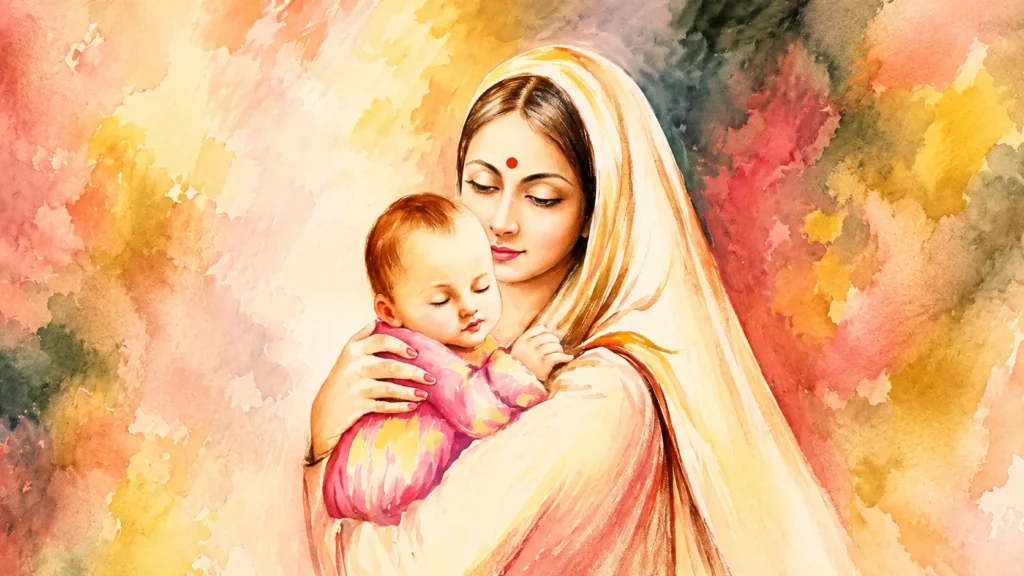
Matru Devo Bhava is a Sanskrit phrase that carries one of the highest spiritual commands in all of Hindu tradition. It translates directly as “May your mother be your God” or “Treat your mother as God.”
Breaking it down word by word:
- Matru = Mother
- Devo = God or the Divine
- Bhava = Be or Become
Together, these three words form a complete spiritual instruction, not a poetic comparison, but a living, daily practice. Hinduism asks every person, regardless of age or social standing, to honor the mother as a divine presence right here on earth.
The mother is not compared to God as a figure of speech. She is recognized as a direct expression of the divine in human form.
“She loved you before you could love yourself.”
What Hindu Scriptures Say About the Mother
The declaration that the mother is divine is not found in one place alone. It runs like a golden thread through the entire body of Hindu sacred literature. Across thousands of years and across entirely different texts, the same truth is stated again and again: no relationship is higher, no love is greater, and no presence is more sacred than the mother.
Manusmriti (2.145) states it with striking clarity:
The Manusmriti, one of the most authoritative texts in Hindu dharmic tradition, states this hierarchy with an arithmetic that leaves no room for debate:
“The teacher is ten times more vulnerable than a sub-teacher, the father a hundred times more than the teacher, but the mother a thousand times more than the father.”
This single line makes the entire argument. The mother is not just elevated above others in Hindu dharma. She is placed a thousand times above the father, who is himself placed a hundred times above the teacher. There is no ambiguity in Manusmriti about where the mother stands.
The Valmiki Ramayana, Yuddha Kanda, gives us one of the most beloved shlokas on this truth:
जननी जन्मभूमिश्च स्वर्गादपि गरीयसी।
Janani Janmabhumischa Swargadapi Gariyasi.
“Mother and motherland are greater even than heaven.”
Heaven, in Hindu cosmology, is the highest reward a righteous soul can receive. And yet the Ramayana places the mother above even that. This is not sentiment. This is scripture. These are not the words of a poet lost in sentiment. They come from one of the two most sacred epics in all of Hinduism.
The Mahabharata, Adi Parva, offers another shloka that captures the irreplaceable nature of the mother:
नास्ति मातृसमा छाया, नास्ति मातृसमा गतिः। नास्ति मातृसमं त्राण, नास्ति मातृसमा प्रिया॥
Nasti Matru Sama Chhaya, Nasti Matru Sama Gatih.Nasti Matru Samam Trana, Nasti Matru Sama Priya.
“There is no shade like a mother, no refuge like a mother, no protection like a mother, no one as dear as a mother.”
These words from the Mahabharata are not mythology. They are lived experience, encoded in Sanskrit, preserved across millennia.
Bhagavata Purana: Motherhood as a Spiritual Force
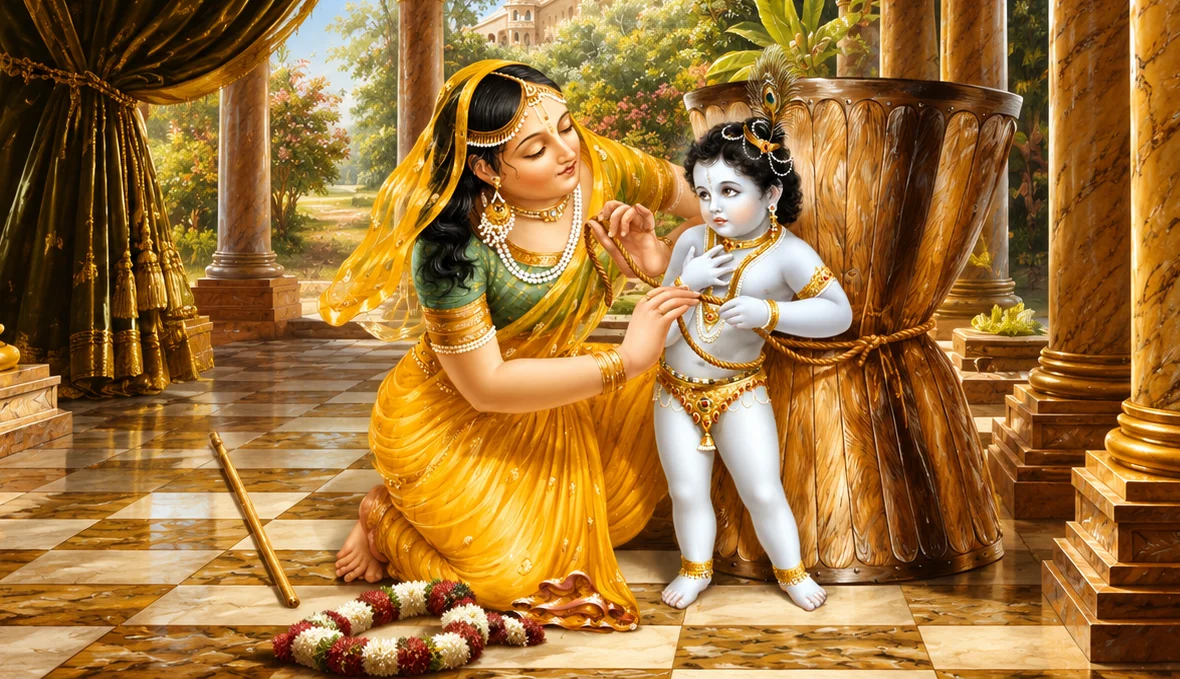
The Bhagavata Purana, through the story of Lord Krishna, offers a teaching on motherhood that goes beyond biology entirely. Krishna had two mothers: Devaki, who gave him birth, and Yashoda, who raised him with love, song, laughter, and the everyday tenderness of devotion.
Both are honoured. Both are revered. Both carry the title of mother in the fullest sacred sense.
This dual recognition reveals something profound about how Hinduism understands motherhood. It is not a biological event alone. It is a spiritual act. Whoever nurtures a soul with unconditional love, whoever shelters and shapes and sacrifices for a child, participates in the same divine energy. The Bhagavata Purana shows that the mother’s sacred status does not come from giving birth. It comes from the quality of love she gives.
Why Mother Comes Before God in Hinduism?
This is the most-asked question surrounding Matru Devo Bhava. The answer lies in the most fundamental experience of human life. The mother is the first universe a child ever inhabits. She shelters the child inside her own body before birth. She provides food, warmth, and love before the child takes a single breath or sees a single ray of light.
She is the first voice a child hears. The first face a child sees. The first hand that offers comfort in fear or pain. No other relationship begins this early or runs this deep. In this way, she becomes the child’s first experience of safety, love, and unconditional care. In Hinduism, that is exactly what God is.
Recognizing God in an abstract, formless presence can feel difficult for most people. But recognizing love, sacrifice, and devotion in a mother feels completely natural. The child first learns to love and revere the mother. That love then expands outward, toward the father, the teacher, and eventually toward God and all of creation.
The mother is the gateway through which all higher devotion begins. This is the heart of the teaching. This is why she comes first.
“The mother is the gateway through which all higher devotion begins.”
Importance of Mother in Hinduism
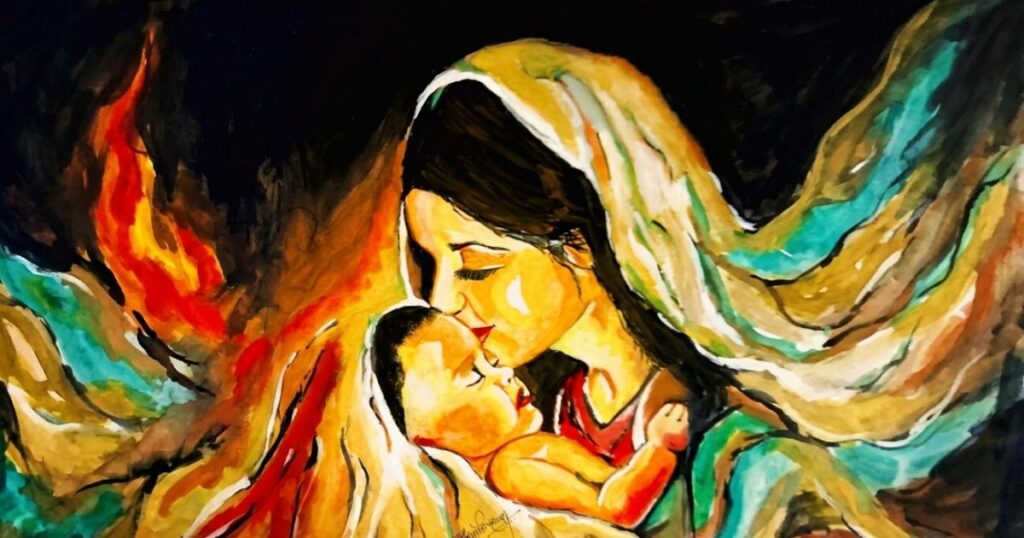
The importance of mother in Hinduism runs through every layer of scripture, ritual, story, and daily life. Many of the most powerful Hindu deities are female, and each is called Mata, meaning mother. This is not a coincidence. It reflects a deeply embedded spiritual truth:
- Goddess Durga, Mata, the fierce protector
- Goddess Lakshmi, Mata, the source of abundance and grace
- Goddess Saraswati, Mata, the giver of knowledge and wisdom
- Kali, Mata, the destroyer of ignorance and evil
- The earth, Dharti Mata
- The sacred river Ganga, Ganga Mata
- India itself, Bharat Mata
Hinduism sees motherhood as a cosmic and sacred force, not merely a biological or social role. The mother is a living symbol of Shakti, the divine feminine energy that powers the entire universe.
Every act of nurturing, every sleepless night, every sacrifice she makes, in Hindu understanding, is a spiritual act of the highest order.
Mother as the First Guru
In Hindu tradition, the word guru carries the deepest spiritual weight. A guru is not simply a teacher of subjects. A guru is the one who removes the darkness of ignorance and brings the light of knowledge and wisdom into a life. The Guru Stotram declares:
गुरुर्ब्रह्मा गुरुर्विष्णुः गुरुर्देवो महेश्वरः। गुरुः साक्षात् परब्रह्म तस्मै श्री गुरवे नमः॥
Gurur Brahma Gurur Vishnu Gurur Devo Maheshwarah. Guruh Sakshat Parabrahma Tasmai Shri Gurave Namah.
“The Guru is Brahma, the Guru is Vishnu, the Guru is Maheshwara. The Guru is the visible Supreme Brahman. Salutations to that Guru.”
The first guru of every child is the mother. Before any formal teacher, before any school, before any temple, she is Brahma, Vishnu, and Maheshwara combined, and most children experience all three of those qualities in her before they ever learn those names.
She teaches the child to speak, to walk, to eat, and to behave with kindness and respect. She plants the seeds of values, faith, and righteous conduct long before the world gets any opportunity to shape the child. These early lessons do not merely educate. They form the conscience. They build character. They shape the soul.
The Bhagavata Purana describes the mother as the one who shapes the very soul of the child from the beginning of life. She is not simply a caregiver. She is a spiritual architect, building the inner temple before the outer one is ever visited.
This is why Hindu scriptures about the mother give her a status that no other figure, not even the father or the teacher, can fully replicate.
Matru Devo Bhava and the Divine Feminine
Hinduism is one of the very few world religions that places the divine in female form at the absolute center of its worship. This is not separate from the teaching of Matru Devo Bhava. It is the same truth expressed at cosmic scale.
The Durga Saptashati, one of the most sacred texts in all of Hinduism and devoted entirely to the goddess, offers this invocation:
सर्वमङ्गलमाङ्गल्ये शिवे सर्वार्थसाधिके। शरण्ये त्र्यम्बके गौरि नारायणि नमोऽस्तु ते॥
Sarva Mangala Mangalye Shive Sarvartha Sadhike. Sharanye Tryambake Gauri Narayani Namostute.
“O auspicious one, O fulfiller of all purposes, O refuge, O three-eyed Gauri, O Narayani, salutations to you.”
This invocation addresses the goddess as the source of all auspiciousness, all refuge, and all fulfilment. These are precisely the qualities every child first encounters in their mother. The human mother and the cosmic goddess are not two separate entities. They are the same Shakti expressed at two different scales, one at the scale of the universe, and one at the scale of a family, a home, a child’s earliest memory.
Creation itself is an act of mothering. Life, nourishment, protection, and love are all motherly qualities at their root. To honour the mother is, in the deepest sense, to honour creation itself.
When Hinduism says Matru Devo Bhava, it does not diminish the divine. It reveals exactly where the divine is closest: in the relationship that gave you life.
Role of Mother in Hindu Culture
The role of mother in Hindu culture is visible in festivals, rituals, daily habits, and family practices across generations.
Navratri, the nine-night festival celebrated across India and the Hindu world, honors the divine feminine in nine sacred forms. Each form represents a different aspect of the mother’s power and grace. Millions of Hindus observe this festival with deep devotion each year, reaffirming their bond to the divine mother.
Mothers hold a central and irreplaceable role in all major life ceremonies. They bless children at birth, at the start of education, and at marriage. Their blessing carries a spiritual weight that no ritual can fully replace.
In many Hindu households, children touch their mother’s feet each morning in an act called Charan Sparsh. This gesture expresses respect, gratitude, and reverence, acknowledging the mother as a sacred presence not only in times of prayer, but in the simple fabric of everyday life.
Significance of Matru Devo Bhava in Modern Life
The significance of Matru Devo Bhava does not belong only to the ancient past. This teaching is deeply relevant in today’s world. In a fast-moving era of careers, technology, and constant distraction, the teaching serves as a powerful reminder: the divine is not only in distant temples. It sits in the next room, in the person who sacrificed their sleep, their comfort, and their dreams for your well-being.
Researchers in psychology and human development agree with what Vedic teachings on motherhood have always understood: children who grow up with deep respect for their mothers develop stronger empathy, better emotional balance, and more compassionate character.
The values a mother instills in early life become the foundation on which a person builds everything else. And in a culture where Mothers Day is celebrated globally every May, Matru Devo Bhava reminds us that for Hinduism, every single day is Mothers Day. This is not sentiment. It is spiritual practice.
“Every day is Mother’s Day. This is not sentiment. It is spiritual practice.”
Famous Teachings and Stories About Mothers in Hinduism
Hindu tradition is filled with stories that celebrate the sacred bond between a child and their mother.
The Story of Shravana Kumar
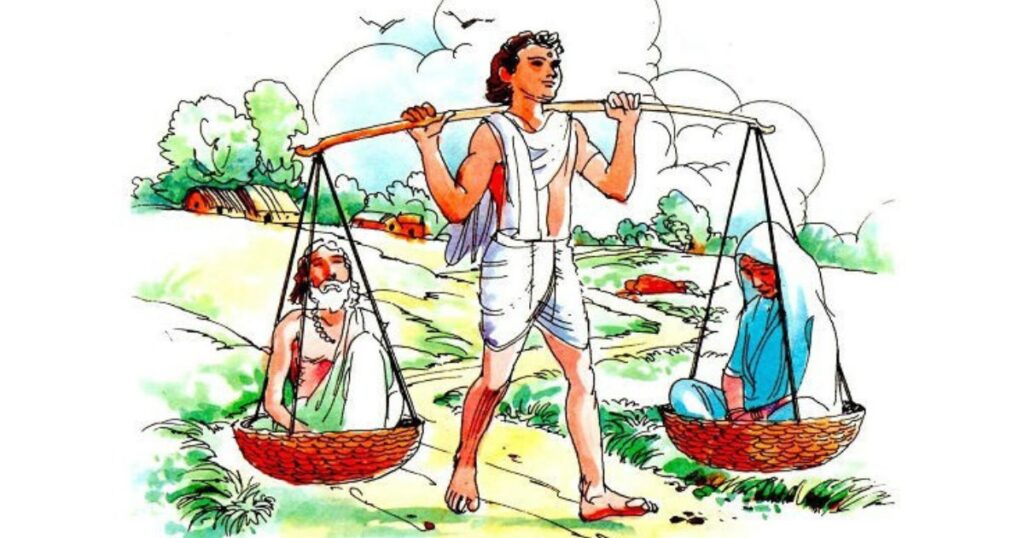
Shravana Kumar stands as the most celebrated example of filial devotion in all of Hinduism. His elderly parents were blind and unable to walk. Shravana did not merely care for them at home; he built two baskets, balanced them on a wooden yoke across his shoulders, and carried his parents on a full pilgrimage across sacred sites of India.
He walked for miles through heat, forest, and rough terrain, not out of duty, but out of pure, unconditional love. He tended to their every need with complete patience and joy. His sacrifice was not a burden to him; it was his highest spiritual act.
This story has been passed down for thousands of years as the living embodiment of Matru Devo Bhava, love that asks for nothing in return.
Swami Vivekananda
One of the greatest spiritual teachers of the modern era, Swami Vivekananda spoke repeatedly about the sacredness of the mother. He called her the living embodiment of God on earth and taught clearly that no spiritual progress was possible for a person who disrespected or neglected their mother.
Chhatrapati Shivaji Maharaj
The great Maratha warrior king publicly credited his mother Jijabai for his values, his courage, and his vision of a just kingdom. She was his first teacher of dharma, strategy, and character. Behind one of history’s greatest leaders stood a mother of extraordinary wisdom. His story proves that Matru Devo Bhava is not a philosophical concept alone; it is a living force that shapes the greatest destinies.
Matru Devo Bhava and Mother’s Day
Mother’s Day is observed every second Sunday of May across the world. Cards are given, flowers are gifted, meals are made, and gratitude is expressed in a hundred different ways. These are beautiful gestures. But Matru Devo Bhava does not wait for a calendar date.
Hindu dharma has been celebrating the mother since the age of the Vedas, not with cards and flowers, but with daily pranams, morning blessings, and the unwavering understanding that in her presence, you are already standing before God. The Manusmriti placed her a thousand times above all others. The Ramayana placed her above heaven. The Mahabharata said no shade, no refuge, and no love compared to hers.
Every morning a child touches the mother’s feet in a Hindu household on Mother’s Day. Every sunrise a mother rises before the family to prepare and nourish and hold together the life of the home is a sacred act rooted in this same ancient teaching.
This Mother’s Day, Matru Devo Bhava is not just a phrase to share or a caption to post. It is an invitation to truly see the divine in the person sitting closest to you.
“Every day is Mother’s Day. This is not sentiment. It is spiritual practice.”
Conclusion
Matru Devo Bhava is more than three Sanskrit words. It is a complete philosophy of life, a way of seeing the divine in the most human of all relationships, the one that began before you were even born.
The Manusmriti placed her a thousand times above all others. The Ramayana placed her above heaven itself. The Mahabharata declared that nothing, no shade, no refuge, no love, compares to hers. The Bhagavata Purana showed that her sacredness comes not from birth but from the quality of love she gives. And the Durga Saptashati revealed that the cosmic goddess and the human mother are the same Shakti, separated only by scale.
Across thousands of years of Hindu life, families have lived this truth every morning, in every pranam, in every blessing given and received at the threshold of a new day.
The mother is the first teacher, the first shelter, the first source of love, and the first experience of the sacred that any human being ever knows. She is the living face of the divine on this earth. Honouring her is not a tradition. It is the very beginning of all spiritual awareness.
“She loved you before you could love yourself. That is where God lives.”
Frequently Asked Questions (FAQs)
1. What does Matru Devo Bhava mean?
Matru Devo Bhava is a Sanskrit phrase meaning “May your mother be your God” or “Treat your mother as God.” It is pronounced Maa-tru Day-vo Bha-va. It is one of the highest spiritual teachings in Hinduism, supported by the Manusmriti, the Ramayana, the Mahabharata, and the Bhagavata Purana.
2. Where does Matru Devo Bhava come from?
The teaching is rooted across multiple sacred Hindu scriptures. The Manusmriti (2.145) places the mother a thousand times above the father. The Valmiki Ramayana places her above heaven. The Mahabharata declares that nothing compares to her. And the Bhagavata Purana recognizes motherhood as a spiritual act that goes beyond biology.
3. Why is the mother considered God in Hinduism?
Hinduism considers the mother as God because she is the child’s first experience of love, creation, and unconditional care. She embodies Shakti, the divine feminine energy that sustains the universe. She is the child’s first guru and the gateway to all higher spiritual devotion.
4. Why does the mother come before God in Hindu teachings?
The mother comes before God because she is the first relationship any human being ever experiences, even before birth. This bond is the closest, most sacred, and most primary of all human connections. It is the foundation of all spiritual life.
5. What is the importance of mother in Hinduism?
Hinduism honors the mother as the first guru, the first shelter, and the first expression of the divine on earth. Many Hindu goddesses carry the title Mata. The earth, sacred rivers, and India itself are called mothers, reflecting how deeply motherhood is woven into Hindu spiritual life.
6. What is the significance of Matru Devo Bhava in modern life?
In modern life, Matru Devo Bhava reminds us to see the divine in the person who shaped our values and gave us life. It is especially relevant during Mother’s Day but applies every day. Gratitude and love for the mother are the starting points of all genuine spiritual growth.
7. Who is an example of Matru Devo Bhava in Hindu stories?
Shravana Kumar is the most celebrated example. He carried his blind, elderly parents on his shoulders across pilgrimage sites so they could fulfill their spiritual wishes. His story is the highest example of devotion to parents in all of Hindu tradition.
The journey does not end here. Follow MFC on Instagram and Facebook to explore more sacred places, festivals, and living traditions of Sanatan Dharma.