
There are festivals we celebrate, and then there are festivals that shake us to our core, that remind us why faith is not weakness, but the most formidable force in the universe. Narsimha Jayanti 2026 is one such day.
On this sacred occasion, we don’t just remember a legend. We reconnect with a truth that has echoed across millennia: that no power, no matter how monstrous, how arrogant, or how heavily armored, can stand against the love of God for a sincere devotee.
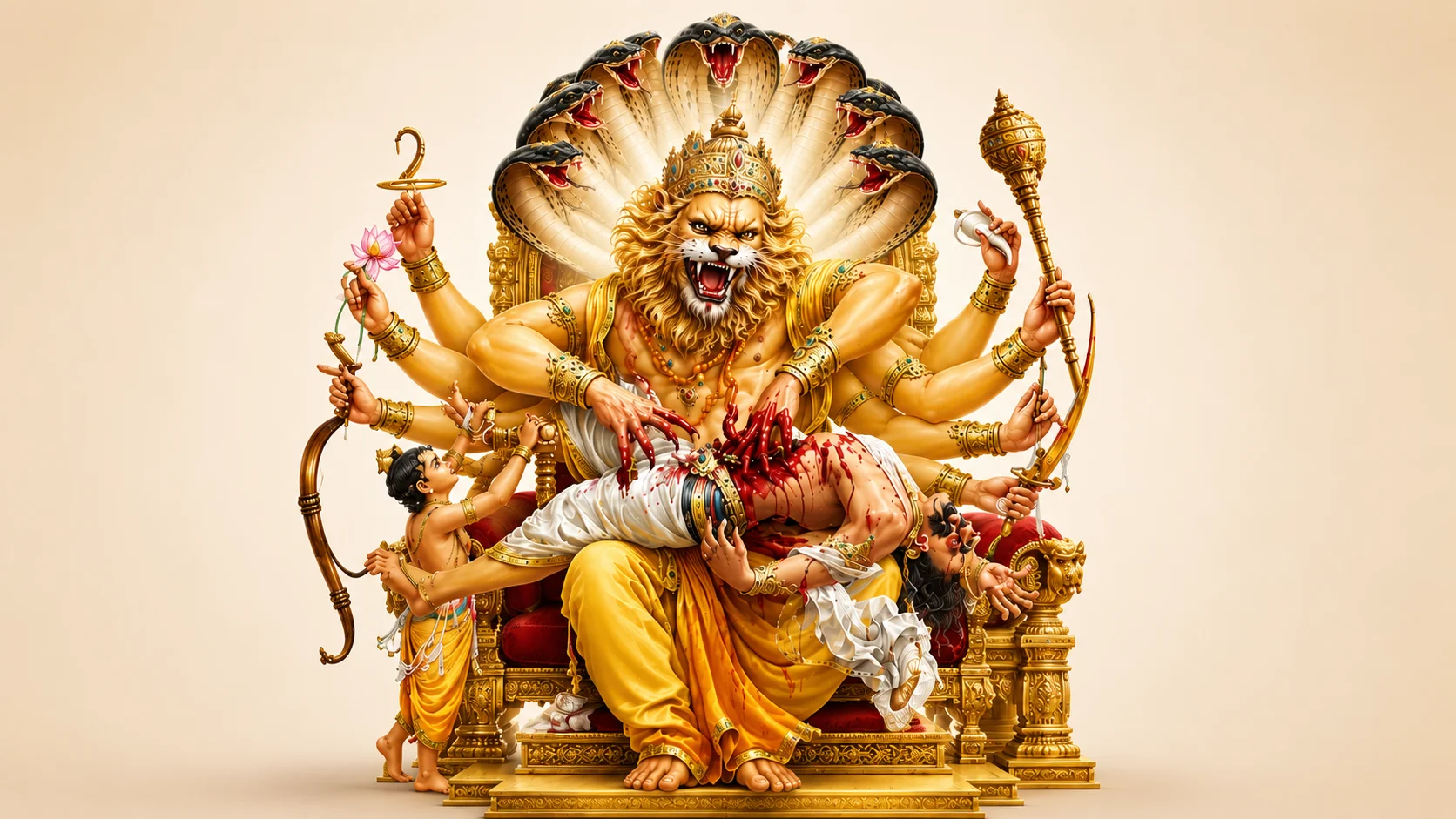
This is the day Lord Vishnu, in his most fierce and extraordinary form: half-man, half-lion, burst forth from a stone pillar at dusk to answer the cry of a child’s unwavering faith.
Narsimha Jayanti 2026: Date and Puja Muhurat
Narsimha Jayanti 2026 falls on Thursday, April 30, 2026.
As per the Hindu Panchang, it is observed on the Chaturdashi Tithi (14th day) of Shukla Paksha in the holy month of Vaishakha. This is why it is also called Narasimha Chaturdashi or Vaisakh Shukla Chaturdashi.
Key Timings at a Glance:
- Chaturdashi Tithi Begins: 7:51 PM on April 29, 2026
- Chaturdashi Tithi Ends: 9:12 PM on April 30, 2026
- Madhyahna Sankalp Time (Sankalp Muhurat): 11:19 AM to 1:53 PM
- Sayana Kala Puja Time (Most Auspicious): 4:27 PM to 7:00 PM
- Parana Time (Breaking the Fast): After 6:11 AM on May 1, 2026
Why is the Lord Narsimha evening puja most important? Because according to the Puranas, Lord Narasimha appeared from the pillar exactly at dusk – at the twilight hour that is neither day nor night. Performing puja during Sayana Kala (evening twilight) honors this precise cosmic moment.
The Full Story of Lord Narasimha
Part 1: The Demon Who Wanted to Be God
In the ancient times, there lived a powerful sage named Kashyap and his wife Diti. They had two sons – Hiranyaksh and Hiranyakashipu. When Lord Vishnu’s Varaha (Boar) avatar killed Hiranyaksh, his brother Hiranyakashipu was consumed by grief and rage.
Determined to avenge his brother and make himself invincible, Hiranyakashipu performed severe tapasya (penance) to please Lord Brahma. His austerities were so intense that the entire universe trembled. Pleased by his devotion, Brahma appeared before him and offered a boon.
Hiranyakashipu, clever in his arrogance, asked for a boon of near-immortality crafted with five conditions. He could not be killed:
- By any human or any animal
- During the day or during the night
- Inside or outside any building
- On the ground or in the sky
- By any weapon – animate or inanimate
With these protections, he declared himself the supreme ruler of all three worlds and commanded that everyone worship him alone, not Lord Vishnu.
Part 2: The Son Who Refused to Bow
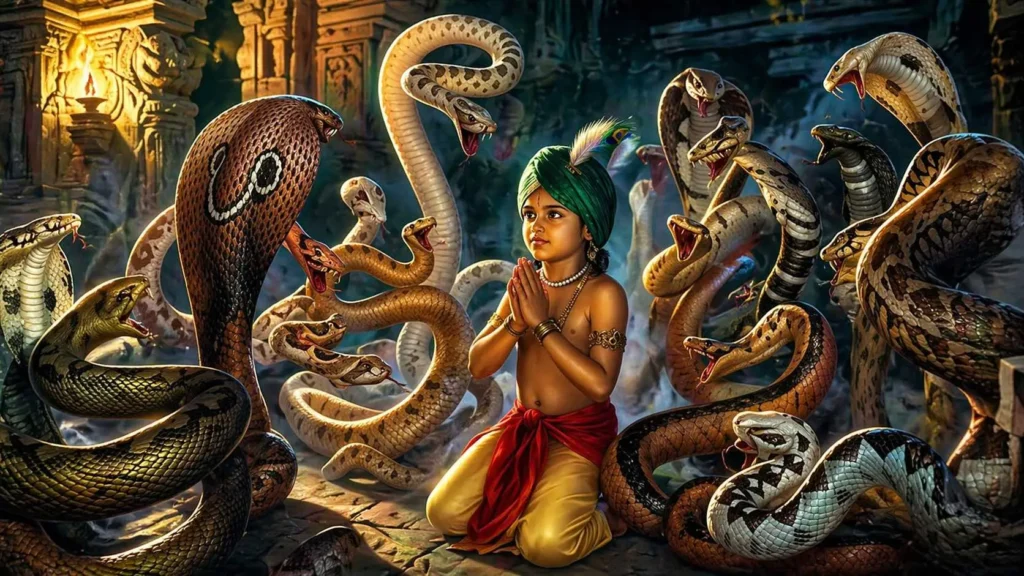
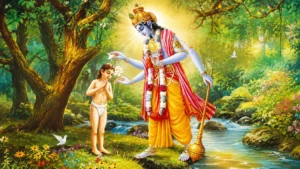
But there was one problem. His own son, young Prahlad, was an unshakeable devotee of Lord Vishnu.
From the moment Prahlad could speak, Vishnu’s name was on his lips. In school, when other children recited lessons, Prahlad spoke of Vishnu’s glory. His father was furious. He tried everything to turn Prahlad away – threats, punishments, manipulation, and finally, attempts on his life.
Prahlad was:
- Thrown off a cliff – he floated down safely
- Trampled by elephants – he remained unhurt
- Cast into a fire by his own aunt Holika (who had a boon of being fireproof) – Holika burned, Prahlad walked out unscathed
(This incident is the origin of the festival of Holi, where the bonfire, Holika Dahan, represents the destruction of evil.)
Yet through every trial, Prahlad never wavered. He said simply, “Vishnu is everywhere. He is in me, in you, in every pillar, in every grain of dust.”
Part 3: The Pillar That Split the World
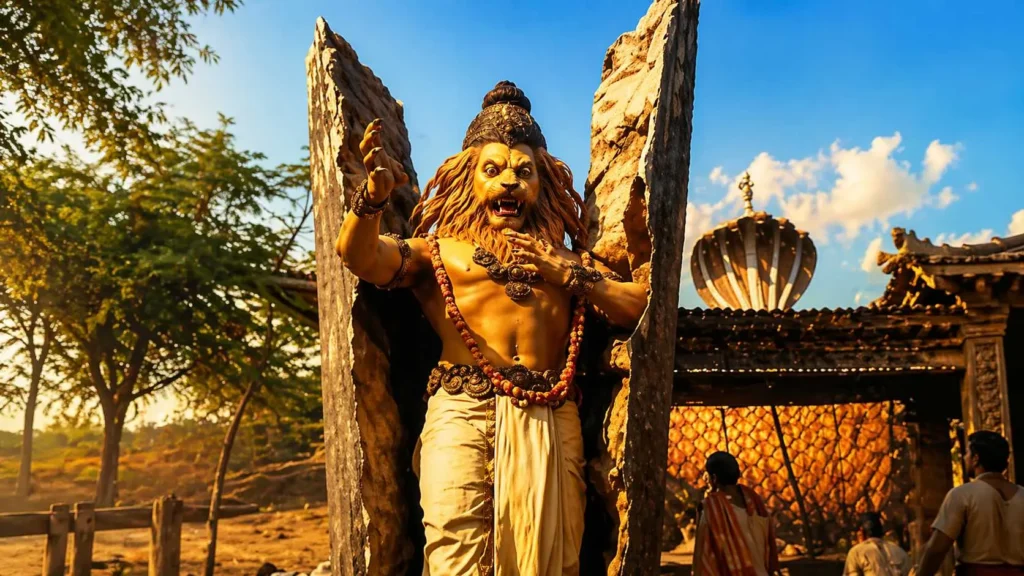
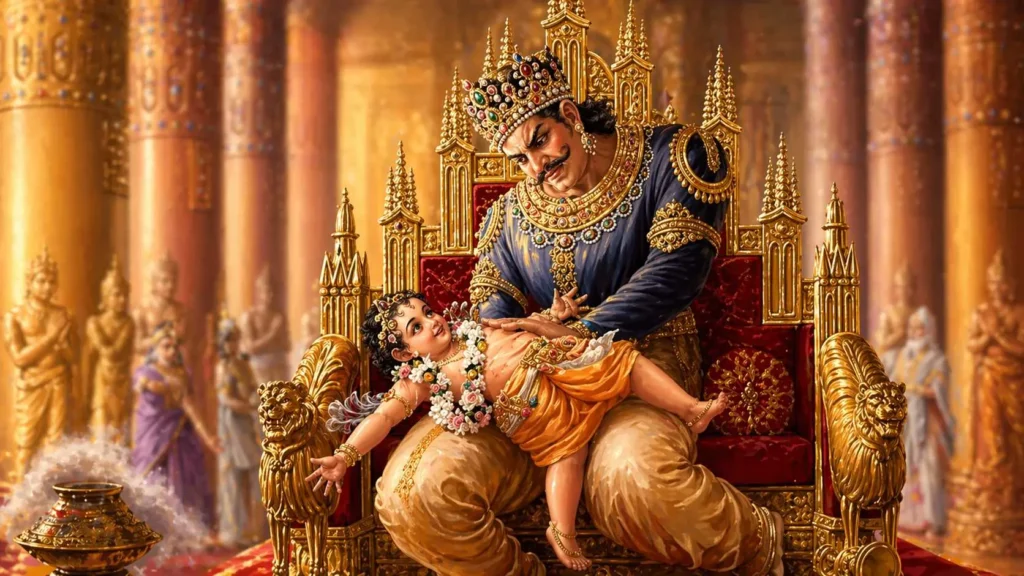
Finally, a furious Hiranyakashipu confronted his son in the royal court. He pointed to a stone pillar and sneered, “Is your Vishnu in this pillar?”
Prahlad replied calmly, “Yes, Father. He is in this pillar too.”
With a thunderous laugh, Hiranyakashipu raised his mace and struck the pillar with full force.
And then, the world changed.
A deafening sound filled the cosmos. The pillar cracked and from within it emerged a form unlike anything creation had seen before: Bhagwaan Narasimha. Half-man, half-lion. Eyes blazing with divine fire. He was neither fully human nor fully animal. It was neither day nor night – it was dusk. And he did not emerge from inside the palace or outside it, but exactly at the threshold, the doorway between both worlds.
Hiranyakashipu’s five protective conditions boon were shattered. Lord Narasimha placed the demon on his thighs, neither on the ground nor in the sky. He tore Hiranyakashipu apart with his bare nails – no weapon.
Every condition was honored. Every protection, circumvented by divine intelligence.
Dharma was restored. Prahlad was safe.
The Deeper Meaning
The story of Narasimha is not merely about a demon’s death. It is about the absolute reliability of faith. Prahlad didn’t pray for protection – he simply loved God. And God, unbounded by form, emerged from a stone pillar when his devotee needed him most.
The message is timeless: wherever a sincere devotee calls, the Divine will find a way to appear.
Narasimha Mantra: Words That Offer Protection
Chanting Narasimha mantras on Jayanti day is considered especially powerful. The vibration of these sacred syllables is believed to invoke divine protection, remove fear, and create a shield against negative energies.
1. Narasimha Mool Mantra (Most Powerful)
ॐ उग्रं वीरं महाविष्णुं ज्वलन्तं सर्वतोमुखम्।
नृसिंहं भीषणं भद्रं मृत्युमृत्युं नमाम्यहम्॥
Om Ugram Veeram Maha-Vishnum Jvalantam Sarvatho Mukham,
Nrisimham Bhishanam Bhadram, Mrityu Mrityum Namamyaham.
Meaning: “I bow to Lord Narasimha – the fierce, the valiant, the all-pervading Vishnu; blazing in all directions; terrible yet auspicious; the death of death itself.”
2. Narasimha Gayatri Mantra
ॐ नृसिंहाय विद्महे, वज्रनखाय धीमहि, तन्नो नृसिंहः प्रचोदयात्।
Om Nrisimhaya Vidmahe, Vajranakhaya Dhimahi, Tanno Nrisimhah Prachodayat.
Meaning: “Let us meditate upon Lord Narasimha with his diamond-sharp nails. May he inspire and illuminate our minds.”
3. Prahlad’s Prayer to Narasimha (Simple Chant for Protection)
नमो नरसिंहाय।
Namo Narasimhaya.
Simple, powerful, and suitable for everyone – including children. Chanting this 108 times with a tulsi mala on Jayanti day is considered deeply auspicious.
Puja Vidhi: How to Worship on Narsimha Jayanti
You don’t need an elaborate setup to observe Narsimha Jayanti meaningfully. What matters is sincerity of heart. Here’s a simple, structured guide:
The Night Before
Eat only a single light meal (Prahar Bhojan). Avoid grains and heavy food. Set your intention to fast and worship the next day.
Morning on Jayanti Day
Wake before sunrise. Take a bath and wear fresh, clean clothes – preferably yellow, the color sacred to Lord Vishnu.
Puja Setup
Place an idol or image of Lord Narasimha (and Goddess Lakshmi, his divine consort) on a clean wooden platform. Offer:
- Sandalwood paste (Chandan)
- Saffron (Kesar)
- Tulsi leaves
- Fresh flowers
- Fruits and sweets
- Coconut
- Incense and a ghee lamp (diya)
Madhyahna Sankalp (11:19 AM – 1:53 PM)
Take a formal sankalp (vow) for the fast and the puja. This is your declaration of intent and devotion.
Evening Puja – Sayana Kala (4:27 PM – 7:00 PM)
This is the heart of Narsimha Jayanti. Light the diya, chant the Lord Narasimha Mool Mantra or
Gayatri Mantra, recite the Lord Narasimha Ashtakam or Stotram if possible, and offer your prayers with complete focus and sincerity.
Breaking the Fast (Parana)
The fast is observed until May 1, 2026, after 6:11 AM. End the observance with gratitude and charitable giving – donating sesame seeds (til), yellow cloth, or food to those in need is considered especially meritorious.
Significance of Narsimha Jayanti: Why This Day Matters
Narsimha Jayanti carries layered significance – spiritual, philosophical, and deeply personal.
Dharma Over Adharma
Hiranyakashipu represents every form of unchecked ego – the belief that power can replace conscience. Narasimha’s intervention is a cosmic reminder that dharma cannot be suppressed forever. Good will rise, even from stone.
Protection of the Sincere Devotee
Prahlad had no weapons, no army, no political power. He had only faith. And that was enough. This story offers immense comfort to anyone who feels powerless in the face of adversity.
Victory Over Fear
Lord Narasimha is worshipped as the destroyer of fear. His very mantra contains the words “Mrityu Mrityum” – the death of death. Observing this Jayanti is believed to dissolve deep-seated fears and give courage.
Protection from Negative Forces
In Vedic astrology and tradition, Lord Narasimha puja is considered one of the most potent remedies for removing evil energies, black magic, and obstacles from one’s life – in health, career, finances, and relationships.
What Makes Narsimha Jayanti Unique Among Vaishnava Festivals?
Narasimha Jayanti stands apart from other Vaishnava festivals because it celebrates Vishnu’s most fierce and protective incarnation. While many Vishnu avatars appear in calm, compassionate forms, Lord Narasimha manifests as a powerful force of divine protection.
Most Vishnu avatars came in gentleness – Lord Ram as a just king, Lord Krishna as a divine friend. But Lord Narasimha came in fire. His fierce form represents the moment when divine power rises to protect true devotion and destroy injustice.
This is not simply a festival celebrating the beauty of God; it is a reminder of God’s unwavering protection in times of danger and darkness.
That powerful symbolism is why devotees facing difficult periods in life – illness, injustice, fear, or financial struggle – often turn to Lord Narasimha. He is revered as the protector of the helpless, the divine guardian who stands between the devotee and harm.
Narsimha Jayanti Regional Celebrations Across India
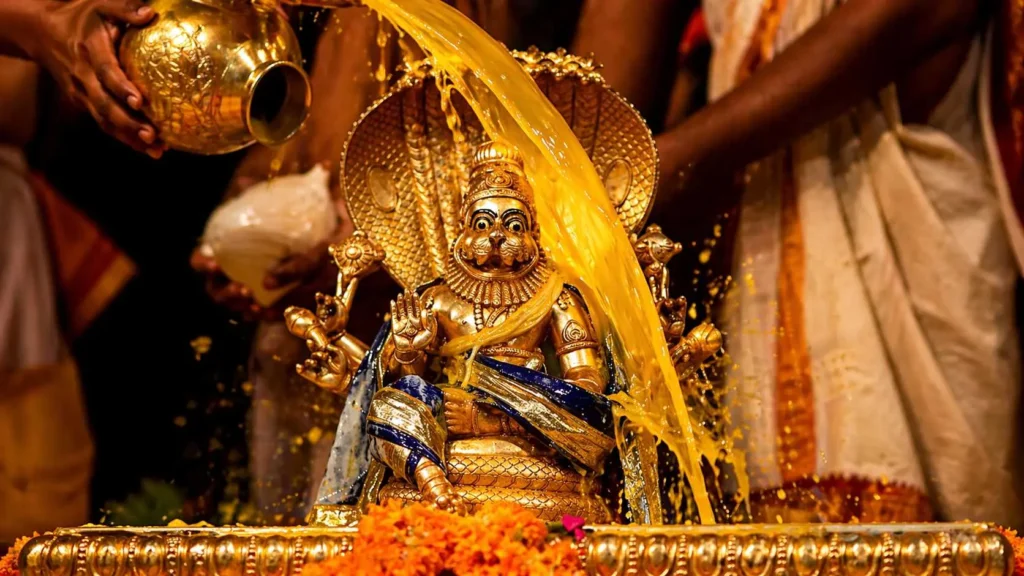
South India (Andhra Pradesh, Tamil Nadu, Karnataka)
Narsimha Jayanti is celebrated with exceptional grandeur. Major Narasimha temples – like the
Lakshmi Narasimha Temple in Yadagirigutta, Andhra Pradesh – see thousands of devotees. Special abhishekam (ritual bathing of the deity), bhajans, and processions mark the day.
Mathura and Vrindavan
ISKCON temples conduct Abhayam (prayers for protection) and elaborate cultural programs including recitation of Prahlad’s story and Narasimha Katha.
Maharashtra
Known here as Narsingh Jayanti, devotees observe strict fasting and community bhajans. Temple trusts organize annadaan (free food distribution) in honor of the day.
North India
Puja is performed at home and in local temples. Families gather in the evening for collective mantra chanting and the reading of Narasimha Purana.
Lesser-Known Facts About Lord Narasimha
1. He is one of the most geometrically perfect avatars
The story is constructed to satisfy every condition of Hiranyakashipu’s boon without breaking a single one. Scholars describe this as the most mathematically precise divine intervention in Puranic literature.
2. The Narasimha avatar appears in multiple Puranas
The story is detailed in the Bhagavata Purana, Vishnu Purana, Agni Purana, and Brahma Purana – with slightly different narrative details in each, offering multiple spiritual layers to the same event.
3. Narasimha is one of the fastest divine responses in Hindu mythology
The pillar broke the moment Hiranyakashipu struck it. There was no delay between Prahlad’s faith and God’s arrival. Theologians cite this as illustrating the immediacy of divine response to pure devotion.
4. Lord Narasimha has 74 different forms
In South Indian tradition, Narasimha is worshipped in 74 distinct forms – each representing a different aspect of the divine: Yoga Narasimha (seated in meditation), Ugra Narasimha (fierce), Lakshmi Narasimha (gentle, with Lakshmi on his lap), and many more.
What You Can Do This Narsimha Jayanti (Practical Guide for Readers)
Even if you cannot fast or perform an elaborate puja, here’s how you can meaningfully observe the day:
- Chant the Mool Mantra 108 times in the evening: Even silently in your heart.
- Read or listen to the Narasimha Katha: The full story of Prahlad and Hiranyakashipu.
- Light a diya at home during Sayana Kala (evening twilight).
- Donate to someone in need: Food, Clothing, or Time.
- Reflect on where you need divine protection in your life, and offer that concern to Lord Narasimha in prayer.
Conclusion: The Pillar Is Always There
The most radical message of Narsimha Jayanti is not that God is all-powerful, though He is. It is that God is always already present. He didn’t travel from a distant heaven when Prahlad called. He was already inside the pillar, and was already in the room.
The festival asks us a quiet but profound question: where in your life are you still waiting for God to arrive – not realizing he is already there, waiting for the right moment to step through?
May Lord Narasimha bless you with courage, clarity, and protection – on this Jayanti and always.
Jai Narsimha. Jai Prahlad.
धर्मो रक्षति रक्षितः
(Dharma protects those who protect dharma.)
At My Favorite Corner, we write from within the tradition, with reverence for the scriptures and love for the path. If this piece spoke to you, share it with someone on their spiritual journey. For more such reflections, follow us on Instagram and Facebook, and stay connected to the path of bhakti.