
Chandika Jayanti is a sacred day dedicated to Goddess Chandika, a powerful form of the Divine Mother in Hindu tradition. In the Devi Mahatmya of the Markandeya Purana, she is described as the fierce and protective form of Shakti, the divine energy that restores balance whenever injustice and chaos arise in the world.
For many devotees, Chandika is another name for Durga, the warrior goddess who defeats powerful demons such as Mahishasura, Shumbha, and Nishumbha. Yet within the scriptures, the name Chandika carries a deeper meaning. It refers to the fierce, uncompromising force of the Divine Mother that rises whenever Dharma must be protected.
Therefore, Chandika Jayanti is not just a ritual observance. It is a day to remember the stories, teachings, and symbolism found in the Devi Mahatmya, a text composed over 1,500 years ago. It presents the Maa Chandika as the supreme source of power, wisdom, and protection in the universe.
This blog explores who Goddess Chandika is, where her story comes from, why Chandika Jayanti is observed, and what the scriptures say about the deeper meaning behind her worship.
Who Is Goddess Chandika? Understanding the Name
Before anything else, the name itself deserves attention.
Chandika comes from the Sanskrit root canda, which means fierce, terrible, or violent toward evil. She is not fierce in an indiscriminate way. The Devi Mahatmya, which is the most authoritative scripture, defines Chandika as “ the Goddess of Truth and Justice who came to Earth for the establishment of Dharma.”
In the Devi Mahatmya, embedded within the Markandeya Purana (Chapters 81 to 93), Chandi and Chandika are the primary names used for the Supreme Goddess. She is neither an ordinary devi nor anyone’s consort. She is described as the supreme power of the universe, the source from which all creation emerges.
The Devi Mahatmya presents Maa Chandika as the ultimate reality, not a helper, not a support system, but the source itself. This was revolutionary in its time and remains philosophically striking even today.
Chandika, Chandi, Ambika, and Durga are often used interchangeably within the text, but Chandika in particular represents the fierce, warrior aspect of the Divine Mother who steps in when no one else can.
The Text That Defines Her: Devi Mahatmya (Markandeya Purana)
Most people have heard of the Durga Saptashati during Navratri. But, what is Durga Saptashati? It simply means “seven hundred” because the text contains 700 verses. These 700 verses span 13 chapters and form Chapters 81 through 93 of the Markandeya Purana.
The text is also popularly called the Chandi Path, precisely because it describes the Goddess most frequently as Chandika.
Devi Mahatmya was composed around the 5th or 6th century CE, and is considered the foundational scripture of Shaktism. Scholars at Britannica describe it as “the earliest appearance in the high Sanskritic literary and religious tradition of a treatise in which the Goddess is elevated to a place of ultimate prominence.”
Here is what makes this text unique and what people rarely talk about. It does not present divinity through abstract philosophy. It presents the Goddess through three great battles, each more complex than the last, each revealing a different dimension of feminine cosmic power.
The three episodes (Charitras) are:
- The first Charitra deals with Madhu and Kaitabha and reveals Chandika as Mahakali, the power of deep sleep and cosmic dissolution.
- The second Charitra deals with Mahishasura, the buffalo demon who had conquered the gods. It reveals Chandika as Mahalakshmi, the radiant combined energy of all the gods.
- The third Charitra deals with the demons Shumbha, Nishumbha, Raktabija, and their armies. It reveals Chandika as Mahasaraswati.
These three are not separate goddesses. They are three aspects of one supreme reality, Chandika herself.
The Battle with Mahishasura: A Story Worth Knowing Fully
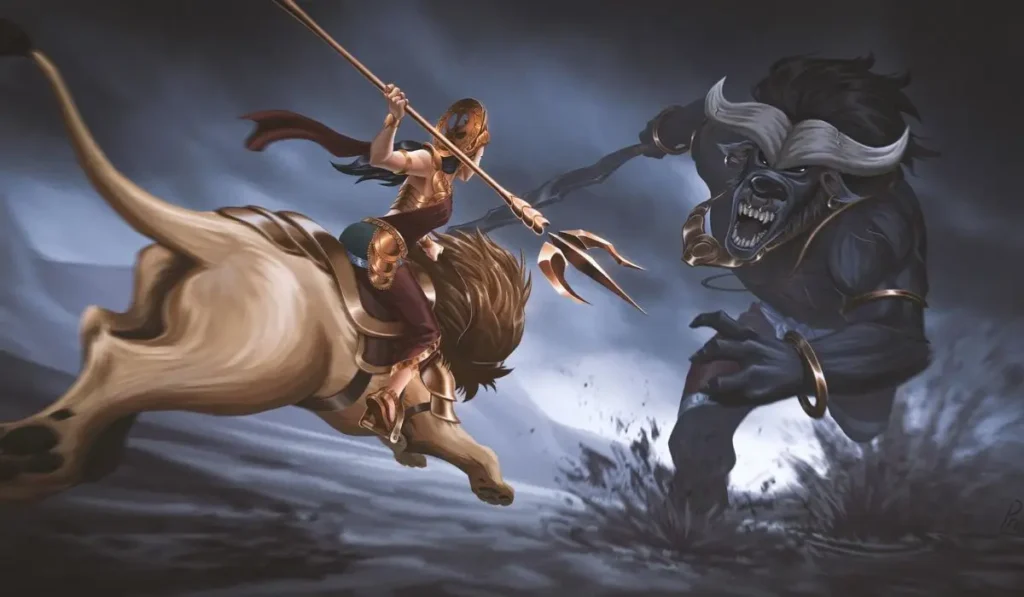
Most people know that Durga killed Mahishasura. Very few know why this story is philosophically important beyond the surface narrative.
Mahishasura had received a boon that no man or god could kill him. He had overthrown the heavens. The gods, helpless, combined all their powers, their weapons, their energies, their divine radiance, and from that convergence, Chandika emerged.
What happened next is big. When Mahishasura sent his general Chikshura to her with a message asking her to submit, Chandika laughed.
The Devi Mahatmya records her response: she declared that she alone would fight, and that her strength was her own, not borrowed from others.
This one line carries enormous philosophical weight. A goddess who emerges from the combined energies of all the gods then declares that her power is entirely her own. The scripture is saying something subtle and profound: that the Feminine Principle does not derive its power from the Masculine.
It is the original source from which all energy flows. The gods gave their energies to her not because she needed them, but because she was the true owner of those powers.
After nine days and nights of battle, Mahishasura was defeated. Those nine days became what we now celebrate as Navratri.
The Raktabija Story: The Most Underrated Episode
If you have never heard about Raktabija, this is the part of the blog you will remember.
Among all the demons in the Devi Mahatmya, Raktabija had a unique and terrifying power.
Every drop of his blood that fell to the ground immediately transformed into a new demon of equal size and strength. As the gods and Chandika’s warriors cut him down, thousands of Raktabijas spawned. The battlefield was becoming impossible to manage.
Chandika then summoned Kali. Kali spread her tongue across the entire battlefield so that not a single drop of Raktabija’s blood could touch the ground. As each clone was cut, she drank the blood before it fell. Eventually, the original Raktabija was drained and slain.
This episode is often reduced to a dramatic battle scene. But the symbolism runs much deeper. Raktabija represents a very specific psychological demon, the ego that multiplies when you attack it directly. Every time you try to suppress or defeat a deep-seated ego pattern by force, it comes back stronger. You cannot defeat it with more force. The only solution is what Kali does, to absorb it completely, to drink it up from the source, to stop it from reproducing.
Chandika Jayanti 2026: When and How It Is Observed
Chandika Jayanti 2026 falls on Friday, May 1, 2026.
According to the Hindu lunar calendar, Chandika Jayanti is observed on the Shukla Purnima (full moon) of the month of Vaishakha. This is the same tithi that also marks Vaishakha Purnima, making it one of the most spiritually charged full moon days of the Hindu year.
For 2026, the Purnima Tithi begins on April 30 at 9:29 PM (IST) and ends on May 1 at 11:47 PM (IST). Since the Purnima is active through the Udaya Tithi (the tithi at sunrise), May 1 is the principal day of observance.
It is worth noting that Chandika Jayanti is not confined to a single annual date. The Devi Mahatmya itself, in Chapter 12, prescribes recurring worship. The Goddess tells her devotees directly:
If anyone recites her deeds daily, or on the Shukla Ashtami, Shukla Navami, or Krishna Chaturdashi of each month, they will achieve their desires. The sick will become healthy, the poor will become prosperous, the childless will have children, and those who seek liberation will achieve it
The Vaishakha Purnima observance, however, is the main annual Jayanti recognized across traditions. Mark your calendar: Friday, May 1, 2026
This means Chandika Jayanti is not a single fixed calendar date but a living, recurring observance tied to lunar cycles. Many traditions also observe Chandika puja on Krishnashtami and during the Sharad Navratri season every year.
Chandika Jayanti Puja Vidhi: How to Worship Step by Step
You do not need a pandit or a large temple to observe this day with sincerity. Here is a complete guide to performing Chandika puja at home on May 1, 2026.
What You Will Need:
Before you begin, keep the following ready: a clean red or yellow cloth for the altar, an image or idol of Goddess Chandika or Durga, red hibiscus flowers and marigolds, a ghee lamp (diya), incense sticks, coconut, seasonal fruits, kumkum (vermillion), turmeric, a water pot (kalash) filled with clean water and mango leaves, a conch if available, and prasad such as kheer, panchamrit, or fruits.
Step 1: Brahma Muhurta Preparation (4:00 AM to 5:30 AM)
Wake before sunrise during Brahma Muhurta. Take a bath and wear clean clothes, preferably red, yellow, or white. This is the hour considered most receptive for Shakti worship. Do not eat or drink before the puja if you are observing a fast.
Step 2: Setting Up the Altar
Spread a clean red or yellow cloth on a raised surface. Place the image or idol of Goddess Chandika at the center. Arrange the kalash to the right side of the idol. Place a ghee lamp before the Goddess and a separate lamp for the kalash. Keep the offerings to one side, ready to use.
Step 3: Sankalpa (Setting Your Intention)
Sit facing east or north. Take a little water in your right palm and state your intention aloud, your name, your gotra if known, and the purpose of the puja. Offer the water from your palm as a sankalpa. This step is often skipped at home but makes the puja significantly more focused and meaningful.
Step 4: Shodashopachara Puja (Sixteen Offerings)
Offer each of the following one at a time to the Goddess, stating each offering before you place it:
- Avahana (invitation)
- Asana (a clean seat for the Goddess)
- Padya (water for feet), Arghya (water offered with both hands)
- Achamana (water for sipping)
- Snanam (a symbolic bath with panchamrit: milk, curd, ghee, honey, sugar)
- Vastra (cloth, represented by a red or yellow dupatta or cloth)
- Yajnopavita (sacred thread if available), Gandha (sandalwood paste or turmeric on the image), Pushpa (red hibiscus, marigold, or any seasonal flowers)
- Dhupa (incense)
- Deepa (lighting the ghee lamp)
- Naivedya (offering of prasad, kheer, or fruit)
- Tambula (betel leaves if available)
- Pradakshina (circling the image three times clockwise with joined hands)
- Pushpanjali (scattering flower petals at the feet of the Goddess while chanting her name).
Step 5: Recitation
This is the heart of the puja. Choose based on the time you have:
For a complete observance, recite the full Durga Saptashati (Chandi Path), all 700 verses across 13 chapters. This takes approximately 2.5 to 3 hours and is done in one continuous sitting ideally.
For a shorter observance, recite the Saptashloki Chandi, the seven-verse condensed version that carries the essence of the full text. This can be done in under ten minutes and is considered equally valid for home worship.
At minimum, chant the Navarna Mantra:
ॐ ऐं ह्रीं क्लीं चामुण्डायै विच्चे॥
Om Aim Hreem Kleem Chamundayai Vichche
108 times with focused attention.
Then chant the Ya Devi mantra:
या देवी सर्वभूतेषु शक्ति-रूपेण संस्थिता।
नमस्तस्यै नमस्तस्यै नमस्तस्यै नमो नमः॥
Ya Devi Sarvabhuteshu Shakti Rupena Samsthita,
Namastasyai Namastasyai Namastasyai Namo Namah.
This can be chanted as many times as you wish.
Step 6: Aarti
Perform the Durga Aarti or Chandi Aarti by moving the ghee lamp in clockwise circles before the Goddess while singing or listening to the aarti. This signals the formal conclusion of the puja ritual.
Step 7: Kanya Pujan (Optional but Highly Recommended)
On Chandika Jayanti and during Navratri, worshipping young girls aged between 2 and 10 as living embodiments of the Goddess is considered one of the highest acts of Shakti worship. Wash their feet, apply kumkum to their foreheads, offer them food and a small gift. This practice is prescribed in the Devi Mahatmya tradition and is said to earn immense grace.
Step 8: Dana (Charity)
Chandika Jayanti is considered an auspicious day to donate. Offer food, clothes, or any essentials to those in need. Feeding crows, cows, or stray animals on this day is also considered meritorious in the Shakta tradition.
Fasting Guidelines
Those who observe a fast on Chandika Jayanti eat only once during the day, after the puja, before sunset. Many choose to eat sattvic food only, meaning no onion, garlic, non-vegetarian food, or intoxicants. Those who cannot observe a full fast may simply avoid a full meal before the puja and eat sattvic food afterward.
In Temples
In Shakti temples and major Devi shrines, Chandika Jayanti is marked with elaborate Chandika Homas (fire rituals). The Chandi Homam is considered the Shakta equivalent of the Rudrabhishekam for Shiva. The full Saptashati is recited by trained pandits, and the ritual can run through the entire night. If a temple near you performs this, attending even part of the Homa carries significant merit according to the tradition.
The Mantras of Chandika
The most well-known mantra from the Devi Mahatmya is:
या देवी सर्वभूतेषु शक्ति-रूपेण संस्थिता।
नमस्तस्यै नमस्तस्यै नमस्तस्यै नमो नमः॥
Ya Devi Sarvabhuteshu Shakti Rupena Samsthita,
Namastasyai Namastasyai Namastasyai Namo Namah.
Meaning: O Goddess who dwells in all beings as the power of Shakti, salutations to her, again and again.
What is remarkable about this mantra is its philosophical universality. It does not say the Goddess lives in the temple or in the heavens. It says she lives in all beings. The same mantra is repeated with different attributes, as intelligence (Buddhi), as sleep (Nidra), as hunger (Kshudha), as shadow (Chhaya), as strength (Shakti), as thirst (Trishna), as forgiveness (Kshanti), and as peace (Shanti). There are 64 such forms. Every human experience, positive or difficult, is seen as a manifestation of the Divine Mother.
The Navarna Mantra (the seed mantra of Chandika worship):
ॐ ऐं ह्रीं क्लीं चामुण्डायै विच्चे॥
Om Aim Hreem Kleem Chamundayai Vichche
This nine-syllable mantra is considered the heart of Chandi sadhana. Aim is the bija for Saraswati, Hreem for Lakshmi, and Kleem for Kali. Together they invoke all three aspects of Chandika in a single breath. It is chanted before and after the full recitation of the Chandi Path.
The Chandika Gayatri:
चण्डेश्वर्यै च विद्महे महादेव्यै च धीमहि।
तन्नश्चण्डी प्रचोदयात्॥
Chandeshvaryai cha vidmahe mahadevyai cha dhimahi,
tannashchandi prachodayat.
Meaning: We meditate upon Chandeswari, the Great Goddess; may Chandi inspire and illuminate our intellect.
Things About Chandika That Most People Do Not Know
1. The city of Chandigarh is named after her
The city of Chandigarh takes its name from the Chandi Mandir temple located in the region selected for the new capital. The Goddess Chandi, as Chandika, gave her name to what is now the joint capital of Punjab and Haryana and one of India’s most planned cities.
2. Guru Gobind Singh honored her in a separate composition
The tenth Sikh Guru, Shri Guru Gobind Singh Ji, composed a text called Chandi Di Var, which retells the battles of Goddess Chandi from the Devi Mahatmya in Punjabi verse. This speaks to how deeply the story of Chandika transcended religious boundaries and entered the living tradition of the Sikh faith, where it is recited to cultivate courage and strength.
3. The composer of the Ya Devi mantra may have been a woman
According to the tradition preserved at the Art of Living, the mantra “Ya Devi Sarvabhuteshu” was composed by Sage Vak, believed to be a woman sage who had a direct experience of cosmic consciousness. The story holds that she began dancing spontaneously after realizing that all existence originates from formless infinite consciousness. That experience became the chant. The mantra itself, according to this tradition, originates in the Rig Veda and was carried into the Devi Mahatmya context.
4. The Devi Mahatmya promises place-level protection
Chapter 12 of the Devi Mahatmya includes a remarkable promise. The Goddess says that any place where her stories are recited on a regular basis should be considered a sacred pilgrimage site, a tirtha. This means the sanctity of a place is not determined by its geography but by the devotion practiced within it.
5. Her iconography carries 18 arms in one form
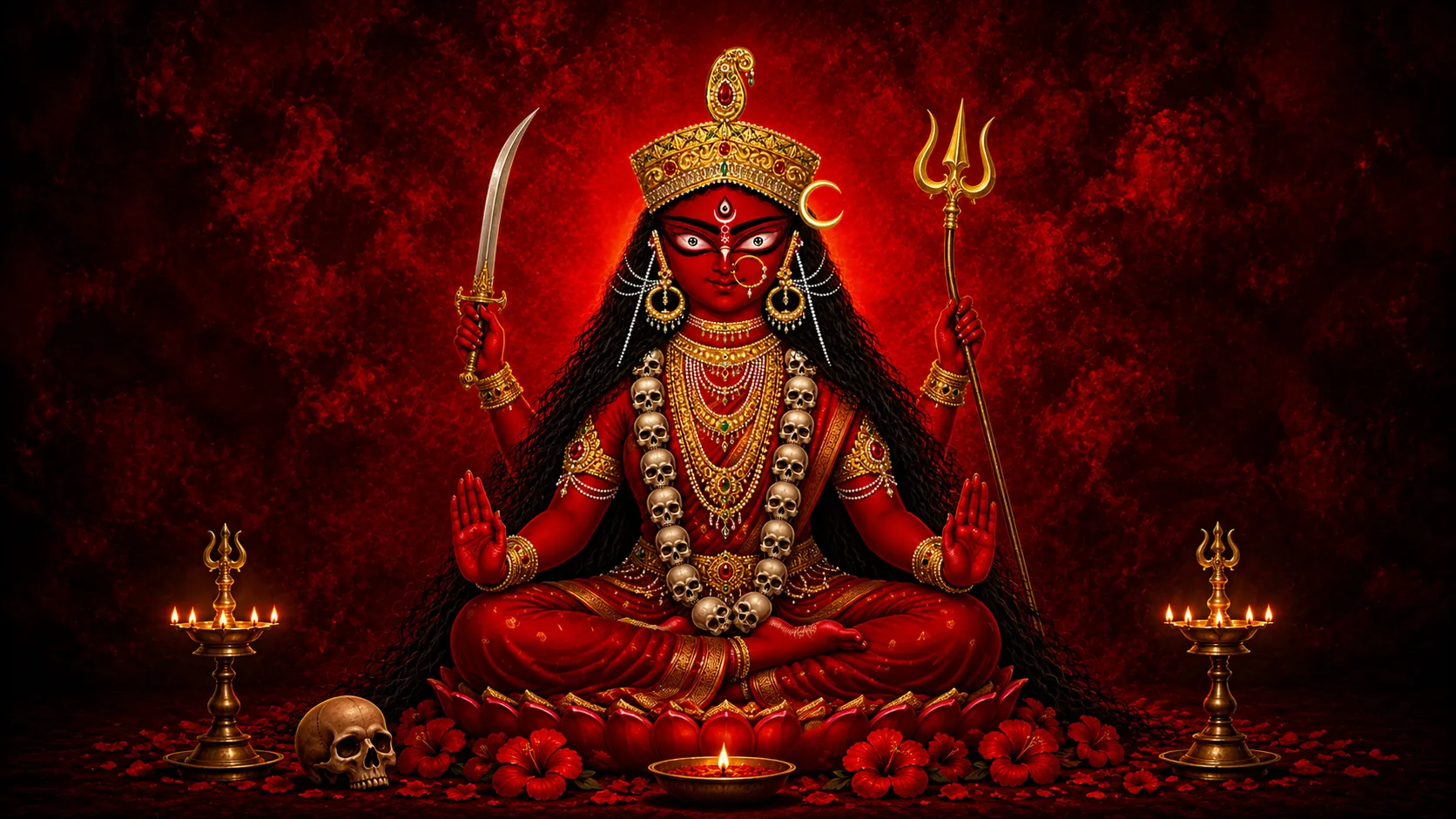
The dhyana (visualization) sloka of the middle episode of the Devi Mahatmya describes Chandika as having 18 arms, each holding a different weapon or sacred object, including a rosary, battle axe, mace, bow, arrow, thunderbolt, lotus, water pot, pestle, spear, sword, shield, noose, bell, wine cup, trident, conch, and discus. Her complexion is compared to coral, and she is seated on a lotus. This iconography reflects not violence for its own sake, but the full range of cosmic powers unified in one being.
6. She absorbs all Shaktis back into herself
In the final battle with Shumbha, when he challenges her by saying she fights with the help of others, Chandika absorbs all the divine Shaktis back into her own body and says: “I am alone in this world. Where is the second besides me? O wicked one, these goddesses are only my own powers, going back into me.” This moment in the Devi Mahatmya is considered one of the most powerful philosophical statements about the nature of non-duality in all of Hindu literature.
Why Chandika’s Story Still Matters
There is a reason the Chandi Path has been recited continuously for over 1,500 years across India and beyond. It is not just a ritual. It is not just tradition. The story maps onto something real in human experience.
Mahishasura, the ego that insists on taking a form that cannot be killed. Raktabija, the self-defeating pattern that multiplies when you try to fight it directly. Shumbha and Nishumbha, the twin delusions of attachment and aversion. Chandika defeats each of them with a different strategy because each requires a different response.
The Chandi Path is, as the tradition says, “a commentary on the evolution of consciousness.” Every battle is also a battle within.
That is why Chandika Jayanti is not simply a day to perform a ritual and move on. It is an invitation to look at what is being defeated within you, and to recognize that the power doing the defeating is not something external. It is the Shakti that already lives inside.
Conclusion:
Chandika Jayanti is one of those observances that becomes more meaningful the more you understand it. The Goddess at its center is not a mythological figure from a distant age. She is described in the Markandeya Purana as one who promised to return whenever the world is oppressed, taking new forms in each age.
The beauty of the Devi Mahatmya is that it leaves open what form that will take. She might come as a warrior. She might come as wisdom. She might come as the quiet recognition that the strength you were looking for was never outside you to begin with.
On Chandika Jayanti, that recognition is worth sitting with.
Frequently Asked Questions
When is Chandika Jayanti in 2026?
Chandika Jayanti 2026 falls on Friday, May 1, 2026. It is observed on the Shukla Purnima (full moon) of the Vaishakha month. The Purnima Tithi begins on April 30 at 9:29 PM IST and ends on May 1 at 11:47 PM IST.
Is Chandika Jayanti the same as Navratri?
No, but the two are connected. Navratri is a nine-night festival observed twice a year (Chaitra and Sharad) during which the Goddess in all her forms, including Chandika, is worshipped. Chandika Jayanti is a specific annual observance on Vaishakha Purnima that celebrates the Goddess Chandika as described in the Devi Mahatmya. Think of Navratri as the extended celebration and Chandika Jayanti as a distinct day of honor.
What is the difference between Chandika and Durga?
In common usage they often refer to the same deity. In scriptural terms, within the Devi Mahatmya, Chandika is the specific name used for the Supreme Goddess, the totality of cosmic feminine power. Durga is one of the forms she takes during the battle with Mahishasura. Chandika is the overarching name; Durga, Kali, Ambika, and Chamunda are aspects or forms that Chandika manifests.
Can I do Chandika puja at home without a pandit?
Yes. The Devi Mahatmya itself states that anyone who reads or recites her stories with faith will receive her grace, regardless of initiation or priestly assistance. The Saptashloki Chandi (seven-verse condensed form) is specifically intended for home worship by any devotee. The step-by-step Puja Vidhi described in this blog can be followed independently.
What should I offer Goddess Chandika on her Jayanti?
Red hibiscus flowers are the most beloved offering for Chandika. Marigolds, jasmine, coconut, seasonal fruits, kumkum, sandalwood paste, and a ghee lamp are all appropriate. For prasad, kheer (rice pudding), panchamrit, and seasonal sweets are traditional. Red cloth or red dupatta can be offered as a symbolic Vastra. Avoid wilted flowers and do not offer tulsi leaves specifically to the fierce forms of the Goddess.
Is fasting mandatory on Chandika Jayanti?
No, fasting is not mandatory. It is a traditional practice of many devotees but it is not a scriptural requirement for observance. Those who cannot fast due to health conditions or other reasons can simply eat sattvic food for the day and perform the puja with full sincerity. The Devi Mahatmya places greater emphasis on the recitation and remembrance of her stories than on physical austerities.
What is the Chandi Path and how long does it take to recite?
The Chandi Path, also known as the Durga Saptashati, is the 700-verse scripture from the Markandeya Purana that forms the scriptural basis of Chandika worship. It contains 13 chapters spread across three Charitras (episodes). A single complete recitation by an experienced reader takes approximately 2.5 to 3 hours. In temples, especially during Chandika Jayanti and Navratri, the full text is recited once a day or in multiple rounds through the night.
Can women recite the Chandi Path?
Yes. There is no scriptural restriction in the Devi Mahatmya against women reciting the text. The Devi Mahatmya is itself a text about the supreme power of the feminine, and many traditions, particularly in Bengal and South India, consider women’s participation in Chandi recitation especially auspicious. Some specific Tantric sadhanas may have different norms, but for general Chandika Jayanti worship, all devotees are welcome.
What is the Navarna Mantra and why is it important?
The Navarna Mantra, Om Aim Hreem Kleem Chamundayai Vichche, is a nine-syllable mantra that is the seed mantra of the entire Chandi Path. The three bija syllables Aim, Hreem, and Kleem represent Saraswati, Lakshmi, and Kali respectively, the three aspects that together constitute Chandika. It is chanted before and after the full Saptashati recitation and is considered the most potent mantra for Chandika worship.
Is Chandika Jayanti celebrated differently across India?
Yes. In West Bengal, Chandika worship through the Chandi Path is central to Durga Puja preparations and the full recitation is done by pandits in many households. In South India, Chandika is worshipped as Chamundeshwari, and her temples in Mysuru are major pilgrimage centers. In Punjab and Himachal Pradesh, Chandi Devi temples observe this day with elaborate rituals. Tantric traditions across India observe it with a Homa. The core observance is the same; the local flavor and temple traditions vary by region.
What is the Chandika Jayanti 2026 significance compared to other years?
May 1, 2026 falls on a Friday, which is the day associated with the Divine Feminine (Shakti). Friday observances for Devi worship are considered especially auspicious across Shakta traditions. The Vaishakha Purnima of 2026 also coincides with Buddha Purnima, making it a day of layered spiritual significance across traditions.
The journey does not end here. Follow MFC on Instagram and Facebook to explore more sacred places, festivals, and living traditions of Sanatan Dharma.