
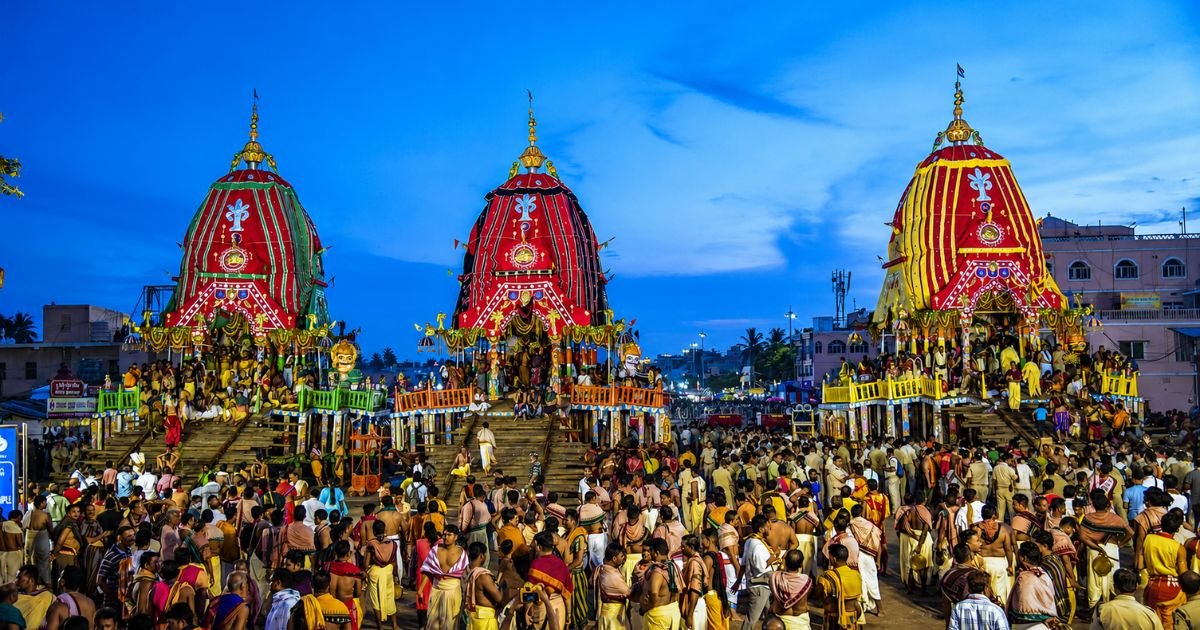
Jagannath Rath Yatra outside Puri is celebrated in over 200 cities across India and the world. In India, Ahmedabad, Mahesh, Baripada, and Kolkata hold the most historic and well-known celebrations.
Globally, ISKCON introduced Rath Yatra around the world starting with San Francisco in 1967, followed by London in 1969. Today, international Rath Yatra celebrations happen across North America, Europe, Australia, and Africa every year.
Some festivals stay rooted to the place where they began. Rath Yatra chose a different path.
Every year, Lord Jagannath leaves His temple and comes out among the people, reminding devotees that no distance is too great when it comes to divine grace. Perhaps that is why this tradition never remained confined to Puri.
Over the centuries, it found a home in new cities, new communities, and eventually, new countries, while preserving the same devotion that has defined it for generations.
In this guide, we’ll explore how Rath Yatra found its way beyond Puri, the places where it is celebrated today, and the unique traditions that make each procession special while keeping the spirit of Lord Jagannath alive.
Why Did Rath Yatra Spread Beyond Puri?
Jagannath Rath Yatra spread beyond Puri because its core message, the Lord coming out to meet everyone, speaks to all people everywhere. Two things drove its expansion. First, Indian communities moving to new cities brought the festival with them. Second, ISKCON’s founder Srila Prabhupada introduced it to the Western world in 1967, turning a single Indian temple tradition into a global event.
The Skanda Purana says that seeing Lord Jagannath on his chariot frees a soul from rebirth. That teaching alone gives millions a reason to celebrate the festival wherever they live. Devotees who could not travel to Puri started their own local celebrations.
Over centuries, this created a second ring of historic Rath Yatra celebrations in India in cities like Mahesh, Baripada, and Ahmedabad. The ISKCON movement then created a third ring around the world. Today, Rath Yatra across India and Rath Yatra around the world together form one of the largest annual religious celebrations on earth.
Rath Yatra Celebrations in India Outside Puri
The most famous Rath Yatra in different states of India are in Mahesh (West Bengal, founded 1396), Baripada (Odisha, temple 1575), Ahmedabad (Gujarat, started 1878), and Kolkata (West Bengal). Each has its own history, its own unique customs, and its own distinct character alongside the shared tradition of three chariots for Lord Jagannath, Balabhadra, and Subhadra.
Mahesh, West Bengal – The Oldest Rath Yatra Outside Puri
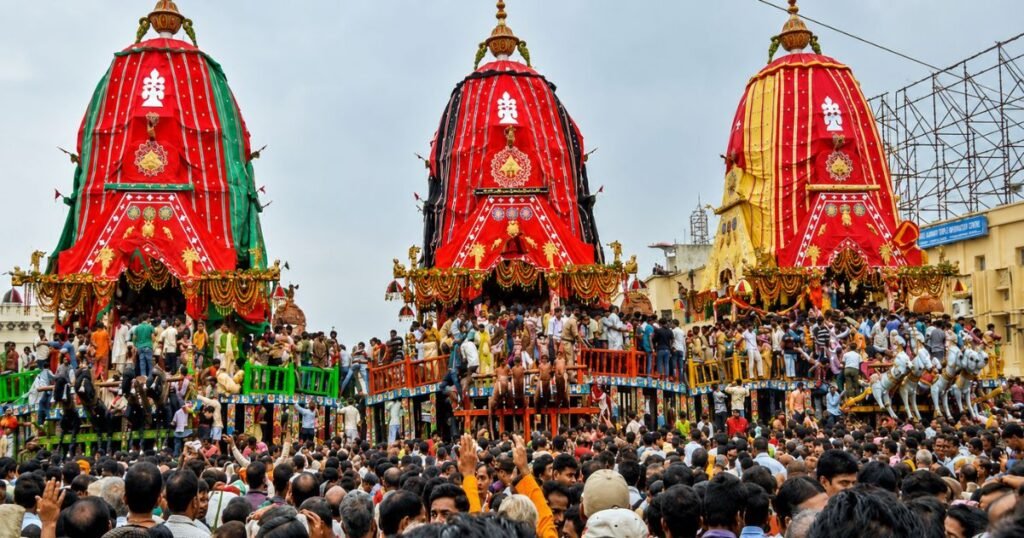
The Rath Yatra at Mahesh in West Bengal is the oldest Jagannath Rath Yatra outside Puri. It started around 1396 CE, over 630 years ago. Saint Dhruvananda Brahmachari first carved and installed the deities at this site. The procession has run every year since without interruption, alongside the Ganges River.
- Place: Mahesh, Hooghly District, West Bengal
- Founded: Around 1396 CE
- Founded by: Saint Dhruvananda Brahmachari
- Location: Near Serampore, Hooghly District
- Standing as of 2026: About 630 years of continuous celebration
- Unique feature: The procession runs along the banks of the Ganges River
Mahesh sits near Serampore in the Hooghly district of West Bengal. The Jagannath temple there ranks among the largest dedicated to Lord Jagannath anywhere outside Odisha. Devotees from all across Bengal travel here each year.
The riverbank setting gives the Mahesh famous Rath Yatra in India a character completely different from any other, the sound of the river, the smell of the Ganges, and the sight of giant chariots moving alongside water creates an atmosphere that has drawn pilgrims for more than six centuries.
Baripada, Odisha – Where Only Women Pull Subhadra’s Chariot
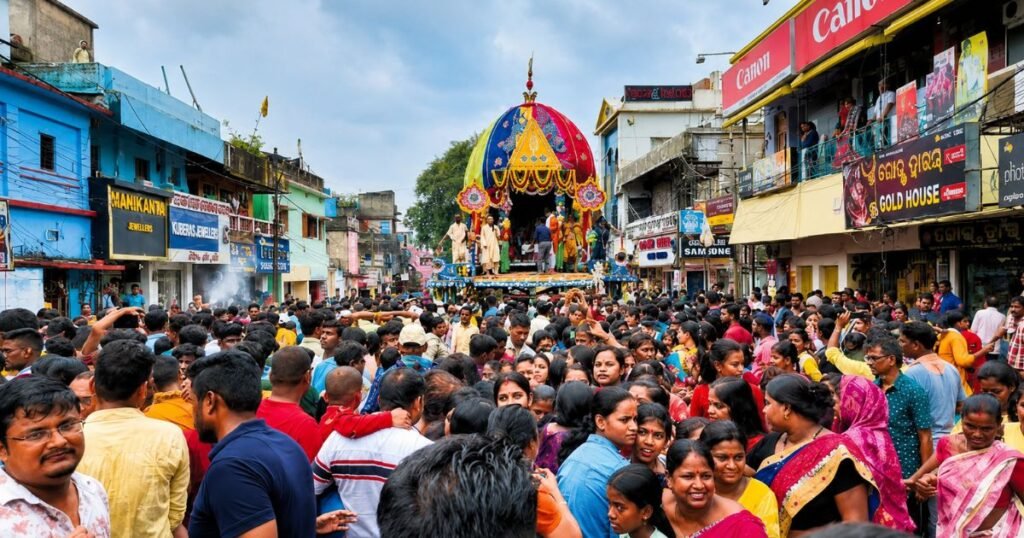
Baripada in Odisha holds the Rath Yatra with one rule found nowhere else in the world: only women pull Goddess Subhadra’s chariot. This tradition started in 1975, during the International Women’s Year. It has continued every year since. Local people call Baripada “Dwitiya Srikhetra”, the second sacred site of Lord Jagannath after Puri.
- Place: Baripada, Mayurbhanj District, Odisha
- Temple founded: Around 1575 CE, by King Baidyanath Bhanj
- Local name: Dwitiya Srikhetra (second sacred Jagannath site after Puri)
- Unique feature: Only women pull Goddess Subhadra’s chariot, a tradition since 1975
- Timing: Usually a day after the main Puri Rath Yatra
This is one of the most unique Rath Yatra in different states features you will find anywhere in India. At every other celebration, all devotees pull all three chariots together. At Baripada, men can pull the chariots of Lord Jagannath and Balabhadra. But Subhadra’s chariot belongs to the women of Baripada.
They grip the rope and pull it themselves, with pride and devotion. The tradition honours both the goddess and the principle of equal participation. It began in 1975, but the feeling it carries is as old as the Jagannath tradition itself.
Ahmedabad, Gujarat – The Second Largest Rath Yatra in India
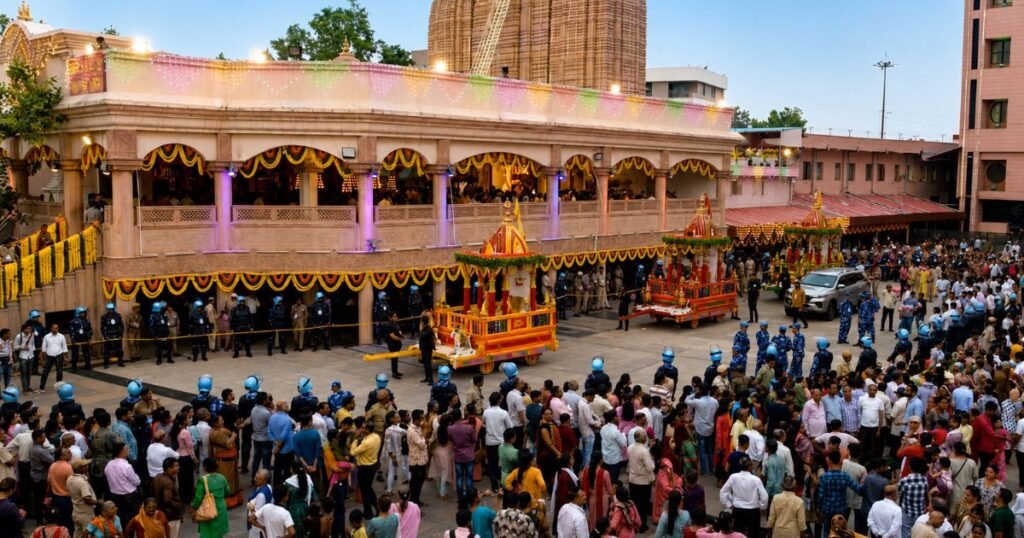
Ahmedabad holds the second largest Rath Yatra celebrations in India after Puri. It started in 1878 when Mahant Narsinhdasji, inspired by his pilgrimage to Puri, began a local procession at the Jamalpur Jagannath Mandir. Today, the route runs about 16 to 18 km through Ahmedabad’s old walled city, with decorated elephants, 100 tableau trucks, and over 10 lakh devotees lining the streets.
- Started: 1878, by Mahant Narsinhdasji
- Temple: 400-year-old Jagannath Mandir, Jamalpur area
- Route length: About 16 to 18 km through the old walled city
- Procession features: 15 to 18 decorated elephants, 100 tableau trucks, 30 akharas
- Key stop: Saraspur – the deities’ symbolic “aunt’s house,” where a grand feast is held
- Pahind Vidhi: Performed by the Gujarat Chief Minister (mirrors the Gajapati King’s sweeping ritual in Puri)
- Returns: Around 8:30 PM
- 2025 attendance: Over 10 lakh devotees
- 2026 date: Thursday, July 16 – same day as Puri
The Ahmedabad Jagannath Rath Yatra in India has its own beautiful local identity. The Gujarat Chief Minister performs the Pahind Vidhi, a ceremonial sweeping of the path before the chariots move, which mirrors the Chhera Panhara ritual performed by the Gajapati King in Puri.
The procession stops at Saraspur, which the Ahmedabad tradition calls the deities’ maternal aunt’s home, for a grand community feast. The chariots then return to Jamalpur by 8:30 PM, completing a full day’s journey through the heart of one of India’s oldest living cities.
In 2025, Ahmedabad deployed 23,884 security personnel and 3,500 CCTV cameras for the procession, a scale that shows how seriously both the state and the community take this celebration today.
| Sources: incredibleindia.gov.in (official Incredible India portal); DD News Government of India; The Hawk news feature (June 2025); Temples.bio Ahmedabad Rath Yatra 2026 guide. |
Kolkata, West Bengal – Where Two Traditions Celebrate Together
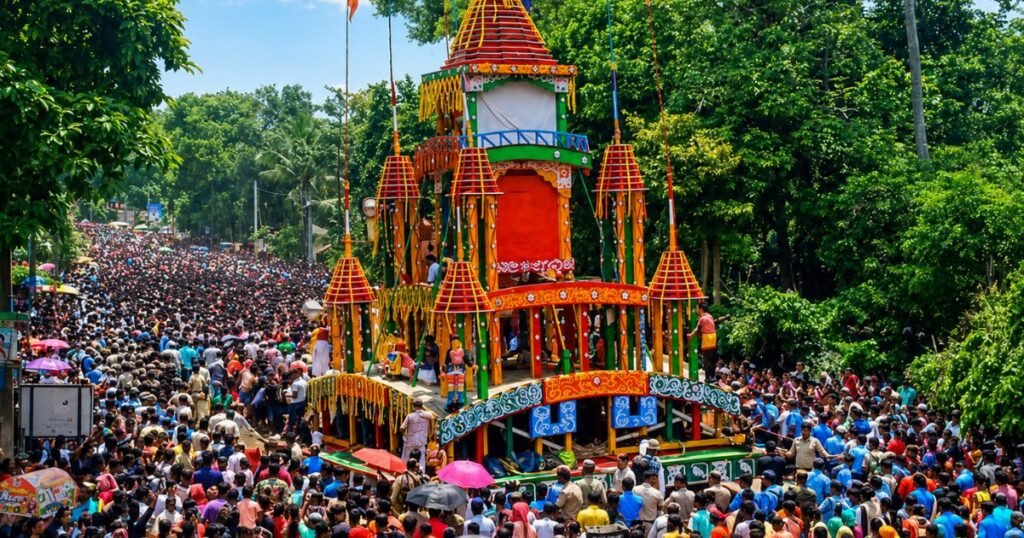
- Place: Kolkata, West Bengal
- Traditions: Traditional Bengali Jagannath temples + ISKCON Kolkata
- ISKCON procession: One of the largest ISKCON-led Rath Yatras in India
- Character: Kirtan-led procession with thousands of chanting devotees
Kolkata celebrates Jagannath Rath Yatra through two streams. The older Bengali temples in the city have run their own neighbourhood processions for generations. The ISKCON Kolkata centre organizes one of the largest ISKCON-led processions in all of India, drawing thousands of devotees who chant the Hare Krishna mahamantra through Kolkata’s streets. The two streams together fill Kolkata with Rath Yatra energy every year on the same day as Puri.
Other Indian Cities That Celebrate Rath Yatra
| City | State | Character of the celebration |
| Mumbai | Maharashtra | ISKCON Juhu organizes one of Maharashtra’s largest Rath Yatras, ending with a large prasadam distribution at the beach. |
| Delhi | Delhi | ISKCON Delhi (Dwarka) holds an annual procession through the city’s broad streets. |
| Surat | Gujarat | A large and growing celebration that mirrors Ahmedabad’s tradition, with decorated chariots and community participation. |
| Cuttack | Odisha | One of Odisha’s oldest cities. Its Rath Yatra has its own long history and large local following. |
| Rourkela | Odisha | A significant Rath Yatra celebration in industrial Odisha, with growing annual participation. |
| Hyderabad | Telangana | ISKCON Hyderabad holds an annual procession with kirtan, prasadam, and cultural programs. |
How ISKCON Made Rath Yatra International?
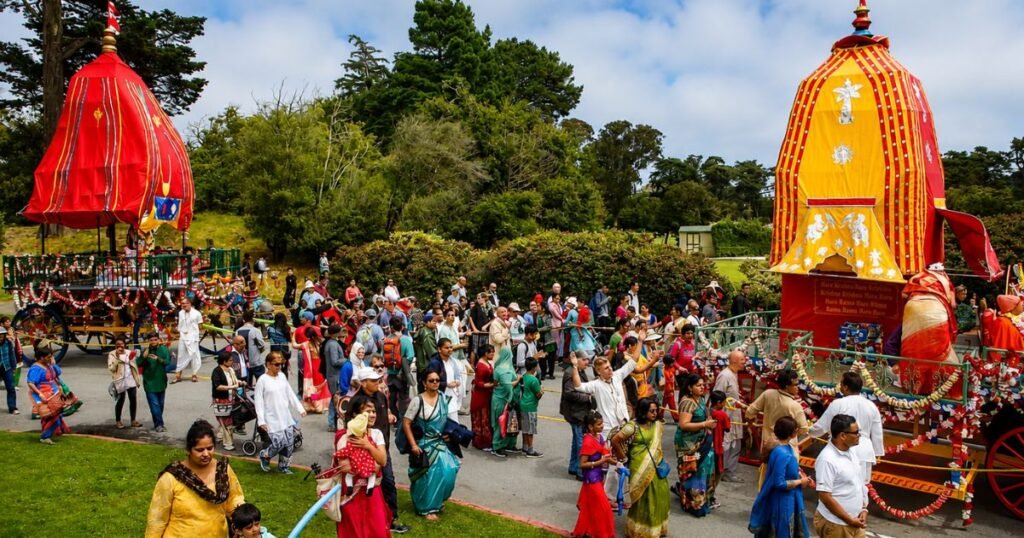
ISKCON’s founder Srila A.C. Bhaktivedanta Swami Prabhupada organized the first Rath Yatra abroad in San Francisco in 1967. He believed that Lord Jagannath belonged to every person, everywhere, not just in Puri or India.
From that one flatbed truck in San Francisco, the international Rath Yatra celebrations grew into festivals in over 200 cities across the world. Today they happen every summer, from London to Sydney to New York to Durban.
Srila Prabhupada grew up celebrating Rath Yatra. His father arranged a small home chariot for him when he was a child. He pulled it through his neighbourhood and distributed prasadam to all the children who joined.
Decades later, as a 69-year-old man who had arrived in New York on a cargo ship with very little, he sat in his room above Frederick Street in San Francisco’s Haight-Ashbury district and had an idea. He asked his young American disciples to build a chariot and take Lord Jagannath through the streets of San Francisco.
What happened next changed the history of this festival forever.
| Source: ISKCON.org official history; ISKCON Berkeley and Sacramento official websites. |
San Francisco, USA – The First Rath Yatra Abroad
| First celebrated | July 9, 1967 – San Francisco, California, USA |
| Organized by | Srila A.C. Bhaktivedanta Swami Prabhupada (ISKCON founder) |
| First chariot | A single flatbed truck decorated with flowers and fabric |
| First crowd | More than 500 people followed the procession to the beach |
| Temple renamed | Srila Prabhupada named the San Francisco ISKCON temple “New Jagannatha Puri” |
| Route | Through Golden Gate Park to the ocean |
The 1967 Story: Srila Prabhupada looked out of his window at Frederick Street in Haight-Ashbury and decided this was the right place and the right moment. He asked his disciples to do three things: organize a procession, distribute prasadam, and chant Hare Krishna throughout.
Two devotees, Mukunda and Syamasundara, got to work. They decorated a 2.5-ton flatbed truck with flowers and fabric and placed the small deities of Jagannath, Balabhadra, and Subhadra on it.
The women cooked chapattis all day. The devotees prepared Hare Krishna balloons to release on the streets. When the procession moved through the park and reached the beach, over 500 people had followed.
In a letter dated July 11, 1967, Srila Prabhupada wrote to a disciple: “The Rathayatra Festival was performed with great pomp. More than 500 people followed the procession to the beach.“
After the festival, he renamed the ISKCON San Francisco temple “New Jagannatha Puri” in honour of this moment. It was a statement: the Lord’s home is not just in Odisha. He lives wherever his devotees call him.
| Source: Srila Prabhupada’s letter dated July 11, 1967 (cited in ISKCON Berkeley and Festivalofindia.org); ISKCON.org official history. |
London, UK – Europe’s Largest Rath Yatra
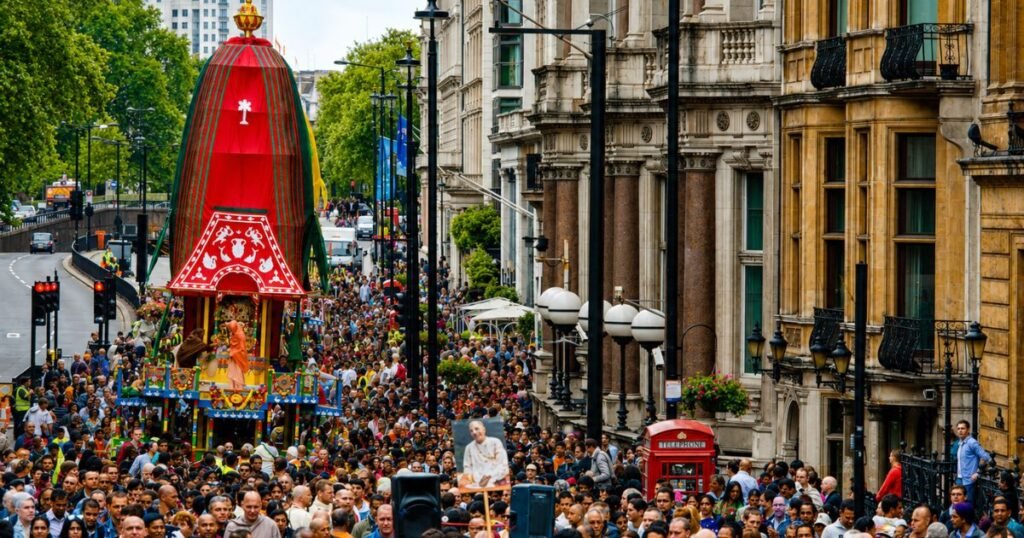
London’s Rath Yatra started in 1969, just two years after San Francisco. Eight pioneering ISKCON devotees organized the first procession from Marble Arch to Trafalgar Square. The event has run every year since. As of 2026, it is 57 years old and holds the title of Europe’s largest Rath Yatra procession, distributing over 16,000 plates of free prasadam and drawing thousands from across the UK and Europe.
| First celebrated | 1969, London, United Kingdom |
| Organised by | 8 pioneering devotees and their congregation |
| First route | Marble Arch to Trafalgar Square |
| Current route | Hyde Park to Trafalgar Square |
| Years running | 57 years as of 2026 |
| Prasadam | Over 16,000 plates distributed free at recent editions |
| Standing in Europe | Europe’s largest Rath Yatra procession |
| Notable attendance | Indian High Commissioner to the UK attended recently |
Shyamasundar Dasa built the first London chariot and carved the deities of Lord Jagannath, Balabhadra, and Subhadra with his own hands for that 1969 procession. National newspapers ran headlines like “Krishna Chant Startles London.”
Srila Prabhupada himself attended the 1973 London Rath Yatra at age 74. He chanted and danced throughout the entire procession, refusing the elegant seat offered to him on the chariot.
He looked out at thousands of people chanting the Hare Krishna mahamantra in Trafalgar Square and said this was the fulfillment of Lord Chaitanya’s prophecy: the holy name being heard in every town and village.
| Source: History – Rathayatra UK (ISKCON London official Rath Yatra history site); ISKCON News (iskconnews.org), 57 Years London Rathayatra report. |
Rath Yatra Around the World: Other Countries
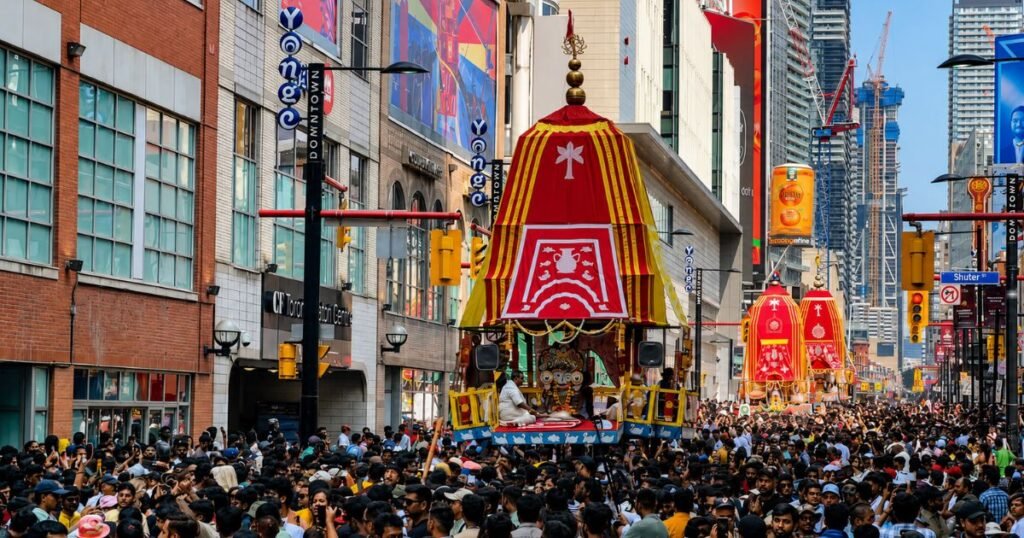
Jagannath Rath Yatra abroad now happens in over 200 cities across every inhabited continent. After San Francisco (1967) and London (1969), the festival spread rapidly through the 1970s to North America, Australia, and South Africa. Today every country in the world has at least one ISKCON centre that celebrates the festival annually.
| Country | City | Notable feature |
| USA | San Francisco | The original Western Rath Yatra (1967). Three full-sized wooden chariots pulled to the ocean, followed by a Festival of India in a park. |
| USA | New York | Procession on prestigious Fifth Avenue. One of the most visible Rath Yatras in the Western world. |
| UK | London | Europe’s largest. Hyde Park to Trafalgar Square. 57 years running. Over 16,000 plates of free prasadam distributed. |
| Canada | Toronto | One of the largest Rath Yatras outside India, drawing tens of thousands of participants from the large Indo-Canadian community. |
| Australia | Sydney | ISKCON Sydney holds an annual procession through the city, followed by a festival in Hyde Park. |
| South Africa | Durban | A large Indian-origin community makes Durban one of Africa’s biggest Rath Yatra cities. The festival reflects both the ISKCON tradition and the local South African Indian heritage. |
| France | Paris | Srila Prabhupada himself participated in the Paris Rath Yatra. Annual procession through the French capital. |
| Japan | Tokyo | Regular ISKCON Rath Yatra procession in the Japanese capital. Cited by Srila Prabhupada in his 1970 lecture as one of the global celebrations running that year. |
| Mauritius | Port Louis | Large Indian-origin community. Significant annual Rath Yatra reflecting centuries of cultural connection to Jagannath worship. |
| Sources: ISKCON.org official history; ISKCON Bangalore blog; rathayatra.co.uk official history (which confirms over 200 cities worldwide); Srila Prabhupada’s lecture, July 5, 1970, San Francisco (confirming simultaneous festivals in San Francisco, London, Buffalo, Melbourne, Tokyo). |
Famous Rath Yatra in India and Outside of India
| Location | Started | Scale | Unique feature |
| Puri, Odisha | Centuries old | The largest in the world | Original festival. Gajapati King sweeps the chariots. |
| Mahesh, West Bengal | Around 1396 | Large, historically significant | Oldest Rath Yatra outside Odisha. Runs beside the Ganges. |
| Baripada, Odisha | Temple: 1575 | Major state celebration | Only women pull Subhadra’s chariot (since 1975). |
| Ahmedabad, Gujarat | 1878 | Second largest in India | Chief Minister performs Pahind Vidhi. 18 elephants, 100 floats. |
| Kolkata, West Bengal | Multiple traditions | Large ISKCON and traditional | Two parallel traditions: local Bengali temples + ISKCON. |
| San Francisco, USA | 1967 | First in the Western world | Started by Srila Prabhupada on a decorated flatbed truck. |
| London, UK | 1969 | Europe’s largest | Hyde Park to Trafalgar Square. 57 years unbroken. |
| Toronto, Canada | ISKCON era | One of the largest outside India | Large Indo-Canadian community. Thousands march annually. |
What Is the Same in Every Rath Yatra Celebration?
Every Rath Yatra celebration around the world, whether in Puri or Paris, shares three things: the three deities of Lord Jagannath, Balabhadra, and Subhadra traveling on chariots; devotees pulling the ropes together; and free prasadam (food) shared with everyone who comes.
The procession, the rope, and the shared meal are the three common threads that connect every celebration on every continent.
The scale changes. The language of the chants changes. The weather changes. But the heart stays the same everywhere. Lord Jagannath steps out from behind his doors and travels through the streets so that every person, rich or poor, Hindu or not, from any background, can see him and receive his blessing.
That one idea has crossed oceans and taken root in over 200 cities. No translation is needed for what it means.
Final Thought
More than many centuries ago, Lord Jagannath’s chariot rolled through the streets of Puri. Today, that same journey continues far beyond the city where it began.
Every year, Rath Yatra outside Puri brings together millions of devotees across India and the world. Some gather along the banks of the Ganges in Mahesh. Others wait on the streets of Ahmedabad, Kolkata, London, Toronto, or San Francisco. The languages may be different, the routes may change, and every city may add its own traditions, but the devotion remains instantly familiar.
Perhaps that is what makes Jagannath Rath Yatra outside Puri so remarkable. It never lost its roots, even as it found new homes across continents. Every chariot that moves, every rope that is pulled, and every plate of prasadam that is shared carries forward a tradition that has connected people for centuries.
No matter where Rath Yatra celebrations in India or the international Rath Yatra celebrations take place, they all remind us of one timeless belief. When Lord Jagannath steps out to meet His devotees, no place feels too far from Puri.
Frequently Asked Questions
The most notable celebrations are in Mahesh (West Bengal, since 1396), Baripada (Odisha, temple since 1575), Ahmedabad (Gujarat, since 1878), Kolkata (West Bengal), Mumbai, Delhi, Surat, and Hyderabad.
Mahesh in West Bengal. It started around 1396 CE, over 630 years ago, founded by Saint Dhruvananda Brahmachari.
Ahmedabad, Gujarat. It started in 1878 and now draws over 10 lakh devotees annually. The procession covers 16 to 18 km through the old walled city.
San Francisco, USA, on July 9, 1967. Srila Prabhupada organized it with his young ISKCON disciples. Over 500 people followed the procession to the beach.
The UK and Canada are both known for very large celebrations. London’s ISKCON Rath Yatra (running since 1969) is Europe’s largest. Toronto’s is one of the largest anywhere outside India.
ISKCON’s Rath Yatra began in San Francisco in 1967. London followed in 1969. By 1970, simultaneous festivals were running in San Francisco, London, Buffalo, Melbourne, and Tokyo.
Over 200 cities celebrate ISKCON Rath Yatra every year, according to ISKCON’s official records. The festival now happens on every inhabited continent.
Only women pull Goddess Subhadra’s chariot at Baripada. This tradition began in 1975 during the International Women’s Year and has continued every year since.
Yes. Ahmedabad, like all other Rath Yatra celebrations in India, follows the same Hindu Panchang tithi as Puri. In 2026, both fall on Thursday, July 16.
Eight pioneering ISKCON devotees organized London’s first Rath Yatra in 1969. Shyamasundar Dasa built the first chariot and carved the deities of Lord Jagannath, Balabhadra, and Subhadra for that occasion.
Three things: the three deities of Lord Jagannath, Balabhadra, and Subhadra on chariots; devotees pulling the ropes together; and free prasadam shared with everyone who comes.
The journey does not end here. Follow MFC on Instagram and Facebook to explore more sacred places, festivals, and living traditions of Sanatan Dharma.