
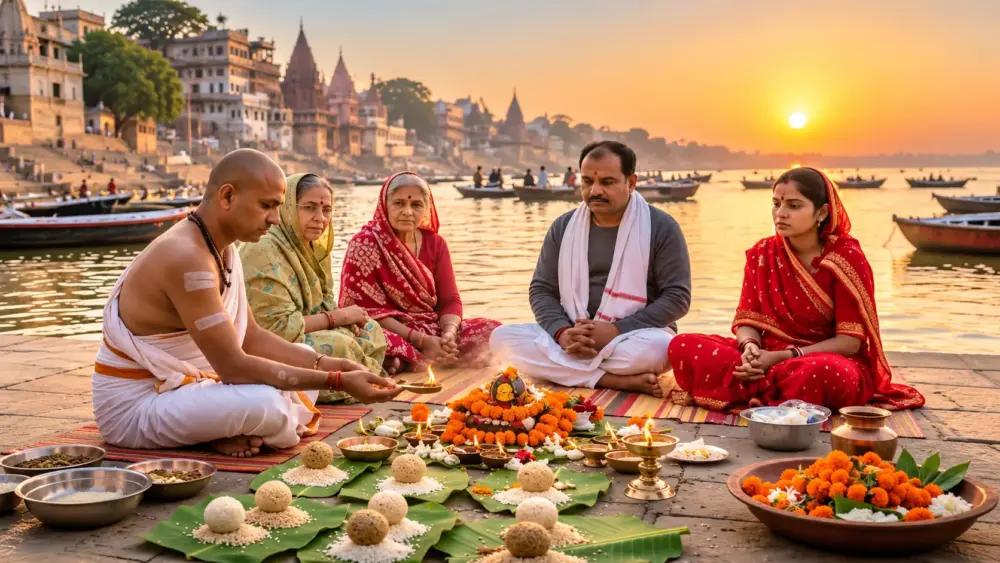
Pitru Paksha 2026 runs from September 26 to October 10. The most important day is Sarva Pitru Amavasya on October 10, when Shradh can be performed for any ancestor, regardless of the exact date they passed away.
Every year, for sixteen days, millions of Hindus pause their celebrations and turn toward their ancestors. This is Pitru Paksha. In 2026, this fortnight begins on Saturday, September 26 with Purnima Shraddha and ends on Saturday, October 10 with Sarva Pitru Amavasya, also called Mahalaya Amavasya.
So, if you have ever wondered why your parents stop buying new clothes in late September, or why your father suddenly starts feeding crows on the terrace, this blog answers it all. We cover the exact 2026 dates, the real meaning behind Shradh, how to perform Tarpan and Pind Daan at home, what to eat and avoid, and what respected saints like Premanand Maharaj have said about honoring our Pitrs.
What Is Pitru Paksha? Meaning of Shradh Explained
Pitru Paksha are two Sanskrit words. “Pitru” means ancestors or forefathers. “Paksha” means a fortnight, a period of about fifteen lunar days. Put together, it means the fortnight of the ancestors.
This period also has other names depending on where you live in India. For instance, in Rajasthan and Haryana, people call it Kanagat. In Bengal, Odisha, and Assam, it is Pitri Pokkho or Mahalaya Paksha. Some traditional texts refer to it as Apara Paksha, and in certain regions it is known as Sola Shradh, meaning the sixteen days of Shradh. The name changes, but the intent stays the same everywhere: to remember and repay the debt we owe our ancestors.
To be honest, Shradh itself is not one single ritual. It is a set of ceremonies performed with faith (shraddha, from which the word comes) for a departed soul. The Garuda Purana and Markandeya Purana both describe Shradh as an act that provides nourishment to ancestors in the afterlife, since they can no longer eat or drink in the physical sense.
So, what does Pitru Paksha mean? Pitru Paksha is a 16-day period in the Hindu lunar calendar, falling in the Krishna Paksha (waning moon fortnight) of Bhadrapada and Ashwin months, dedicated to performing Shradh, Tarpan, and Pind Daan for one’s deceased ancestors.
What is the Significance of Pitru Paksha?
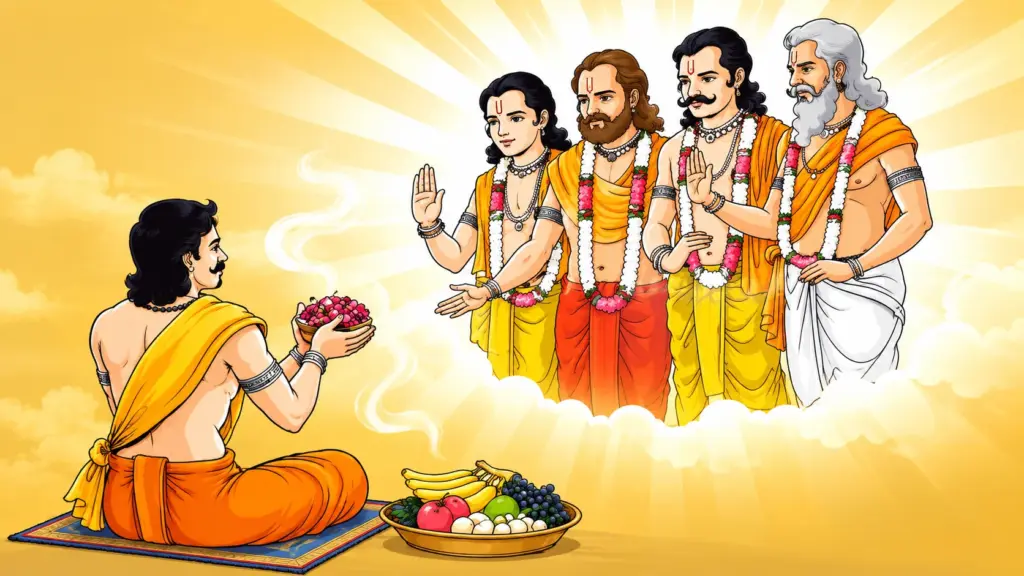
Hindu philosophy says that every person is born with three debts, called Rin. You owe a debt to the sages who gave you knowledge (Rishi Rin), a debt to the gods who sustain the universe (Deva Rin), and a debt to your ancestors who gave you life (Pitru Rin). Pitru Paksha exists specifically to repay Pitru Rin.
This concept comes straight from the Manu Smriti and other Dharma Shastra texts, which lay out detailed rules for how a householder should conduct Shradh for his father, grandfather, and great-grandfather. The logic is very simple and grounded: your ancestors gave you your body, your bloodline, and your place in the world. Feeding them, even symbolically, is a way of saying thank you.
The significance of shraddh is also psychological here. Pitru Paksha gives grieving families a structured, repeated occasion to remember those they lost. Instead of grief becoming a private, isolated burden, it becomes a shared, annual ritual. Swami Sivananda often spoke about Shradh in exactly this way, describing it as a discipline that keeps the memory of one’s elders alive rather than letting time erase them.
What is the Purpose of Pitru Paksha (Shradh)?
The purpose of Shradh is to help the ancestor’s soul to detach from earthly bonds and move easily towards higher realms. Shradh also helps in removing any obstacle that may have arise due any unfulfilled wish or duties, so that soul can continue their afterlife journey without any obstruction.
What’s the Connection Between Pitru Paksha and Karma?
Hinduism does not see death as an ending. It sees it as a transition. After death, a soul moves through different stages before reaching Pitru Loka, the realm of ancestors, or moving on toward further rebirth or maybe attain moksha.
Shradh rituals directly affect how smoothly this transition happens. When performed with sincerity, Tarpan and Pind Daan are said to give the departed soul the strength (in a subtle, non-physical sense) to move past Pitru Loka and progress further.
Skipping these rituals, according to tradition, can leave a soul in an unsettled state, which is one root explanation of Pitru Dosha, which you may have heard about many times. We cover it in detail later in this blog.
This is also connected to karma in a second way. Performing Shradh is itself a karmic act for the living person. It generates punya (merit) for the person who performs it with devotion, not just for the ancestor receiving it. This is why texts describe Shradh as beneficial for both sides: the one who gives and the one who receives.
Where did this Concept of Pitru Paksha or Shradh Rituals Come From?
Pitru Paksha is not a regional folk. It has clear scriptural roots across several major texts.
The Garuda Purana, one of the eighteen Maha Puranas, dedicates entire chapters to describing what happens to the soul after death and how Shradh helps it on its journey. The Markandeya Purana contains a widely cited verse on the benefits of Shradh:
आयुः प्रजां धनं विद्यां स्वर्गं मोक्षं सुखानि च।
प्रयच्छन्ति तथा राज्यं पितरः श्राद्धतर्पितः॥
Meaning: “Ancestors, when satisfied through Shradh, grant long life, progeny, wealth, knowledge, heaven, liberation, happiness, and even kingship.” This verse appears widely across Dharma Shastra commentaries and Puranic literature on Pitru Karma.
The Manu Smriti lays out the practical side. It specifies that Shradh should ideally be performed during the Aparahna Kaal, the early afternoon period, and describes which family members are eligible to perform it. The Mahabharata, in its Anushasana Parva, also has a section where Bhishma explains the origin and importance of Shradh to Yudhishthira while lying on his bed of arrows.
These are mainstream, widely available texts, which is exactly why Pitru Paksha continues to be observed with such consistency across regions and centuries.
When is Pitru Paksha 2026? Dates and Tithis
When is Pitru Paksha 2026? Pitru Paksha 2026 begins on September 26 and ends on October 10. Sarva Pitru Amavasya, the most important day of the fortnight, falls on October 10, 2026. Here is a list of full Pitru Paksha Tithis:
Pitru Paksha 2026 Full Tithi Calendar
| Tithi | Date (2026) | Day |
| Purnima Shraddha | September 26 | Saturday |
| Pratipada Shraddha | September 27 | Sunday |
| Dwitiya Shraddha | September 28 | Monday |
| Tritiya Shraddha | September 29 | Tuesday |
| Chaturthi Shraddha | September 30 | Wednesday |
| Panchami Shraddha | October 1 | Thursday |
| Shashthi Shraddha | October 2 | Friday |
| Saptami and Ashtami Shraddha | October 3 | Saturday |
| Navami Shraddha (Matru Navami) | October 4 | Sunday |
| Dashami Shraddha | October 5 | Monday |
| Ekadashi Shraddha | October 6 | Tuesday |
| Dwadashi Shraddha | October 7 | Wednesday |
| Trayodashi Shraddha | October 8 | Thursday |
| Chaturdashi Shraddha (for accidental/violent deaths) | October 9 | Friday |
| Sarva Pitru Amavasya (Mahalaya Amavasya) | October 10 | Saturday |
Important Suggestion: Shradh is performed on the tithi (lunar date) matching the day the ancestor passed away, not the English calendar date. If you don’t know the exact tithi, Sarva Pitru Amavasya on October 10 covers every ancestor, known or forgotten.
Why Sarva Pitru Amavasya is Most Important?
Sarva Pitru Amavasya is important because of all sixteen days, it carries the most weight. This is the day set aside for every ancestor at once: the ones whose death tithi you know, the ones you’ve forgotten, and even ancestors who died in ways that make their tithi hard to trace, like sudden accidents.
Because of this, many families who cannot perform Shradh on all fifteen or sixteen individual days choose to do a single, complete ritual on Amavasya. Pandits at Gaya, Kashi, and Prayagraj see their heaviest footfall on exactly this day, since it is considered spiritually equivalent to performing Shradh on the correct tithi for anyone you might have missed.
What is the Impact of Pitru Paksha in Kaliyug?
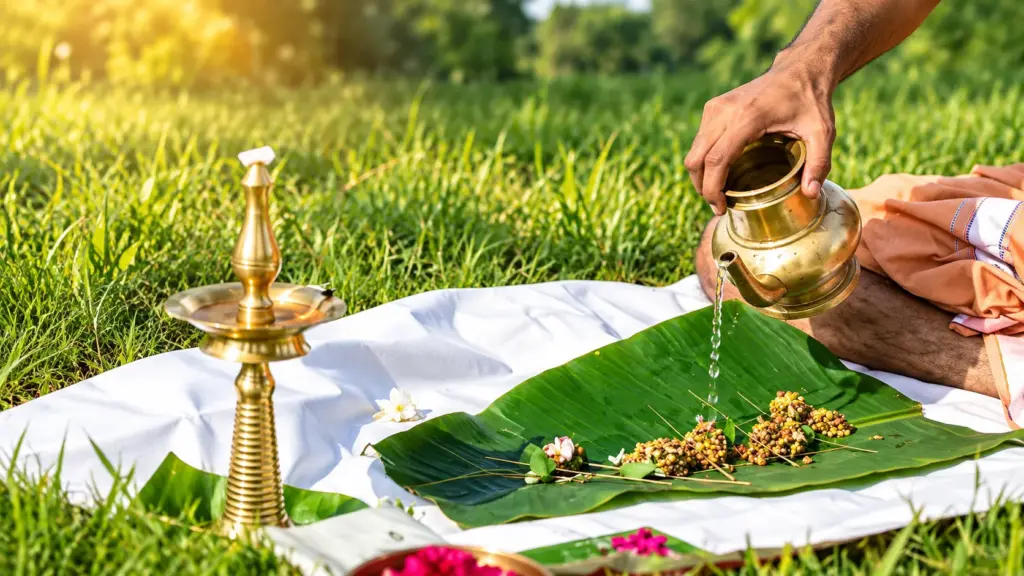
A question that always surfaces especially in younger people: do these rituals really matter in Kaliyug? Because kaliyug is known as the age of massive spiritual decline. Many Rishi and reformers have addressed this directly. But yes, Pitru Paksha does matter and it’s impact is also massive.
Premanand Maharaj, a very grounded and popular saint based in Vrindavan, has spoken about kaliyug. He says simple acts of devotion carry enormous weight in kaliyug precisely because people’s capacity for elaborative ritual and deep tapasya has weakened.
What does that mean? It means, in Kaliyug, may souls get stuck in Pitra lok because of their attachment to earthly wants, these souls are unable to move on. So, out of love, rituals such as Shradh, help these souls move on.
And due to the impact of kaliyug and it’s spiritual decline, you don’t need to do very elaborative and lengthy rituals. Doing simple shradh is enough to give your ancestors freedom to move on with rebirth.
Stories of Shradh/Pitru Paksha
Two stories are told again and again to explain why Shradh is important, and both come from the Mahabharata.
The first is the story of Karna. After Karna’s death in the great war, his soul reached heaven and was offered gold and jewels as food, since that is what he had donated during his life. But he had never performed Shradh for his own ancestors and had no food to eat, since he had given no food-based charity.
Lord Indra explained the gap to him, and Karna was sent back to earth for a period to perform proper Shradh and Tarpan for his forefathers, after which he was allowed to eat in Pitru Loka. This story is the most commonly cited origin narrative for why Pitru Paksha exists at all.
The second is the story of Nachiketa from the Katha Upanishad, where a father’s careless words during a Yajna lead his son to question death itself. While this story is more famous for its exploration of Atma and Yama, it is often referenced alongside Shradh legends because it deals with the same core theme: what a person owes their family, and what happens when that obligation is dismissed thoughtlessly.
What Is Pitru Dosha in Kundali?
Pitru Dosha is an astrological condition in Vedic astrology believed to occur when ancestors’ souls remain unsatisfied or restless, often because proper Shradh was not performed for them, or because they died in an unnatural or untimely way.
In a birth chart (Kundali), Pitru Dosha is typically checked through the position and affliction of the Sun, particularly in the ninth house, which represents the father and ancestral line. harmful influences from Rahu, Ketu, or Saturn on this house are commonly read as indicators.
Astrological Indications of Pitru Dosha
Astrologers generally look for a few specific combinations. Rahu or Ketu sitting with the Sun in the ninth house is one of the most commonly cited markers. A weak or afflicted Sun in the birth chart overall is another. Some traditions also read Saturn’s aspect on the ninth house as a sign worth investigating further.
It’s worth being direct here: Pitru Dosha is not a diagnosis every family needs to fear. Millions of birth charts show some affliction to the ninth house without any real disturbance in daily life. A qualified astrologer should always confirm this reading rather than assuming it from a single detail.
Spiritual Cause Behind Pitru Dosha
Beyond astrology, the spiritual explanation ties directly back to what we discussed earlier. If Shradh has been skipped for generations, if an ancestor died a violent or sudden death, or if there was serious unresolved conflict within a family before someone passed away, tradition holds that this creates a kind of residue that affects descendent
What is the Impact of Pitru Dosha on Life?
Families who consult astrologers about persistent, unexplained problems are often told to check for Pitru Dosha. The reported effects generally fall into a few clear patterns, which we break down below.
Signs and Symptoms of Pitru Dosha
Common signs people associate with Pitru Dosha include repeated delays in marriage, unexplained health issues that don’t respond well to treatment, a general sense of stagnation despite hard work, and recurring nightmares involving deceased family members. None of these symptoms are exclusive to Pitru Dosha on their own, which is why astrologers insist on reading the full chart rather than jumping to conclusions from one or two signs.
Impact on Children and Family Lineage
A commonly cited belief is that Pitru Dosha can affect a family’s ability to have children, or can show up as behavioral or health struggles in children specifically. This belief is one reason Pind Daan is treated as urgent by families facing such difficulties, since it is seen as directly addressing the ancestral line.
Financial Struggles Linked to Pitru Dosha
Persistent financial instability, despite reasonable effort and opportunity, is another pattern astrologers connect to this dosha. The idea is that blocked ancestral blessings translate into blocked material flow for descendants.
Recurring Problems and Instability
Beyond specific categories, many families describe a general feeling that nothing sticks, where jobs, relationships, or plans keep falling apart for no clear reason. This vague but persistent instability is often what finally pushes a family to consult a priest or astrologer about Pitru Dosha.
Health and Marriage Concerns
Health issues that move between family members in unusual patterns, and repeated delays or failures in marriage proposals, round out the most commonly reported effects. These should be evaluated by a professional rather than self-diagnosed.
Remedies and Nivaran for Pitru Dosha
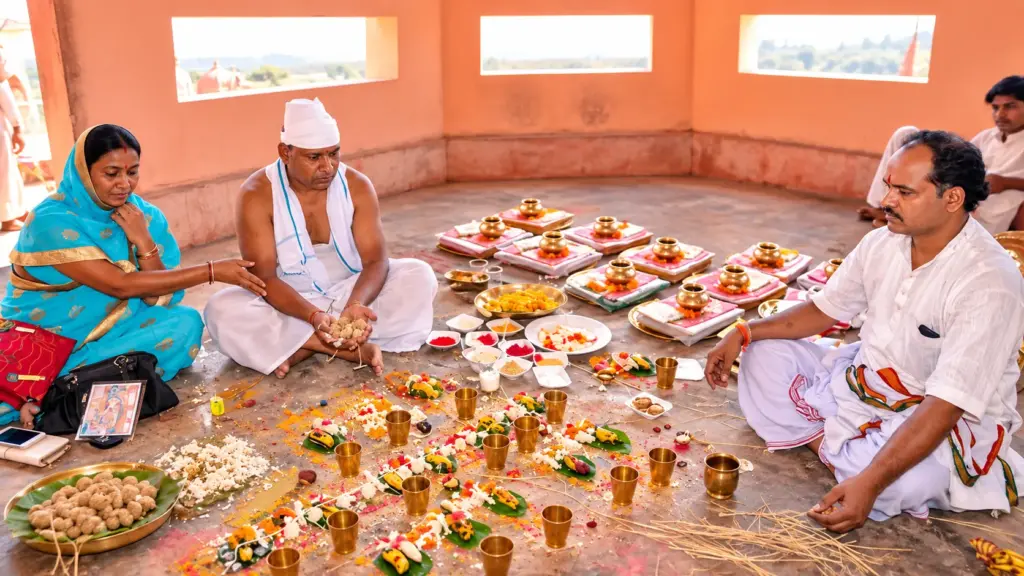
The remedy or nivaran for Pitru Dosha is the same rituals we’ve already discussed: performing Shradh, Tarpan, and Pind Daan with sincerity during Pitru Paksha. Beyond this, several specific practices are commonly recommended.
Feeding Brahmins, cows, crows, and dogs is treated as a direct remedy, since these beings are traditionally understood as intermediaries who carry offerings to the ancestors. Reciting the Pitru Stotra or Pitru Gayatri Mantra daily during the fortnight is another widely followed practice. Donating items like sesame seeds, black clothes, and food grains on Amavasya, especially Sarva Pitru Amavasya, is also considered effective.
For more severe or persistent cases, families often travel to Gaya in Bihar, considered the most sacred site in India for Pind Daan, based on the belief that Lord Vishnu himself blessed the location as a place where ancestral souls attain peace.
Pitru Paksha Dos and Don’ts
Pitru Paksha dos and don’ts come from a set of customary restrictions. Following the right pitru paksha dos and don’ts is less about fear and more about keeping the fortnight’s spirit of restraint. Here is a practical, ground-level breakdown.
Do this during Pitru Paksha
- Perform Tarpan and Shradh on the correct tithi, or on Amavasya if unknown
- Feed Brahmins, cows, crows, and dogs daily if possible
- Donate food, clothes, and money to those in need
- Maintain a simple, sattvic lifestyle during the fortnight
- Recite Pitru Stotra, Gayatri Mantra, or family ancestral prayers
Avoid this during Pitru Paksha
- Starting new ventures, businesses, or major projects
- Buying gold, vehicles, or property
- Weddings, engagements, and Griha Pravesh ceremonies
- Non-vegetarian food, alcohol, onion, and garlic
- Haircuts and shaving, in families that follow this custom
It helps to know that regular office work, travel, and daily responsibilities continue as normal. Pitru Paksha asks you to pause celebration and new beginnings, not your entire life.
Can you get married during Pitru Paksha?
No, weddings and engagements are traditionally avoided during Pitru Paksha since it is considered a period of remembrance rather than celebration. Most families schedule weddings before the fortnight begins or after Sharad Navratri starts.
Can you cut your hair during Pitru Paksha?
Many families avoid haircuts and shaving during Pitru Paksha, treating it similarly to a mourning period, though this is a regional and family custom rather than a strict scriptural rule, and practices vary across communities.
Pitru Paksha Food: What to Avoid During Shradh
Pitru paksha food rules follow one consistent logic: this is a period of sattvic, simple eating that mirrors the offerings made to ancestors. Getting pitru paksha food choices right matters as much to most families as getting the ritual timing right.
Non-Vegetarian and Addictive Substances
Meat, fish, and eggs are avoided across most observing households. Alcohol and tobacco are also set aside, since both are considered tamasic (heavy, dulling) substances that clash with the fortnight’s spirit of quiet remembrance.
Pulses and Grains to Avoid
Certain pulses like masoor dal (red lentils) and urad dal are traditionally skipped during Shradh cooking, based on regional Dharma Shastra guidance that treats them as unsuitable for ritual food. Wheat is generally fine and commonly used in Pind preparation.
Spices and Salts to Exclude
Common salt is often substituted with rock salt (sendha namak) during Shradh meals in many households, similar to fasting food traditions. Strong spices like asafoetida (hing) and excessive turmeric are also reduced or skipped in ritual cooking.
Vegetables to Avoid
Onion and garlic top this list, again for their tamasic classification. Some traditions also avoid vegetables grown underground more broadly during the actual day of Shradh cooking, though this varies significantly by region and family.
Other Dietary Restrictions
Many families also avoid eating outside food, restaurant meals, or anything not cooked fresh at home during the days they are actively performing Shradh, treating home-cooked purity as part of the offering itself.
Who Can Perform Shradh?
Traditionally, the eldest son performs Shradh, but any close family member, including daughters, can perform it when no male descendant is available, provided the ritual is done with proper guidance and sincerity.
Who can perform shradh is one of the most common questions families ask a priest before the fortnight begins. This comes from Dharma Shastra guidance that places the responsibility on the direct male line, particularly the son who inherits the family’s property and name.
That said, practical reality has shifted this in recent decades. If there is no male descendant available, or if a family chooses to, daughters and other female family members can and do perform Shradh, Tarpan, and even Pind Daan, with a qualified priest guiding the process. Several temples at Gaya and Kashi Vishwanath now regularly conduct Pind Daan ceremonies led by daughters.
When to Perform Shradh?
Timing matters as much as the ritual itself, and when to perform shradh depends on two things: the correct tithi and the correct window within that day. Shradh should ideally be performed on the specific tithi matching the ancestor’s date of death, during the Aparahna Kaal, the early afternoon window roughly between 1:00 PM and 3:30 PM, as prescribed in the Manu Smriti.
Two other muhurats are also considered auspicious: Kutup Muhurat, a short window around late morning, and Rohina Muhurat, immediately following it. These exact clock times shift daily based on sunrise and sunset, so checking a local Panchang for your city is more reliable than relying on a single fixed time for the whole fortnight.
If the exact tithi is unknown, forgotten, or the death was sudden and untraceable to a specific date, Sarva Pitru Amavasya on October 10, 2026 is the universally accepted day to perform Shradh instead.
Can Pitru Paksha rituals be performed at home?
Yes, Tarpan and a simplified Pind Daan can be performed at home using basic items like sesame seeds, Kusha grass, water, and rice flour, though families seeking the full traditional Pind Daan often still consult a priest or visit Gaya.
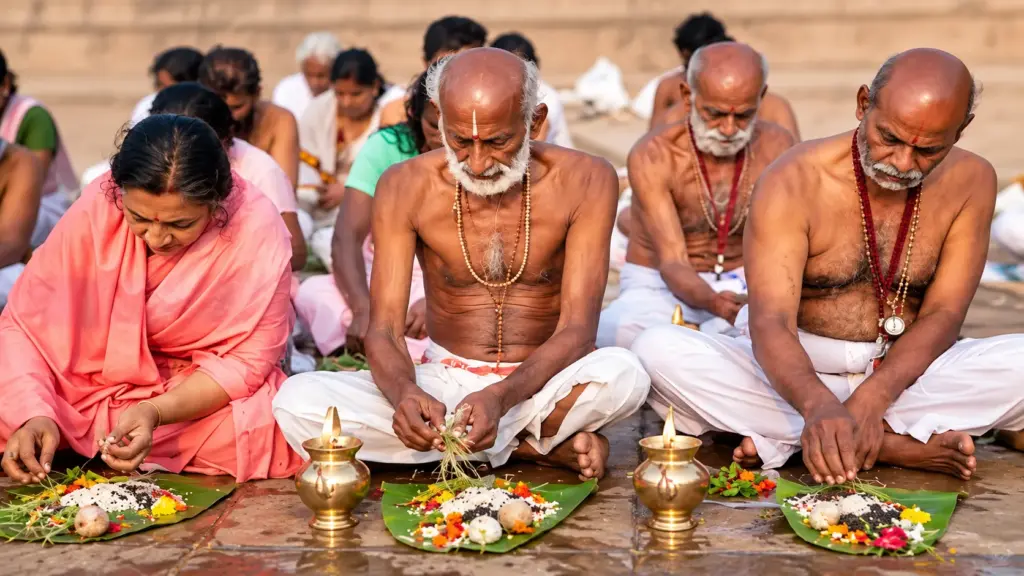
Step-by-Step: Pitru Paksha Puja at Home
You do not need a pandit present for a basic, sincere Shradh. Many families perform a simplified pitru paksha puja at home, especially for Tarpan, and a proper pitru paksha puja at home setup needs only a handful of everyday items. Here is a clear, practical walkthrough.
Essentials and Setup
Gather black sesame seeds (til), Kusha grass, a copper or brass vessel, unbroken rice (akshat), barley or wheat flour, ghee, honey, milk, fresh flowers, and Ganga jal if available. Wear clean, preferably white or light-colored clothing. Face south while performing the ritual, since south is traditionally associated with Yama and the ancestral realm.
Water Offering (Tarpan)
Take water in the copper vessel, mix in black sesame seeds, and hold Kusha grass between your fingers. Pour the water slowly through your fingers onto the ground or into a plate, reciting the names of your father, grandfather, and great-grandfather (or your mother’s equivalent line, depending on family tradition) while doing so. This is repeated for each ancestor being remembered.
Offering Pindas
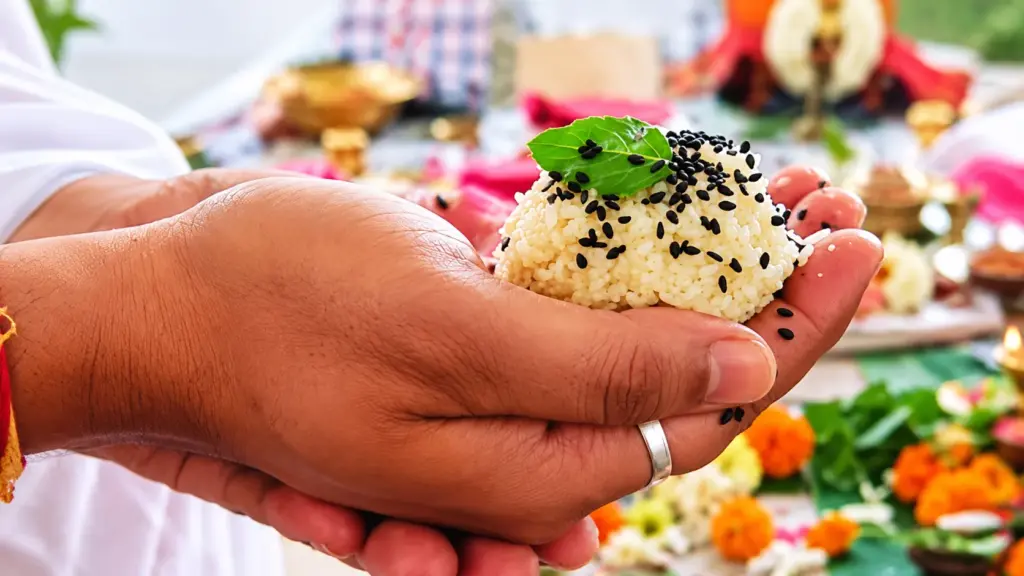
Pindas are small balls made from cooked rice or barley flour mixed with ghee, honey, and sometimes milk. These are offered on Kusha grass, again while facing south, with specific mantras invoking the ancestors by name and lineage. If you are unfamiliar with the exact mantras, a purohit can guide you through this part even in a short home visit or phone consultation.
Charity and Gratitude
After the main offering, food is typically prepared and offered first to crows, cows, and dogs, then to Brahmins or guests, and finally eaten by the family. Charity, whether food, clothes, or money, is given to those in need as a closing act.
Completing the Ritual
The ritual closes with a small prayer of gratitude and, in many households, a moment of silence or a shared meal that includes the specific foods the departed ancestor enjoyed in life. This personal touch, cooking something your grandfather loved, for instance, is a detail that formal texts don’t always mention but that families consistently describe as the most meaningful part.
What is the difference between Shradh, Tarpan, and Pind Daan?
Shradh is the overall ancestral ceremony; Tarpan is the water-and-sesame offering within it; Pind Daan is the offering of rice or flour balls representing the ancestor’s body. All three are the part of one complete Shradh ritual.
These three terms get used interchangeably, but they are not the same thing, and knowing the difference actually clarifies a lot about the fortnight.
Shradh is the umbrella term for the entire ceremony performed for ancestors, done with faith and devotion. Tarpan specifically refers to the water offering, mixed with sesame seeds, given to ancestors, gods, and sages. Pind Daan specifically refers to the offering of rice or flour balls (pindas), representing the physical body, meant to help the soul complete its journey after death.
Think of Shradh as the full ceremony, with Tarpan and Pind Daan as two of its core components, alongside feeding Brahmins and giving charity.
Benefits of Shradh in Pitru Paksha
Beyond the removal of Pitru Dosha, families consistently report a handful of tangible benefits from observing this fortnight seriously.
Restoring Harmony and Peace
Homes that perform Shradh regularly often describe a calmer atmosphere afterward, something priests attribute to the psychological relief of having actively honored one’s ancestors rather than letting the obligation sit unaddressed.
Health and Obstacle Removal
Traditional belief connects satisfied ancestors to fewer unexpected health setbacks and obstacles in the family’s path going forward, particularly for the male line most directly involved in the ritual.
Financial Stability and Security
Just as unresolved Pitru Dosha is linked to financial instability, its resolution through sincere Shradh is believed to open up steadier income and reduce unexpected losses.
Progress in Career and Marriage
Delayed marriages and stagnant careers are two of the most commonly cited problems people bring to priests during this period, and Shradh is offered as the traditional first remedy before other astrological solutions are explored.
Positive Energies in the Home
Many families report simply feeling lighter after completing their Shradh obligations for the year, a mix of genuine belief and the practical comfort of having honored a duty rather than avoided it.
Regional Variations of Pitru Paksha
India’s diversity shows clearly in how this fortnight is observed. The core purpose stays identical everywhere, but the names, dates, and specific customs shift by region.
Names Across Regions
In Rajasthan and Haryana, it’s called Kanagat. In West Bengal, Odisha, and Assam, it’s known as Pitri Pokkho or Mahalaya Paksha, and Mahalaya itself marks the transition point before Durga Puja begins. Karnataka observes a specific day called Mattu Amavasya for cattle and ancestors together. Kerala calls the ritual Bali, performed at sacred spots called Kavu. Tamil Nadu generally centers its observance on Mahalaya Amavasya specifically rather than all sixteen days individually.
Calendar and Practice Differences
Bengali households tend to focus heavily on the final Amavasya with a holy river bath and Tarpan, rather than spreading rituals across all sixteen days. North Indian families, by contrast, are more likely to observe each individual tithi and consider a pilgrimage to Gaya, Prayagraj, Kashi, or Badrinath as the gold standard for Pind Daan.
Unified Significance Across India
Despite these differences, one thing holds true everywhere: no region treats this fortnight as optional or symbolic only. The underlying belief, that unresolved ancestral debt has real consequences and that rituals restore balance, remains consistent from Kashmir to Kerala.
Mantras for Pitru Paksha Puja and Tarpan
Correct mantra recitation matters in Shradh, though sincerity is always emphasized over perfect pronunciation, a point Premanand Maharaj and other contemporary saints repeat often when devotees worry excessively about getting Sanskrit exactly right.
Pitru Gayatri Mantra
ॐ पितृगणाय विद्महे जगत् धारिणे च धीमहि।
तन्नो पितरो प्रचोदयात्॥
This mantra invokes the collective energy of ancestors, asking for their blessings and guidance, following the standard Gayatri format used across many deity-specific Gayatri mantras.
Avaahanam Mantra (Invocation)
This mantra is recited to formally invite the ancestors’ spirits to be present and receive the offerings being made. Wording varies slightly by family tradition and the officiating priest’s lineage, so it is best learned directly from your family purohit.
Pitru Mantra
ॐ पितृभ्यः स्वधायिभ्यः स्वधा नमः पितामहेभ्यः स्वधायिभ्यः स्वधा नमः प्रपितामहेभ्यः स्वधायिभ्यः स्वधा नमः॥
This mantra directly addresses the father, grandfather, and great-grandfather with the sacred offering formula “svadha namah,” a term specifically reserved for ancestral offerings, distinct from “svaha,” which is used for offerings to deities.
Practical Notes on Mantra Use: If Sanskrit pronunciation feels unfamiliar, reciting with genuine intent while a priest or an audio guide leads the chanting is entirely acceptable. What tradition asks for is devotion, not theatrical performance.
Pujas and Other Rituals Related With Pitru Paksha
Beyond the daily Tarpan and Pind Daan, several specific, larger pitru paksha rituals exist for particular situations. Families dealing with severe or long-standing issues often opt for one of these.
Tripindi Shraddh Puja
This is performed when the exact ancestors or the cause of Pitru Dosha cannot be identified clearly. It is a more elaborate ceremony covering three generations at once and is usually conducted by specialized priests at pilgrimage sites.
Narayan Nagbali Puja
This specific and lengthy ritual, performed most famously at Trimbakeshwar in Maharashtra, is recommended when a family suspects Pitru Dosha combined with Kaal Sarp Dosha, or when there is a family history of unnatural deaths. It typically spans multiple days and requires a qualified priest throughout.
Pitru Dosh Nivaran Puja
This is a more general, targeted ceremony specifically designed to remove Pitru Dosha from a birth chart, often recommended by astrologers alongside standard Shradh and Tarpan.
Mahalaya Shraddh Puja
Performed specifically on Sarva Pitru Amavasya, this is the most widely attended Shradh ceremony of the year, since it covers every ancestor at once and doesn’t require knowing individual death tithis.
Conclusion
Pitru Paksha is not about fear or superstition. It is about a fifteen-day pause built into the calendar to make sure gratitude toward those who came before us doesn’t get buried under daily life. If you follow every ritual precisely or simply light a diya and remember your grandparents on Sarva Pitru Amavasya this October 10, the intent behind the act matters more than its scale.
As saints from Premanand Maharaj to older reformist voices within Sanatan Dharma have said in different words, our ancestors don’t need our gold or our grand ceremonies. They need to be remembered, and Pitru Paksha simply gives us sixteen dedicated days each year to do exactly that.
Frequently Asked Questions About Pitru Paksha 2026
Families perform Tarpan, Pind Daan, and Shradh for ancestors on the tithi matching their death date, feed Brahmins, cows, and crows, give charity, and avoid new purchases and celebrations for sixteen days.
Shradh involves offering water mixed with sesame seeds (Tarpan), offering rice or flour balls (Pind Daan), reciting ancestral mantras, feeding Brahmins and animals, and giving charity, ideally during the Aparahna Kaal on the correct tithi.
Tarpan involves pouring water mixed with black sesame seeds through the fingers while holding Kusha grass, facing south, and reciting the names of one’s father, grandfather, and great-grandfather.
Pind Daan involves offering balls made from rice or barley flour, mixed with ghee and honey, on Kusha grass while reciting specific mantras invoking the ancestor by name and lineage, typically with a priest’s guidance.
Black sesame seeds, Kusha grass, a copper or brass vessel, rice or barley flour, ghee, honey, milk, flowers, and Ganga jal are the standard items needed for a home Shradh ceremony.
Avoid weddings, buying gold or vehicles, starting new businesses, non-vegetarian food, haircuts, and loud celebrations during Pitru Paksha, based on family and regional tradition.
Most families avoid buying gold, vehicles, and property during Pitru Paksha, deferring such purchases until after Sarva Pitru Amavasya, though everyday essentials are generally fine to buy.
Most observing households avoid non-vegetarian food, alcohol, onion, and garlic during Pitru Paksha, favoring simple, sattvic meals in line with the fortnight’s spirit of remembrance.
Rice, barley flour, ghee, honey, milk, and the specific foods the ancestor enjoyed in life are commonly offered during Shradh, followed by feeding Brahmins, cows, crows, and dogs.
My Favorite Corner (MFC) brings clear, scripture-sourced explanations of Hindu philosophy and practice to readers seeking authentic spiritual guidance. Explore more of our content on dharma, karma, and the paths to liberation. Follow MFC on Instagram and Facebook to explore more sacred places, festivals, and living traditions of Sanatan Dharma.