
Some prayers transcend time. The Gayatri Mantra is one of them. Composed over 3,000 years ago, it still resonates in temples, homes, and hearts every single morning. Gayatri Jayanti is the sacred day we honor its divine source, Ved Mata Gayatri, the mother of the Vedas.
Gayatri Jayanti 2026 falls on Thursday, June 25. This day arrives on Jyeshtha Shukla Ekadashi, one day after Ganga Dussehra. For millions of devotees, it is not just a festival. It is an invitation to reconnect with divine wisdom.
This blog covers everything: the date, the story behind the Goddess, the Gayatri Mantra meaning word by word, how to celebrate, and the real spiritual power this mantra carries.
What is Gayatri Jayanti?
Gayatri Jayanti is the birth anniversary of Goddess Gayatri, the presiding deity of the Vedas. Hindus observe it on Jyeshtha Shukla Ekadashi each year. The Goddess carries a unique position in Sanatan Dharma. She is Veda Mata, the mother of all four Vedas.
She is the living embodiment of the Gayatri Mantra itself. Scriptures describe her as the combined energy of Goddess Saraswati, Goddess Lakshmi, and Goddess Parvati. She governs wisdom, abundance, and inner strength, all three at once.
Gayatri Jayanti is also observed during Shravana Purnima in South India. This date coincides with Upakarma, a day of Vedic renewal. Both observations honor the same truth: Vedic wisdom must be received, practiced, and preserved.
Gayatri Jayanti 2026: Date and Tithi Timings
Gayatri Jayanti 2026 falls on June 25. It is observed on Jyeshtha Shukla Ekadashi and comes the day after Ganga Dussehra. Here are the exact Ekadashi tithi timings:
| Event | Date and Time |
| Ekadashi Tithi Begins | June 24, 2026 at 3:42 PM |
| Ekadashi Tithi Ends | June 25, 2026 at 5:39 PM |
| Gayatri Jayanti (Jyeshtha) | Thursday, June 25, 2026 |
| Observed one day after | Ganga Dussehra (June 24, 2026) |
The best time for Gayatri Mantra japa is Brahma Muhurta, approximately 90 minutes before sunrise. This period is considered the most spiritually potent time of day. Devotees also chant at midday and during Sandhyavandanam at sunset.
Why Is Gayatri Jayanti Celebrated?
Hindus celebrate Gayatri Jayanti to honor the day Goddess Gayatri appeared in this world. Her appearance marks the descent of Vedic light into human consciousness. Without her grace, the Vedas would remain beyond human reach.
The celebration carries another purpose. It reminds devotees of their duty toward Vedic wisdom and Gayatri Mantra practice. Chanting this mantra is not a ritual act alone. It is an inner commitment to truth, dharma, and righteous living.
On this day, families pass the mantra to children. Gurukuls and spiritual organizations conduct mass japa yagnas. Communities gather for satsangs and kirtans. The goal is the same across all traditions: activate the divine intellect within.
Who Is Maa Gayatri? Identity, Story, and Symbolism
Maa Gayatri in History and Scriptures
The name Gayatri comes from the Sanskrit root gāyatra, meaning a sacred song or hymn. In the Rigveda, Gayatri originally referred to a Vedic meter of 24 syllables. Over time, this meter took the form of a goddess.
The Skanda Purana identifies Maa Gayatri as theconsort of Lord Brahma. The Matsya Purana describes her as a form that emerged from Brahma’s left half, along with Saraswati and Savitri. TheDevi Bhagavata Purana presents her as the embodiment of Parabrahman, the ultimate Vedic truth.
Scriptures consistently describe her as Veda Mataand the mother of all gods. She is the Shakti that holds Vedic knowledge together. She is also called Deva Mata, the mother of all celestial beings.
Gayatri Devi Symbolism: The Panchamukhi Form
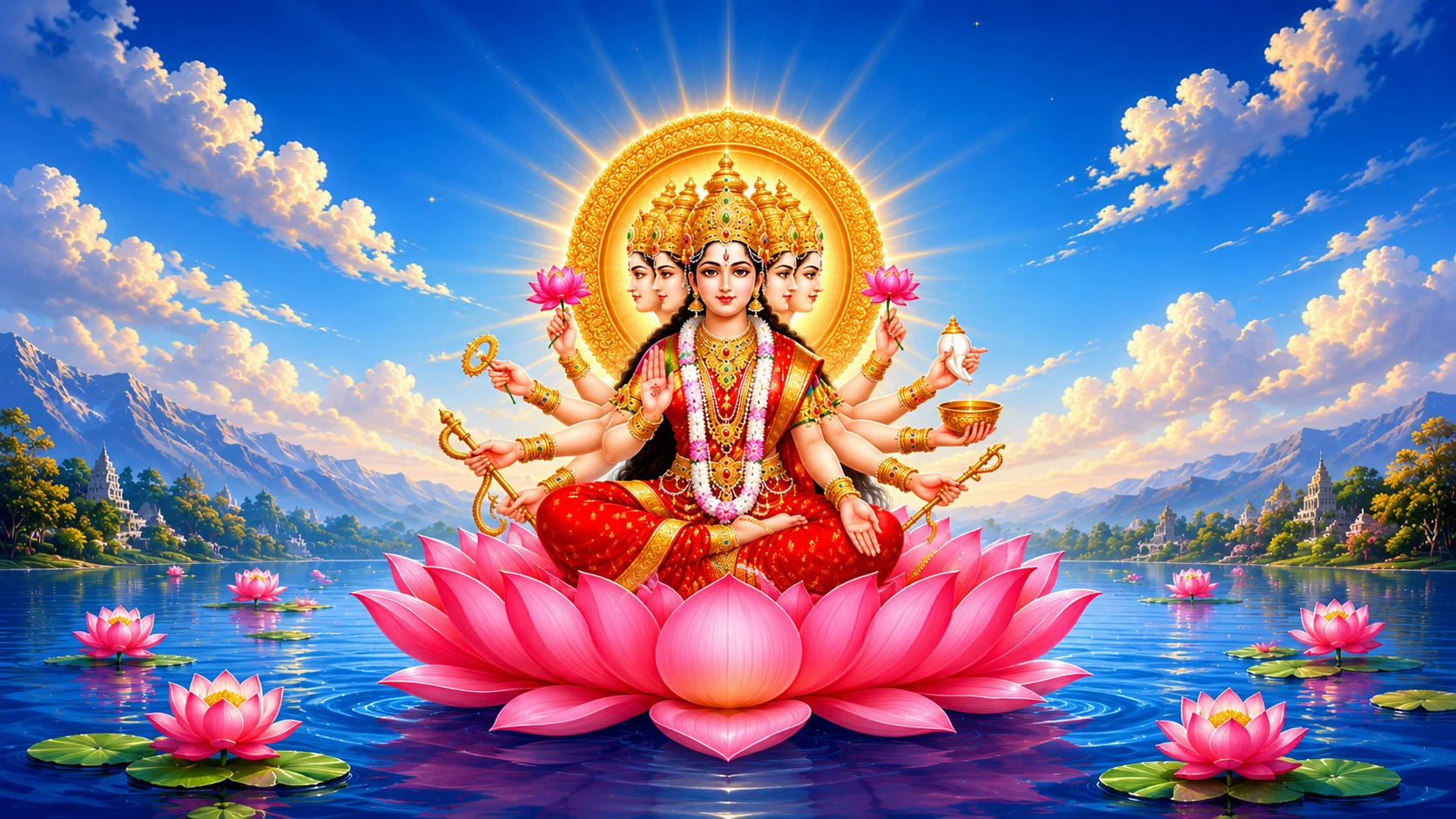
Gayatri Devi appears as Panchamukhi, the five-faced Goddess. Each face holds a distinct meaning:
| Face | What It Represents |
| First Face | Earth (Prithvi) and the physical body |
| Second Face | Water (Jala) and the life force |
| Third Face | Fire (Agni) and transformation |
| Fourth Face | Air (Vayu) and breath |
| Fifth Face | Ether (Akasha) and pure consciousness |
Her five faces also represent the five Pranas: Prana, Apana, Vyana, Udana, and Samana. She holds ten arms, which is why she is also called Dashabhuji. Her weapons and offerings represent protection, liberation, and Vedic authority. Her mount is the Hamsa (swan), a symbol of discernment and divine realization.
The Puranas state that only 24 rishis fully understood and wielded the complete power of the Gayatri Mantra. Sage Vishwamitra was the first. Sage Yajnavalkya was the last.
The Story of Goddess Gayatri and Lord Brahma
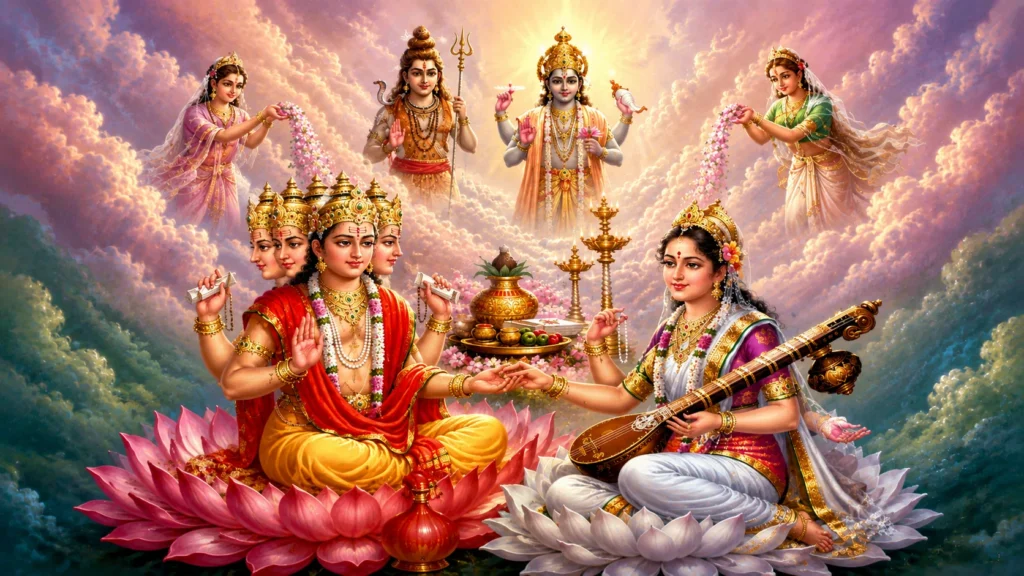
The Puranas tell a well-known story about Goddess Gayatri and Lord Brahma. Brahma had arranged a major yajna. His wife Savitri was delayed in arriving. The yajna could not begin without a companion seated beside him. Brahma asked Indra to find a solution quickly.
Indra brought Gayatri, a woman of pure Vedic devotion. Brahma married her so the yajna could proceed in time. When Savitri arrived and witnessed this, she was deeply hurt. She cursed Brahma, saying he would not receive worship on earth except at Pushkar.
Savitri also blessed Gayatri: her name would be chanted across the world forever. This story explains why Brahma temples remain rare in India. It also shows why the Gayatri Mantra carries such universal reverence. Savitri’s own blessing made it immortal.
Sage Vishwamitra and the Revelation of the Gayatri Mantra
Sage Vishwamitra and Gayatri Mantra are inseparable in Vedic tradition. Vishwamitra began his journey as a powerful king, not a sage. He had an army, a kingdom, and immense pride.
One day, Vishwamitra visited the ashram of Sage Vashishtha. He saw a wish-fulfilling cow, Nandini. He demanded her for his kingdom. Vashishtha refused. The refusal ignited Vishwamitra’s ego into burning ambition.
Vishwamitra vowed to surpass Vashishtha through spiritual power alone. He surrendered his kingdom and entered the forest. For thousands of years, he performed intense tapas. He faced obstacles, temptations, and failures. He never stopped.
At the peak of his austerities, the Gayatri Mantra revealed itself to him in deep meditation. It arrived as 24 golden syllables. Vishwamitra understood this was not a personal blessing. It was a gift for all of humanity. He composed it in the Rigveda as Mandala 3.62.10.
His story teaches a vital truth: the Gayatri Mantra spiritual meaning is not inherited. It is earned through discipline, surrender, and sincerity.
Gayatri Mantra Meaning: Word by Word
The Gayatri Mata mantra appears in the Rigveda (Mandala 3.62.10). It is also honored in the Yajurveda and Sama Veda. This makes it the most universal mantra in the Vedic tradition.
The Gayatri Mantra:
ॐ भूर्भुवः स्वः।
तत्सवितुर्वरेण्यं।
भर्गो देवस्य धीमहि।
धियो यो नः प्रचोदयात्॥
Om Bhur Bhuvah Svah,
Tat Savitur Varenyam,
Bhargo Devasya Dheemahi,
Dhiyo Yo Nah Prachodayat.
Word-by-Word Breakdown
| Sanskrit Word | Meaning |
| Om (ॐ) | The primordial sound of creation; the vibration of universal consciousness |
| Bhur (भूर्) | The physical plane; the earthly realm and material body |
| Bhuvah (भुवः) | The vital life force; the mental and emotional realm |
| Svah (स्वः) | The spiritual realm; the plane of higher consciousness |
| Tat (तत्) | That supreme divine reality beyond name and form |
| Savitur (सवितुर्) | Savitur, the solar deity; the divine source of light and wisdom |
| Varenyam (वरेण्यं) | Most excellent; most worthy of adoration and surrender |
| Bhargo (भर्गो) | The divine radiance; the purifying light that burns away ignorance |
| Devasya (देवस्य) | Of the divine; belonging to the luminous Supreme Being |
| Dheemahi (धीमहि) | We meditate; we absorb ourselves into this divine light |
| Dhiyo (धियो) | Our intellect; our reasoning and discerning mind |
| Yo (यो) | Who; referring to the divine light itself |
| Nah (नः) | Our; belonging to all of us collectively |
| Prachodayat (प्रचोदयात्) | May inspire and illuminate; may awaken and guide forward |
The Complete Meaning of Gayatri Mantra
The Gayatri mantra meaning in full is: “We meditate on the divine radiance of the Creator, who pervades all three realms. That supreme light is the most worthy of all worship. May it illuminate our intellect and guide us toward truth.“
The mantra is not a request for material gain. It is an act of surrender to divine light. It asks for one thing only: clarity of mind. In Vedic thought, a clear mind leads to right action, right speech, and right living.
What is the Significance of the Gayatri Mantra in Vedic Tradition?
The Gayatri Jayanti significance connects deeply to the mantra itself. In Vedic texts, the Gayatri Mantra is called Sarva Veda Sara, the essence of all Vedas. The Chandogya Upanishad describes it as the most powerful of all hymns.
The mantra addresses Savitur, the solar deity. In Vedic understanding, the sun represents not just physical light. It represents inner knowledge, the intelligence that distinguishes truth from illusion.
The three Vyahritis (Bhur, Bhuvah, Svah) are significant on their own. They address the body, the mind, and the spirit together. This means the mantra heals at all three levels of human existence simultaneously.
The Gayatri Jayanti importance in Hinduism also rests on its universality. In ancient times, only those initiated through Upanayana could chant it. Over centuries, this mantra transcended all divisions of caste, gender, and geography. Today, any sincere devotee may chant it with purity of intention.
Gayatri Jayanti Puja Vidhi: How to Worship?
The Gayatri Jayanti puja vidhi follows a specific set of steps rooted in Vedic tradition. Devotees observe a sattvic worship on Gayatri Jayanti, keeping everything pure, calm, and spiritually intentional.
Step-by-Step Puja Process:
1. Brahma Muhurta Snan: Wake before sunrise. Take a cleansing bath with pure water. Wear fresh, clean clothes in white or yellow.
2. Puja Sthal Setup: Clean your place of worship. Place an idol or image of Maa Gayatri on a wooden seat. Lay a yellow or red cloth beneath it.
3. Sankalpa: Take water in your right palm. State your name, your intention, and your vow for the day. Release the water as a seal of the vow.
4. Panchamrit Abhishek: Offer the five sacred liquids to the Goddess: milk, curd, honey, ghee, and sugar. Follow with Ganga water or clean water.
5. Shodashopachara Puja: Offer sandalwood paste, flowers, akshat (unbroken rice), incense, a lit lamp, and naivedya (prasad food).
6. Gayatri Mantra Japa: Chant the Gayatri Mata mantra 108 times. Use a tulsi or crystal mala. Focus on the meaning, not just the sound.
7. Gayatri Chalisa and Stotra: Recite the Gayatri Chalisa or the Maa Gayatri Kavach for additional blessings.
8. Havan (Optional but Powerful): Perform a Gayatri Havan by offering ahutis with ghee and sesame seeds. Chant the mantra with each offering.
9. Aarti and Pushpanjali: Conclude with the Gayatri Aarti. Offer flowers at her feet with gratitude.
10. Prasad Distribution: Share fruits, sweets, or cooked sattvic food. Donate food or essentials to the needy as an act of Devi-seva.
The entire Gayatri Jayanti puja vidhi centers on purity of body, mind, and speech. Avoid harsh words, negative thoughts, and unclean food throughout the day.
Gayatri Jayanti Vrat Katha
The Gayatri Jayanti vrat katha is deeply woven into the Devi Bhagavata Purana. The katha describes how Goddess Gayatri first descended into this world as a divine light. She arrived to restore the knowledge that darkness had obscured.
The katha tells of a devoted Brahmin who performed rigorous penance. He sought the Goddess with purity of heart and no selfish motive. Pleased by his sincere devotion, Maa Gayatri appeared before him. She blessed him with Vedic knowledge, inner clarity, and the ability to transmit this wisdom to others.
The vrat katha carries a central message. The Goddess does not appear before those who seek power or praise. She appears before those who seek truth. The vrat on Gayatri Jayanti is a symbol of that sincerity. A devotee who observes it with full faith opens their mind to divine guidance.
It is traditional to listen to or recite this katha at the conclusion of puja. Temples often hold katha sessions throughout the day. Families gather and listen together, reinforcing Vedic values across generations.
गायत्री जयंती व्रत कथा in Hindi पौराणिक कथाओं के अनुसार, एक समय सृष्टिकर्ता भगवान ब्रह्मा ने एक महान यज्ञ करने का निश्चय किया। इस यज्ञ को पूर्ण करने के लिए उनकी पत्नी देवी सावित्री का उपस्थित होना आवश्यक था। सभी देवता, ऋषि और मुनि यज्ञ में उपस्थित थे, किंतु देवी सावित्री के आने में विलंब हो रहा था। यज्ञ का शुभ मुहूर्त निकलता जा रहा था। तब देवताओं ने भगवान ब्रह्मा से प्रार्थना की कि मुहूर्त व्यर्थ नहीं जाना चाहिए। शास्त्रों के अनुसार पत्नी के बिना यज्ञ पूर्ण नहीं हो सकता था। तब इन्द्रदेव ने एक तेजस्विनी, पवित्र और तपस्विनी कन्या को वहाँ उपस्थित किया, जिसका नाम गायत्री था। भगवान ब्रह्मा ने विधिपूर्वक गायत्री के साथ विवाह किया और उन्हें अपने वाम भाग में बैठाकर यज्ञ आरम्भ कर दिया। कुछ समय बाद देवी सावित्री वहाँ पहुँचीं। उन्होंने देखा कि उनके स्थान पर दूसरी स्त्री बैठी हुई है और यज्ञ प्रारम्भ हो चुका है। यह देखकर देवी सावित्री अत्यंत क्रोधित हो गईं। क्रोध में उन्होंने भगवान ब्रह्मा को शाप दिया कि पृथ्वी पर उनकी पूजा कहीं भी नहीं होगी, केवल पुष्कर में ही उनका मंदिर और पूजा स्थापित होगी। देवी सावित्री ने वहाँ उपस्थित देवताओं को भी शाप दिया। कहा जाता है कि इसी कारण भगवान ब्रह्मा के मंदिर बहुत कम हैं। तब सभी देवताओं ने देवी सावित्री को शांत करने का प्रयास किया। भगवान विष्णु और अन्य देवताओं के समझाने पर देवी सावित्री का क्रोध शांत हुआ। उन्होंने कहा कि यद्यपि यह घटना उनके लिए दुःखद है, फिर भी गायत्री कोई साधारण स्त्री नहीं, बल्कि आदिशक्ति का स्वरूप हैं। देवी सावित्री ने गायत्री को आशीर्वाद देते हुए कहा, “कलियुग में तुम्हारी उपासना समस्त संसार में होगी। जो मनुष्य श्रद्धा और भक्ति से तुम्हारा स्मरण करेगा, गायत्री मंत्र का जप करेगा और धर्म के मार्ग पर चलेगा, उसकी बुद्धि शुद्ध होगी और उसके जीवन से अज्ञान का अंधकार दूर होगा।” ऐसा माना जाता है कि इसी पावन तिथि पर देवी गायत्री ने वेदमाता के रूप में प्रकट होकर संसार को ज्ञान का प्रकाश प्रदान किया। यही कारण है कि ज्येष्ठ शुक्ल एकादशी को गायत्री जयंती के रूप में मनाया जाता है। एक अन्य मान्यता के अनुसार, इसी दिव्य दिन महर्षि विश्वामित्र को कठोर तपस्या के पश्चात गायत्री मंत्र का दिव्य ज्ञान प्राप्त हुआ था। उन्होंने इस मंत्र को मानव कल्याण के लिए प्रकट किया। गायत्री मंत्र इस प्रकार है — ॐ भूर्भुवः स्वः। तत्सवितुर्वरेण्यं। भर्गो देवस्य धीमहि। धियो यो नः प्रचोदयात्॥ इस मंत्र को वेदों का सार कहा गया है। मान्यता है कि जो मनुष्य श्रद्धा, संयम और शुद्ध आचरण के साथ गायत्री मंत्र का जप करता है, उसकी बुद्धि निर्मल होती है, मन शांत होता है और जीवन में धर्म, ज्ञान तथा सद्बुद्धि की प्राप्ति होती है। गायत्री जयंती के दिन प्रातः स्नान कर स्वच्छ वस्त्र धारण किए जाते हैं। माँ गायत्री की पूजा की जाती है, दीप प्रज्वलित किया जाता है, तथा श्रद्धापूर्वक गायत्री मंत्र का जप किया जाता है। इस दिन व्रत, दान, हवन और सत्संग का विशेष महत्व माना गया है। जो श्रद्धा और भक्ति से गायत्री जयंती का व्रत करता है तथा इस कथा का श्रवण करता है, माँ गायत्री उस पर कृपा करती हैं और उसे ज्ञान, विवेक तथा आध्यात्मिक शक्ति प्रदान करती हैं। ॥ इति श्री गायत्री जयंती व्रत कथा सम्पूर्ण ॥ |
How to Celebrate Gayatri Jayanti?
Gayatri Jayanti celebration takes many forms, from quiet personal practice to large community events. Here is how devotees across India observe this day:
Personal Practice
- Chant the Gayatri Mantra 108 times at dawn, noon, and dusk.
- Observe a sattvic fast: fruits, milk, and light grains only.
- Spend time in silence and reflection for at least one hour.
- Offer water to the sun at sunrise while chanting the mantra.
- Read from the Devi Bhagavata Purana or Gayatri Chalisa.
Family and Community Observance
- Introduce children to the Gayatri Mantra meaning and its practice.
- Attend satsangs or kirtans at a nearby temple or Gayatri Parivar center.
- Organize a group havan with experienced Vedic pandits.
- Donate books, food, or educational materials to those in need.
Gayatri Jayanti and Ganga Dussehra
Gayatri Jayanti and Ganga Dussehra arrive one day apart. Ganga Dussehra celebrates the descent of the Ganga river from heaven. Gayatri Jayanti celebrates the descent of Vedic light through the Goddess. Together, these two days form a powerful spiritual window. Many devotees observe both, performing Ganga snan on Dussehra and Gayatri puja on Jayanti.
Benefits of Gayatri Puja on Gayatri Jayanti
The Gayatri Jayanti rituals and benefits span the physical, mental, and spiritual dimensions of life. Performing sincere puja and mantra japa on this day carries extraordinary results according to Vedic texts.
Spiritual Benefits
- Deep benefits of chanting Gayatri Mantra include purification of the mind and past karmas.
- The Goddess grants clarity of dharma and guides one away from adharmic choices.
- Regular devotees report a deepening sense of inner peace and reduced mental clutter.
- The mantra vibration activates the Ajna (third eye) chakra, improving intuition.
Intellectual and Psychological Benefits
- Chanting strengthens focus, memory, and creative thinking over time.
- The rhythmic vibration of the 24-syllable mantra calms the nervous system.
- Students who practice Gayatri japa regularly report sharper concentration.
- The mantra builds self-confidence by aligning one with a higher sense of purpose.
For the Family and Household
- Puja and havan performed on this day bring harmony and positive energy into the home.
- Children who receive the mantra early carry strong moral and intellectual foundations.
- The collective energy of group japa purifies the shared space of a household or community.
Key Insight: The benefits of chanting Gayatri Mantra are not magical gifts. They arise from the repeated alignment of the mind with divine light. The more sincere the practice, the deeper the result.
Rules for Chanting the Gayatri Mantra
The Vedic tradition places importance on how the Gayatri Mata mantra is chanted. Proper practice multiplies the benefit. Careless practice weakens it.
- Time: Chant at sunrise, noon, and sunset. These three Sandhya periods are the most potent.
- Direction: Face east during morning japa. Face north during evening practice.
- Pronunciation: Pronounce each syllable clearly and with care. The 24 syllables carry specific vibrational values.
- Count: Chant a minimum of 108 times per session. Use a mala to keep count without mental distraction.
- Posture: Sit in Sukhasana or Padmasana. Keep the spine upright and the body still.
- Diet: Avoid meat, alcohol, onion, and garlic on the day of japa. Eat light and sattvic food.
- Intention: Chant with awareness of the Gayatri Mantra spiritual meaning. Do not treat it as background sound.
According to Ayurveda, the human body contains 108 Marma points. Chanting 108 times aligns these vital energy centers. It connects the individual self to cosmic energy in a measurable, experiential way.
What is Gayatri Jayanti Importance in Hinduism?
The Gayatri Jayanti importance in Hinduism goes beyond ritual observance. It is one of the few festivals dedicated entirely to Vedic knowledge itself. Most Hindu festivals honor a deity’s life event or a mythological victory. Gayatri Jayanti honors the arrival of wisdom itself on earth.
Gayatri Devi symbolism also carries a broader message for modern Hindus. Her five faces represent the five elements that constitute all of creation. She holds weapons to protect and offerings to nourish. She is not distant from the world. She is woven into it.
In modern India, Gayatri Jayanti during Shravana Purnima is also observed as Sanskrit Diwas. This day promotes the preservation of the Sanskrit language. Seminars, workshops, and cultural events take place across universities and temples. The connection is clear: Vedic wisdom lives inside Sanskrit, and Sanskrit lives inside the Gayatri Mantra.
Birth of Goddess Gayatri is, in essence, the birth of conscious spiritual life on earth. Celebrating her is an act of cultural remembrance and personal devotion at once.
Conclusion
Gayatri Jayanti is one of the most spiritually charged days in the Hindu calendar. It brings together the birth of a Goddess, the power of a mantra, and the purpose of an entire civilization in one sacred observance.
The Gayatri Mantra is not ancient history. It is a living practice. Every morning, millions across the world wake before sunrise and let those 24 syllables move through them. They seek the same thing Vishwamitra sought: not power, but light.
On Gayatri Jayanti 2026, June 25, let the day be more than a calendar event. Let it be a turning point. Chant the mantra with full awareness. Understand each word. And allow Maa Gayatri’s grace to do what it has done for thousands of years: illuminate the mind, and guide the heart toward truth.
Jai Maa Gayatri.
Frequently Asked Question (FAQs)
1. When is Gayatri Jayanti 2026?
Gayatri Jayanti 2026 falls on Thursday, June 25, 2026. It is observed on Jyeshtha Shukla Ekadashi, the 11th day of the waxing moon in the Jyeshtha lunar month.
2. Why is Gayatri Jayanti celebrated?
Gayatri Jayanti marks the divine birth anniversary of Goddess Gayatri, the mother of the Vedas. Devotees honor her through mantra chanting, puja, and sattvic fasting to receive her blessings of wisdom and clarity.
3. What is the meaning of the Gayatri Mantra?
The Gayatri mantra meaning is: “We meditate on the divine radiance of the Creator. May that supreme light illuminate our intellect and guide us toward truth.” The mantra appears in the Rigveda (Mandala 3.62.10), revealed through Sage Vishwamitra.
4. Who is Maa Gayatri?
Maa Gayatri is Veda Mata, the mother of all four Vedas. She is the personified form of the Gayatri Mantra and embodies the combined energies of Saraswati, Lakshmi, and Parvati. She appears as Panchamukhi, the five-faced Goddess.
5. What are the benefits of chanting the Gayatri Mantra?
The benefits of chanting Gayatri Mantra include sharpened focus, mental clarity, emotional stability, purification of past karmas, and alignment with dharmic living. Regular practice builds a strong inner foundation for decision-making and spiritual growth.
6. Is the Gayatri Mantra for everyone?
Yes. The Gayatri Mantra is a universal prayer for enlightenment. Anyone can chant it with devotion and purity of heart, regardless of gender, caste, or background.
7. What is the difference between Jyeshtha Gayatri Jayanti and Shravana Purnima Gayatri Jayanti?
Jyeshtha Gayatri Jayanti falls on Shukla Ekadashi in the Jyeshtha month. North India primarily observes this date. Shravana Purnima Gayatri Jayanti is widely observed in South India and coincides with Upakarma, the Vedic thread ceremony. Both dates honor the same Goddess and carry equal spiritual value.
Also Read:
1. Nirjala Ekadashi 2026: Date, Vrat Katha, Paran Time & Rules
2. Adhik Maas Samapan 2026: Udyapan & Ending Rituals
3. What is Parama Ekadashi? Meaning, Vrat Katha and Spiritual Importance
4. Somnath Temple: History, Significance, Timings & Interesting Facts
5. What Sanatan Dharma Really Teaches About Fatherhood?