

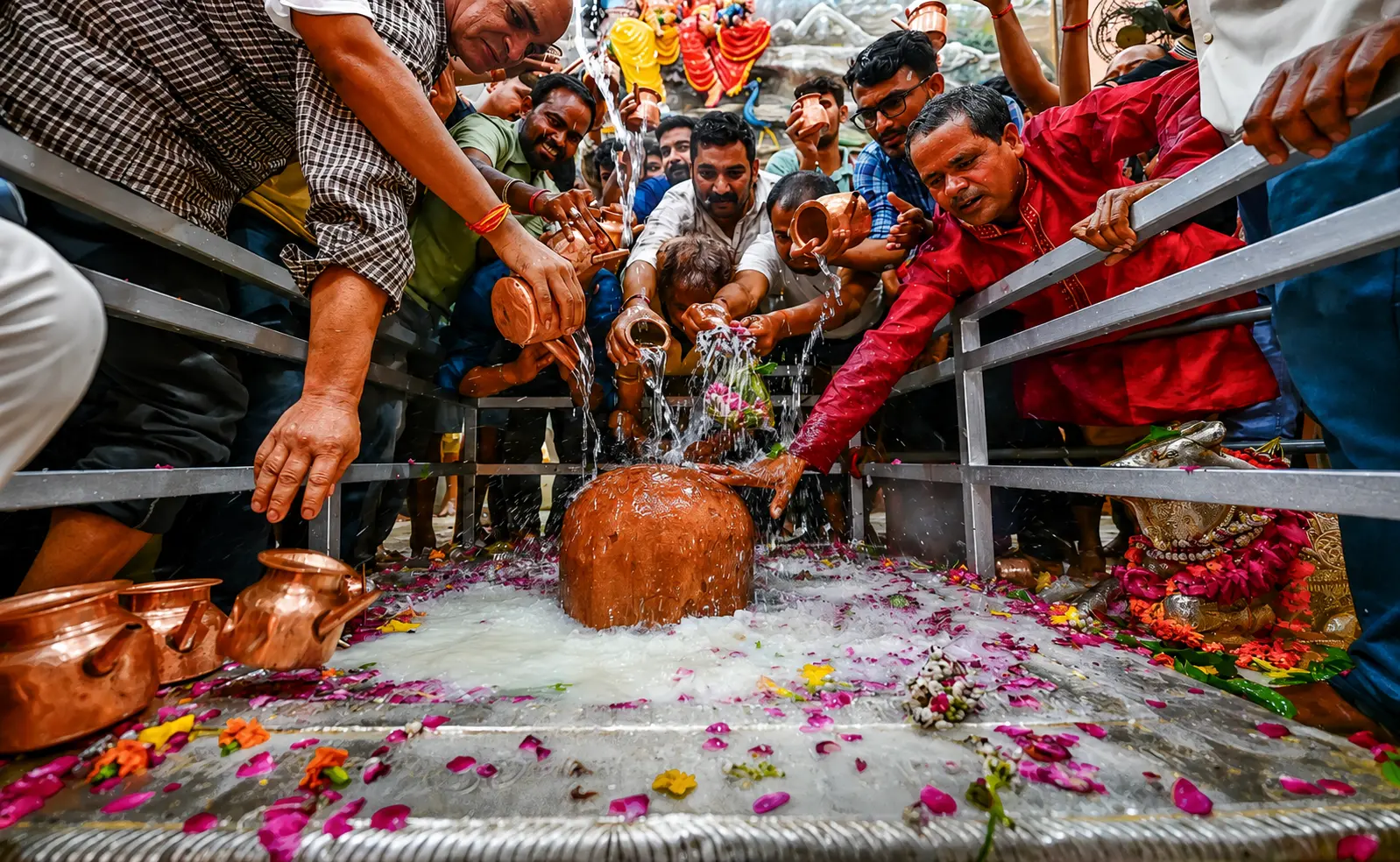
The Sawan 2026date in North India runs from Thursday, July 30 to Friday, August 28. In Maharashtra, Gujarat, and South India, Sawan 2026 runs from Thursday, August 13 to Friday, September 11. Both calendars share the same festivals, only the month window differs.
सावन 2026 की पूरी जानकारी, जिसमें सभी सावन सोमवार, व्रत और त्योहारों की सही तारीखें एक ही जगह दी गई हैं।
Search “Sawan 2026 date” and you will find at least four different start dates floating around online, some off by as much as two weeks. That confusion is exactly why this guide exists.
Every date below has been cross-checked against Swiss Ephemeris panchang calculations and multiple independent sources, so you can plan your Somvar vrat, Kanwar Yatra, or family puja with real confidence, not guesswork.
Key Takeaways
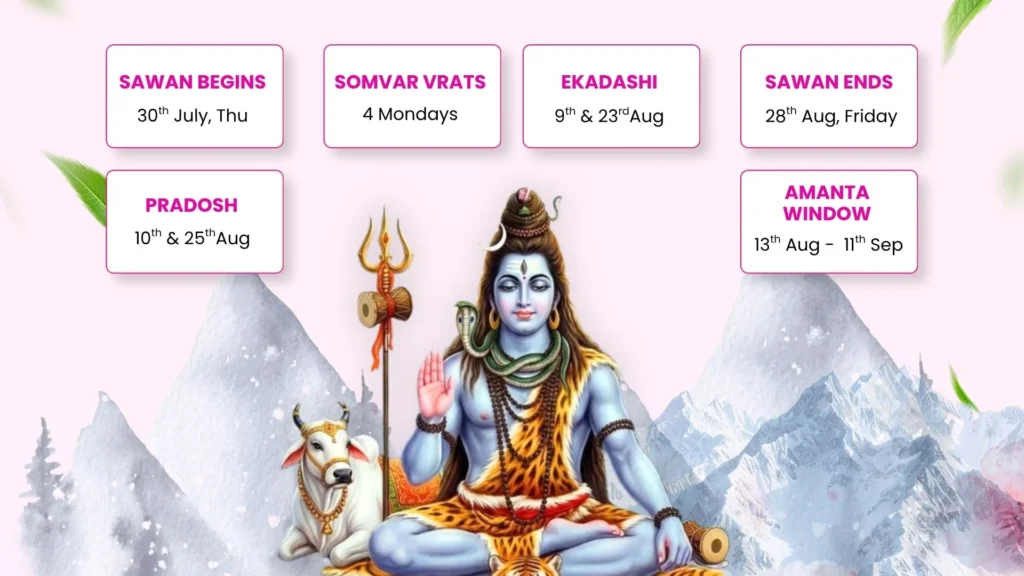
- Sawan Begins: Thursday, 30 July 2026
- Sawan Ends: Friday, 28 August 2026
- Sawan Somvar Vrats: 4 Mondays during Sawan
- Ekadashi Dates: 9 August and 23 August 2026
- Pradosh Vrat: 10 August and 25 August 2026
- Amanta Sawan Period: 13 August to 11 September 2026
Sawan 2026 Start Date and End Date
Sawan 2026 starts on July 30 and ends on August 28 in North India. In South India, it starts on August 13 and ends on September 11. The gap exists because these regions follow different lunar calendar systems, not because the festival itself changes.
The sawan start date and sawan end date depend entirely on which regional calendar your family follows. North India uses the Purnimanta system, which closes a lunar month on the full moon. South and West India use the Amanta system, which closes a lunar month on the new moon. Both are equally correct within their own tradition.
North India (Purnimanta)
- Start: Thu, 30 July 2026
- End: Fri, 28 August 2026
- Uttar Pradesh, Madhya Pradesh, Rajasthan, Bihar, Delhi, Punjab, Haryana, Himachal Pradesh, Jharkhand, Chhattisgarh
South & West India (Amanta)
- Start: Thu, 13 August 2026
- End: Fri, 11 September 2026
- Maharashtra, Gujarat, Karnataka, Andhra Pradesh, Telangana, Tamil Nadu, Goa, Kerala
Important Note: A small number of sources online list Sawan 2026 as starting on July 14 or July 18. These figures do not match Swiss Ephemeris panchang calculations or any major panchang authority, and we have excluded them from this guide after cross-verification. If you see a start date outside the July 30 or August 13 windows, treat it as an error.
Why Do Sawan Dates Differ Across India?
Sawan dates differ because North India follows the Purnimanta calendar, ending months on the full moon, while South and West India follow the Amanta calendar, ending months on the new moon. The festivals inside the month stay identical either way.
This is one of the most misunderstood parts of the Hindu calendar, and most articles skip explaining it clearly. Both the Purnimanta and Amanta systems track the same lunar cycle. They simply disagree on where one month ends and the next begins. Purnimanta closes the month right after the full moon (Purnima). Amanta closes it right after the new moon (Amavasya).
Because of this offset, Amanta Shravan starts roughly two weeks after Purnimanta Shravan begins, and ends about two weeks later too. A family in Uttar Pradesh and a family in Maharashtra are both observing genuine Shravan, on genuinely different calendar windows. Neither is more correct than the other.
All Sawan Somvar Dates 2026
North India has four Sawan Somwar dates 2026: August 3, 10, 17, and 24. Amanta states observe four Somvars on August 17, 24, 31, and September 7.
| Somvar | North India (Purnimanta) | Amanta States |
| First Somvar | Monday, 3 August | Monday, 17 August |
| Second Somvar | Monday, 10 August | Monday, 24 August |
| Third Somvar | Monday, 17 August | Monday, 31 August |
| Fourth Somvar | Monday, 24 August | Monday, 7 September |
Devotees who wish to begin the Solah Somvar Vrat, the sixteen-consecutive-Monday fast, during Sawan traditionally start on the first Sawan Somvar of their regional calendar: August 3 in North India, or August 17 in Amanta states.
Complete Sawan 2026 Calendar: Every Festival and Tithi
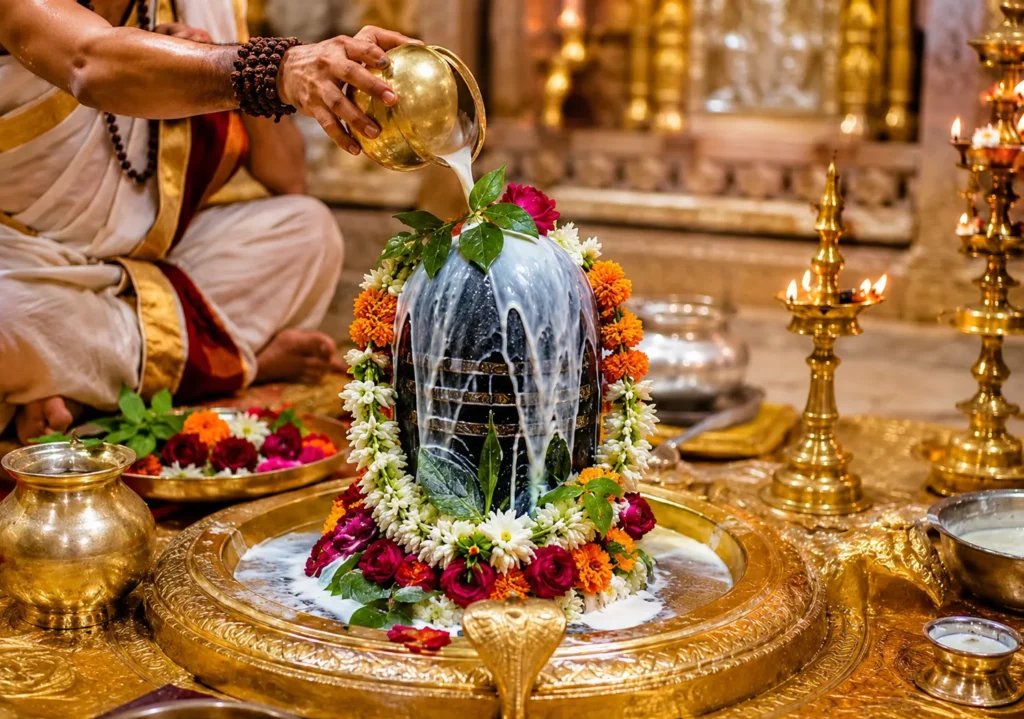
The Sawan 2026 festival dates include Kamika Ekadashi, Sawan Shivratri, Hariyali Amavasya, Hariyali Teej, Nag Panchami, four Mangala Gauri Vrats, Shravan Putrada Ekadashi, and Raksha Bandhan, all falling within the North Indian month window.
This is the full sawan 2026 calendar, laid out day by day for North India’s Purnimanta window. Every major vrat and festival that falls inside Shravan is listed here, so nothing gets missed.
- 30 July, Thursday – Sawan Begins & Kanwar Yatra Starts
- 3 August, Monday – First Sawan Somvar
- 4 August, Tuesday – First Mangala Gauri Vrat
- 9 August, Sunday – Kamika Ekadashi
- 10 August, Monday – Second Sawan Somvar & Som Pradosh Vrat
- 11 August, Tuesday – Second Mangala Gauri Vrat, Sawan Shivratri & Kanwar Yatra Peak
- 12 August, Wednesday – Hariyali Amavasya
- 15 August, Saturday – Hariyali Teej
- 17 August, Monday – Third Sawan Somvar & Nag Panchami
- 18 August, Tuesday – Third Mangala Gauri Vrat
- 23 August, Sunday – Shravan Putrada Ekadashi
- 24 August, Monday – Fourth Sawan Somvar
- 25 August, Tuesday – Fourth Mangala Gauri Vrat & Bhaum Pradosh
- 28 August, Friday – Raksha Bandhan, Shravan Purnima & Sawan Ends
Ekadashi and Pradosh Vrat Dates in Sawan 2026
Two Ekadashi fasts and two Pradosh fasts fall within Sawan 2026, both important for devotees who observe fortnightly vrats alongside their Sawan Somvar practice.
| Vrat | Date | Deity |
| Kamika Ekadashi | Sunday, 9 August | Lord Vishnu |
| Som Pradosh Vrat | Monday, 10 August | Lord Shiva |
| Shravan Putrada Ekadashi | Sunday, 23 August | Lord Vishnu |
| Bhaum Pradosh Vrat | Tuesday, 25 August | Lord Shiva |
Is There a Lunar Eclipse During Sawan 2026?
Eclipse Alert: Yes. A partial lunar eclipse occurs on Friday, August 28, 2026, the same day as Raksha Bandhan. It happens during Indian daytime hours, so the eclipse will not be visible anywhere in India. Because Sutak Kaal only applies where an eclipse is visible, no Sutak restrictions apply in India this year, and Raksha Bandhan celebrations, temple visits, and daily puja can proceed exactly as planned.
This is a detail many devotees search for closer to the date, and it is worth knowing well in advance. The eclipse’s umbral phase falls roughly between 8:00 AM and 11:30 AM IST, entirely during daylight, while the moon sits below the horizon for Indian observers. Skywatchers in the Americas and the Pacific will see it; India will not, and that single fact settles every ritual question around it.
Kawad Yatra 2026 Starting Dates
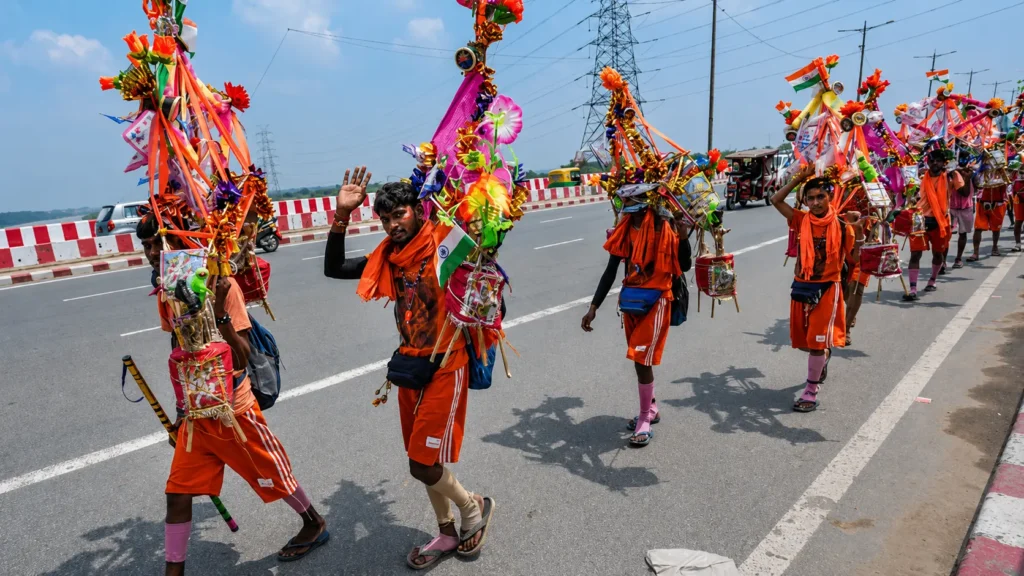
Kawad Yatra 2026 begins on July 30, the first day of Sawan, and concludes on August 11, Sawan Shivratri, when most Kanwariyas perform Jalabhishek with Ganga water collected from Haridwar, Gaumukh, or other sacred sites.
No Sawan calendar is complete without the Kawad Yatra, one of the largest annual pilgrimages in the world. Kawadiyas, dressed in saffron, walk from the Ganga at Haridwar, Gaumukh, or Sultanganj to their home temples, carrying holy water in a kanwar slung across their shoulders. The yatra opens with Sawan itself on July 30 and builds toward its peak on Sawan Shivratri, August 11, when the collected water is offered to the Shivling.
Families and commuters in Delhi-NCR, Uttar Pradesh, and Uttarakhand should plan travel around this window, since major routes including NH-34 see heavy diversions in the days leading up to August 11.
Raksha Bandhan 2026: The Day Sawan Closes
Raksha Bandhan falls on Friday, August 28, 2026, the Shravan Purnima that marks the end of Sawan in North India. The auspicious Rakhi-tying window generally falls in the morning hours, roughly between 6:00 AM and 9:50 AM IST, since no Bhadra period affects the day. As with all muhurat timings in this guide, confirm the exact window for your city against a local panchang closer to the date.
| Planning Your Sawan Somvar Vrat? Read our complete Sawan Somvar vrat vidhi guide with puja steps, samagri list, and vrat katha at My Favorite Corner. |
Conclusion
Sawan 2026 gives devotees a clear, panchang-verified window to plan around: July 30 to August 28 in North India, and August 13 to September 11 in Amanta states, with four Somvars, two Ekadashis, two Pradosh vrats, and a full run of festivals from Hariyali Teej to Raksha Bandhan.
Save this calendar, share it with your family, and check back closer to each date for exact muhurat timings in your city.
Frequently Asked Questions About Sawan 2026 Dates
In North India, following the Purnimanta calendar, Sawan 2026 starts on Thursday, July 30. In Maharashtra, Gujarat, and South India, following the Amanta calendar, Sawan 2026 starts on Thursday, August 13.
In North India, Sawan 2026 ends on Friday, August 28, the day of Shravan Purnima and Raksha Bandhan. In Amanta states, Sawan 2026 ends on Friday, September 11.
There are four Sawan Somvar dates in 2026. In North India they fall on August 3, 10, 17, and 24. In Amanta states they fall on August 17, 24, 31, and September 7.
Sawan dates differ because North India follows the Purnimanta lunar calendar, which ends the month on the full moon, while Maharashtra, Gujarat, and South India follow the Amanta calendar, which ends the month on the new moon. Both traditions observe the same festivals within their own month window.
Sawan 2026 includes Kamika Ekadashi, Sawan Shivratri, Hariyali Amavasya, Hariyali Teej, Nag Panchami, Mangala Gauri Vrat, Shravan Putrada Ekadashi, and Raksha Bandhan, which falls on the closing Shravan Purnima.
Yes, a partial lunar eclipse falls on August 28, 2026, the same day as Raksha Bandhan. It will not be visible from India, so no Sutak Kaal applies and Rakhi celebrations proceed without any restriction.
Devotees who wish to begin the sixteen-week Solah Somvar Vrat during Sawan traditionally start on the first Sawan Somvar, which falls on August 3, 2026, in North India, or August 17 in Amanta states.
Kawad Yatra 2026 begins on July 30, the first day of Sawan, and concludes on August 11, Sawan Shivratri, when most Kanwariyas complete their Jalabhishek with Ganga water.
| The journey does not end here. Follow MFC on Instagram and Facebook to explore more sacred places, festivals, and living traditions of Sanatan Dharma. |