
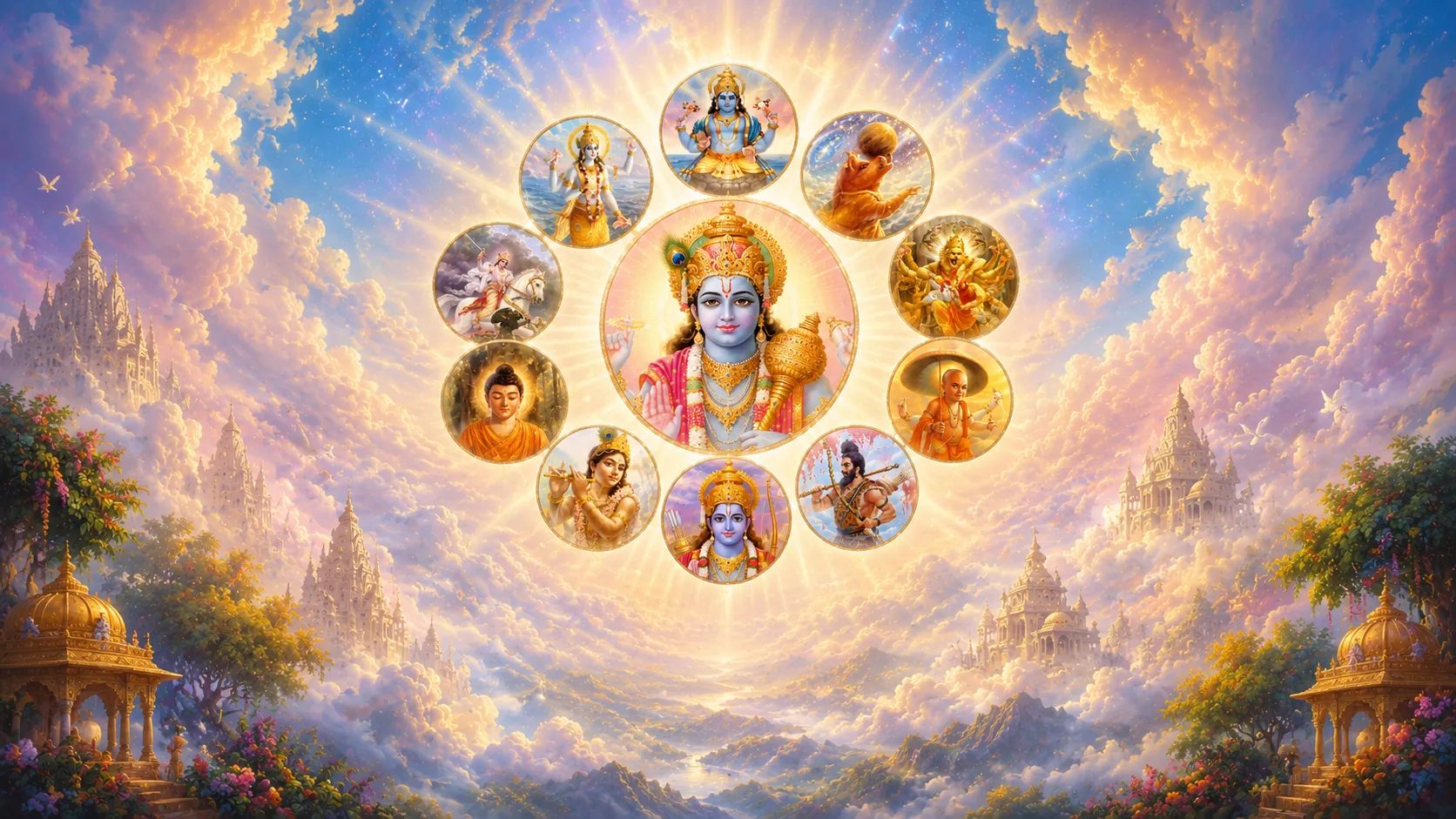
The Dashavatara refers to the 10 avatars of Lord Vishnu, the great preserver god in Hinduism. The word comes from Sanskrit. “Dasha” means ten. “Avatara” means a divine being who descends to Earth. Lord Vishnu took these ten forms across different ages called Yugas.
Each Lord Vishnu incarnation came to destroy evil and restore Dharma (righteousness). The ten avatars are: Matsya, Kurma, Varaha, Narasimha, Vamana, Parashurama, Rama, Krishna, Buddha, and Kalki. Nine have already appeared. Kalki is yet to come.
Dashavatara at a Glance: All 10 Avatars of Vishnu
This table gives you a quick overview of all ten incarnations of Vishnu in order. You can see the name, form, Yuga, purpose, and scripture at one glance.
| Avatar Name | Form / Appearance | Yuga (Age) | Purpose | Key Scripture | |
| 1 | Matsya | Giant fish; upper human body, lower fish tail | Satya Yuga | Save the Vedas and all life from the great flood | Matsya Purana, Srimad Bhagavatam |
| 2 | Kurma | Giant tortoise; four-armed upper body on a tortoise shell | Satya Yuga | Support Mount Mandara during the churning of the cosmic ocean | Kurma Purana, Srimad Bhagavatam |
| 3 | Varaha | Boar head on a powerful human body; carries Earth on tusks | Satya Yuga | Rescue the Earth from the demon Hiranyaksha | Varaha Purana, Srimad Bhagavatam |
| 4 | Narasimha | Lion head and claws on a human body; fierce, golden eyes | Satya Yuga | Protect devotee Prahlada; destroy tyrant Hiranyakashipu | Narasimha Purana, Srimad Bhagavatam |
| 5 | Vamana | Short dwarf Brahmin boy; expands into cosmic giant Trivikrama | Treta Yuga | Reclaim the three worlds from the prideful King Bali | Vamana Purana, Srimad Bhagavatam |
| 6 | Parashurama | Brahmin sage with an axe; long matted hair, fierce posture | Treta Yuga | Destroy corrupt Kshatriya kings who misused their power | Vishnu Purana, Srimad Bhagavatam |
| 7 | Rama | Blue-skinned prince; standing with a bow and arrow, noble crown | Treta Yuga | Defeat demon king Ravana; uphold ideal human virtue | Valmiki Ramayana, Srimad Bhagavatam |
| 8 | Krishna | Blue-skinned; playing flute, peacock-feather crown, yellow garment | Dvapara Yuga | Destroy Kansa and evil; deliver the Bhagavad Gita to the world | Srimad Bhagavatam, Bhagavad Gita, Mahabharata |
| 9 | Buddha | Serene meditating figure; saffron robes, peaceful demeanor | Kali Yuga | Teach compassion and non-violence; end needless animal sacrifices | Srimad Bhagavatam 1.3.24, Padma Purana |
| 10 | Kalki | Warrior on a white horse; blazing sword, divine armor | End of Kali Yuga | Destroy all evil; end Kali Yuga; begin Satya Yuga again | Kalki Purana, Srimad Bhagavatam |
What is Dashavatara? Why Did Lord Vishnu Take 10 Avatars?
Imagine a world falling into chaos. Evil rulers take over. Good people suffer. Righteousness fades away. Who steps in to save the day? Lord Vishnu does. He descends to Earth. He takes a form. He fixes the problem. Then he leaves.
This idea is the heart of the Dashavatara. Lord Vishnu is the Preserver of the universe in the Hindu Trinity. Brahma creates. Shiva destroys. Vishnu protects. Whenever life on Earth faces a great threat, Vishnu acts.
Why exactly 10 avatars?
The Srimad Bhagavatam says Lord Vishnu has countless avatars. Many saints, sages, and cosmic beings carry his divine energy. But out of all these, ten are considered the most complete and powerful. Ancient sages chose these ten as the greatest representatives of Vishnu’s cosmic mission.
These ten are spread across four great ages or Yugas. Four avatars appeared in Satya Yuga. Three came in Treta Yuga. Two appeared in Dvapara Yuga. One more is still to come in Kali Yuga.
What is an Avatar?
In Sanskrit, the word “Avatar” means “one who descends.” It specifically describes God coming down from the spiritual realm to Earth. This is different from a regular birth. A normal being is born due to past karma. An avatar descends by free will. The purpose is always to restore Dharma and protect the good.
Bhagavad Gita, Chapter 4, Verse 7: “Whenever there is a decline in righteousness and an increase in evil, I manifest myself. For the protection of the good and the destruction of the wicked, I take birth age after age.” This is the direct promise of Lord Vishnu himself.
01. Matsya Avatar
- First Avatar of Vishnu
- The Sacred Fish
- Satya Yuga
- Matsya Purana, Srimad Bhagavatam
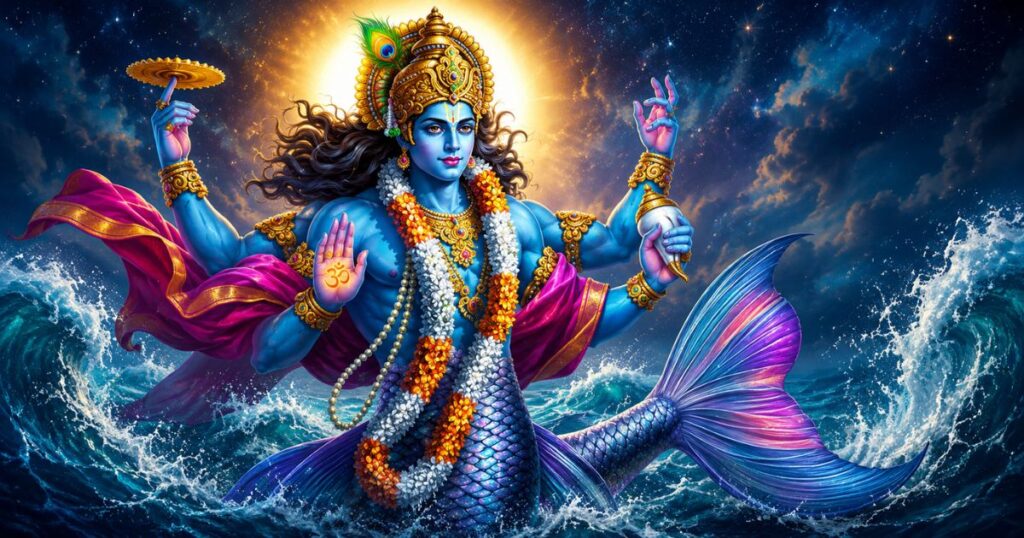
- Giant Fish Form
How He Looks: Matsya has the upper body of a four-armed human and the lower body of a giant golden fish. He holds a conch, a discus, a mace, and a lotus. His body shines like the morning sun on the water. | Purpose: Save the sacred Vedas from a demon. Rescue the first man Manu and all living creatures from a massive flood. Start a fresh cycle of creation. |
The Story of Matsya Aavatar
A long time ago, the demon Hayagriva stole the sacred Vedas from Lord Brahma. The Vedas are the oldest and most important scriptures in Hinduism. Without them, all knowledge of the universe would vanish.
At the same time, a great flood was coming. It would swallow the entire world. The first human, Manu, was washing his hands in a river one day. A tiny fish swam into his hands. It asked him to protect it. Manu placed the fish in a pot. But it kept growing. It grew bigger and bigger until the ocean itself could not hold it.
The fish then revealed its true identity. It was Lord Vishnu himself. He told Manu about the coming flood. He asked him to build a great boat. Manu gathered all living beings, plant seeds, and the seven great sages onto the boat. The giant Matsya then towed the boat with a snake tied to his horn. He carried everyone safely through the flood. He also recovered the Vedas from the demon and returned them to Brahma.
A new world began. Life started fresh. Manu became the father of all future humanity.
02. Kurma Avatar
- Second Avatar of Vishnu
- The Giant Tortoise
- Satya Yuga
- Kurma Purana · Srimad Bhagavatam
- Giant Tortoise Form
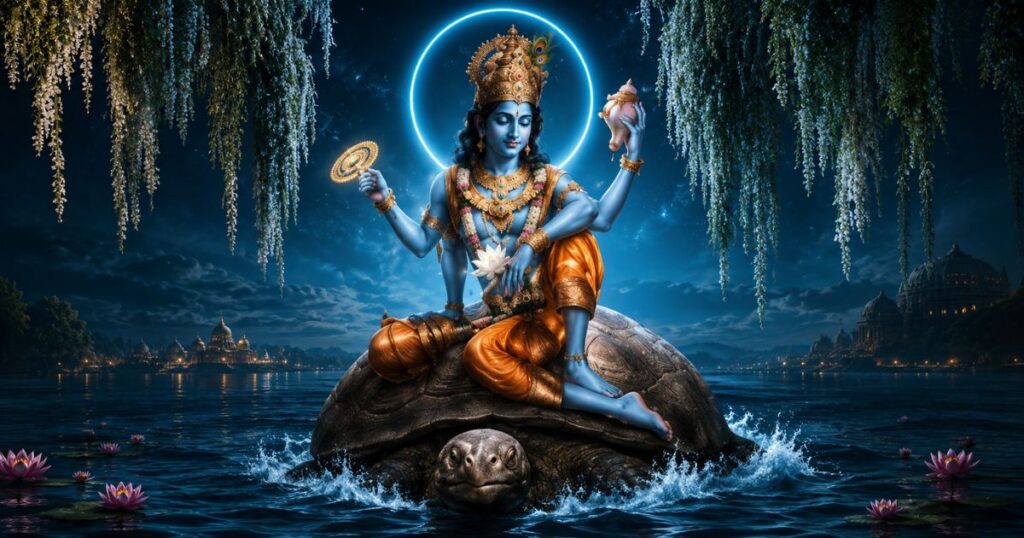
| How He Looks: Kurma appears as a massive tortoise with a bright golden shell. Some texts show him as half-man and half-tortoise with four arms. His shell is enormous enough to hold an entire mountain on it. | Purpose: Support the great mountain Mandara during the famous Samudra Manthan, the churning of the cosmic ocean. Without this support, the mountain would sink and the mission would fail. |
The Story of Kurma Avatar
The gods (Devas) and demons (Asuras) made a deal. They would churn the cosmic ocean together to get the nectar of immortality called Amrita. They used the great mountain Mandara as a churning rod. The giant serpent Vasuki wrapped around the mountain as a rope.
But there was a big problem. As they started churning, the mountain began to sink into the ocean floor. Everything was about to fall apart. The Devas and Asuras cried out to Vishnu for help.
Lord Vishnu took the form of the giant tortoise Kurma. He dived into the cosmic ocean. He placed the mountain Mandara on his enormous shell. He supported it from below. The churning continued steadily. From the ocean emerged many treasures.
The divine physician Dhanvantari appeared with Amrita. Goddess Lakshmi herself rose from the waters. Eventually, Vishnu ensured the gods received the nectar of immortality.
03. Varaha Avatar
- The Cosmic Boar
- Third Avatar of Vishnu
- Satya Yuga
- Varaha Purana · Srimad Bhagavatam
- Boar-Headed Human Form
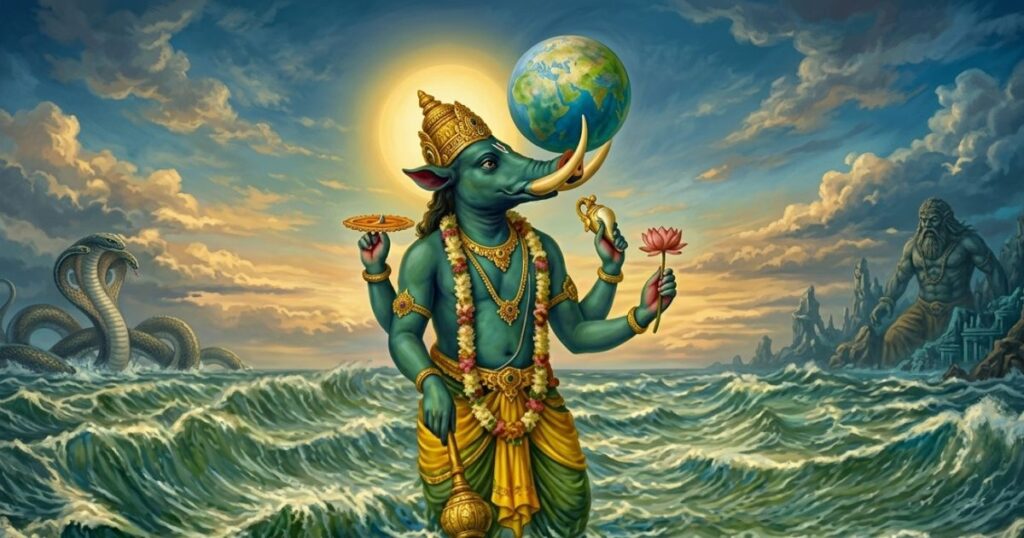
| How He Looks Varaha has the mighty head of a wild boar on a powerful human body. He has four arms. He holds the Earth, shown as a goddess called Bhudevi, gently on his tusks. His body is dark blue. His eyes glow like molten gold. | Purpose Rescue the Earth goddess from the demon Hiranyaksha who had dragged her to the bottom of the cosmic ocean. Protect the planet and restore its rightful place in the universe. |
The Story of Varaha Avatar
The demon Hiranyaksha was enormously powerful. He challenged everyone in the universe to fight him. Finding no worthy opponent, he decided to cause chaos. He grabbed the entire Earth and dragged her deep into the cosmic ocean. Without Earth, all life would disappear.
Lord Brahma was deep in thought about this crisis. From his nostril, a tiny boar emerged. That boar began growing rapidly. It expanded to the size of a mountain. It grew to fill the entire sky. It was Lord Vishnu in his Varaha form.
Varaha dove into the cosmic ocean. A fierce battle took place in the deep waters. For a thousand years they fought. Finally, Varaha killed Hiranyaksha with his powerful tusks. He then gently lifted the Earth goddess on his tusks and carried her back to the surface. He set her back in her proper place in the universe. Balance was restored.
04. Narasimha Avatar
- The Man-Lion
- Fourth Avatar of Vishnu
- Satya Yuga
- Narasimha Purana · Srimad Bhagavatam
- Man-Lion Hybrid Form
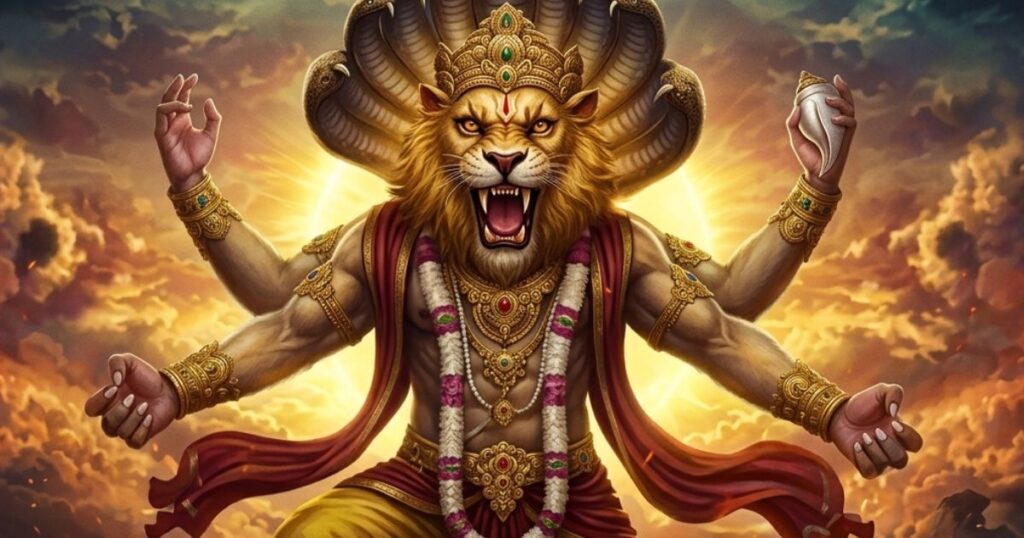
| How He Looks Narasimha has the head and claws of a lion on the body of a human. He has four arms. His eyes blaze with golden fire. He appears at dusk, not in day and not in night. His mane stands tall. His expression shows fierce yet protective fury. | Purpose Protect the young devotee Prahlada from his evil father. Destroy the tyrant king Hiranyakashipu who had received a boon making him nearly impossible to kill. |
The Story of Narasimha Avatar
After Vishnu killed Hiranyaksha (in the Varaha avatar), the demon king’s brother Hiranyakashipu was furious. He performed intense austerities to please Lord Brahma. He asked for a special boon. He wanted to be unkillable.
Brahma gave him this powerful boon. Hiranyakashipu could not be killed by any man or any animal. He could not be killed with a weapon or without one. He could not die indoors or outdoors. He could not die during the day or at night. He could not die on the ground or in the sky. With this protection, he became a tyrant. He declared himself a god. He banned the worship of Vishnu.
But his young son Prahlada was a devoted follower of Lord Vishnu. No matter what Hiranyakashipu did, Prahlada refused to stop his worship. The king tried to kill his own son many times. Prahlada survived every attempt through Vishnu’s protection.
One day, in fury, Hiranyakashipu challenged Prahlada. He pointed to a pillar and asked, “Is your Vishnu in this pillar too?” Prahlada said yes. The king struck the pillar with his fist.
From that pillar emerged Lord Narasimha. He was neither man nor animal. He appeared at dusk, not day, not night. He was at the threshold, neither inside nor outside. He placed Hiranyakashipu on his lap, neither on the ground nor in the sky. He used his bare claws, not a weapon. Every condition of the boon was met and broken at the same time. He destroyed the tyrant. Prahlada was safe.
05. Vamana Avatar
- The Dwarf Brahmin
- Fifth Avatar of Vishnu
- Treta Yuga
- Vamana Purana · Srimad Bhagavatam
- Dwarf / Cosmic Giant Form
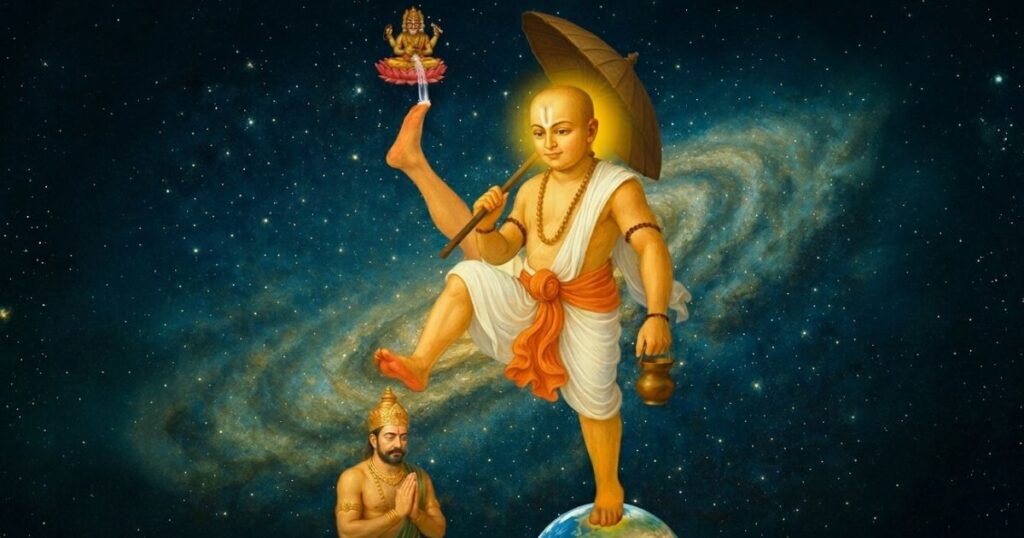
| How He Looks Vamana first appears as a tiny, cheerful dwarf Brahmin boy with a sacred thread and a wooden staff. He has bright eyes and a calm smile. When he expands, he fills the entire cosmos in three massive steps. | Purpose Restore the three worlds to the gods after the powerful demon king Bali took control of everything. Teach the lesson that pride leads to downfall, but humility leads to blessings. |
The Story of Vamana Avatar
King Bali was a very powerful and generous king. He was a descendant of Prahlada and was actually quite virtuous. Through his devotion and penance, he became so powerful that he defeated the king of gods, Indra. He took control of all three worlds, the Earth, the heavens, and the underworld.
The gods appealed to Lord Vishnu for help. Vishnu took the form of a tiny dwarf Brahmin child called Vamana and approached King Bali during a great ceremony.
Bali, known for his generosity, told Vamana he could have anything he wanted. Vamana asked for just three steps of land. Bali laughed at the small request and agreed. His teacher Shukracharya warned him that Vamana was Lord Vishnu himself. But Bali honored his word.
Immediately, Vamana began to grow. He expanded to cosmic size as Trivikrama. He covered the entire Earth with his first step. He covered the heavens with his second step. No space remained for the third step.
Bali, humbled and true to his word,offered his own head. Vamana placed his foot on Bali’s head and pushed him to the underworld. But because Bali showed such humility and truth, Vishnu rewarded him. He was given immortality and his own kingdom in the underworld.
06. Parashurama Avatar
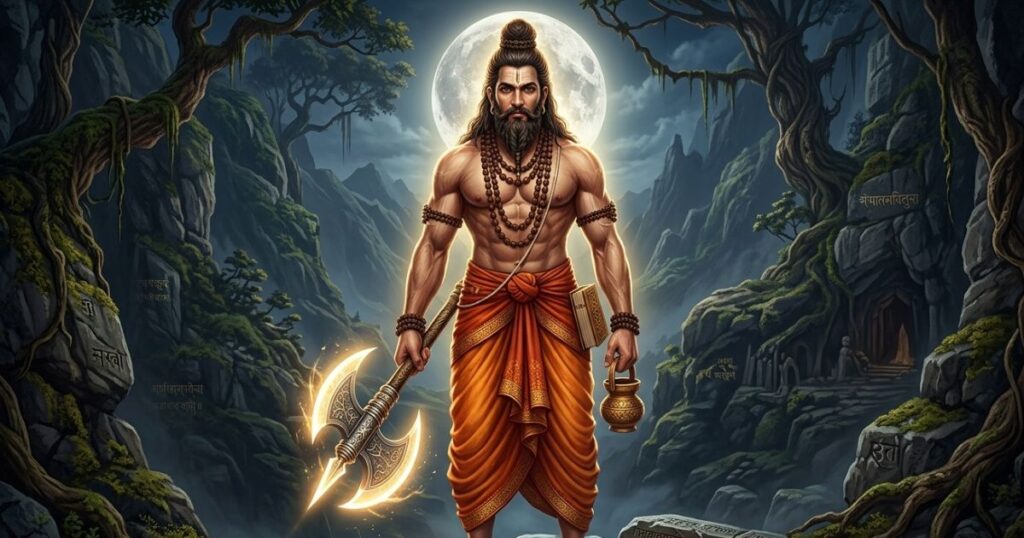
- The Warrior Sage
- Sixth Avatar of Vishnu
- Treta Yuga
- Vishnu Purana · Srimad Bhagavatam · Ramayana
- Brahmin Warrior with Axe
| How He Looks Parashurama appears as a tall, powerful Brahmin sage. He has long matted hair and a beard. He carries a divine battle-axe called the Parashu on his shoulder. His posture is fierce and warrior-like. His eyes hold both the fire of a fighter and the calm of a sage. | Purpose Punish and remove corrupt Kshatriya (warrior-king) rulers who misused their power and oppressed the poor and the Brahmins. Restore balance between knowledge and power. |
The Story of Parashuram Avatar
Parashurama was born as the son of the sage Jamadagni and his wife Renuka. He was a Brahmin by birth but received warrior training. Lord Shiva gave him the divine axe called the Parashu. From that day, he was called Parashurama, which means “Rama with an axe.”
The powerful and arrogant king Kartavirya Arjuna came to Jamadagni’s ashram. He stole the family’s sacred wish-fulfilling cow, Kamadhenu. When Parashurama was away, soldiers killed the peaceful sage Jamadagni.
Parashurama was devastated. His anger burned like a wildfire. He killed King Kartavirya Arjuna in battle. But the corrupt Kshatriyas continued to cause trouble. Parashurama circled the Earth 21 times, removing every corrupt king who had abused his power.
Parashurama is unique among the avatars. He is a Chiranjivi, meaning immortal. He is still believed to be alive today.According to scriptures, he will reappear to train Kalki, the tenth and final avatar of Vishnu.
07. Rama Avatar
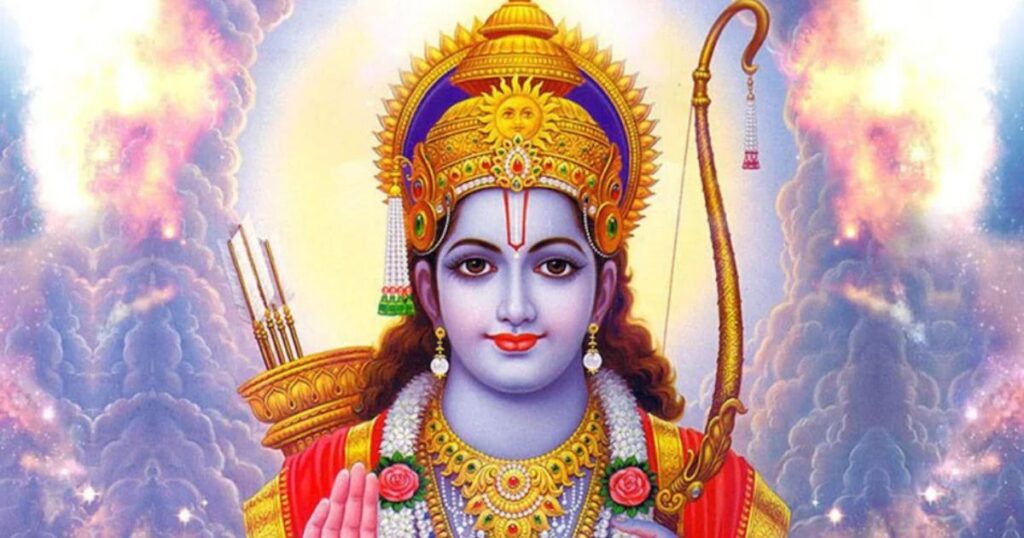
- The Ideal King
- Seventh Avatar of Vishnu
- Treta Yuga
- Valmiki Ramayana, Srimad Bhagavatam, Ramcharitmanas
- Blue-Skinned Prince with Bow
| How He Looks Rama has blue skin like a rain cloud. He stands tall and noble. He holds a powerful bow called Kodanda in his hand. He wears a crown, yellow royal garments, and earrings. His expression is gentle, calm, and deeply compassionate. He is described as the most handsome of all beings. | Purpose Defeat the ten-headed demon king Ravana of Lanka who had kidnapped his wife Sita. Show the world the perfect example of virtue, devotion, duty, and ideal human character. |
The Story of Rama Avatar
Rama was born as the prince of Ayodhya. His father was King Dasaratha. His mother was Queen Kausalya. From childhood, Rama was the ideal son, brother, student, and friend. His story is told in the great epic Ramayana, written by the sage Valmiki. It is one of the longest and most loved stories in the world.
Through a palace conspiracy, Rama was sent into exile for 14 years. He went to the forest with his devoted wife Sita and his loyal brother Lakshmana. During this exile, the demon king Ravana kidnapped Sita and took her to his island kingdom of Lanka.
Rama built a great army with the help of the monkey-king Sugriva and the heroic devotee Hanuman. They built a bridge across the ocean to Lanka. A great war followed. Rama killed Ravana and rescued Sita. He returned to Ayodhya and was crowned king. His rule, called Rama Rajya, became the symbol of a perfect and just kingdom.
Rama is called Maryada Purushottam, which means “the ideal being within the bounds of propriety.” He always followed Dharma, even when it hurt him personally. He remains the most beloved avatar for millions of Hindus today.
08. Krishna Avatar
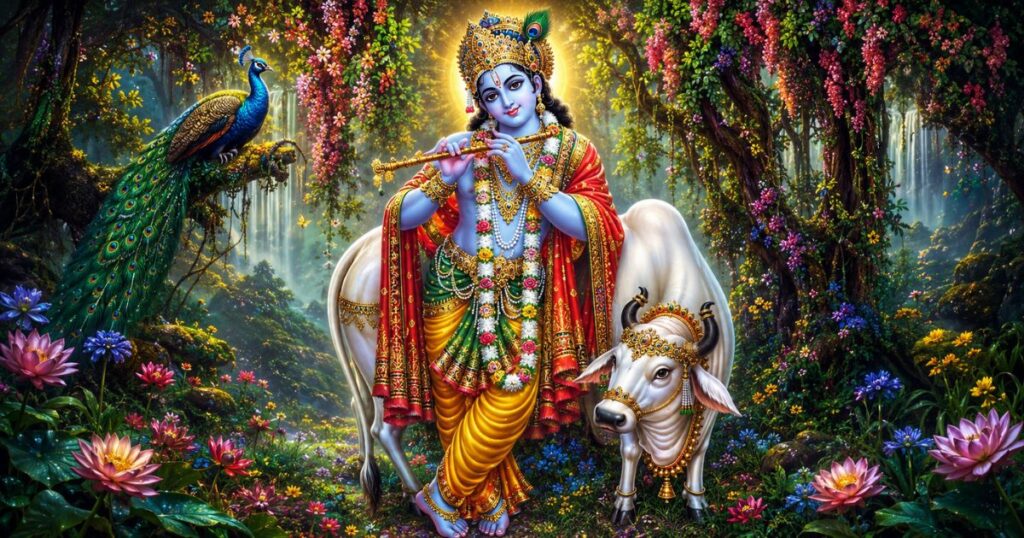
- The Divine Guide
- Eighth Avatar of Vishnu
- Dvapara Yuga
- Srimad Bhagavatam · Bhagavad Gita · Mahabharata
- Blue-Skinned Flute Player
| How He Looks Krishna has deep blue skin like the night sky. He wears a peacock feather in his crown. He plays a divine flute called the Murali. He wears yellow garments called Pitambara. His smile is said to calm even the stormiest heart. He sometimes holds the Sudarshana Chakra, his spinning divine weapon. | Purpose Destroy his evil uncle Kansa and many other demons. Guide the Pandavas to victory in the Mahabharata war. Deliver the Bhagavad Gita, one of the world’s greatest spiritual teachings, to all humanity. |
The Story of Krishna Avatar
Krishna was born in a prison cell to Devaki and Vasudeva. His uncle, the tyrant king Kansa, had imprisoned them because a prophecy said Devaki’s eighth child would kill him. At birth, Krishna was miraculously carried across the river Yamuna to safety by his father Vasudeva.
He grew up in Vrindavan with his foster mother Yashoda and father Nanda. His childhood was full of miraculous deeds. He killed demons sent by Kansa. He lifted the great Govardhan mountain on his little finger to protect the villagers from Indra’s storms. He played his divine flute and filled the world with beauty.
Later, Krishna returned to Mathura. He killed Kansa and freed his parents. He became a great statesman, warrior, and king. During the great Mahabharata war at Kurukshetra, Krishna acted as the charioteer of the Pandava hero Arjuna.
Before the battle began, Arjuna was overcome with doubt and grief. Krishna then delivered the Bhagavad Gita, the Song of God, to Arjuna. It contains 700 verses of the highest spiritual wisdom. It remains one of the most read scriptures in the world today.
09. Buddha Avatar
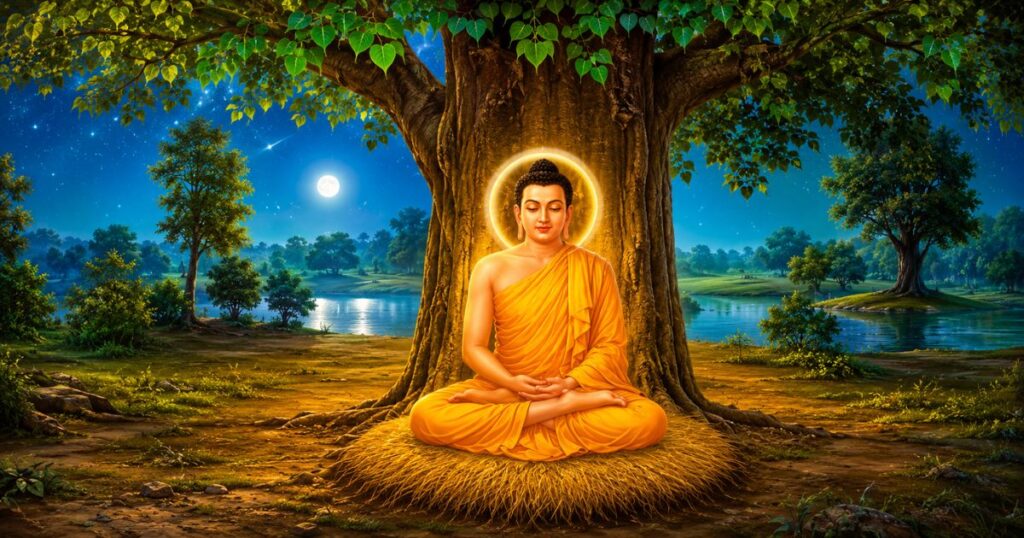
- The Enlightened Teacher
- Ninth Avatar of Vishnu
- Beginning of Kali Yuga
- Srimad Bhagavatam 1.3.24, Padma Purana, Garuda Purana
- Serene Meditating Figure
| How He Looks Buddha appears as a serene, peaceful human figure. He wears simple saffron robes. His expression is calm and deeply compassionate. He is often shown sitting in meditation under the Bodhi tree. His presence communicates stillness, kindness, and inner freedom. | Purpose Teach compassion and non-violence to the world. End the misuse of Vedic rituals. Stop needless animal sacrifices done in the name of religion. Guide humanity toward inner peace and the end of suffering. |
The Story of Buddha Avatar
Buddha was born as Prince Siddhartha Gautama in the kingdom of Kapilavastu. He grew up surrounded by luxury. His father protected him from all knowledge of suffering. But one day, the young prince stepped outside the palace walls. He saw an old man, a sick man, a dead body, and a wandering monk. These sights changed his life forever.
He quietly left his palace, his wife, and his newborn son. He went into the world to find the truth behind suffering. After years of seeking, he sat under a Bodhi tree in Bodh Gaya. He meditated without moving until he received complete enlightenment. From that day, he was called Buddha, the Awakened One.
He spent the rest of his life teaching. He taught the Four Noble Truths and the Noble Eightfold Path. He taught that suffering comes from desire and attachment. He taught a way to end all suffering through right understanding, right action, and compassion for all living beings. His teachings spread across all of Asia and the whole world.
The Srimad Bhagavatam (1.3.24) specifically includes Buddha as an avatar of Lord Vishnu. His mission was to redirect people away from rituals that caused harm and toward inner transformation and kindness.
10. Kalki Avatar
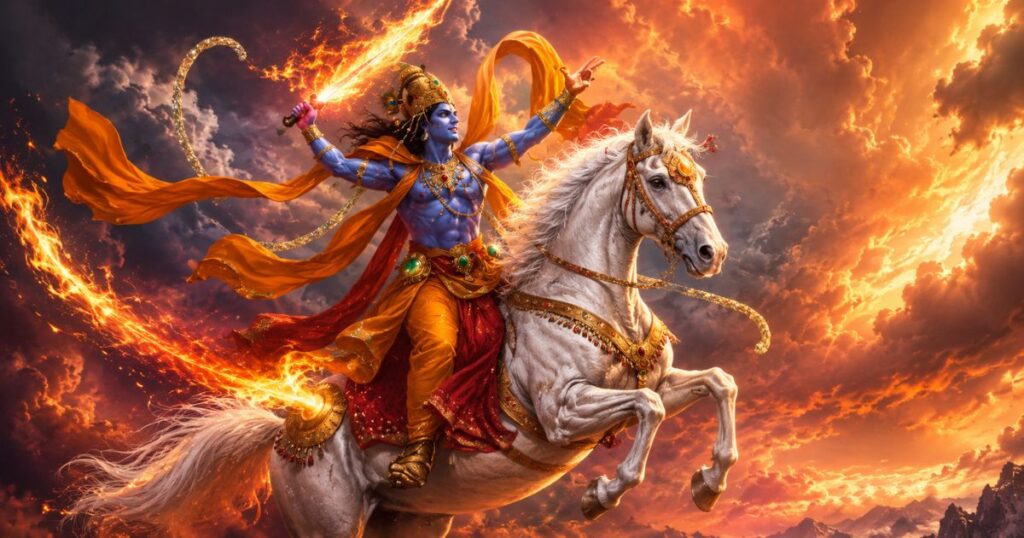
- The Future Warrior
- Tenth Avatar of Vishnu
- End of Kali Yuga (Future)
- Kalki Purana, Srimad Bhagavatam, Agni Purana
- Warrior on White Horse
| How He Looks Kalki will appear as a powerful warrior riding a brilliant white horse named Devadatta. He will carry a blazing sword that shines like a comet. He will wear divine armor. His arrival will bring fire to evil and peace to the righteous. | Purpose End the age of Kali Yuga where evil, corruption, and unrighteousness dominate. Destroy all darkness. Restart the Satya Yuga, the Golden Age of truth, purity, and divine living. |
The Prophecy of Kalki Avatar
Kalki has not appeared yet. He is the only avatar of the Dashavatara who is still to come. The Kalki Purana describes his coming in detail. He will be born to a Brahmin family in a village called Shambhala. His father will be named Vishnuyasha.
He will come at a time when the Kali Yuga has reached its darkest point. According to the Srimad Bhagavatam, in those times, rulers will be corrupt and cruel. Truth will be rare. Life will be short and hard. People will live only for sensory pleasure. Spiritual knowledge will vanish.
At that point, Lord Vishnu will descend as Kalki. He will ride his white horse and carry his blazing sword. He will swiftly destroy all sources of unrighteousness. After this great cleansing, the world will become pure again. A new Satya Yuga will begin. The cosmic cycle of four Yugas will restart from the beginning.
The Vishnu Purana says this entire Yuga cycle has already been repeated countless times. Kalki is not just a future event. He is the promise that goodness always returns, no matter how dark things become.
Dashavatara and the Theory of Evolution
Here is one of the most fascinating ideas in all of Hindu scripture. The sequence of Dashavatara closely mirrors the scientific theory of biological evolution.
British geneticist J. B. S. Haldane once said the Dashavatara represents “a rough idea” of vertebrate evolution. He called it an uncanny match with the modern scientific understanding of life’s development on Earth.
Even the great Vaishnava teacher Bhaktivedanta Swami Prabhupada noted that the Padma Purana’s description of avatars anticipates Darwin’s theory of evolution. Let us see how.
Stage 1: Aquatic Life – Matsya (Fish)
All life on Earth started in water. Matsya is a pure water creature. Darwin’s theory also says life began in the ocean.
Stage 2: Amphibian Life – Kurma (Tortoise)
Tortoises live in both water and on land. They represent the step from sea creatures to creatures that could survive on both.
Stage 3: Land Mammal – Varaha (Boar)
The boar is a fully land-based mammal. This matches the evolution of four-legged terrestrial animals on Earth.
Stage 4: Half-Human – Narasimha (Man-Lion)
Half-animal, half-human. This represents the early stage of human evolution where human and animal qualities still mixed.
Stage 5: Early Human – Vamana (Dwarf)
A short but fully human form. This represents early primitive humans who were smaller and still developing.
Stage 6: Primitive Forest Human – Parashuram
A human living in forests with simple tools like an axe. This parallels early Stone Age humans who lived in nature.
Stage 7: Civilized Moral Human – Rama
A fully civilized, moral, and virtuous human with advanced society, language, ethics, and values. Human civilization at its best.
Stage 8: Enlightened Human – Krishna
A fully enlightened spiritual human who delivers cosmic wisdom. Represents humans who understand the deep nature of existence.
Stage 9: Universal Compassion – Buddha
The human who reaches inner perfection through compassion. Represents humanity moving beyond physical evolution to spiritual evolution.
Stage 10: Cosmic Reset – Kalki
The final form who ends and restarts the cycle. Represents the idea that evolution is not linear but cyclical.
Important Note on This Comparison
The Dashavatara is a spiritual and theological concept, not a biological science text. It describes God descending to Earth, not random species evolving. Darwin’s evolution is based on natural selection and has no role for God. The Dashavatara begins with God’s will and divine purpose. The two come from very different starting points.
What makes the comparison fascinating is the order. The sequence from water creature to amphibian to land animal to human to enlightened being matches the direction of evolutionary science. Whether this is coincidence or ancient wisdom is a question that scientists and philosophers still debate today.
Significance of Dashavatara in Hinduism
Why does Dashavatara matter so much?
The Dashavatara is not just a list of ten stories. It is a complete worldview. It answers the deepest questions of life. Why is there suffering? Does God care about human beings? What is the purpose of existence?
The answer the Dashavatara gives is powerful. Yes, God cares. When things go badly wrong, the divine does not stay distant. It comes down. It takes a form. It acts. It fixes things. And then it teaches humanity to be better.
Each Avatar Solves a Specific Problem
- A flood destroyed the world? Matsya saved it.
- The cosmic ocean needed support? Kurma provided it.
- Earth was stolen? Varaha retrieved it.
- A tyrant seemed unkillable? Narasimha found a way.
- The three worlds were controlled by pride? Vamana restored balance.
- Corrupt rulers oppressed the world? Parashurama removed them.
- A demon king terrorized creation? Rama defeated him.
- The world needed divine wisdom? Krishna delivered it.
- Rituals caused harm? Buddha redirected humanity.
- Kali Yuga reaches its darkest end? Kalki will restart everything.
What Dashavatara Teaches Us?
- Good always triumphs over evil in the end.
- God is compassionate and actively protects the innocent.
- Every age gets the divine help it needs most.
- Devotion protects a person even from the most powerful evil.
- Pride and arrogance always lead to downfall.
- Duty (Dharma) is more important than personal comfort.
- Life is cyclical. Every ending is a new beginning.
- Spiritual evolution matters as much as physical existence.
Cultural Reach: The Dashavatara has inspired thousands of years of art, sculpture, dance, music, and literature. Every major Hindu temple features avatars on its walls. Classical dance forms like Bharatanatyam and Kathakali depict these stories. The avatars appear in the Ramayana, Mahabharata, Bhagavad Gita, and 18 major Puranas. Their influence on Indian civilization is immeasurable.
Conclusion
The Dashavatara of Lord Vishnu is one of the most extraordinary ideas in the history of spiritual thought. Ten divine forms. Ten different ages. Ten different missions. One unwavering purpose: protect the good and restore balance to the world.
From a tiny fish saving the Vedas in a great flood, to a future warrior riding a white horse to end Kali Yuga, the story of Vishnu’s ten avatars spans the entire arc of creation itself.
Each avatar is more than a story. It is a mirror. Matsya teaches protection and selflessness. Kurma teaches steady support. Varaha teaches courage. Narasimha teaches that devotion protects even from the impossible. Vamana teaches that humility always wins over pride.
Parashurama teaches that justice has no compromise. Rama teaches that duty and virtue matter above all else. Krishna teaches wisdom and love. Buddha teaches compassion and peace. Kalki promises that no matter how dark the night gets, the dawn always comes.
Whether you read these stories as a child or as a grown adult, they offer something new every time. They speak to the universal human experience. Good and evil. Courage and fear. Love and loss. And ultimately, the unbreakable hope that righteousness always returns.
Jai Dashavatara. Jai Srihari Vishnu.
Frequently Asked Questions (FAQs) About Dashavtar of Shri Vishnu
1. What is Dashavatara meaning in simple words?
Dashavatara means the ten divine descents of Lord Vishnu. “Dasha” means ten in Sanskrit. “Avatara” means descent or incarnation. These ten forms are Matsya, Kurma, Varaha, Narasimha, Vamana, Parashurama, Rama, Krishna, Buddha, and Kalki. Lord Vishnu took these forms at different times to protect the world and restore Dharma.
2. What are the 10 avatars of Vishnu in order?
The 10 avatars of Vishnu in the most widely accepted order are: 1. Matsya (Fish), 2. Kurma (Tortoise), 3. Varaha (Boar), 4. Narasimha (Man-Lion), 5. Vamana (Dwarf), 6. Parashurama (Warrior Sage), 7. Rama (Ideal King), 8. Krishna (Divine Guide), 9. Buddha (Enlightened Teacher), 10. Kalki (Future Warrior). This order comes from the Garuda Purana, Padma Purana, and other major scriptures.
3. Why did Vishnu take 10 avatars?
Lord Vishnu took these avatars to restore cosmic balance. Whenever evil grew so strong that good people suffered, Vishnu descended. Each avatar solved a specific problem of that age. This reflects a core Hindu belief: God is not passive. When Dharma is in danger, the divine acts directly and personally.
4. In which Yuga did each avatar of Vishnu appear?
Four avatars appeared in Satya Yuga: Matsya, Kurma, Varaha, and Narasimha. Three appeared in Treta Yuga: Vamana, Parashurama, and Rama. Two appeared in Dvapara Yuga: Krishna (and Balarama in some traditions). One appeared at the start of Kali Yuga: Buddha. And one, Kalki, will appear at the end of Kali Yuga.
5. Which scripture mentions the Dashavatara?
Multiple ancient scriptures describe the Dashavatara. The Srimad Bhagavatam (Bhagavata Purana) is the most complete. The Garuda Purana, Padma Purana, Vishnu Purana, Agni Purana, and individual Puranas for each avatar also describe them. The Kalki Purana specifically describes the final avatar. The earliest epigraphic (stone inscription) reference dates to the 7th century CE at Mahabalipuram.
6. Is Buddha really an avatar of Vishnu?
In many Hindu traditions, yes. The Srimad Bhagavatam (1.3.24) explicitly mentions Buddha as an avatar of Vishnu. The Garuda Purana, Padma Purana, and Agni Purana agree. By the 8th century CE, Buddha was widely accepted as a Vishnu avatar in Vaishnavism. However, some traditions replace Buddha with Balarama in the Dashavatara list. Both views exist and are respected.
7. What is the purpose of Dashavatara?
The purpose of Dashavatara is to restore Dharma in every age. Each avatar targets a specific form of evil or cosmic imbalance. Together, they show that the divine is always present and responsive. They also teach moral and spiritual lessons. They inspire devotion, courage, compassion, and ethical living in all who hear their stories.
8. Is there an evolution theory connection in Dashavatara?
Many scholars have noted a parallel. The Dashavatara sequence moves from aquatic life (Matsya), to amphibian (Kurma), to land animal (Varaha), to half-human (Narasimha), to primitive human (Vamana), to forest human (Parashurama), to civilized human (Rama), to enlightened human (Krishna), and then to Buddha. British geneticist J. B. S. Haldane called this a “rough idea” of vertebrate evolution. However, Dashavatara is a spiritual concept rooted in divine purpose, not random natural selection.
9. Who is Kalki and when will he come?
Kalki is the tenth and final avatar of Lord Vishnu. He has not appeared yet. According to the Kalki Purana and Srimad Bhagavatam, he will come at the end of the current Kali Yuga when evil, corruption, and unrighteousness reach their peak. He will ride a white horse and carry a blazing sword. He will destroy all evil and restart the Satya Yuga. The Kali Yuga is said to last 432,000 years in total.
10. What does “Avatar” mean in Sanskrit?
The Sanskrit word “Avatar” (also written Avatara) comes from the root ava meaning down, and tri meaning to cross. Together it means “one who descends” or “one who crosses down.” It specifically means God choosing to come down from the spiritual realm to Earth. This is different from reincarnation, where a soul is born due to karma. An avatar descends by divine will alone.
11. Which avatar of Vishnu is considered the most important?
This depends on the tradition. Most Vaishnavas consider Krishna the most complete and supreme avatar. The Srimad Bhagavatam calls Krishna the fullest expression of divine being. Rama is equally beloved and considered the perfect human avatar. In some traditions, Krishna is not just an avatar but the original source of all avatars. Both Rama and Krishna are worshipped as the supreme deity in their own traditions.
12. Does Dashavatara appear in art and culture?
Yes, extensively. The Dashavatara has inspired Hinduism’s greatest art for over 1,500 years. The 7th-century Adivaraha cave at Mahabalipuram has the earliest known Dashavatara inscription. Temple sculptures across India depict all ten avatars. Classical dance forms like Bharatanatyam, Kathakali, and Odissi perform Dashavatara stories. The 12th-century poet Jayadeva wrote the Dashavatara Stotra, a beautiful hymn to all ten forms. Even today, films, comic books, and TV shows retell these stories worldwide.
The journey does not end here. Follow MFC on Instagram and Facebook to explore more sacred places, festivals, and living traditions of Sanatan Dharma.