
Hindu festivals do not follow fixed dates because they are not based on a fixed calendar.
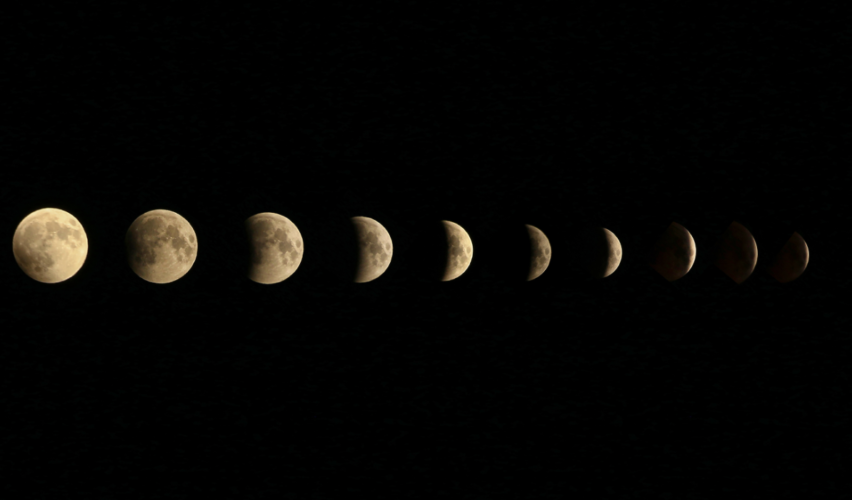
They follow the lunar calendar, which is calculated using the phases of the moon.
This is why festivals like Maha Shivratri, Amavasya, Purnima, and many vrat shift every year on the modern Gregorian calendar. The moon is used as a natural timekeeper, helping align religious practices with cycles of nature rather than man-made dates.
To understand why Hindu festivals follow the moon, it is important to first understand how the Hindu lunar calendar works and why it has remained central to Hindu timekeeping for more than thousands of years.
What Is the Hindu Lunar Calendar?
The Hindu lunar calendar is a traditional system of timekeeping that is based on the movement and phases of the moon. Unlike the Gregorian calendar, which follows the sun, the Hindu calendar tracks time through lunar cycles.
Each lunar month begins with the new moon and ends with the next new moon. These months are divided into two phases:
- Shukla Paksha, also known as the waxing phase (when the moon grows brighter). It consists of 15 days.
- Krishna Paksha, also known as the waning phase (when the moon gradually fades). It also consists of 15 days.
Remember: 1 Paksha is of 15 days. And each day is known as Tithis.
This system allows time to be measured through visible and natural changes in the sky, making it accessible long before modern instruments existed. For Hindu traditions, time is not viewed as a straight line but as a repeating cycle, and the lunar calendar reflects this understanding.
Because of this structure, festival dates do not remain fixed. They move each year depending on the moon’s position, which is why Hindu festivals change dates on the English calendar even though they are perfectly consistent within the lunar system.
Why the Moon Is Central to Hindu Timekeeping?
The moon plays a central role in Hindu timekeeping because it directly reflects natural rhythms that affect both the environment and human life.
The moon’s phases are easy to observe and follow a predictable cycle. This made the moon a reliable guide for measuring time in ancient India, especially for religious observances that required precision without mechanical tools.
Beyond practicality, the moon is also associated with mental states, awareness, and balance in Hindu philosophy. Many spiritual practices are designed to align with these lunar phases, as they are believed to influence focus, emotional stability, and inner stillness.
By using the moon as a reference point, Hindu festivals encourage people to live in rhythm with nature rather than against it. This is why important observances are tied to specific moon phases instead of fixed calendar dates.
This lunar alignment is not symbolic decoration. It is a deliberate system designed to connect time, nature, and spiritual practice into a single flow.
What Is a Tithi and Why It’s Important in the Hindu Calendar?
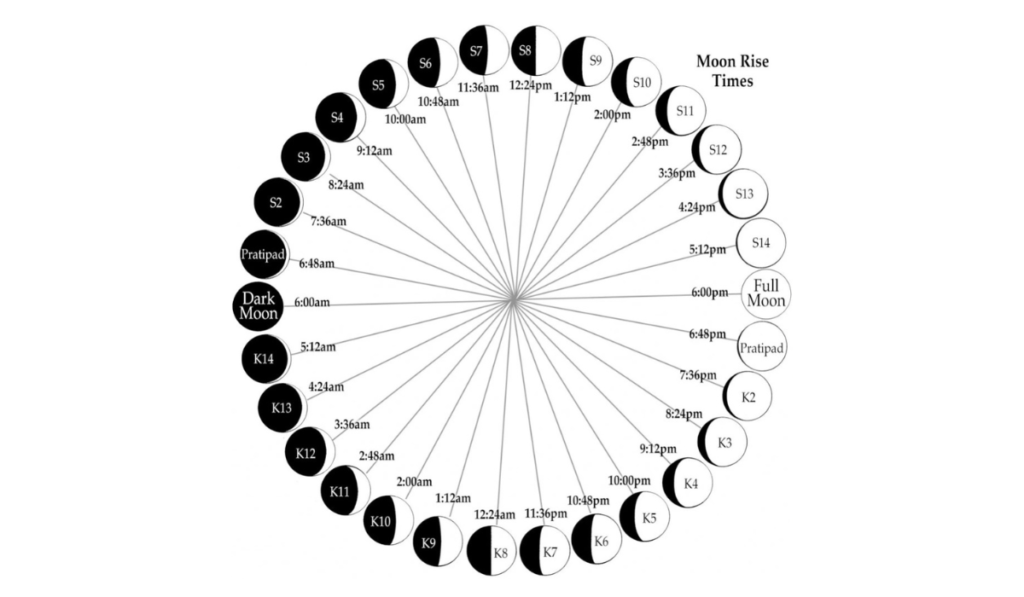
A Tithi is a lunar day, but it is not the same as a 24-hour day. In the Hindu calendar, festivals are not decided by dates. They are agreed by Tithi. A Tithi is defined by the changing angular distance between the Chandra (Moon) and the Surya (Sun). Each time this distance increases by a specific measure, one Tithi is completed.
Because the Moon does not move at a constant speed, ancient Hindus knew that fact. So, a Tithi can be shorter or longer than a regular day. This is why Hindu festivals may begin at different times of the day or night, and why their dates shift every year on the modern calendar.
Each lunar month contains 30 Tithis, divided equally between the two Pakshas:
- 15 Tithis in Shukla Paksha
- 15 Tithis in Krishna Paksha
Festivals, vrats, and fasts are prescribed on specific Tithis, not on fixed dates. For example, a vrat may be observed only when a particular Tithi is active, even if it begins after sunset or extends into the next day.
This system ensures that religious observances remain aligned with cosmic and natural cycles, rather than being restricted to rigid clock-based timekeeping.
Understanding Tithi is crucial to understanding why Hindu festivals are precise, intentional, and deeply connected to the movement of celestial bodies.
Why are Amavasya and Purnima the Most Important Tithis?
Among all Tithis in the Hindu calendar, Amavasya and Purnima hold special importance. They are not just moon phases. They are energetic turning points in the lunar cycle.
| Amavasya Tithi | Purnima Tithi |
| Amavasya is the Tithi when the Moon is not visible in the sky. It marks the end of Krishna Paksha and the completion of a lunar cycle. Traditionally, Amavasya is associated with stillness, inward focus, remembrance, and release. Many ancestral rituals, vrats, and quiet spiritual practices are observed on this day. | Purnima is the Tithi of the full Moon, marking the completion of Shukla Paksha. On this night, the Moon is at its brightest. Purnima is associated with clarity, fullness, balance, and heightened awareness. Several important vrats, daan, and spiritual observances are performed on Purnima because it is believed that the mind is naturally more receptive. |
These two Tithis act as natural anchors in the Hindu lunar calendar. Rather than measuring time only by numbers, the calendar uses visible and experiential changes in the Moon to guide religious life.
This is why many Hindu festivals, fasts, and observances are placed on Amavasya or Purnima. Understanding them helps explain why the Hindu calendar feels alive and responsive, rather than fixed and mechanical.
Why Hindu Festivals Are Celebrated at Night?
Hindu festivals are celebrated at night because they are timed according to the Hindu lunar calendar, and when a specific Tithi is active, not at a fixed clock time. The second reason is that tithi can only be observed when the moon comes out, and that happens after sunset.
And since many important Tithis begin after sunset, night becomes the most accurate period for observing festivals, vrats, and spiritual practices.
Night-time also supports focus and discipline, which is why fasting, chanting, and meditation are traditionally performed after sunset during major Hindu observances.
Lunar Calendar vs Solar Calendar in Hinduism
Hindu festivals follow either the lunar calendar or the solar calendar, depending on the purpose. This is why some Hindu festival dates change every year, while others remain almost fixed. To understand the difference between the lunar vs solar calendar in Hinduism, let’s look at the table:
| Comparison | Lunar Calendar (Chandramāna) | Solar Calendar (Sauramāna) |
| Based on | Movement of the Moon (Chandra) | Movement of the Sun (Surya) |
| Time Unit | Tithi and Moon phases | Solar day and zodiac transition |
| Festival Timing | Dates change every year on the English calendar | Dates remain mostly fixed |
| Used For | Vratas, fasting, night observances, spiritual festivals | Seasonal festivals, harvest, solar transitions |
| Examples | Maha Shivratri, Amavasya, Purnima, Ekadashi | Makar Sankranti, Pongal, Mesha Sankranti |
| Purpose | Aligns festivals with spiritual and lunar cycles | Aligns festivals with seasons and agriculture |
So, in simple words, hindu lunar calendar is used to observe religious observances, and the solar calendar for seasonal and environmental changes. This combined use of lunar and solar calendars explains why Hindu timekeeping is flexible, precise, and deeply connected to nature.
Common Misconceptions About Hindu Festival Dates
Many people find Hindu festival dates confusing because they change every year on the modern calendar. This has led to several common misconceptions.
“Hindu festival dates keep changing every year.”
Partially true, but in reality, Hindu festival dates do not change within the Hindu lunar calendar. They are fixed to specific Tithis. What changes is their position on the English calendar, which follows a different timekeeping system.
“Hindu festivals are decided randomly.”
Hindu festivals are carefully timed according to the Moon’s movement, not randomly chosen dates. Each festival is placed on a Tithi that aligns with its spiritual purpose.
“Moon-based calendars are unscientific.”
The Hindu lunar calendar is based on precise astronomical calculations of the Sun–Moon relationship. It is a systematic and consistent method of timekeeping, not a belief-based approximation.
“All Hindu festivals follow the lunar calendar.”
Not all festivals are lunar. Hinduism uses both lunar and solar calendars, depending on whether the festival relates to spiritual observance or seasonal change.
Understanding these points helps explain why Hindu festival dates change and why this system has remained in use for thousands of years till now.
Conclusion
Hindu festivals follow the Moon because the Hindu lunar calendar is designed to align spiritual practices with natural cycles rather than fixed dates. By using Tithis, Pakshas, and Moon phases, Hinduism treats time as living and responsive, not mechanical.
What appears confusing on the modern calendar is, in fact, a precise and intentional system rooted in observation, astronomy, and spiritual discipline. This is why Hindu festival dates change each year yet remain consistent within their own calendar.
Understanding this lunar system helps make sense of Hindu festivals, vrats, and night observances. More importantly, it reveals a deeper idea: time in Hindu tradition is meant to be experienced in harmony with nature, not controlled by the clock.
Save or bookmark this page so you can return to it whenever you seek calm, clarity, or devotion. Follow us on Instagram and Facebook to stay connected, and share your thoughts or suggestions in the comments.
This corner is meant to be returned to, not just read once.