
Is dharma religion, duty, law, morality, or righteousness?
Most of us first meet the word through a translation that tries to make it familiar. Yet each English substitute feels slightly incomplete, like describing the ocean by calling it “water.” Something vast, living, and relational gets reduced to a concept.
The search for the meaning of dharma begins when we notice this gap. Because dharma is not just a rule to follow. It is the principle that holds life together.
What Is Dharma? The Actual Meaning
Dharma is the principle that upholds harmony within the individual, in society, and in the cosmos. It is the alignment between one’s inner nature, one’s responsibilities, and the larger order of life. Rather than a fixed law, it is a living wisdom that guides right action in changing circumstances.
This is the closest a definition of dharma can come in a single breath.
The Root Meaning of Dharma: “That Which Sustains”
The Sanskrit root dhṛ means “to hold,” “to support,” or “to sustain.” So in its deepest sense, dharma is:
- the force that keeps planets in motion
- the truth that sustains relationships
- the integrity that holds a human life together
In dharma in Hinduism, this sustaining principle operates at every level:
- Cosmic order: the rhythm of existence
- Social harmony: the balance of roles and responsibilities
- Inner alignment: living according to one’s nature
When a tree gives shade, when a river flows, when a teacher teaches with sincerity, each is expressing its dharma.
Why Dharma Cannot Be Translated into One Word?
Every common translation captures one face of dharma and misses the rest.
- Is Dharma “Religion”?
Religion usually implies belief in a particular doctrine or institution. Dharma is not dependent on belief. It is about being and living.
- Is Dharma “Duty”?
Duty suggests obligation, often external. Dharma includes responsibility, but it must arise from inner nature. Forced duty without alignment is not dharma.
- Is Dharma “Law”?
Law is fixed and universal. Dharma is contextual and responsive.
- Is Dharma “Morality”?
Morality is often a general code of right and wrong. Dharma asks: What is right for this person, in this moment, in this role?
This is why discussions on why dharma cannot be translated always return to the same insight because it is not a single idea. It is a way of understanding life.
Dharma in the Ancient Scriptures: Lived, Not Defined
The epics and the Gita do not give us a dictionary definition. They give us human situations.
1. Bhagavad Gita: The Courage to Live One’s Swadharma
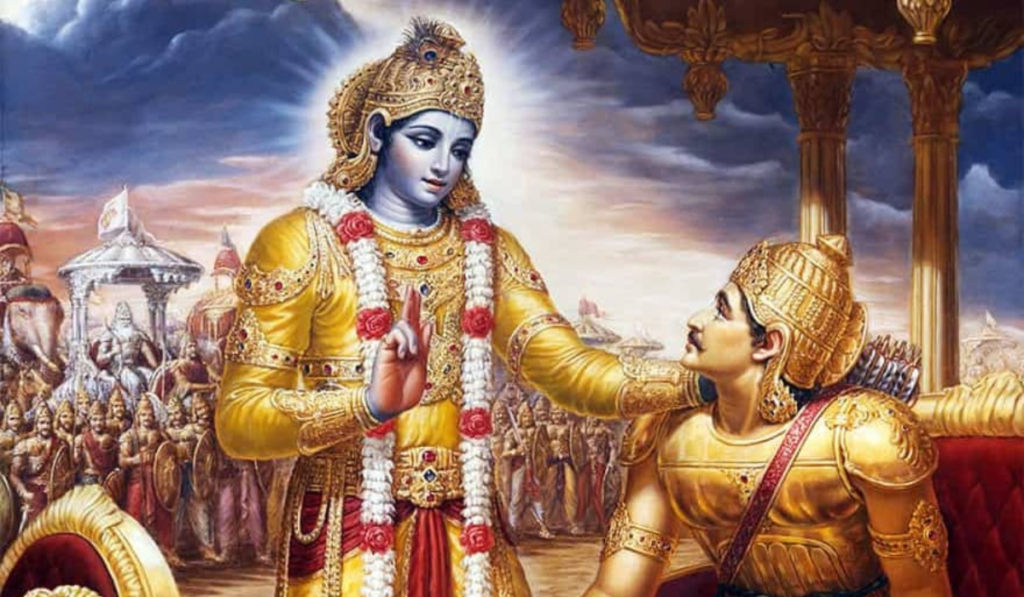
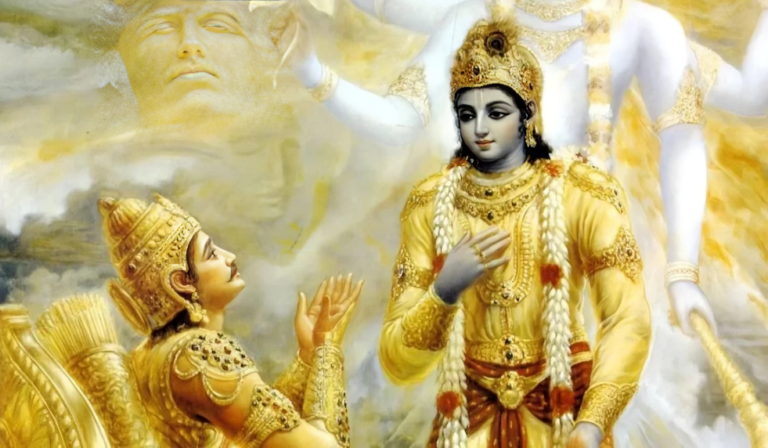
On the battlefield, Arjuna wants to withdraw. Compassion, grief, and confusion overwhelm him. Shri Krishna does not give him a universal rule. He speaks of swadharma, one’s own path shaped by inner nature.
For Arjuna, avoiding the war looked moral on the surface. But it was a refusal of his deeper calling. His dharma was not violence, it was the protection of justice. This is the heart of dharma in Bhagavad Gita: Better to live one’s own dharma imperfectly than to imitate another’s perfectly.
2. Ramayana: The Pain of Right Choices
When Shri Ram accepts exile to honor his father’s word given by Maa Kekkai, it is not passive obedience. It is a conscious choice to preserve the integrity of relationships.
Later, when Bharat refuses the throne and places Rama’s sandals upon it, he too acts from dharma, not ambition, not renunciation, but alignment.
In the dharma in Ramayana, we see that dharma often involves sacrifice. Not because suffering is holy, but because harmony sometimes demands personal cost.
3. Mahabharata: When Right Is Not Simple
The Mahabharata is a long meditation on moral complexity. Yudhishthira, known for truthfulness, speaks a half-truth in the war. Bhishma serves a throne he knows is unjust. Karna remains loyal to friendship over fairness.
Each is bound by a different understanding of dharma. This is dharma in Mahabharata, not certainty, but discernment in a world where every choice has consequences.
Is Dharma Fixed or Contextual?
Dharma is not rigid because life is not rigid. A student’s dharma is to learn. A parent’s dharma is to nurture. A leader’s dharma is to protect and serve. The same action can be dharmic or adharmic depending on:
- Time
- Place
- Person involved
This is the simple meaning of the classical idea of desh–kaal–patra context. Speaking a harsh truth in anger is not dharma. Speaking a difficult truth with compassion may be.
Dharma vs Religion: What Is Sanatana Dharma?
The sanatana dharma meaning points to something timeless. Sanatana means eternal. It refers to the universal principles that sustain life that includes truth, compassion, balance, responsibility, self-knowledge.
So when we explore dharma vs religion, we see the difference that religion can be a path.
But dharma is the law of harmony that makes every path meaningful. It is not about belonging to a system. It is about living in alignment with reality.
Dharma and Karma: The Relationship
To say dharma is right action and karma is the result of action is true but incomplete in the same way saying “a seed becomes a tree” ignores soil, season, sunlight, and time.
Dharma is not merely what you do. It is the inner alignment from which an action arises. Karma is not a reward–punishment system. It is the natural echo of that alignment or misalignment, moving through life.
Together, they describe a living law of cause and harmony.
Two people may perform the same action, yet create very different karma. A doctor serving with compassion and another working only for recognition generate different inner worlds, even if their work looks identical. Dharma lives in intention, awareness, and integrity.
When action comes from dharma, three forms of harmony appear:
- Inner clarity: the mind becomes steady, even in difficulty. Arjuna’s confusion ends when he accepts his swadharma.
- Relational trust: dharmic action sustains respect and authenticity in human connections.
- Long-term balance: it may not give immediate comfort, but it creates lasting stability.
When action ignores dharma, friction begins within the doer first such as restlessness, emptiness, and repeating dissatisfaction. This is karma unfolding as a present psychological reality, not merely a future reward or punishment.
Karma is not fixed fate. It is momentum. Dharma is what allows that momentum to be redirected. Every aligned choice reshapes the future. In simple terms:
Dharma asks: From where within me am I acting?
Karma answers: This is the life that grows from that choice.
Dharma in Daily Life Today
Dharma is not only for epics or monks. It appears in ordinary decisions. This is dharma in daily life, alignment, not comparison:
- A Career Choice: Choosing a profession only for status while ignoring one’s natural abilities creates restlessness. Choosing work that expresses one’s nature becomes dharma in action.
- Speaking the Truth: Truth spoken without kindness breaks. Kindness without truth weakens. Dharma holds both together.
- Personal Growth and Responsibility: A young seeker wanting solitude has a different dharma than a parent raising a child. Neither is higher. Both are valid in their time.
How Do I Recognize My Dharma?
Dharma is not discovered through a rulebook. It is understood through reflection.
Three gentle questions help:
- What are my natural tendencies and strengths?
- What responsibilities has life placed in my hands right now?
- What action creates harmony rather than agitation?
Where these meet, dharma begins to reveal itself.
Dharma as Life Purpose in Hindu Philosophy
In the traditional vision of life, dharma gives direction to everything else that includes success, desire, even spiritual liberation. Without dharma, achievement becomes empty.
With dharma, even small actions become meaningful. This is why life purpose in Hindu philosophy is not a distant goal. It is expressed through right living in the present.
The Power of Living in Dharma
Dharma does not demand perfection. It asks for sincerity and the movement:
- from imitation to authenticity
- from confusion to clarity
- from self-centeredness to contribution
It is not a command from outside but a recognition from within.
Conclusion
So what is dharma?
It is the intelligence that keeps the universe in balance and the whisper that guides a human heart toward the same harmony. It cannot be translated into one word because it is not merely an idea but a way of seeing, choosing, and being.
When we live in dharma, life stops feeling like a series of conflicts to be managed and begins to feel like a rhythm we are learning to move with. And perhaps that is the simplest way to understand it:
Dharma is the art of living in such a way that both the world and the soul remain held together.
Follow us on Instagram and Facebook for simple festival guides, rituals, and traditions explained clearly, and share your thoughts or questions in the comments.
This space is here to help you prepare, not just read and forget.