


Every year on March 8th, the world pauses to honour women, their strength, their sacrifices, their brilliance. But long before the United Nations declared International Women’s Day, one of the world’s oldest living traditions had already enshrined the feminine as the supreme force of existence. Sanatan Dharma did not merely include women in its sacred texts, it made the feminine the very foundation of creation.
International Women’s Day Through a Different Lens
International Women’s Day is observed across more than 160 countries as a moment of recognition, remembrance, and resolve. It honors the struggles of women who have fought for dignity and equal standing in every field of human life. That recognition matters and deserves its full weight.
Yet, alongside the language of rights and representation, there exists another way of understanding feminine power. One that does not measure it against a standard set elsewhere, but locates it at the very source of creation. This is the way of Sanatan Dharma, the eternal order of being, in which feminine energy is not a secondary consideration but the animating force of the cosmos itself.
To understand this is to see International Women’s Day not merely as a moment of social acknowledgment. But as an annual reminder of something sacred and ancient.
What Is Shakti in Sanatan Dharma?
| In Sanatan Dharma, Shakti is the primordial cosmic energy that underlies all creation, preservation, and dissolution. It is not merely a symbol of feminine strength but the fundamental dynamic force of the universe, inseparable from consciousness itself, without which nothing in existence can move, grow, or manifest. |
The word Shakti comes from the Sanskrit root shak, meaning “to be capable” or “to have power.” But in the philosophy of Sanatan Dharma, it reaches far beyond capability in the everyday sense. Shakti is the energy that makes a seed split open. It draws the tide toward shore, that holds stars in their orbits and draws breath through every living body.
Without Shakti, even the highest consciousness, represented in philosophy as Bhagwaan Shiva, pure awareness, cannot act. Awareness without energy is stillness without expression, light without warmth, potential without life. Shakti is what transforms the infinite into the actual. It is the creative impulse of the universe made personal, made worshippable, made near.
The Divine Feminine in Hindu Philosophy
Sanatan Dharma does not treat the feminine as subordinate to a masculine divine. It treats the relationship between Shiva and Shakti, consciousness and energy, as the foundational polarity that generates all existence. Neither is superior. Neither is complete without the other.
Ardhanarishvara: The Indivisible Whole
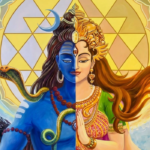
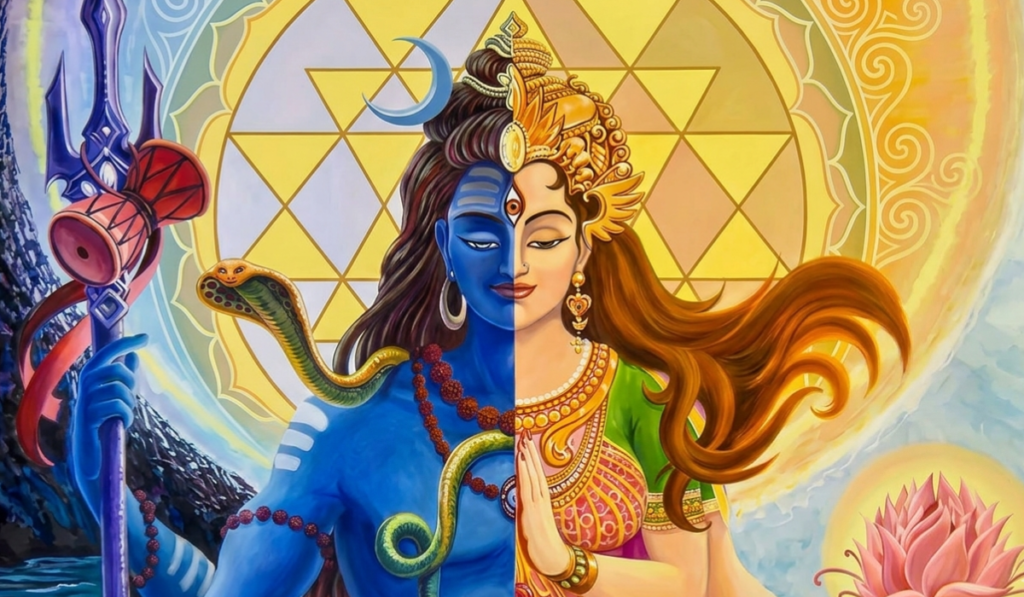
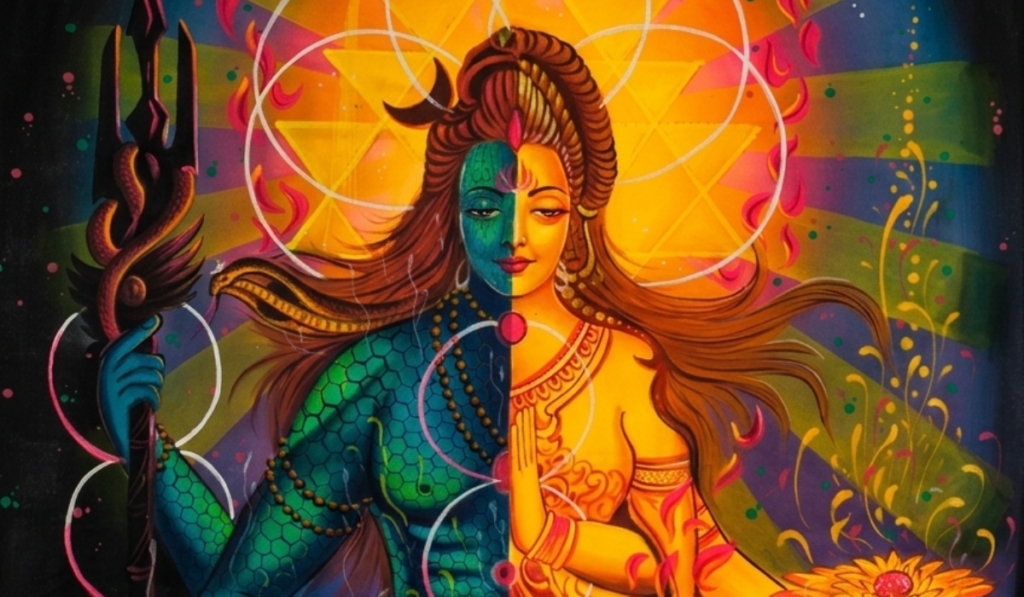
This philosophical truth is encoded in one of Hinduism’s most profound images: Ardhanarishvara. The form of Shiva that is half-masculine and half-feminine, literally split down the middle. This is not a metaphor for compromise between two opposing forces. It is a declaration that masculine and feminine principles are not opposites at all. They are two aspects of the same indivisible reality.
Ardhanarishvara symbolism teaches that wherever consciousness dwells, energy is already present. Wherever energy moves, consciousness is already witnessing. The divine is neither purely male nor purely female, it is the harmony that contains both. This understanding places feminine power not beneath the divine but within it, inseparably.
Scriptural Roots of Feminine Power
The reverence for the Divine Feminine in Sanatan Dharma is not a later addition to tradition. It runs through some of the oldest and most revered texts in human history.
1. The Rigveda Devi Sukta In the Rigveda, one of humanity’s oldest surviving scriptures, there appears the Devi Sukta, a hymn in which the Goddess speaks in her own voice. She declares: “I am the sovereign queen, the treasure of all that is precious, the greatest of all beings worthy of worship.” She identifies herself as the force pervading all existence, the ground from which the universe arises. This is not myth in the dismissive sense, it is philosophy in the form of devotion. |
2. Devi Mahatmya The Devi Mahatmya, a text of approximately 700 verses contained within the Markandeya Purana, is among the most significant scriptures of the Shakta tradition. It presents the Goddess, addressed as Devi, Chandika, Ambika, as the supreme power who subdues forces that neither Vishnu nor Shiva could overcome alone. Her victories are not merely martial. They represent the triumph of truth over distortion, of clarity over confusion, of sacred order over chaos. The Devi Mahatmya closes with a declaration that the Goddess is present wherever women dwell, as memory, as understanding, as patience, as faith. |
3. Durga Saptashati The Durga Saptashati, another name for the Devi Mahatmya, literally “seven hundred verses in praise of Durga”, is recited across India during Navratri and at moments of personal and collective difficulty. It is not merely a liturgical text. It is a map of the inner life, showing how the Goddess manifests as every form of strength a human being requires in the face of adversity: fierce clarity, nurturing grace, and ultimately, liberating wisdom. |
The Shakta Tradition: Worshipping the Goddess as Supreme
Within the vast field of Sanatan Dharma, the Shakta tradition is the current of devotion that places the Goddess at the very center of spiritual life. Not as consort, not as complement, but as the Absolute itself.
Shaktas worship the Goddess in her many forms: Maa Durga, who rides a lion and wields the weapons of all the gods, embodying protective valor. Maa Lakshmi, who pours forth abundance and holds prosperity as a sacred responsibility. Similarly, Maa Saraswati, who dwells at the source of language, music, and learning. Maa Kali, who stands at the edge of time itself, consuming illusion so that truth may survive.
These are not separate goddesses in the way one might imagine a pantheon of discrete deities. They are faces of the one Shakti, revealing different qualities of the same cosmic intelligence as circumstances demand.
In the Shakta view, the material world is not a lesser realm to be escaped. It is Shakti’s own body, alive, intelligent, and worthy of reverence. To engage with the world with full presence and ethical care is itself a form of worship.
What Does Hinduism Say About the Power of Women?
| Hindu philosophy, particularly its Shakta streams, holds that feminine power is not derived from external permission but is intrinsic to the nature of existence. Women are understood to carry within them the qualities of the Divine Feminine, wisdom, nurturing strength, moral discernment, and spiritual depth. Honoring women is, in this view, an act of recognizing the Shakti that moves through all life. |
The classical Sanskrit tradition praised women as grihalakshmi, the Lakshmi of the household, recognizing that the woman who creates and sustains a home is performing a sacred act of world-maintenance, a kind of daily Dharma in practice.
But this recognition extends far beyond the domestic sphere. The tradition honors women as teachers, as seers, as leaders. Among the Vedic rishikas, female sages and figures such as Gargi, who famously debated the philosopher Yajnavalkya in the court of King Janaka, and Maitreyi, who renounced wealth in pursuit of spiritual liberation, stand as enduring examples of feminine intellectual and spiritual authority.
The Role of Women as Shakti in Everyday Life
Philosophy can sometimes feel remote from the texture of daily experience. But Shakti is not an abstract principle stored in ancient libraries. It is present wherever life is generated, sustained, and renewed.
Shakti is present in the patience of a mother explaining something for the twentieth time, not because she must but because she understands that persistence is love made practical. It is present in the teacher who recognizes a student’s potential before the student can see it herself.
It is present in every woman who has held a household together through loss, rebuilt a life after it was dismantled, or spoken an uncomfortable truth at a moment when silence would have been easier.
This is what the texts are pointing to when they say the Goddess is present as memory, as patience, as faith. Shakti is not separate from the woman who lives it, it is expressed through her, the way light is expressed through a lamp. The lamp does not create the light. But without the lamp, the light does not illuminate the room.
International Women’s Day as a Moment of Reflection
When International Women’s Day arrives each March, it brings with it a chance to do more than audit progress. It invites us to ask what kind of foundation we are building on, what understanding of feminine power is informing the world we are trying to create.
If that understanding is purely economic or political, it will answer some questions but leave others untouched. It will be unable to explain why a mother’s quiet presence in a moment of grief is irreplaceable.
It will have no language for the specific quality of wisdom that comes from having carried life, endured loss, and chosen to continue with grace. Shakti in Sanatan Dharma provides that language. It says: this is not soft power. This is the power the universe itself runs on.
Celebrating women on this day, viewed through the lens of Sanatan Dharma, becomes an act of remembrance as much as recognition, a remembering of the Devi traditions that have always known what the rest of the world is only beginning to articulate.
Conclusion: Honoring Shakti on International Women’s Day
Sanatan Dharma does not ask us to celebrate women as exceptions to the rule of history. It asks us to recognize them as expressions of something far older than history, the creative force that was present before the first syllable was spoken, that will remain when all constructed things have dissolved.
To honor a woman is, in this understanding, to honor the Shakti moving through her, the same energy that moves through the turning seasons, the same intelligence that holds the stars in their courses, the same force that ensures, in the end, that what truly matters endures.
On International Women’s Day, let that recognition run deeper than a gesture. Let it be a remembrance. Let it be, in its own quiet way, a kind of reverence.
The next time you are in the presence of a woman who is patient when she has every reason not to be, who creates beauty from difficulty, who holds the center when the edges fray, pause for a moment and recognize: this is not only human strength. This is Shakti, taking form. This is the universe expressing itself through a life. And it is worthy of the deepest respect. -My Favorite Corner |