




On 31st March 2026, millions of people across India and the world will pause to honor a soul whose life changed the course of human thought. Mahavir Jayanti is more than a festival. It is a living reminder that the deepest strength a human being can possess is not power over others, but mastery over oneself.
For those of us who grew up surrounded by the values of Sanatan Dharma, this day carries a particular weight. Lord Mahavir’s message of ahimsa, truth, and non-attachment did not stay within the boundaries of Jainism. It flowed into the wider river of Indian spiritual life and continues to shape how we think about compassion, duty, and the sacred.
This year, as we mark Mahavir Jayanti 2026, we look at the life he lived, the teachings he left behind, and the reason his words still echo so clearly across twenty-six centuries.
Who Was Lord Mahavir?
Lord Mahavir was the 24th Tirthankara of Jainism, born as Vardhamana in Kundagrama, Bihar, around 599 BCE. After renouncing his royal life at 30, he attained Kevala Jnana (infinite knowledge) through twelve years of austerity and became the foremost teacher of Jain philosophy, ethics, and the doctrine of ahimsa.
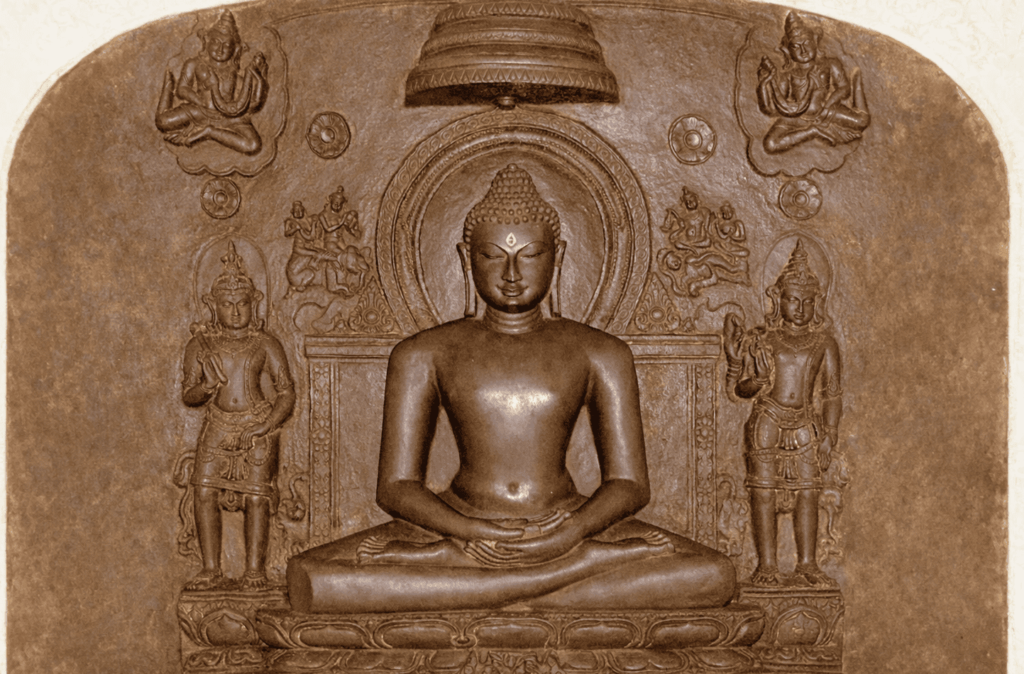
Before the world knew him as Mahavir, he was a prince named Vardhamana, born in Kundagrama, Bihar, a region that scholars of Jainism and historians of ancient India identify as present-day Vaishali district.
The Jain canonical texts, including the Acharanga Sutra and the Kalpa Sutra, record his birth on the thirteenth day of the bright fortnight of Chaitra, a date that Jain communities have observed for over two and a half millennia.
Vardhamana grew up in comfort and privilege. Yet those closest to him noted from his early years a quality that no palace could cultivate: a stillness, a sensitivity to suffering, and a refusal to accept that the world had to be as painful as it appeared. At the age of 30, he acted on what he knew. He gave up his robes, his possessions, and his title, and walked into a life of complete renunciation.
For twelve years, he wandered. He endured harsh weather, physical pain, and the cruelty of those who did not understand what he was doing. Through it all, he practiced kayotsarga, the complete abandonment of bodily attachment, and remained rooted in silence and equanimity. At 42, meditating under a Sala tree near the Rijupalika river, Vardhamana attained Kevala Jnana, complete and infinite knowledge. He became Mahavir, the great hero.
He spent the next thirty years teaching. At 72, in Pawapuri, Bihar, he attained nirvana. His soul and body left the world. His teachings did not.
Lord Mahavir Life History: From Palace to Enlightenment
Lord Mahavir’s life history spans 72 years, from his royal birth in 599 BCE to his nirvana in Pawapuri around 527 BCE. He renounced his princely life at 30, practiced twelve years of intense austerity, attained Kevala Jnana at 42, and spent thirty years building the Jain sangha before attaining moksha.
What sets Lord Mahavir’s life history apart is not the arc of renunciation itself, but the quality of discipline he brought to every moment of it. After leaving his palace, he did not seek a teacher or a community. He walked alone and owned nothing. He harmed nothing, not an insect on the ground, not a word spoken in anger.
Communities turned him away. People mocked him. At times he faced physical cruelty from those who feared or misunderstood him. The Acharanga Sutra, one of the oldest surviving Jain texts and a primary source for scholars studying his life, records many of these encounters in detail. Through every one of them, Mahavir held his ground without raising a hand or a voice.
This was not passivity. Jain practitioners and teachers consistently emphasize that Mahavir’s equanimity came from an absolute clarity about who he was and what he was doing. He had nothing left to fear because he had released his attachment to everything that fear protects.
When he attained Kevala Jnana and returned to the world as a tirthankara, a ford-builder between ordinary life and liberation, he built what Jain tradition calls the four-fold sangha: monks, nuns, laymen, and laywomen. This was deliberate. He did not teach a path only for those who could renounce everything. He made his teachings accessible to people living ordinary lives.
What Did Lord Mahavir Teach?
Lord Mahavir taught three core principles known as the Triratna: Right Faith (Samyak Darshana), Right Knowledge (Samyak Jnana), and Right Conduct (Samyak Charitra). He also taught Anekantavada, the doctrine of many-sided truth, and the Pancha Mahavrata, five ethical vows centered on non-violence, truth, non-stealing, celibacy, and non-possessiveness.
The teachings of Lord Mahavir were never confined to doctrine. They were practical instructions for how a human being could live with integrity, compassion, and an ever-deepening sense of freedom.
At the heart of his philosophy are the Triratna, the Three Jewels of Jainism:
- Right Faith (Samyak Darshana): Seeing reality as it truly is, without the distortions of ego, habit, or wishful thinking.
- Right Knowledge (Samyak Jnana): Understanding the nature of the soul, the nature of the world, and the path that leads from suffering to liberation.
- Right Conduct (Samyak Charitra): Living in full alignment with what you know and believe to be true.
Mahavir also gave the world Anekantavada, the doctrine of many-sidedness. Rooted in the Jain Agamas and later elaborated by Jain philosophers such as Umasvati in the Tattvarthasutra, this teaching holds that no single point of view captures the whole of reality.
Every perspective is partial. Every truth has more dimensions than any one observer can see. Scholars of comparative philosophy have noted striking parallels between Anekantavada and modern concepts of epistemic humility and pluralism.
For those of us raised in a tradition that holds multiple paths to the divine as equally valid, this teaching feels deeply familiar. It is the philosophical foundation of a life lived without arrogance.
What Are the Five Vows of Jainism?
The five vows of Jainism, known as the Pancha Mahavrata for monastics and Anuvrata for lay practitioners, are: Ahimsa (non-violence), Satya (truthfulness), Asteya (non-stealing), Brahmacharya (celibacy or faithfulness), and Aparigraha (non-possessiveness). These vows form the ethical core of Jain practice as taught by Lord Mahavir.
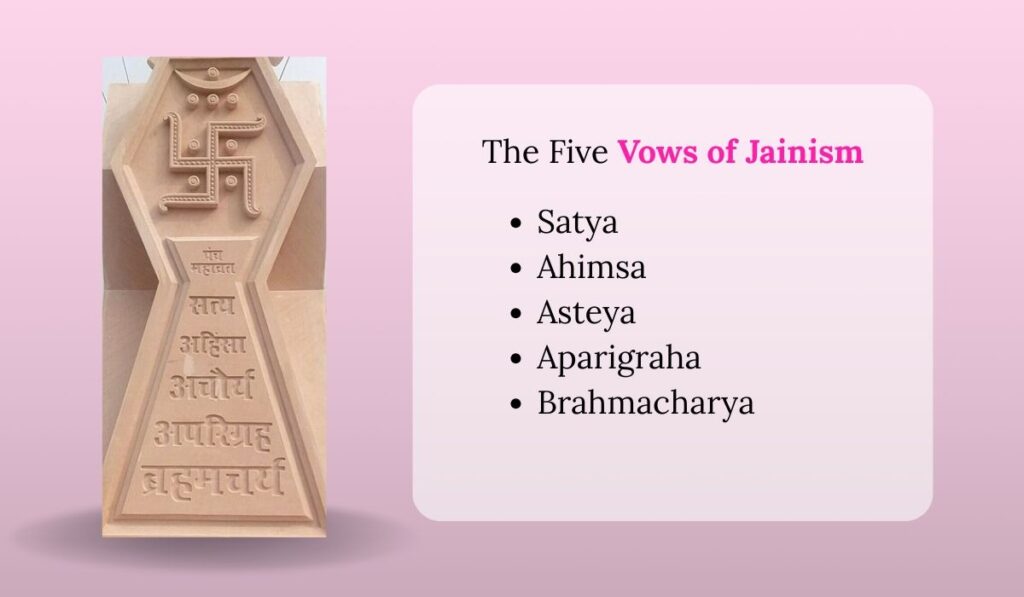
The Pancha Mahavrata represent the most concentrated expression of what Mahavir taught. The Acharanga Sutra prescribes these vows in their fullest form for Jain monastics. For lay practitioners, the Anuvrata offers the same five commitments in a form compatible with family and professional life. Jain communities across India observe these vows with a seriousness that outsiders sometimes find remarkable.
1. Ahimsa: Non-violence
Ahimsa is the foundation on which all other vows rest. It means causing no harm in thought, word, or action to any living being. Mahavir’s understanding of ahimsa extended to every form of life. This is why Jain monks and nuns filter their drinking water, sweep the path before them, and practice a level of care toward the living world that most of us have never attempted.
2. Satya: Truthfulness
Speak only what is true, and only when speaking it causes no harm. Mahavir taught that truth without compassion is itself a form of violence. Satya asks us to be honest and kind at the same time, which is often far harder than being simply one or the other.
3. Asteya: Non-stealing
Do not take what has not been freely given. Asteya reaches beyond material objects to include taking credit, time, or energy that does not belong to you. Jain teachers often describe Asteya as the vow that most directly governs professional and commercial life.
4. Brahmacharya: Celibacy or Faithfulness
For monastics, Brahmacharya means complete celibacy. For lay practitioners, it means faithfulness within relationship and the broader discipline of not allowing sensory craving to govern one’s choices. At its core, this vow is about directing one’s energy toward what matters most.
5. Aparigraha: Non-possessiveness
Do not accumulate beyond what you need. Of all five vows, Aparigraha may be the most quietly radical. Mahavir taught that attachment, whether to objects, outcomes, or identities, keeps the soul bound to the cycle of karma and rebirth. Jain laypeople and monastics alike describe Aparigraha as the vow they return to most often, because the pull toward accumulation is constant and subtle.
Together, these five vows do not describe a religion. They describe a way of being free.
Ahimsa in Jainism: Why Non-violence Goes Far Deeper Than You Think
Ahimsa in Jainism means causing no harm, in thought, word, or deed, to any living being. Unlike a simple prohibition on physical violence, Jain ahimsa recognizes consciousness in all life forms and requires practitioners to actively minimize harm in every area of life, from diet and occupation to speech and intention.

When people first encounter the Jain practice of ahimsa, they often focus on the visible expressions: the dietary restrictions, the face masks that some monks wear to avoid inhaling insects, the gentle sweeping of paths. These are real and meaningful. But they are expressions of something far deeper.
Mahavir taught that every soul, jiva, carries consciousness. Humans, animals, plants, even earth and water bodies possess varying degrees of awareness. To harm any of them is to disturb the natural order of the universe and to bind your own soul more tightly to the cycle of karma.
Jain scholars, including the medieval philosopher Hemachandra, elaborated this understanding into a sophisticated taxonomy of living beings and the varying degrees of harm caused by different actions.
Jain communities in India have historically been leaders in animal welfare, vegetarianism, and, more recently, environmental advocacy. These are not coincidences. They flow directly from a worldview in which every act of care for the living world is also an act of spiritual purification.
13 Mahavir Quotes for Mahavir Jayanti 2026
Lord Mahavir’s most cited teachings include:
‘Live and allow others to live; hurt no one; life is dear to all living beings.’
His words emphasize inner conquest, compassion for all life, and the recognition of the soul’s true nature as the foundation of all spiritual progress.
Swami Mahavir Quotes:
1. Killing a living being is killing one’s own self; showing compassion to others is showing compassion to oneself.”
2. “Non-violence is the highest ethical code.”
3. “In happiness and suffering, in joy and grief, we should regard all creatures as we regard our own self.”
4. “The greatest mistake of a soul is non-recognition of its real self and can only be corrected by recognizing itself.”
5. “Violence, even in thought, leads to fear and weakness.”
6. “Silence and self-control is non-violence.”
7. “There is no enemy out of your soul. The real enemies live inside yourself, they are anger, pride, greed, attachments, and hate.”
8. “It is better to win over self than to win over a million enemies.”
9. “Truthfulness, chastity, simplicity, and equanimity are the four pillars of a pious life.”
10. “The essence of all knowledge consists in not committing violence.”
11. “The soul comes alone and goes alone, no one accompanies it and no one becomes its mate.”
12. “Attachment and aversion are the root cause of karma, and karma creates the bondage of the material world.”
13. “Every soul is independent. None depends on another.”
These words are not poetry written for effect. They are instructions, tested by a man who lived them under conditions most of us will never face. Growing up within the traditions of Sanatan Dharma, I have always found that Mahavir’s voice feels like a quieter, more austere version of the same truth that runs through our own scriptures: that the path inward is the only path that leads anywhere real.
How Is Mahavir Jayanti Celebrated?
Mahavir Jayanti is celebrated through temple rituals including the abhisheka (ritual bathing of Lord Mahavir’s idol), processions through city streets, devotional singing, fasting, reading of Jain scriptures, and charitable acts.
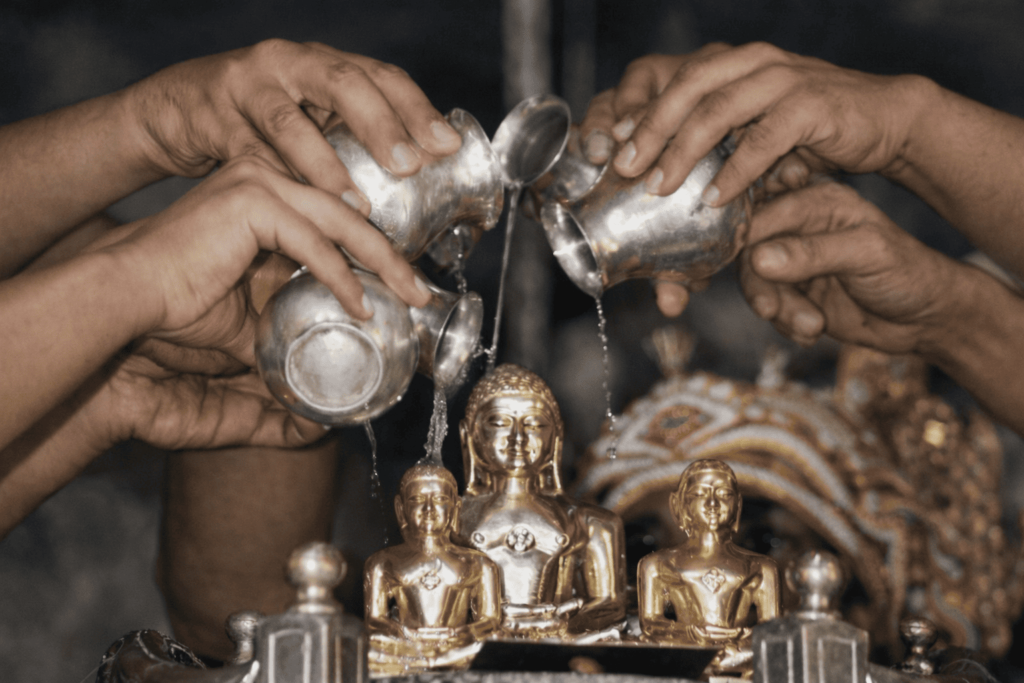
For Jain communities across India, the days leading up to Mahavir Jayanti are filled with quiet preparation. Here is how the day unfolds:
- Temple preparation: Temples are cleaned and decorated with flowers, flags, and lights. Devotees arrive early to participate in rituals that Jain communities have observed, in some form, for over two millennia.
- Abhisheka: The central ritual of the morning is the ceremonial bathing of Lord Mahavir’s idol with panchamrit, a sacred mixture of milk, curd, ghee, honey, and water, followed by sandalwood paste, flowers, and saffron water. For those who participate, it is an act of deep personal reverence, a direct moment of connection with a soul they regard as having shown the highest possibility of human life.
- Processions: Images of Lord Mahavir are carried through city streets on decorated palanquins. Devotional songs fill the air. In many cities, these processions draw participants from Hindu communities as well, a natural expression of the shared spiritual heritage that connects the traditions of ancient India.
- Fasting and scripture: Many devotees fast through the day. Others gather for communal readings of the Jain Agamas and discourses by Jain monks and nuns.
- Charity: Acts of giving are considered especially meritorious on this day. Donations to the poor, care for animals, and support for Jain educational institutions are all common expressions of the spirit of Mahavir Jayanti.
In 2026, as Mahavir Jayanti falls on 31st March, a Tuesday and a gazetted public holiday across India, communities from Mumbai to Jaipur to Chennai will gather in this spirit of remembrance and renewal.
Final Thought
Lord Mahavir did not build temples or kingdoms. He built something far harder: a way of living that asks the best of human beings without demanding the impossible from them. He taught that liberation is not reserved for the extraordinary. It is available to anyone willing to do the inner work.
Twenty-six centuries after his birth, his teachings sit alongside the deepest currents of Indian spiritual life. The Anekantavada he taught gave philosophers a framework for humility. The Pancha Mahavrata he prescribed gave millions of ordinary people a structure for living with integrity.
On Mahavir Jayanti 2026, the invitation is the same as it has always been. Pause. Look inward. Notice what you are holding onto that no longer serves you. And take, even in the smallest way, one step in the direction of ahimsa.
The great hero did not conquer armies. He conquered himself. And in doing so, he showed the rest of us that this, the victory within, is the only one that truly lasts.
Frequently Asked Questions (FAQs)
1. When is Mahavir Jayanti in 2026?
Mahavir Jayanti 2026 falls on 31st March 2026. It is observed on the thirteenth day of the bright fortnight of the Hindu month of Chaitra and is a gazetted public holiday across India.
2. What is the significance of Mahavir Jayanti?
Mahavir Jayanti marks the birth anniversary of Lord Mahavir, the 24th Tirthankara of Jainism. It is one of the most important festivals in the Jain calendar, observed through rituals, processions, fasting, and charitable acts to honor Mahavir’s life and teachings.
3. What are the five vows of Jainism?
The five vows of Jainism, or Pancha Mahavrata, are Ahimsa (non-violence), Satya (truthfulness), Asteya (non-stealing), Brahmacharya (celibacy or faithfulness), and Aparigraha (non-possessiveness). These form the ethical foundation of Jain practice as prescribed by Lord Mahavir.
4. Who was Lord Mahavir and why is he important?
Lord Mahavir was the 24th Tirthankara of Jainism, born in Kundagrama, Bihar, around 599 BCE. He attained Kevala Jnana through twelve years of austerity and spent thirty years teaching the principles of ahimsa, truth, and non-attachment. His teachings shaped Jain philosophy and influenced Indian spiritual and ethical thought far beyond the Jain community.
5. What does ahimsa mean in Jainism?
In Jainism, ahimsa means causing no harm in thought, word, or deed to any living being. It is the foundational principle of Jain ethics and extends to all forms of life, not just human beings. Jain practice of ahimsa includes dietary choices, occupation, speech, and even the way one walks.
6. Where was Lord Mahavir born?
Lord Mahavir was born in Kundagrama, which lies in present-day Vaishali district of Bihar, India. His birth place is a significant pilgrimage site for Jain communities and is identified by historians and Jain canonical texts including the Kalpa Sutra.
7. How is Mahavir Jayanti celebrated in India?
Mahavir Jayanti is celebrated through the abhisheka ritual (bathing of Lord Mahavir’s idol), religious processions, devotional singing, fasting, scripture readings, and acts of charity. Jain temples across India observe the day with community gatherings, and the festival draws participants from across the wider Indian spiritual community.
The journey does not end here. Follow MFC on Instagram and Facebook to explore more sacred places, festivals, and living traditions of Sanatan Dharma.