



The days leading up to Holi are not simply a waiting period. They are a carefully structured spiritual arc, beginning with the quiet restraint of Holashtak, building toward the purifying fire of Holika Dahan, and finally releasing into the joyful celebration of Holi. Understanding this arc transforms a cultural festival into a deeply meaningful inner journey.
What is Holashtak?
Holashtak is an eight-day period in the Hindu calendar beginning on Phalguna Shukla Ashtami (the 8th lunar day of the bright fortnight of the month of Phalguna) and ending on Phalguna Purnima, the full moon night of Holika Dahan. The word combines Hola (Holi) and Ashtak (eight), marking eight days of spiritual vigilance before the festival.
During Holashtak, auspicious ceremonies such as marriages, engagements, property purchases, and other significant samaskaras are traditionally avoided. This is not superstition, it reflects a deeper understanding of cosmic energy.
According to Vedic astrology and Panchang tradition, each of the eight days of Holashtak is ruled by a different planet in a state of heightened agitation. The sequence attributed in folk tradition runs: Sun (day 1), Moon (day 2), Mars (day 3), Mercury (day 4), Jupiter (day 5), Venus (day 6), Saturn (day 7), and Rahu (day 8 / Holika Dahan).
When planetary energies are turbulent, the wisdom of the tradition is to pause, observe, and prepare, not to initiate. This is the Holashtak meaning in practice: a pause before the purification.
Holashtak 2026 Date
Snippet block: In 2026, Holashtak begins on Wednesday, 24 February (Phalguna Shukla Ashtami) and concludes on Wednesday, 3 March (Phalguna Purnima / Holika Dahan night). This applies to the Amanta calendar system followed in most of North and West India. Regions following the Purnimanta system observe the same Purnima date for Holika Dahan.
| Note: Always verify dates with a current Panchang, as exact timings may vary by region and calendar authority. |
Why Auspicious Activities Are Paused During Holashtak?
Beyond the astrological reasoning, Holashtak carries a psychological significance that resonates even today. It is a period of inner observation, a time to notice where ego, attachment, and unresolved patterns still have a hold on us. Just as the agricultural cycle in North India is completing its Rabi harvest and the season is transitioning, our inner landscape is also in transition.
The eight days of Holashtak invite restraint not as deprivation but as preparation. A bonfire burns most completely when the ground is cleared. In the same way, Holika Dahan, the fire of purification does its deepest work when we have spent eight days honestly looking at what we are ready to release.
What is Holika Dahan?
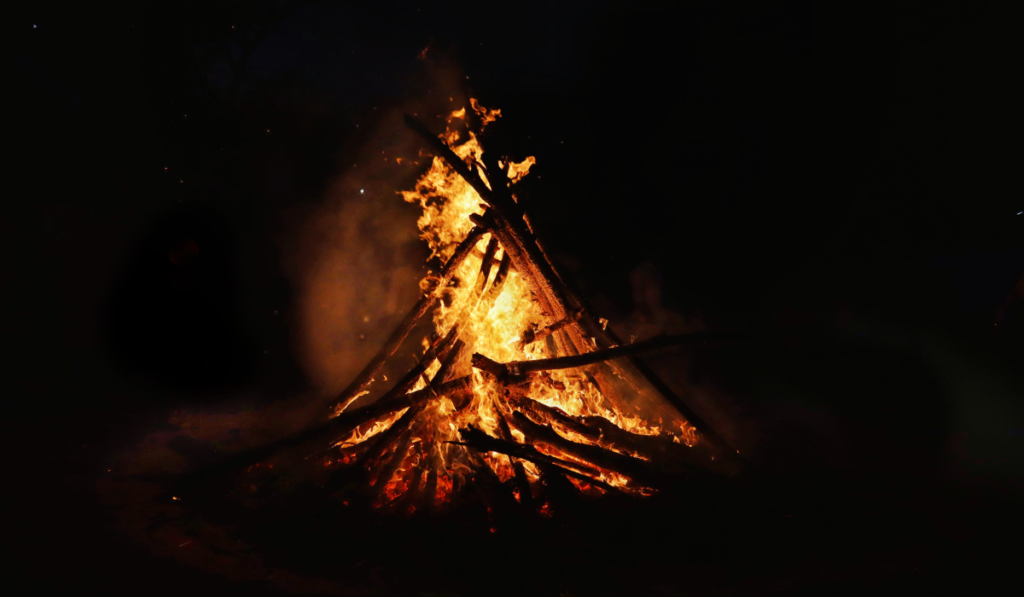
Holika Dahan is the ritual bonfire lit on the evening of Phalguna Purnima (the full moon of the Hindu month of Phalguna), the night before Holi. It commemorates the destruction of the demoness Holika and the protection of the devoted child Prahlada, as narrated in the Bhagavata Purana (Skanda 7). The holika dahan meaning is the burning away of evil, ego, and spiritual ignorance through the power of devotion.
Holika Dahan 2026 Date & Muhurta
Holika Dahan 2026 falls on the evening of Wednesday, 3 March 2026.
The ritual is performed after sunset during the Pradosh Kaal, provided the Bhadra period (an inauspicious window determined by the lunar calendar) has ended. Bhadra Kaal, ruled by Bhadra, sister of Saturn, is considered deeply inauspicious for the lighting of the bonfire. The muhurta for Holika Dahan must be confirmed through a current Panchang for your region.
| Important: In some years, Purnima tithi begins late enough that Bhadra extends into the night. In such cases, the bonfire is lit only after Bhadra concludes. Never perform Holika Dahan during Bhadra, this is both a scriptural and traditional caution observed across India. |
The Significance of Holika Dahan
The significance of Holika Dahan is layered which is mythological, psychological, and cosmic.
1. Scriptural Foundation
The Bhagavata Purana (Skanda 7) narrates the story of Prahlada, a young devotee of Shri Vishnu born into the household of the demon king Hiranyakashipu. Despite repeated persecution by his own father, Prahlada’s devotion remained unwavering.
When Hiranyakashipu’s sister Holika, who possessed a boon of fire immunity, attempted to burn Prahlada in her lap, she perished while Prahlada emerged unharmed. The Bhagavata Purana frames this as a direct demonstration of the principle stated in the Bhagavad Gita (4.7–8): that dharma is upheld and those who abide in it are protected.
2. Psychological Interpretation
Holika represents the ego reinforced by false immunity, the belief that our negativity, pride, or harmful patterns will not ultimately harm us. Prahlada represents bhakti, pure devotion that does not negotiate with what is false. The fire of Holika Dahan is the confrontation between the two. What burns is not merely symbolic; it is an invitation to honestly examine what within us has been operating with false immunity.
3. Vedic Fire Symbolism
In Vedic tradition, Agni is not a destroyer but a transformer and purifier. The Rigveda opens with an invocation to Agni as the divine priest, the carrier of offerings between worlds. When we circumambulate the Holika Dahan fire and offer our intentions into it, we are participating in this ancient understanding: fire does not eliminate, it refines.
4. Seasonal Transition
Holika Dahan also marks the end of winter and the arrival of spring. Traditionally, the heat of the bonfire was said to protect the community from the diseases and imbalances of seasonal change. New barley and wheat from the Rabi harvest are roasted in the fire and distributed as prasad, a deeply grounded expression of gratitude for the earth’s abundance.
The Ritual of Holika Dahan
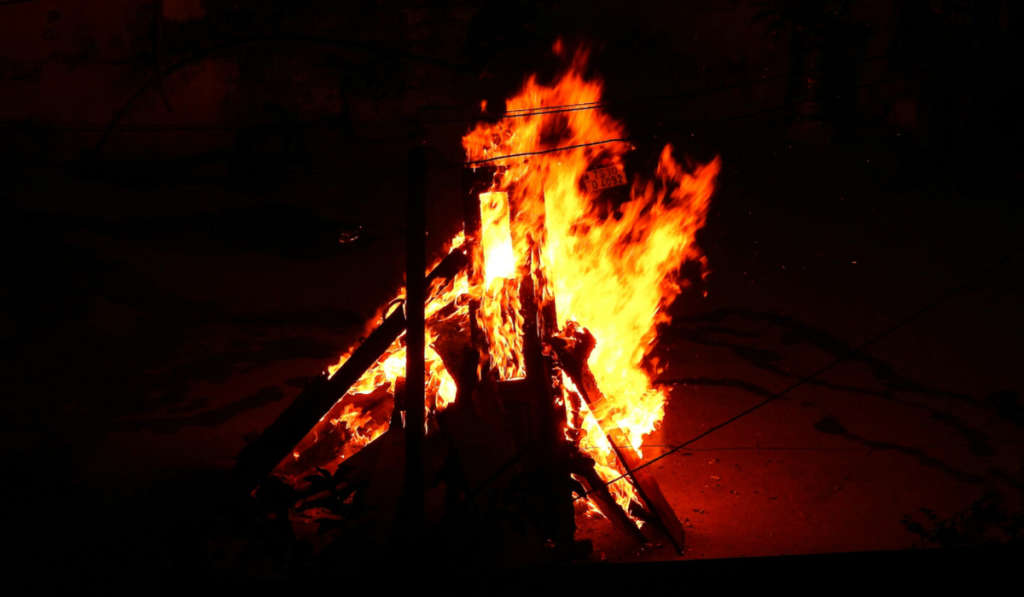
The holika dahan ritual is accessible to anyone, regardless of their level of familiarity with Hindu practice. Here is a simple mini guide:
Samagri You Need:
- Wood, dried cow dung cakes (upla), and dry grass for the bonfire
- Raw cotton thread (suraksha dhaaga)
- Akshat (unbroken rice grains), flowers, and roli (vermilion)
- New grain from the harvest (wheat, barley, or corn)
- Water (Gangajal if available)
Simple Ritual Steps:
- Prepare the bonfire in a community open space before sunset. The effigy of Holika is placed at the center.
- Offer water around the base of the bonfire as purification.
- Circumambulate (parikrama) the unlit bonfire three or seven times while winding raw cotton thread around it, symbolically binding what you wish to release.
- Light the bonfire after sunset, following the confirmed muhurta after Bhadra Kaal ends.
- Offer grain into the fire with gratitude for the harvest.
- Sit in the warmth and hold a clear intention of what you are releasing and what you are inviting in.
- Receive prasad, roasted grain offered as blessing.
The parikrama is perhaps the most meaningful gesture: walking around the fire, we acknowledge that transformation is not passive. We bring ourselves into the orbit of what purifies.
From the Bonfire to the Colors: Holi’s Spiritual Bridge
The morning after Holika Dahan is Holi, the festival of colors. The spiritual significance of Holi is inseparable from what came before it. The ash of the bonfire is cool, the air is clean, and we are invited to step into celebration not from escapism but from genuine renewal.
The significance of colors in Holi reflects this: each color is a sensory expression of the qualities that emerge when ego has been released. Red for love and vitality, yellow for learning and auspiciousness, green for new growth, blue for the infinite, the color play of Holi is the world seen through eyes that have been washed clean by the fire of the night before.
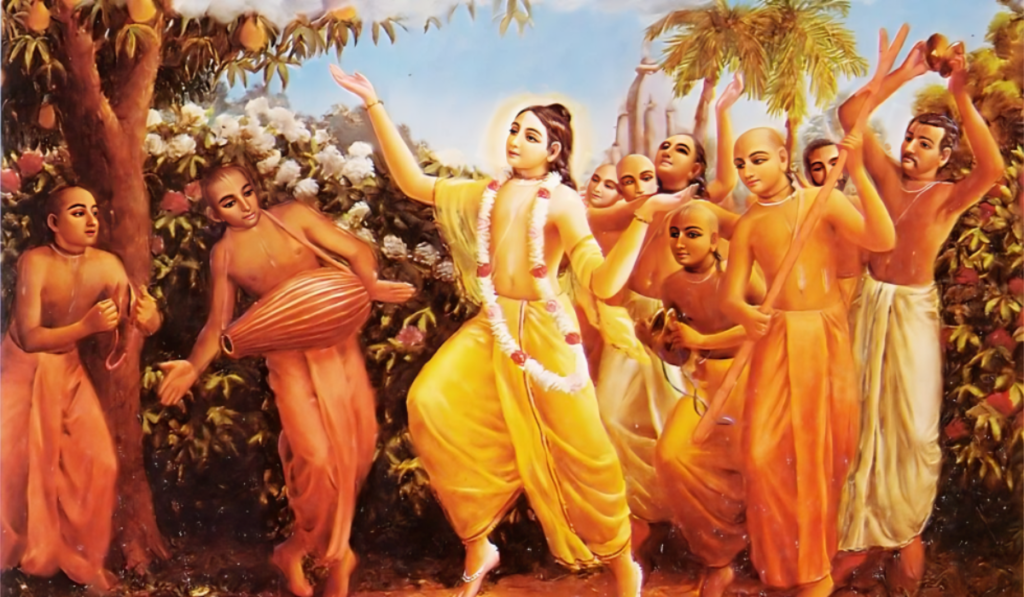
The religious significance of Holi also connects to the Radha-Krishna tradition in Braj, where colors celebrate divine love in its most joyful expression. This is not a contradiction of the Prahlada narrative, it is its completion. Prahlada’s devotion was ultimately an act of love. Holi, at its heart, celebrates love’s victory.
For a deeper exploration, read our rangwali holi festival importance blog and its regional traditions across India.
Frequently Asked Questions
1. What is the Holashtak meaning and when does it begin in 2026?
Holashtak is an eight-day period of spiritual vigilance before Holi, beginning on Phalguna Shukla Ashtami. In 2026, Holashtak begins on 24 February and ends on 3 March with Holika Dahan. Auspicious ceremonies are avoided during this period due to heightened planetary agitation as indicated by the Vedic Panchang.
2. What is the significance of Holika Dahan?
The significance of Holika Dahan lies in its commemoration of Prahlada’s devotion over Holika’s malice, as described in the Bhagavata Purana Skanda 7. It symbolizes the destruction of ego and evil through the purifying power of fire. The ritual affirms that sincere devotion (bhakti) is protected even against forces that appear more powerful.
3. What is the Holika Dahan 2026 date and muhurta?
Holika Dahan 2026 falls on the evening of Wednesday, 4 March 2026. The bonfire is lit during Pradosh Kaal after sunset, but only after the Bhadra period concludes. Exact muhurta timings should be verified through a current regional Panchang, as Bhadra timing varies by location.
4. Why are auspicious events avoided during Holashtak?
According to Vedic tradition, each of the eight days of Holashtak is ruled by a planet in a state of agitation, making the period inauspicious for initiating new ventures, marriages, or significant ceremonies. The holashtak significance is spiritual preparation, not prohibition, it is a time for reflection and inner clearing before Holika Dahan.
5. What is Bhadra Kaal and why does it matter for Holika Dahan?
Bhadra is an inauspicious period determined by the position of the moon, falling within specific tithis including Purnima. Performing Holika Dahan during Bhadra is considered highly unfavorable in both scriptural and folk tradition. The bonfire must only be lit after Bhadra concludes, which is why checking the Panchang for the exact muhurta is essential.
6. What is the spiritual significance of Holi colors?
The significance of colors in Holi connects to the joy that follows purification. Colors symbolize the vibrancy of a life lived in alignment, red for love, yellow for auspiciousness, green for renewal, and blue for the infinite. In the Braj tradition, the color play of Holi celebrates the divine love of Radha and Krishna, making it an expression of the religious significance of Holi at its most joyful.
7. What is the difference between Amanta and Purnimanta calendars for Holika Dahan?
In the Amanta calendar (followed in Maharashtra, Gujarat, and most of North India), Phalguna Purnima falls in the month of Phalguna. In the Purnimanta calendar (followed in parts of North India including Punjab and Himachal), the same full moon may be labeled as the Purnima of Chaitra month. However, both systems observe the same actual full moon night for Holika Dahan, the naming differs, the date does not.