
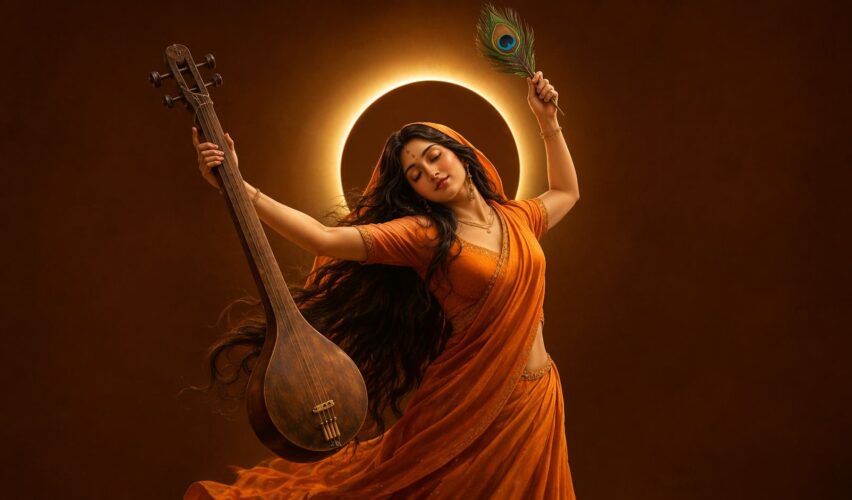
You don’t need to renounce the world to find God. You don’t need to master meditation or study ancient texts for years. According to Shri Krishna in the Bhagavad Gita, there is one path that is open to everyone, and it begins simply with love. Bhakti yoga is the path of reaching God through love and devotion.
The word bhakti means loving worship, and yoga means union. So bhakti yoga means uniting with God through heartfelt love. Shri Krishna teaches this path in the Bhagavad Gita and calls it the highest of all yogas. A true devotee, He says, is the most dear to Him.
What Does Bhakti Yoga Mean?
To understand bhakti yoga, it helps to look at the two Sanskrit words that make it up.
Bhakti comes from the root bhaj – which means to love, to serve, and to be devoted. It is not a quiet or distant feeling. It is active. When you sing a bhajan, offer a flower at a temple, or simply remember God with warmth in your heart, that is bhakti.
Yoga comes from the root yuj – to join or unite. It describes the state of being fully connected to something greater than yourself. Most people think of yoga as physical exercise, but at its root, yoga is about union with the Divine.
Put them together: bhakti yoga is the path of becoming one with God through love. It does not ask you to give up the world or master complex practices. It asks you to turn your heart toward God – and keep it there.
In one line: Bhakti yoga is the spiritual practice of surrendering to God through pure, selfless love, with no desire for reward in return.
Bhakti Yoga in the Bhagavad Gita
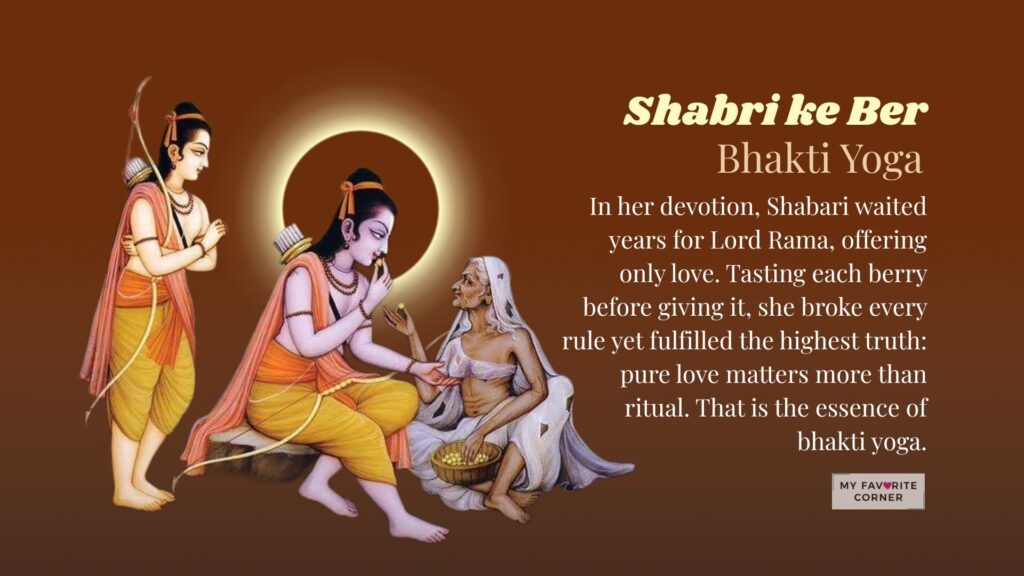
The Bhagavad Gita is where bhakti yoga is laid out most clearly. Shri Krishna does not present it as one choice among equals. He builds toward it chapter by chapter, and by the end of the Bhagwat Gita’s chapters, it stands as the highest teaching He has given.
Here is how bhakti unfolds across the key chapters.
Chapter 9 – The Royal Secret
In Chapter 9, Shri Krishna calls this path raja vidya – the king of all knowledge. He explains it simply: those who worship Him with full faith and love reach Him. There is no complicated formula.
He also speaks honestly about what happens without this love. He says those who have no faith in this path continue moving through the cycle of birth and death. This is not a warning meant to frighten. It is like a map, showing where the road leads and where it does not.
अश्रद्दधानाः पुरुषा धर्मस्यास्य परन्तप ।
अप्राप्य मां निवर्तन्ते मृत्युंसंसारवर्त्मनि ॥
“Ashraddadhanah purusha dharmasyasya parantapa,
aprapya mam nivartante mrityu-samsara-vartmani.”
Meaning: Those who are not faithful in this devotional service cannot attain Me. Therefore they return to the path of birth and death in this material world.
Chapter 12 – The Bhakti Yoga Chapter
Chapter 12 is entirely devoted to bhakti yoga. It opens with a question from Arjuna: who reaches You faster – the one who meditates on the formless, or the one who loves You as a personal God?
Shri Krishna answers with great warmth. He says those who worship Him with full faith, keeping their minds on Him always, are the best yogis. He then spends the rest of the chapter describing what such a devotee looks like – someone who is kind to all, does not hate anyone, is not attached to outcomes, and remains steady whether life brings joy or hardship.
BG 6.47 – Even the Meditation Chapter Points to Bhakti
Chapter 6 teaches dhyana yoga – how to meditate. Yet even here, Shri Krishna ends with a remarkable statement about bhakti. After describing the full discipline of seated meditation, He says:
योगिनामपि सर्वेषां मद्गतेनान्तरात्मना ।
श्रद्धावान्भजते यो मां स मे युक्ततमो मतः ॥
“Yoginam api sarvesham mad-gatenantar-atmana,
shraddhavan bhajate yo mam sa me yuktatamo matah.”
Meaning: Of all yogis, the one who loves Me with great faith, keeping Me always in his heart, is the most deeply united with Me – and the highest of all.
This verse carries a quiet lesson: no matter which yoga you practise, it is most complete when it is filled with love for God.
BG 18.66 – The Final Word
The Bhagavad Gita closes with 18 chapters of teaching on duty, knowledge, action, and devotion. And after all of it, Shri Krishna offers one last, simple instruction:
सर्वधर्मान्परित्यज्य मामेकं शरणं व्रज ।
अहं त्वां सर्वपापेभ्यो मोक्षयिष्यामि मा शुचः ॥
“Sarva-dharman parityajya mam ekam sharanam vraja.
Aham tvam sarva-papebhyo mokshayishyami ma shucah.”
Meaning: Give up all other paths and simply come to Me. Surrender fully. I will free you from all fear and all sin. Do not be afraid.
This is the final gift of the Gita. Everything before this verse was preparation. This verse is the destination – and it is pure bhakti yoga.
The Four Types of Bhakti Devotees
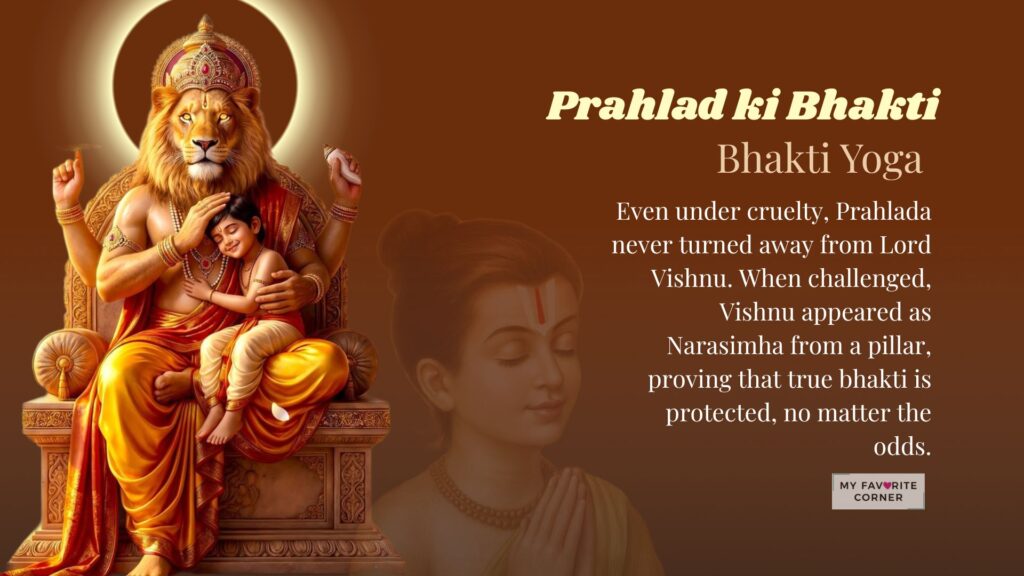
In Chapter 7 of Bhagwat Geeta, Shri Krishna makes a beautiful observation. He says that people come to God for all kinds of reasons: some in pain, some out of curiosity, some seeking something, and some simply out of love. He welcomes all of them.
Here are the four types He describes:
| Type | Name | What they seek | Real-life example |
| 1 | Arta | Help in a time of pain or fear | Someone who turns to God after losing a loved one |
| 2 | Jijnasu | To understand God and the deeper meaning of life | A young seeker reading scripture for the first time |
| 3 | Artharthi | A specific blessing – health, a job, a child | Someone who keeps a vow during a difficult time |
| 4 | Jnani | Nothing. They love God for the sake of love alone | The devotee Shri Krishna calls most dear to Him |
What matters most is not where you start, it is that you START. Shri Krishna says all four types are noble. The Arta who first called on God during a crisis may, through that very act of reaching out, begin a journey that ends in pure, effortless love.
Every form of bhakti is a door. Walk through any one of them, and the path opens.
What is the Difference Between Bhakti Yoga vs Karma Yoga vs Jnana Yoga?
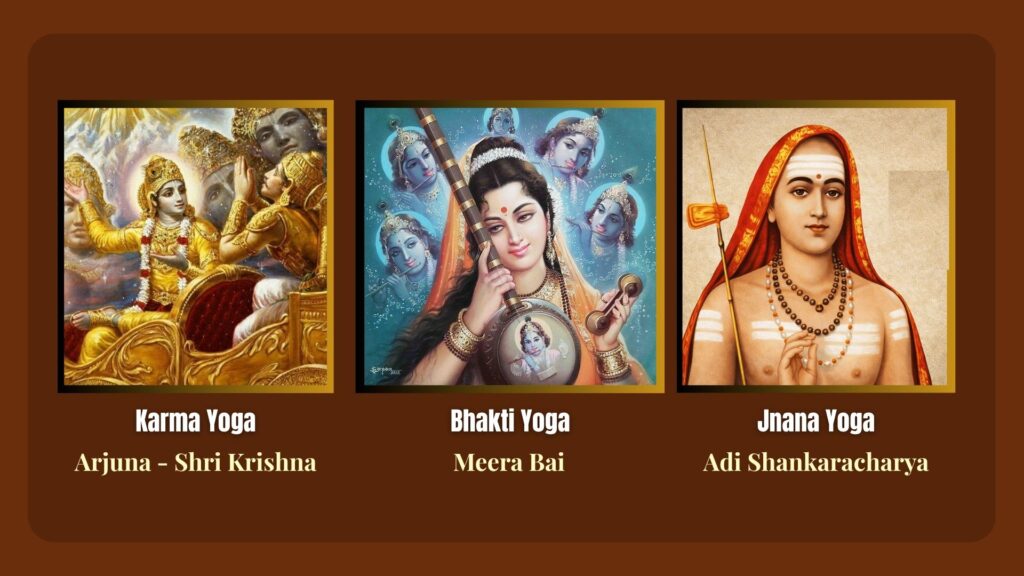
The Bhagavad Gita describes three main paths to God. They are not rivals. Think of them as three rivers, each one flowing from a different source, but all moving toward the same ocean.
| Yoga path | How you practice it | The heart of the path | Where it leads |
| Bhakti Yoga | Loving, worshipping, and surrendering to God | Love (Prema) | A personal, eternal relationship with the Divine |
| Karma Yoga | Doing your duty without expecting a reward | Selfless action (Nishkama) | Freedom from the ego through right action |
| Jnana Yoga | Studying scripture and asking deep questions about the Self | Wisdom (Viveka) | Liberation through direct knowledge of the Self; the seeker dissolves into the formless Brahman |
Learn more about Karma ~ What is Karma?
The simplest way to see the difference: karma yoga is about what you do. Jnana yoga is about what you know. Bhakti yoga is about who you love. Shri Krishna says the path of love – bhakti yoga – leads to the most intimate union with Him.
These paths also flow into one another naturally. A karma yogi who offers every action to God is, in that moment, practising bhakti. A jnana yogi who finally sees God not just as a concept but as a living, loving presence – that realisation is bhakti. The deeper you go on any path, the closer you come to devotion.
Why Is Bhakti Yoga the Highest Yoga?
Shri Krishna does not just describe bhakti yoga – He returns to it again and again across 18 chapters. At the end of the Gita, it is the path He personally recommends. There are three clear reasons why.
1. Anyone can practise it. Classical meditation (dhyana yoga) requires years of strict discipline – controlled diet, celibacy, long hours of silent sitting. Deep philosophical inquiry (jnana yoga) requires great patience with abstract ideas. Bhakti yoga asks only for a sincere heart. A child can practise it. An elderly grandmother can practise it. A busy working person can practise it. The door is always open.
2. It creates the closest bond with God. In BG 6.47, Shri Krishna uses the word yuktatamah – which means “most intimately joined.” He does not say the bhakta is the most intelligent or the most disciplined. He says the bhakta is the most deeply connected to Him. That closeness comes only through love.
3. It holds all other paths within it. A devotee who offers every action to God is naturally doing karma yoga. And a devotee who studies the Gita or chants the Vishnu Sahasranama is building jnana. A devotee who meditates on Shri Krishna’s form in the heart is doing dhyana. Bhakti does not replace the other paths – it is the love that gives all of them meaning.
In Chapter 12, Shri Krishna paints a picture of His ideal devotee – not someone sitting alone in a cave, but someone living fully in the world: gentle with others, free from bitterness, steady in difficulty, and anchored always in love for God. That is what bhakti yoga looks like in daily life.
How to Practise Bhakti Yoga?
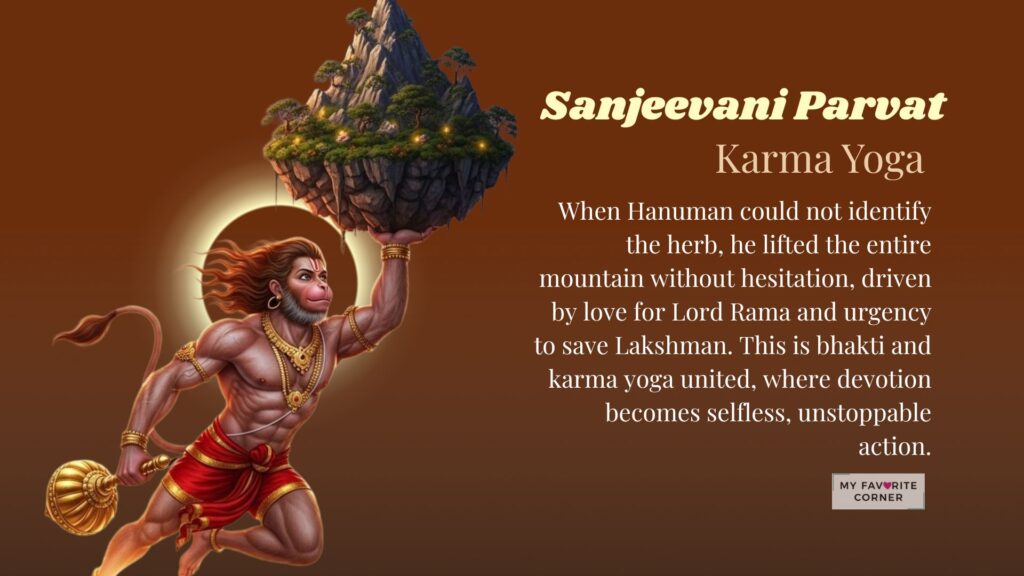
So how does one actually live bhakti yoga? The Bhagavata Purana describes nine classical forms – known as Navadha Bhakti. Each one is a practical way to keep God in your heart throughout the day.
1. Shravanam – listening
2. Kirtanam – singing
3. Smaranam – remembering
4. Pada-sevanam – serving at God’s feet
5. Archanam – daily worship
6. Vandanam – bowing
7. Dasyam – serving as a humble instrument
8. Sakhyam – friendship with God
9. Atma-nivedanam – total surrender
Frequently Asked Questions About Bhakti Yoga
1. Is bhakti yoga mentioned in the Vedas?
Yes. The word bhakti first appears in the Shvetashvatara Upanishad, one of the ancient Upanishads, where it describes devotion and love for the Divine. Bhakti yoga as a complete spiritual path – with clear teachings, practices, and goals – is most fully laid out in the Bhagavad Gita, especially in Chapters 9 and 12.
2. Who founded bhakti yoga?
Bhakti yoga was not founded by one person. Its roots go all the way back to the Vedic tradition. Shri Krishna gives its clearest teaching in the Bhagavad Gita. Over time, great saints across India deepened this path – Ramanuja, Madhva, Mirabai, Kabir, Tukaram, and Shri Chaitanya Mahaprabhu among them. Each brought their own expression of love for God, and together they shaped the living bhakti tradition we have today.
3. What is the goal of bhakti yoga?
The deepest goal of bhakti yoga is moksha – freedom from the cycle of birth and death – through a loving relationship with God. Unlike jnana yoga, where the self merges into the formless Brahman, bhakti yoga leads to something even more personal: the devotee abides in the presence of God, known and loved. As the tradition says, the bhakta does not disappear into God. The bhakta rests in God, held by love.
4. Can anyone practise bhakti yoga?
Yes – and this is one of the most beautiful things about this path. Shri Krishna says in the Bhagavad Gita that He accepts devotion from anyone who comes to Him with a sincere heart, regardless of their background, caste, age, or past. Bhakti yoga does not require you to be a scholar or a monk. It requires love. That is something every person is capable of.
5. How is bhakti yoga different from devotion in other traditions?
What makes bhakti yoga distinctive within Sanatan Dharma is the nature of the relationship. The devotee does not worship God only out of fear, or to earn a reward, or to fulfil a social duty. The devotee loves God for the sake of love itself – asking for nothing in return. Shri Krishna says in the Bhagavad Gita that this kind of love, pure and selfless, is the highest form of bhakti. It is also the most joyful.
Continue Exploring the Path of Devotion
Bhakti yoga is not a concept to understand once and move on from. It is a way of living – something that deepens the more you practise it. If this piece has stirred something in you, here are a few places to go deeper on My Favorite Corner.
- What Is Dharma? Meaning, Definition, and Why It Can’t Be Translated Simply
- Is There Heaven in Hinduism? Swarga, Naraka & Moksha
- Why Hindu Festivals Follow The Lunar Calendar (Moon Phases Explained)?
- Who Broke India’s Gurukul System and Why It Never Recovered?
At My Favorite Corner, we write from within the tradition, with reverence for the scriptures and love for the path. If this piece spoke to you, share it with someone on their spiritual journey. For more such reflections, follow us on Instagram and Facebook, and stay connected to the path of bhakti.