

A modern yoga class has warm light, a playlist, guided flows, occasional breath cues, and a room full of people chasing strength and calm in equal measure. It feels good. But ask: what actual benefits of Yoga were people seeking from thousands of years ago?
Not Instagram-ready flexibility. Not calories burned. They were aiming for something far greater than anything and that is inner freedom.
What is the Actual Meaning of Yoga?
The word yoga comes from a root meaning “to yoke” or “to join.” And this union is more than asanas. It is the joining of body, breath, mind and, ultimately, awareness, a practical path toward self-realisation. The aim was not contortion or cardio.
It was steadiness of the heart and clarity of mind so a person could live rightly, see reality clearly, and be free from needless suffering. Because Yoga is an undeniable organ of Dharma that supports righteousness.
What the Yoga Sutras Actually Teach?
Patanjali opens with a single line that became the textbook definition for classical yoga:
Yogaḥ chitta-vritti-nirodhaḥ. It means yoga is the stilling of the fluctuations of consciousness.
In simple term, when the noisy patterns of thought like worry, craving, identification goes down, the deeper reality of who you are becomes visible. The practice is a technology for mental mastery, not only physical fitness.
What are the Eight Limbs of Yoga?
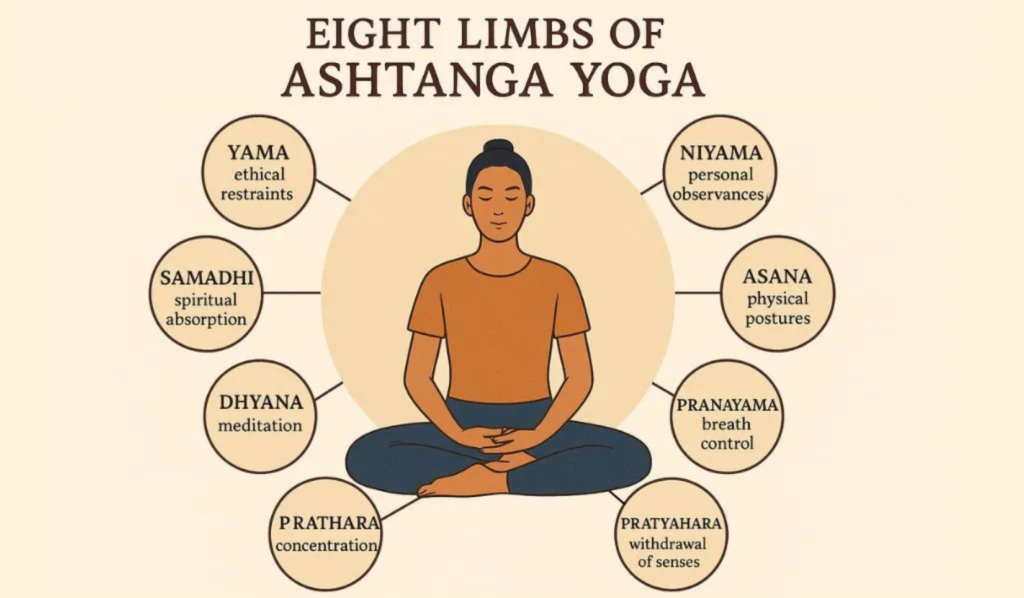
Patanjali lays out an integrated framework to easily understand the authentic meaning of Yoga, the eight limbs of yoga, that form a whole way of living:
1. Yama: How we relate to others
Practices like non-violence and truthfulness begin in small moments. For example, speaking without sarcasm that wounds, not taking what isn’t yours including someone’s time, credit, or trust. It is the shift from “How do I win?” to “How do I live without creating disturbance in myself and others?”
2. Niyama: How we relate to ourselves
Cleanliness becomes mental as much as physical, reducing comparison, consuming what uplifts, keeping inner space uncluttered. Contentment and self-study mean you stop outsourcing your worth and start observing your patterns with honesty instead of judgment.
3. Asana: Becoming steady in the body
Originally, posture meant sitting in a way that the body no longer distracts the mind; comfort that allows awareness to deepen. It trains you to stay present inside mild discomfort, the same skill you need in difficult conversations and uncertain phases of life.
4. Pranayama: Learning to regulate your inner state through breath
Instead of being hijacked by stress, you discover that slow, conscious breathing can calm the heart, sharpen focus, and release stored tension. It is the moment you realise your mood is not just psychological, it is physiological and trainable.
5. Pratyahara: Freedom from constant stimulation
Not suppression of the senses, but the ability to not be pulled by every notification, craving, or opinion around you. You can sit in a room without reaching for your phone and feel full, not restless.
6. Dharana: Training the mind to stay
Choosing one point of focus, the breath, a mantra, a task, and gently returning whenever the mind wanders. This is the muscle behind deep work, real listening, and finishing what you start without mental exhaustion.
7. Dhyana: Effortless meditation
Attention becomes continuous and unbroken, like being completely absorbed in music, prayer, or meaningful work. The sense of “I am trying to focus” dissolves, and you experience a quiet, flowing awareness. In simple words, you achieve flow state.
8. Samadhi: Wholeness and direct experience of unity
The usual boundary between “me” and “life” softens; there is clarity, peace, and a deep sense of completeness without external cause. Not an escape from the world, but the end of inner fragmentation. You act, love, and live without the constant noise of ego.
What are the real benefits of traditional yoga?
Traditional yoga trains the mind and heart for lasting inner freedom: mental clarity, emotional resilience, ethical living, nervous-system regulation through breath, reduced dependence on external validation, clearer life purpose, a deep and steady joy, and ultimately self-realisation, and freedom from habitual patterns of suffering.
Below are the core benefits, each shown in a practical way and linked to how it transforms inner life, not just appearance.
1. Mental clarity and freedom from overthinking
Your mind stops replaying the same worries all day. You become able to focus on one task without feeling mentally tired. This is the direct result of practising breath awareness and concentration.
2. Emotional balance and resilience
Situations still happen, but your reactions become calmer and more mature. You respond instead of reacting, which improves both personal and professional relationships.
3. Stronger relationships through yama and niyama
When you practise truthfulness, contentment, and non-greed, comparison and jealousy reduce naturally. People feel safe around you, and connection becomes deeper and more genuine.
4. A calm and regulated nervous system through pranayama
Your breath becomes a tool to handle stress, sleep better, and reduce anxiety. This is one of the most practical mental benefits of yoga in the modern world.
5. Freedom from the need for constant validation
You no longer depend on social media approval or external success to feel worthy. This creates emotional independence and inner stability.
6. A clear sense of purpose and dharmic direction
Your decisions start aligning with your values instead of social pressure. Work becomes meaningful because it feels connected to who you really are.
7. Joy that is not dependent on circumstances
You feel peaceful without needing everything to go your way. This is a key part of the spiritual benefits of yoga.
8. Self-realisation and inner awakening
You slowly realise that you are not your thoughts, roles, or achievements. This is the ultimate goal of yoga for inner transformation and the true union of body and mind.
Yoga as Different Paths for Different People
Yoga was never one method. It offered multiple approaches for different personalities.
- Karma Yoga: serving selflessly through your daily work without attachment to the result.
- Bhakti Yoga: expressing love and devotion through prayer, chanting, or remembering the Divine.
- Jnana Yoga: asking deep questions like “Who am I?” and seeking truth through reflection.
- Dhyana/Raja Yoga: the meditative path described in the eight limbs of yoga.
All of them lead to the same goal and that is self-realisation.
How Yoga Gradually Became Mostly a Physical Practice?
The journey of yoga across centuries is a story of adaptation, not loss. When yoga travelled beyond forest hermitages into cities and later across the world, the physical aspect became the easiest doorway for people to enter.
In the early 20th century, posture-based practice was easier to teach in groups, easier to demonstrate, and easier for modern lifestyles. Over time, fitness culture, visual media, and commercial spaces highlighted asana, because it was visible and measurable.
This shift made yoga accessible to millions. But it also meant that the deeper traditional yoga benefits such as mental stillness, ethical living, and self-realisation became less visible.
Today, many people enter through the body. The invitation of the ancient tradition is to continue the journey inward and discover yoga beyond asanas.
Why Are The Original Benefits Of Yoga Important Today?
We live in a time of constant stimulation. The mind rarely rests. Comparison is continuous. Success is visible but peace is rare.
The mental benefits of yoga directly address anxiety, overthinking, and emotional exhaustion. Breath awareness calms the nervous system. Concentration practices rebuild attention. Ethical living reduces inner conflict.
The spiritual benefits of yoga give something modern life often cannot offer. A sense of meaning that is not based on achievement. A feeling of completeness that does not depend on approval.
This is why the authentic meaning of yoga is not ancient history. It is a practical response to modern restlessness.
How to Experience the Real Benefits of Yoga in Modern Life?
You do not need to change your lifestyle completely. Small daily shifts begin the process of yoga for inner transformation.
- Breathe consciously in stressful moments: Before replying to a difficult message or entering a meeting, take five slow breaths. This simple practice brings immediate mental clarity.
- Sit in stillness for two minutes daily: No technique, no pressure. Just sit and observe your thoughts. This is the beginning of dhyana in real life.
- Practise mindful action: While eating, walking, or listening to someone, give full attention. This trains the mind in dharana and reduces overthinking.
- Live one value from yama or niyama each day: Speak truthfully. Practise contentment. Avoid unnecessary comparison. These small actions create deep inner stability.
These are simple ways to experience the real benefits of yoga without changing your external routine.
Conclusion
The true benefits of yoga were never limited to physical fitness. They were always about creating a steady mind, a compassionate heart, and a life aligned with purpose.
Through the eight limbs of yoga, through breath, awareness, and right living, yoga becomes a path to freedom from inner conflict and a direct experience of peace.
In a restless world, yoga is not an escape. It is a return to your natural state of completeness and the rediscovery of a simple joy that was never absent.
The journey does not end here. Follow MFC on Instagram and Facebook to explore more sacred places, festivals, and living traditions of Sanatan Dharma.