


High in the Himalayas, there is a silence that speaks. It does not arrive in emptiness. It arrives in presence of something or someone far greater than all of us. Every year, hundreds of thousands of pilgrims climb into that silence. They carry nothing but faith and the quiet weight of their lives.
This is the Char Dham Yatra.
It is one of the most sacred pilgrimages in India. It crosses four ancient shrines, three sacred rivers, and the inner landscape of the human soul. But, what makes the Char Dham Yatra so powerful in Sanatan Dharma? The answer lives in its history, its temples, and the transformation it quietly demands.
What Is the Char Dham Yatra in Hinduism?
“Char Dham” means four sacred homes.
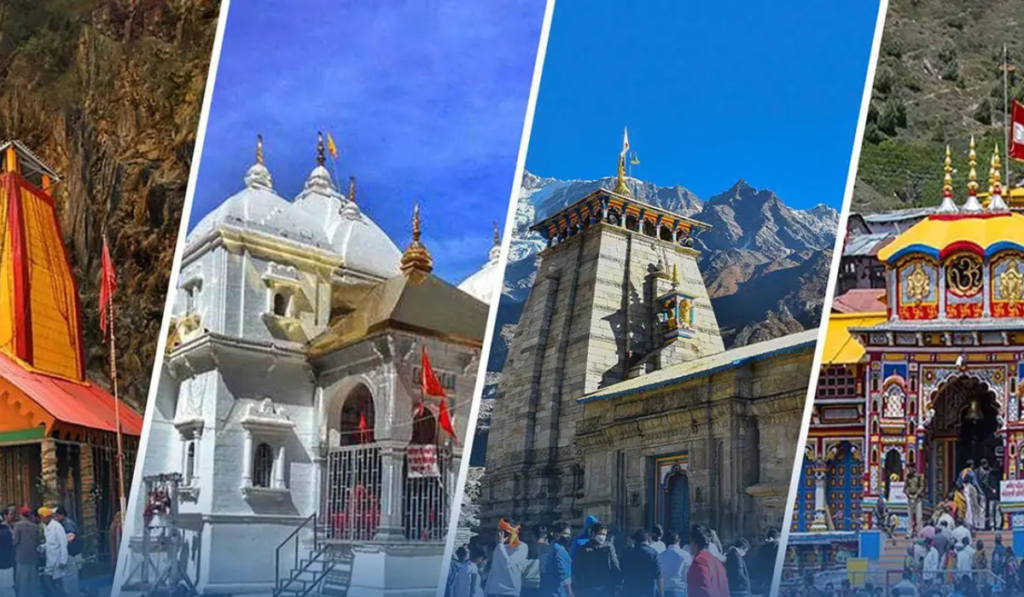
In Uttarakhand, these four sacred homes are Yamunotri, Gangotri, Kedarnath, and Badrinath. All four shrines sit high in the Garhwal Himalayas.
In simple words, the Char Dham Yatra is a sacred pilgrimage circuit of four ancient Himalayan temples in Uttarakhand, India. Devoted to Goddess Yamuna, Goddess Ganga, Bhagwaan Shiva, and Bhagwaan Vishnu respectively, the Yatra purifies the soul, clears accumulated karma, and brings the devotee closer to moksha. That is, liberation from the cycle of rebirth. |
Sanatan Dharma treats pilgrimage as an act of spiritual discipline, not tourism. Every step carries intention. Every climb earns grace. Completing the Char Dham Yatra is among the highest acts of devotion a Hindu can perform in one lifetime.
Char Dham Yatra History: The Role of Adi Shankaracharya
To understand the Char Dham Yatra, you need to understand one extraordinary man. Adi Shankaracharya was born in Kerala in the eighth century CE. He became a philosopher, a monk, and a reviver of Sanatan Dharma.
By his time, many of India’s sacred sites had fallen into neglect. Pilgrimage traditions had weakened. Temples had lost their living continuity. Shankaracharya walked the length of India on foot. He revived temples, debated scholars, and restored spiritual purpose to ancient sites.
He established four monastic centres, called mathas, at India’s four geographic corners. These became the original, all-India Char Dham:
- Badrinath in the north
- Dwarka in the west
- Puri in the east
- Rameswaram in the south
This circuit united India’s diverse spiritual traditions under one living pilgrimage. It was an act of cultural genius. Today, most pilgrims use the term Char Dham Yatra for the Uttarakhand circuit.
Here is the key distinction:
- The all-India Char Dham covers Badrinath, Dwarka, Puri, and Rameswaram. These four shrines span India’s four cardinal directions.
- The Uttarakhand Char Dham (also called Chota Char Dham) covers Yamunotri, Gangotri, Kedarnath, and Badrinath. All four shrines sit within the Garhwal Himalayas.
Both traditions carry Adi Shankaracharya’s signature: devotion, unity, and the belief that sacred geography shapes a living civilisation.
Which Temples Are Included in the Uttarakhand Char Dham?
The four temples of the Uttarakhand Char Dham are: Yamunotri, Gangotri, Kedarnath, and Badrinath. Each shrine holds a different deity, a different story, and a different face of the Divine.
1. Yamunotri: Source of the Yamuna
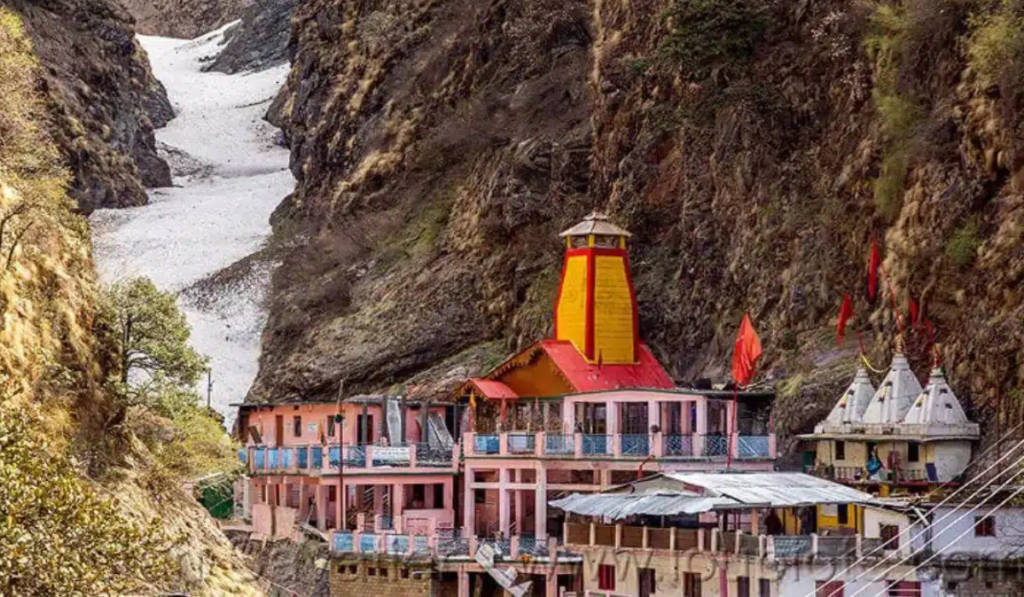
Yamunotri sits at 3,293 metres in Uttarkashi district. It is the starting point of the Yatra.
The temple honours Maa Yamuna. She is the daughter of the sun god Surya and twin sister of Yama, the god of death.
Devotion to Yamuna frees the soul from the fear of death. There is something deeply tender about beginning a pilgrimage with that prayer. Pilgrims reach the temple by foot, through mountain terrain that itself teaches humility.
2. Gangotri: Origin of the Ganga
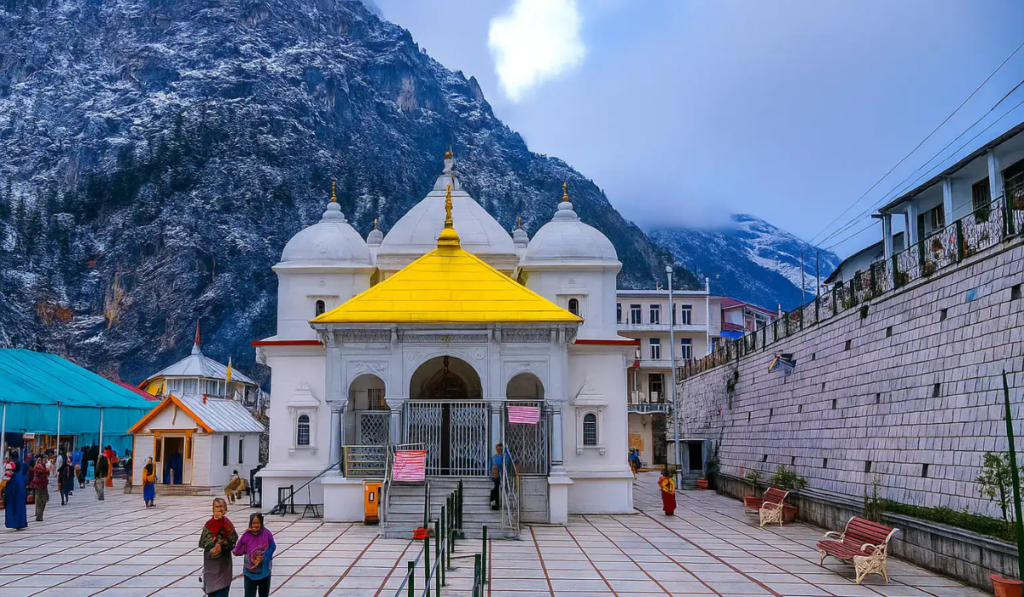
Gangotri stands at 3,100 metres, also in Uttarkashi district. Here, the Ganga begins her earthly journey. The temple enshrines Maa Ganga. She is the divine river who descended from the heavens through Bhagwaan Shiva’s matted locks.
In Sanatan Dharma, the Ganga is not simply water. She is a living goddess who absorbs and purifies all karma. The Bhagirathi river flows beside the temple. Its cold water carries the memory of the glacier above, and something older still.
3. Kedarnath: The Shiva of the High Peaks
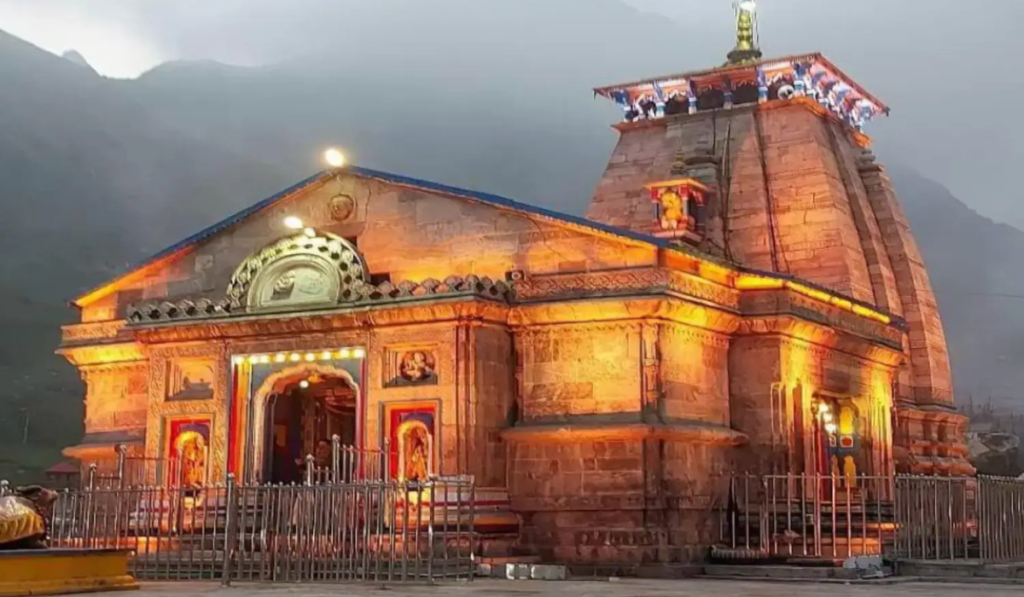
Kedarnath rises at 3,583 metres in Rudraprayag district. It is the most demanding of the four shrines. The temple houses one of India’s twelve Jyotirlingas. These are ancient pillars of sacred light, each dedicated to Bhagwaan Shiva.
Puranas teach that Shiva concealed himself here after the Kurukshetra war to avoid the Pandavas. He submerged into the earth as a bull. Pilgrims walk 16 kilometres from Gaurikund to reach the temple.
The Mandakini river and surrounding peaks create an atmosphere of raw, austere devotion. No other site on the Char Dham circuit demands as much from the body. And few experiences in life reward it as deeply.
4. Badrinath: The Final Abode
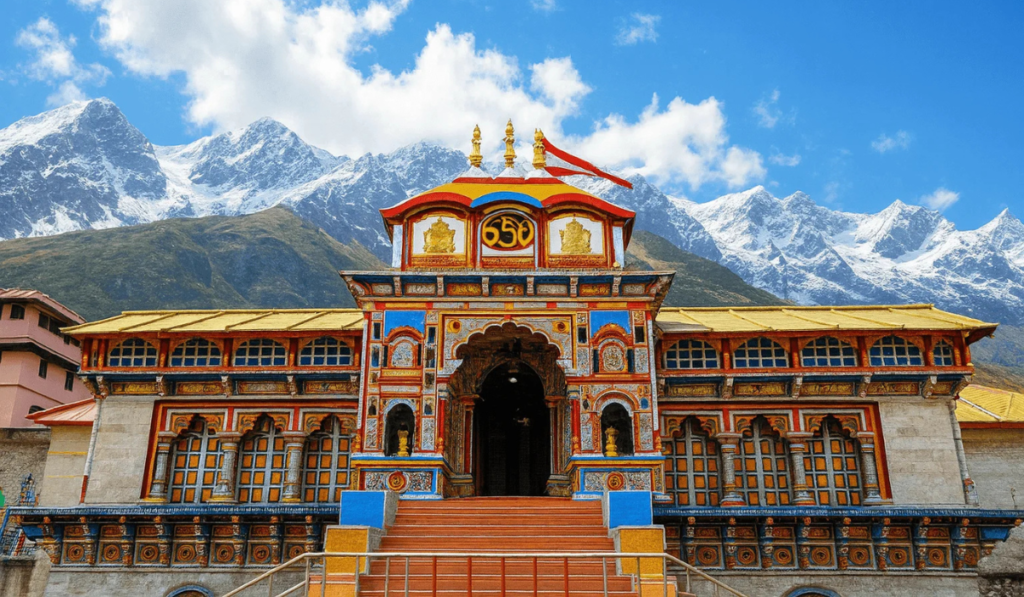
Badrinath stands at 3,133 metres in Chamoli district. It completes the circuit. The temple honours Bhagwaan Vishnu in his form as Badrinarayan. He meditated under the Badri tree while Goddess Lakshmi shielded him from the cold.
Shankaracharya himself revived this temple during his travels across India. The Alaknanda river flows beside it. The Nar and Narayan mountain ranges rise above. Badrinath carries both Vaishnava devotion and the philosopher’s legacy.
Char Dham Yatra Route and Order of Visit
The traditional order of the Char Dham Yatra:
Yamunotri → Gangotri → Kedarnath → Badrinath
This sequence follows a west-to-east arc through the Garhwal Himalayas. It moves from the source of the Yamuna to the source of the Ganga, then from Shiva to Vishnu. The order is not arbitrary. It reflects a spiritual logic. You begin with purification and end with liberation.
Most pilgrims start from Haridwar or Rishikesh. Both cities serve as the traditional gateways to the Himalayan pilgrimage region. The route then climbs through Uttarkashi, Barkot, Rudraprayag, Joshimath, and Chamoli. Each town carries its own sacred weight.
Some sections require trekking. Others are accessible by road, with mountain paths completing the final stretch. Physical effort is not a barrier. That is the point. A journey made effortless would not be a pilgrimage.
Why the Char Dham Yatra is So Important in Sanatan Dharma?
In Sanatan Dharma, it is believed completing Char Dham Yatra helps attain moksha, from the cycle of birth and death. A tirtha is a crossing point. It is a ford where the ordinary world meets the sacred.
The Char Dham offers four such crossings, each approaching the Divine from a different direction. The physical endurance of the Yatra is a spiritual act. Every step at altitude, every cold morning at a temple threshold, every moment of dependence on the mountain becomes tapasya. A form of spiritual discipline that no classroom can teach.
The Yatra also honours India’s sacred rivers. Yamuna and Ganga are not mythological abstractions. They are living presences, worshipped as goddesses because they gave India’s civilisation its first breath.
To reach their headwaters is to stand at the source of something far older and far greater than any of us. Finally, the four shrines place devotees before four different expressions of the Divine: the river goddess, the cosmic mother, the eternal ascetic, and the sustaining god. To complete the circuit is to receive blessing from creation itself, in all its forms.
When Does the Char Dham Yatra Start in 2026?
| Temple | Opening Date (2026) | Closing Date (2026) |
| Yamunotri Temple | 19 April 2026 | 11 Nov 2026 (Tentative) |
| Gangotri Temple | 19 April 2026 | 10 Nov 2026 (Tentative) |
| Kedarnath Temple | 22 April 2026 | 10 Nov 2026 (Tentative) |
| Badrinath Temple | 23 April 2026 | 13 Nov 2026 (Tentative) |
The four Uttarakhand temples do not stay open year-round. Himalayan winters force a seasonal closure of roughly six months.
The temples reopen each spring around Akshaya Tritiya, an auspicious date in the Hindu Lunar calendar, month of Vaishakha (April or May). Temple priests set the exact opening dates each year through astrological calculation. The government publishes these dates officially.
The pilgrimage season peaks between May and June, and again between September and October after the monsoon retreats. By October or November, the first heavy snowfalls arrive. Priests close the temples and ceremonially move the presiding deities to lower-altitude locations for winter worship.
Pilgrims should plan their Yatra between May and early October. Always confirm that year’s official opening dates before travelling.
The Spiritual Symbolism of the Journey
Pilgrimage in Sanatan Dharma has always been an interior journey wearing the costume of an exterior one. The Char Dham Yatra is no exception.
Each of the four dhams connects, in a deeper reading, to one of the four aims of human life: dharma (right conduct), artha (prosperity), kama (fulfilment), and moksha (liberation). Completing all four closes a symbolic circle of human purpose.
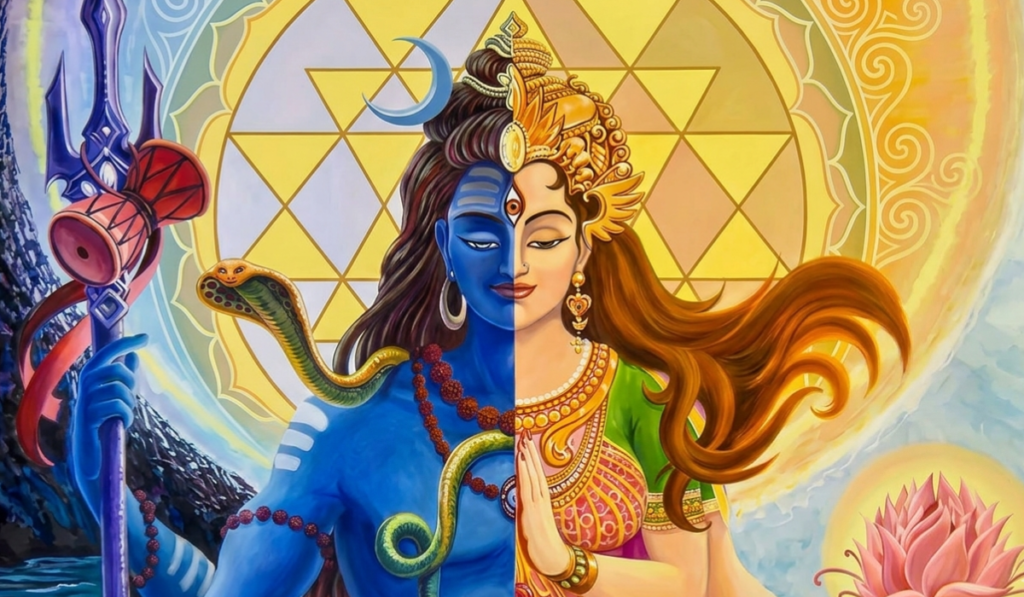
The mountains themselves are not environments to conquer. They are presences to approach with humility. In the Himalayan vision of Sanatan Dharma, Bhagwaan Shiva resides at the peak. The rivers are goddesses. The stones are altars. To walk among them is to enter a living temple, not merely visit a landscape.
Surrender, faith, endurance, and devotion. The Yatra asks for all four. These are the same qualities spiritual life asks of us always. The pilgrimage simply makes them visible, physical, and impossible to avoid.
The Char Dham Yatra Today
The pilgrimage has grown enormously in recent decades. In 2025, more than 5 million (50+ lakh) devotees visited the Char Dham Yatra of Uttrakhand. It became possible because of better roads, helicopter services to Kedarnath, and online registration portals bring the Yatra within reach of millions.
The national Char Dham Mahamarg Vikas Pariyojana project improves road infrastructure across the region year by year.
Hundreds of thousands complete the circuit every season. The numbers grow annually.
Yet the spirit of the pilgrimage remains intact. Rituals at every shrine follow ancient patterns. Priests carry their hereditary roles. The prayers at Yamunotri and Badrinath belong to the same tradition they always have.
The Char Dham Yatra proves something essential about Sanatan Dharma. Tradition here is not a museum exhibit. It is a living river, continuously fed by those who return to it with devotion.
Conclusion
The Char Dham Yatra does not simply take you to four temples. It takes you somewhere far more difficult to reach. Generations of seekers walked this path before us. They carried grief, gratitude, unanswered questions, and quiet faith. They left no written record. Only the worn devotion in the stones beneath each pilgrim’s feet.
When a devotee stands at the source of the Ganga or before the ancient linga at Kedarnath, something shifts. The distance between the one who travels and the destination begins to dissolve.
Sanatan Dharma teaches that the Divine does not sit behind a temple door. It lives in rivers, mountains, stone, and silence. The Char Dham Yatra walks us into that presence. Slowly, humbly, one step at a time.
Whether you are a devoted pilgrim, a spiritual seeker, or someone drawn by curiosity alone, the Char Dham Yatra asks one thing above all.
Come with an open heart.