

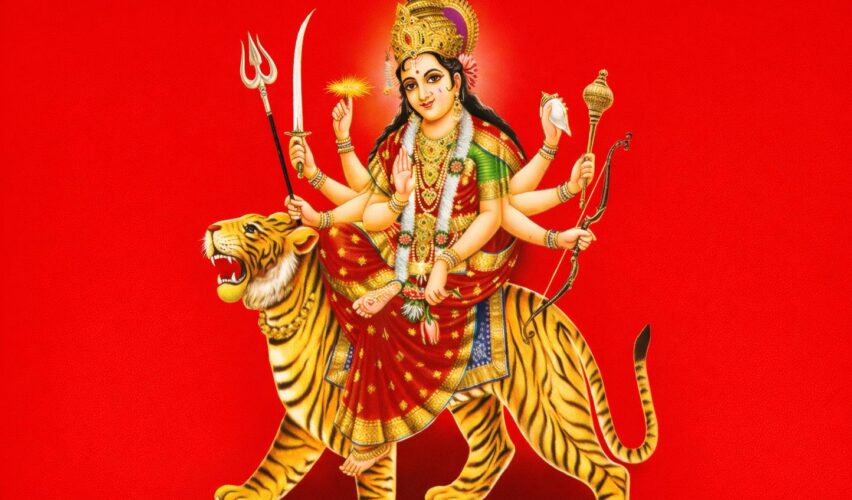
दुर्गा चालीसा
॥ दोहा ॥
नमो नमो दुर्गे सुख करनी।
नमो नमो अम्बे दुःख हरनी॥
निरंकार है ज्योति तुम्हारी।
तिहूँ लोक फैली उजियारी॥
॥ चालीसा ॥
1
नमो नमो दुर्गे सुख करनी।
नमो नमो अम्बे दुःख हरनी॥
2
निरंकार है ज्योति तुम्हारी।
तिहूँ लोक फैली उजियारी॥
3
शशि ललाट मुख महाविशाला।
नेत्र लाल भृकुटि विकराला॥
4
रूप मातु को अधिक सुहावे।
दरश करत जन अति सुख पावे॥
5
तुम संसार शक्ति लय कीना।
पालन हेतु तीन रूप धरि लीना॥
6
सृष्टि पालन करत हैं माया।
आदि शक्ति यह तेरी काया॥
7
अग्नि सोम रूप तुम मात।
शरण परे की करत प्रभात॥
8
भुजा चार अति शोभित माता।
वार करत बरदायिनी विख्याता॥
9
खड्ग खप्पर रखवारी दीन्हा।
जो जो शरण तुम्हारी लीन्हा॥
10
नगर कोट में तुमही विराजत।
तिहूँ लोक में डंका बाजत॥
11
शुम्भ निशुम्भ दानव तुम मारे।
रक्तबीज शंखन संहारे॥
12
महिषासुर नृप अति अभिमानी।
जेहि अघ भार मही अकुलानी॥
13
रूप कराल काली का धारा।
सेन सहित तुम तिहि संहारा॥
14
परी गाढ़ संतन पर जब जब।
भई सहाय मातु तुम तब तब॥
15
अमरपुरी अरु बासव लोका।
तब महिमा सब रहें अशोका॥
16
ज्वाला में है ज्योति तुम्हारी।
तुम्हें सदा पूजें नर नारी॥
17
प्रेम भक्ति से जो यश गावे।
दुःख दारिद्र निकट नहिं आवे॥
18
ध्यावे तुम्हें जो नर मन लाई।
जन्म मरण ताकु छुटि जाई॥
19
जोगी सुर मुनि कहत पुकारी।
योग न हो बिन शक्ति तुम्हारी॥
20
शंकर आचारज तप कीनो।
काम अरु क्रोध जीति सब लीनो॥
21
निशिदिन ध्यान धरो शंकर को।
काहु काल नहिं सुमिरो तुमको॥
22
शक्ति रूप का मर्म न पाया।
शक्ति गई तब मन पछताया॥
23
शरणागत हुई कीर्ति बखानी।
जय जय जय अम्बे भवानी॥
24
भई प्रसन्न आदि जगदम्बा।
दई शक्ति नहिं कीन विलम्बा॥
25
मोको मातु कष्ट अति घेरो।
तुम बिन कौन हरे दुःख मेरो॥
26
आशा तृष्णा निपट सतावे।
मोह मदादिक सब विनशावे॥
27
शत्रु नाश कीजे महारानी।
सुमिरौं इकचित तुम्हें भवानी॥
28
करो कृपा हे मातु दयाला।
ऋद्धि सिद्धि दे करहु निहाला॥
29
जब लगि जिऊं दया फल पाऊं।
तुम्हरो यश मैं सदा सुनाऊं॥
30
दुर्गा चालीसा जो गावे।
सब सुख भोग परमपद पावे॥
31
देवीदास शरण निज जानी।
करहु कृपा जगदम्ब भवानी॥
Durga Chalisa with Meaning
॥ Doha ॥
Namo namo Durge sukh karani. Namo namo Ambe dukh harani.
Nirankaar hai jyoti tumhari. Tihun lok pheli ujiyaari.
Meaning:
I bow to you, O Durga, giver of happiness, remover of sorrow. Your formless divine light fills all three worlds.
1
Namo namo Durge sukh karani.
Namo namo Ambe dukh harani.
Meaning:
I bow to you, O Durga, the giver of happiness.
I bow to you, O Amba, the remover of sorrow.
2
Nirankaar hai jyoti tumhari.
Tihun lok pheli ujiyari.
Meaning:
Your divine light is formless and eternal.
Its radiance spreads across all three worlds.
3
Shashi lalaat mukh mahavishaala.
Netra laal bhrikuti vikraala.
Meaning:
The moon adorns your forehead, your face is majestic and vast.
Your eyes are red and your brows are fierce.
4
Roop maatu ko adhik suhaave.
Darash karat jan ati sukh paave.
Meaning:
The form of the Mother is supremely beautiful.
Those who behold it receive immense joy.
5
Tum sansaar shakti lay keena.
Palan hetu teen roop dhari leena.
Meaning:
You are the cosmic energy that pervades all creation.
For sustenance, you assumed three divine forms.
6
Srishti palan karat hain maya.
Aadi Shakti yeh teri kaaya.
Meaning:
Through your Maya, you sustain all creation.
This cosmic form is the very body of Adi Shakti.
7
Agni som roop tum maat.
Sharan pare ki karat prabhaat.
Meaning:
O Mother, you are fire and you are soma, both.
You bring a new dawn to those who seek your refuge.
8
Bhuja chaar ati shobhit maata.
Vaar karat bardaayini vikhyaata.
Meaning:
Your four arms shine with divine grace, O Mother.
You are renowned across all worlds as the granter of boons.
9
Khadga khappar rakhwaari dinha.
Jo jo sharan tumhari linha.
Meaning:
You hold the sword and the skull bowl as your weapons.
You protect all who take shelter in your grace.
10
Nagar kot mein tumhi viraajat.
Tihun lok mein danka baajat.
Meaning:
You reside in the sacred fort of Nagarkot.
Your glory resounds like a drum across all three worlds.
11
Shumbh Nishumbh daanav tum maare.
Raktabeej shankhana sanhaare.
Meaning:
You slew the demons Shumbha and Nishumbha.
You destroyed the powerful Raktabeeja and his army.
12
Mahishaasur nrip ati abhimaani.
Jehi agh bhaar mahi akulaani.
Meaning:
The demon king Mahishasura was filled with great arrogance.
The earth groaned under the weight of his sins.
13
Roop karaal Kaali ka dhaara.
Sen sahit tum tihi sanhaara.
Meaning:
You took the fierce form of Kali.
Together with your divine army, you annihilated him.
14
Pari gaadh santan par jab jab.
Bhai sahaay maatu tum tab tab.
Meaning:
Whenever devotees fell into deep trouble,
you came as their helper and savior, O Mother.
15
Amarpuri aru baasav loka.
Tab mahima sab rahen ashoka.
Meaning:
In the realm of the gods and in Indra’s world above,
all remain free from sorrow through your glory.
16
Jwaala mein hai jyoti tumhari.
Tumhein sadaa poojen nar naari.
Meaning:
Your eternal flame burns as divine light in Jwala Devi.
Men and women worship you always.
17
Prem bhakti se jo yash gaave.
Dukh daaridr nikat nahin aave.
Meaning:
Whoever sings your glory with love and devotion,
sorrow and poverty will never come near them.
18
Dhyaave tumhein jo nar man laai.
Janm maran taaku chhuti jaai.
Meaning:
The one who meditates on you with a focused mind,
is released from the cycle of birth and death.
19
Jogi sur muni kahat pukaari.
Yog na ho bin Shakti tumhari.
Meaning:
Yogis, gods, and sages all proclaim that no true yoga,
is possible without your divine Shakti.
20
Shankar Aachaaraj tap keeno.
Kaam aru krodh jeeti sab leeno.
Meaning:
Shankaracharya performed great penance.
He conquered desire and anger through your grace.
21
Nishidin dhyaan dharo Shankar ko.
Kaahu kaal nahin sumiro tumko.
Meaning:
He meditated on Lord Shankar day and night.
But there was never a moment he forgot to remember you.
22
Shakti roop ka marm na paaya.
Shakti gayi tab man pachhtaaya.
Meaning:
He did not grasp the essence of Shakti’s form.
When Shakti departed, he was filled with deep regret.
23
Sharanaagat hui keerti bakhaani.
Jai jai jai Ambe Bhavaani.
Meaning:
He surrendered at your feet and proclaimed your glory.
Victory, victory, victory to you, O Amba Bhavani.
24
Bhai prasann Aadi Jagadamba.
Dai Shakti nahin keen vilamb.
Meaning:
The primordial Mother Jagadamba was pleased.
Without delay, she bestowed her divine Shakti upon him.
25
Moko maatu kasht ati ghero.
Tum bin kaun hare dukh mero.
Meaning:
O Mother, I am surrounded by great suffering.
Without you, who else can remove my sorrow?
26
Aashaa trishnaa nipat sataave.
Moh madaadik sab vinashaave.
Meaning:
Hope and thirst afflict me greatly.
O Mother, destroy all my attachments, pride, and delusion.
27
Shatru naash keeje mahaaraani.
Sumiron ikchit tumhein Bhavaani.
Meaning:
O Great Queen, destroy my enemies.
I remember you with one-pointed devotion, O Bhavani.
28
Karo kripa he maatu dayaala.
Riddhi siddhi de karahu nihaala.
Meaning:
O compassionate Mother, bestow your mercy.
Grant me Riddhi and Siddhi, and make my life blessed.
29
Jab lagi jiun daya phal paaun.
Tumharo yash main sadaa sunaaunn.
Meaning:
As long as I live, may I receive the fruit of your mercy.
I shall always sing your glory.
30
Durga Chaalisa jo gaave.
Sab sukh bhog parmapad paave.
Meaning:
Whoever sings the Durga Chalisa enjoys all worldly pleasures
and attains the supreme abode.
31
Devidas sharan nij jaani.
Karahu kripa Jagdamb Bhavaani.
Meaning:
Devidas considers himself your own devotee and seeks refuge.
O Jagdamb Bhavani, show your grace.
Origin of Durga Chalisa
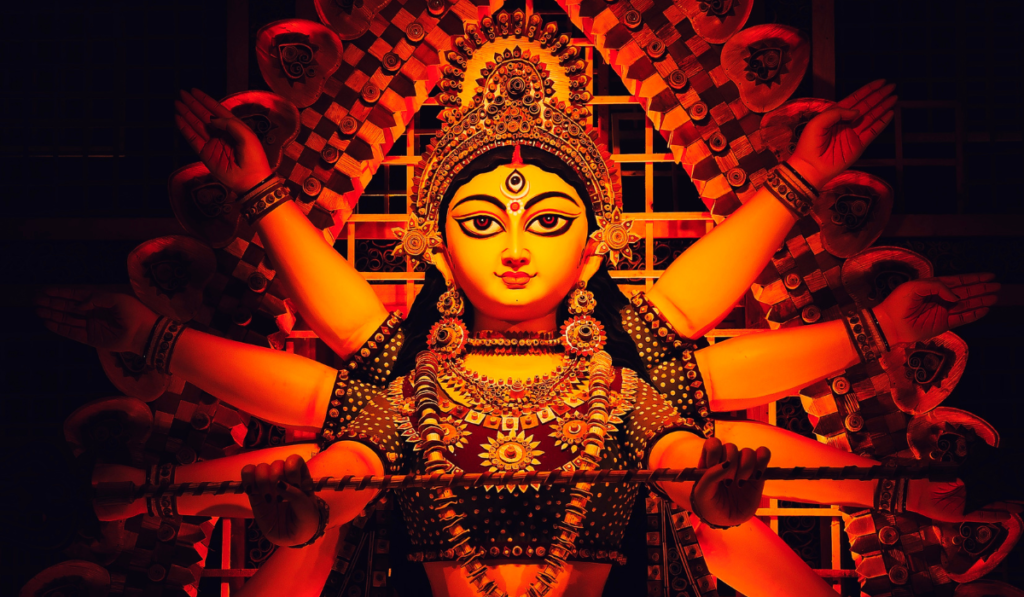
The Durga Chalisa is a devotional hymn composed in the Avadhi language, closely associated with the Bhakti tradition of North India. The word Chalisa refers to a composition of forty verses, a form popularized by Sant Tulsidas through the Hanuman Chalisa.
While the precise authorship of the Durga Chalisa is not unanimously attributed to a single historical figure, it is traditionally associated with the devotional poet Devidas, whose name appears in the final verse as the composer. The hymn draws from Puranic accounts of Goddess Durga, particularly her battles against Mahishasura, Shumbha, Nishumbha, and Raktabeeja, all of which are rooted in the Devi Mahatmya of the Markandeya Purana.
The Chalisa format itself carries a spiritual significance. The number forty in Indian sacred tradition is associated with completeness of practice. The Durga Chalisa follows this tradition, covering the Goddess’s attributes, her cosmic role, her fierce battles, and her compassionate boons across forty dohas, making it a compact yet comprehensive devotional text.
Religious and Spiritual Significance
In Sanatan Dharma, Durga represents Adi Shakti, the primordial energy from which all creation emerges. She is not merely a protector. She is the force that activates, sustains, and dissolves existence. The Durga Chalisa honors this by describing her simultaneously as fierce destroyer and compassionate mother.
The Chalisa covers the following dimensions of her divine nature:
- Describes Durga as the formless light (jyoti) that illuminates all three worlds
- Reveals her as the cosmic Shakti without whom even yoga and tapas are incomplete
- Honors her role in protecting sages, sants, and devotees across time
- Acknowledges her as both the terrifying Kali who destroys evil and the gentle Bhavani who grants boons
Unlike stotras that address Durga only in times of fear or crisis, the Chalisa addresses her as a constant presence, one whose light fills the universe and whose grace is available to any devotee who calls on her with sincerity.
Best Time to Chant Durga Chalisa
The Durga Chalisa is traditionally recited in the early morning after a bath, or in the evening during the sandhya period. It is especially significant during:
- Navratri, the nine nights dedicated to Devi worship, twice annually in Chaitra and Ashwin
- Fridays, which are considered auspicious for Devi worship in most Hindu traditions
- Ashtami and Navami tithi, the eighth and ninth lunar days, both closely connected to Durga’s cosmic energy
- Any moment of fear, difficulty, or transformation when divine Shakti is invoked for protection
Traditional upanyas emphasize that the Durga Chalisa is not bound by strict ritual requirements. A devotee who recites it with a pure heart and genuine longing receives its full benefit at any time.
How to Chant Durga Chalisa?
The Durga Chalisa is best chanted aloud with a steady rhythm. Silence is not required, but presence is. Classical Devi upanyas advise:
- Sit facing east or north, ideally before an image or murti of Maa Durga
- Light a diya with ghee or sesame oil before beginning
- Chant with clear pronunciation, especially the Sanskrit-rooted words, as sound carries the Shakti
- Maintain stillness of body during recitation, as movement disrupts the inner gathering of energy
The recommended daily recitation is one complete reading. During Navratri, some devotees complete the Chalisa nine times across the nine days, one full recitation per day. Even a single verse, read with full awareness and devotion, is said to invoke her grace.
Benefits of Chanting Durga Chalisa
Hindu tradition describes the benefits of the Durga Chalisa not only as worldly protection but as inner transformation:
- Removes fear, instability, and the anxiety caused by enemies or hostile circumstances
- Destroys the inner enemies of desire, pride, anger, and delusion, which the text explicitly names
- Grants Riddhi and Siddhi, prosperity of life and accomplishment of purpose
- Frees the devoted practitioner from the cycle of repeated birth and death over time
- Builds courage and clarity, as the devotee aligns with Shakti herself
Because the Chalisa invokes Durga in her full cosmic role, from the tender Bhavani to the fierce Kali, it trains the mind to hold both strength and surrender together. This is its deepest teaching.
Final Thought
The Durga Chalisa is not merely a recitation. It is a conversation with the Mother of all creation. Each verse opens a door to one aspect of her infinite being, from her formless light to her battle-worn hands, from her compassionate glance to her terrifying roar.
Rooted in the Puranas and carried through the devotional river of Bhakti, this Chalisa teaches that Shakti is not somewhere distant. She is the very energy that moves breath through the body and thought through the mind.
Those who chant the Durga Chalisa do not ask the Goddess to fight their battles for them. They ask to be made strong enough, steady enough, and clear enough to live in her light.
That is its real power.
Also Read:
- श्री हनुमान चालीसा | Shri Hanuman Chalisa Timing, Benefit & Origin
- श्री शिव तांडव स्तोत्रम् | Shiv Tandav Stotram Meaning, Origin & Benefit
- सरस्वती वंदना | Saraswati Vandana with Meaning and Benefits
Save or bookmark this page so you can return to it whenever you seek calm, clarity, or devotion. Follow us on Instagram and Facebook to stay connected, and share your thoughts or suggestions in the comments.
This Bhakti corner is meant to be returned to, not just read once.