
Krishna Janmashtami 2026 falls on Friday, September 4, with the Nishita Puja extending past midnight into the early hours of September 5. In a rare alignment, both the Smarta and Vaishnava calendars agree on this same date this year. Puja and parana timings still vary by city, so check the location-specific table below before you plan your night.
सर्वधर्मान्परित्यज्य मामेकं शरणं व्रज।
अहं त्वां सर्वपापेभ्यो मोक्षयिष्यामि मा शुचः॥
When the world was burning from the unjust wrath of Kansa, everyone took refuge under the preserver Vishnu. Thus, the god of Liberation was born – Shri Krishna
Janmashtami is not just a day, but a moment. In which all the devotees devote themselves to lord krishna exactly at midnight, 12:00 AM. Janmashtami is not just a festival. It’s a way to unite the whole of India to celebrate the birth of the divine and majestic Chaliya in the world.
On the very day of Ashtai on Krishna Paksha, all the devotees around the world join their hands and close their eyes to welcome the divine incarnation of the Preserver into a little boy.
But this is not just a tale of defeating evil, but a tale of how this world came to know what dharma and karma are. This is a tale of how the Dvapara Yuga became the turning point for not just history but for what the future holds.
Key Takeaways
- Krishna Janmashtami 2026 date: Friday, September 4 (Smarta and ISKCON/Vaishnava calendars align this year)
- Nishita Puja for New Delhi: 11:57 PM (Sep 4) to 12:43 AM (Sep 5)
- Krishna’s birth is traditionally placed at the midnight moment, around 12:20 AM on Sep 5 for Delhi
- Core observances: day-long vrat, midnight abhishek, cradle puja, bhog, and aarti
- Vrat Parana depends on which rule your family follows: Dharma Shastra (after sunrise) or modern practice (after Nishita Kaal)
- Dahi Handi is celebrated the next day, Saturday, September 5, 2026
Krishna Janmashtami 2026 at a Glance
| Detail | Timing |
| Festival | Krishna Janmashtami |
| Janmashtami 2026 date | Friday, September 4, 2026 |
| Tithi | Krishna Paksha Ashtami, Bhadrapada month |
| Ashtami Tithi begins | 2:25 AM, September 4 |
| Ashtami Tithi ends | 12:13 AM, September 5 |
| Rohini Nakshatra window | 12:29 AM to 11:04 PM, September 4 |
| Nishita Puja Muhurat | 11:57 PM (Sep 4) to 12:43 AM (Sep 5) |
| Midnight moment | Approx. 12:20 AM, September 5 |
| Parana (Dharma Shastra rule) | After 6:01 AM, September 5 |
| Parana (modern/Nishita-based practice) | After 12:43 AM, September 5 |
| Dahi Handi | Saturday, September 5, 2026 |
Important note: These timings are for New Delhi. Every other city has its own puja window, listed in the city-wise table further down.
When Is Krishna Janmashtami 2026?
Krishna Janmashtami 2026 date falls on Friday, September 4, for both the Smarta and Vaishnava calendars, according to Drik Panchang’s calculations. This is a genuine Ashtami Rohini year, where the Ashtami Tithi and Rohini Nakshatra both fall predominantly on September 4, so most traditions land on one shared date instead of splitting across two days.
The Hindu calendar runs on lunar cycles, so the Krishna Janmashtami 2026 date shifts every year against the Gregorian calendar. In 2026, it falls in the Bhadrapada month, on the eighth day of the waning moon’s Krishna Paksha.
Is Janmashtami on September 4 or 5 in 2026?
The core observance day is September 4. The Nishita Puja itself runs past midnight into September 5, which is why several calendars display the main worship window under a September 5 date stamp. Dahi Handi, the curd-pot festival, is celebrated the day after, on September 5. Because sampradaya rules can still differ by region and family tradition, confirm your date with your local priest or temple if you are unsure.
Janmashtami 2026 Tithi and Nishita Kaal
For New Delhi, the Ashtami Tithi begins at 2:25 AM on September 4 and ends at 12:13 AM on September 5. Rohini Nakshatra runs from 12:29 AM to 11:04 PM on September 4. The Nishita Puja Muhurat, the most sacred window for Krishna Janmashtami 2026 worship, is calculated at 11:57 PM (Sep 4) to 12:43 AM (Sep 5), with the midnight moment itself placed around 12:20 AM.
Nishita Kaal matters because scripture places Krishna’s birth at this exact hour. Devotees time their abhishek, cradle puja, and first aarti to peak inside this window rather than before or after it.
Janmashtami 2026 Puja Muhurat by City
The Janmashtami 2026 muhurat is not identical everywhere. Nishita Puja timing depends on your city’s local sunrise, moonrise, and Panchang calculation. Use the closest city below as a reference point.
| City | Nishita Puja Muhurat (2026) |
| New Delhi | 11:57 PM (Sep 4) – 12:43 AM (Sep 5) |
| Noida | 11:57 PM (Sep 4) – 12:42 AM (Sep 5) |
| Gurgaon | 11:58 PM (Sep 4) – 12:44 AM (Sep 5) |
| Chandigarh | 11:59 PM (Sep 4) – 12:45 AM (Sep 5) |
| Jaipur | 12:03 AM – 12:49 AM (Sep 5) |
| Mumbai | 12:14 AM – 1:01 AM (Sep 5) |
| Pune | 12:10 AM – 12:57 AM (Sep 5) |
| Ahmedabad | 12:16 AM – 1:02 AM (Sep 5) |
| Hyderabad | 11:52 PM (Sep 4) – 12:38 AM (Sep 5) |
| Chennai | 11:45 PM (Sep 4) – 12:31 AM (Sep 5) |
| Bengaluru | 11:55 PM (Sep 4) – 12:42 AM (Sep 5) |
| Kolkata | 11:13 PM – 11:59 PM (Sep 4) |
Which Janmashtami Date Should You Follow?
Since 2026 is an Ashtami Rohini year, most devotees will not need to choose between two dates. But if your local temple or family Panchang still lists a split, use this as a general guide.
| If you are… | Follow |
| Following your family’s regional Panchang | Your family’s stated observance day |
| Part of a specific Vaishnava sampradaya | That sampradaya’s own calendar |
| Observing at an ISKCON temple | The local ISKCON temple’s published calendar |
| Unsure which to follow | Ask your local Panchang publisher or temple priest |
Why Is Janmashtami Celebrated?
Janmashtami significance comes from Krishna’s identity as an avatar of Vishnu, born to restore dharma during a period of tyranny. His appearance marks the turning point in a story of oppression, courage, and divine intervention that unfolds in Mathura.
Why is Janmashtami celebrated through fasting, midnight worship, and joyous ritual together?
Because each element mirrors the original night. The fast recalls Devaki and Vasudeva’s suffering as prisoners. The Nishita Puja recreates the birth moment itself. The cradle ritual repeats Yashoda’s first act of welcome. Every practice traces back to a specific point in the narrative.
Krishna’s Birth Story
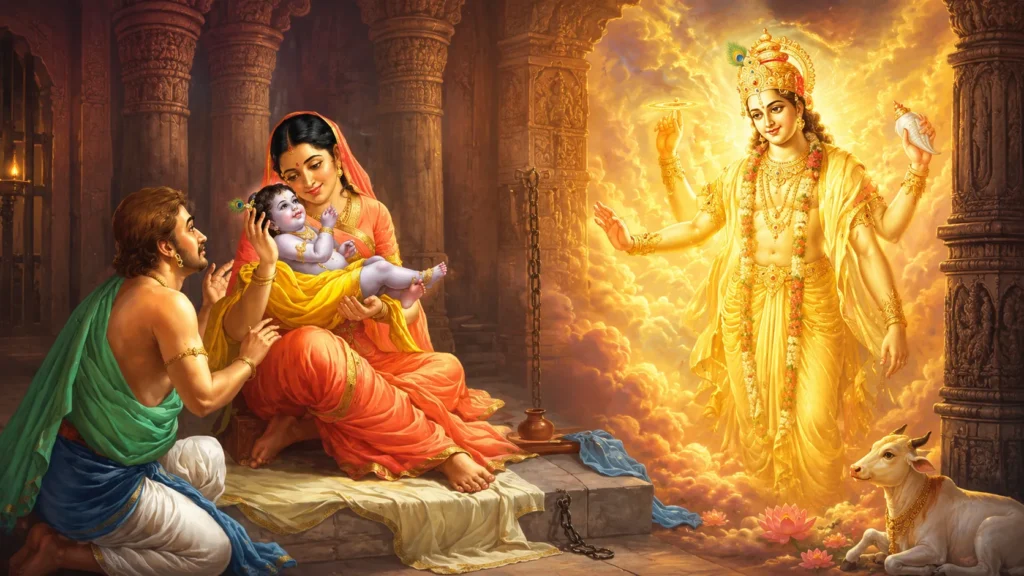
The Krishna birth story is recorded across several Hindu scriptures, most prominently in the Śrīmad Bhāgavatam. King Kansa of Mathura had imprisoned his own sister Devaki and her husband Vasudeva after a prophecy warned him that Devaki’s eighth child would end his rule. To prevent this, Kansa killed each of their first seven children.
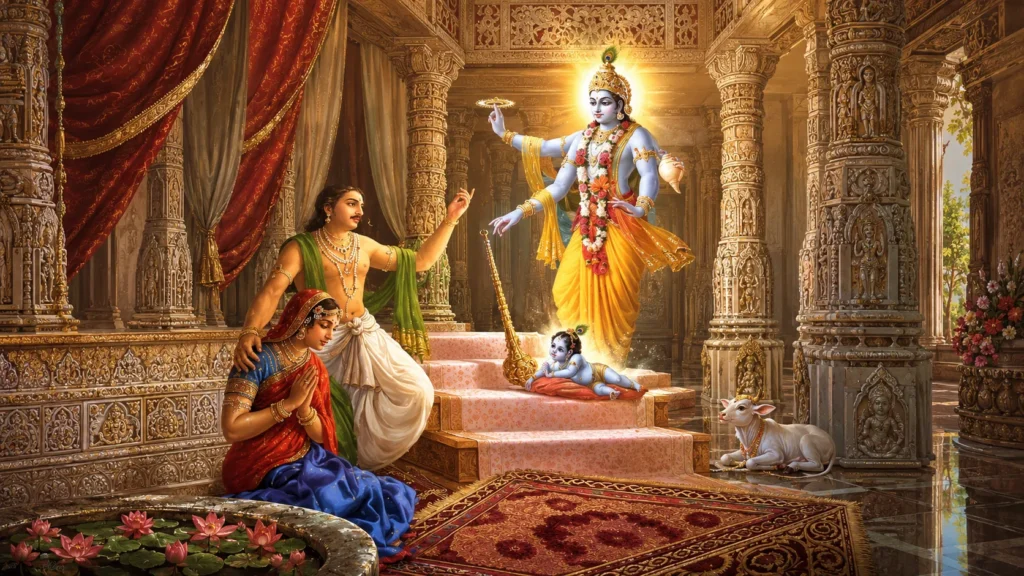
The Bhāgavata Purāṇa’s Tenth Canto, in the chapter describing Krishna’s appearance, narrates that on the eighth night, the prison guards fell into a deep sleep, the chains loosened, and the doors opened on their own. Vasudeva carried the infant Krishna across the flooded Yamuna to Gokul, leaving him with Nanda and Yashoda, and returning with their newborn daughter in his place.
This account is echoed in the Vishnu Purāṇa and in the Harivamsa, an appendix to the Mahābhārata that details Krishna’s life in Vrindavan and Mathura. Because the story appears across multiple scriptural sources, it forms the narrative backbone for nearly every Janmashtami ritual practiced today.
What Does Krishna’s Birth Symbolise?
Devotees commonly read Krishna’s midnight birth inside a prison as a symbol of hope emerging from darkness. The imagery of doors opening and guards falling asleep is understood as divine grace overriding worldly power. This interpretation shapes the devotional, rather than purely historical, reading of the festival.
How to Observe Janmashtami Vrat?
Fasting practices for Janmashtami fasting rules vary by sampradaya, family tradition, and individual health. Broadly, devotees follow one of these approaches.
- Nirjala Vrat: A stricter fast without food or water, observed by some devotees until the midnight puja or the next day.
- Phalahar Vrat: A lighter fast permitting fruits, milk, and simple sattvic food, avoiding grains.
- Partial fast: Grains are avoided, with one light meal taken during the day.
Common Janmashtami vrat rules generally avoid grains until the fast is broken, following the same principle used for Ekadashi fasting. Practices around onion, garlic, and salt differ by family and region, so follow what your own tradition specifies. This article is not medical guidance; anyone with health concerns should consult a doctor before undertaking a strict fast.
When to Break Janmashtami Vrat (Parana)?
Janmashtami vrat parana timing depends on which rule you follow. According to Dharma Shastra guidance, the fast should ideally break the next morning, after sunrise, once both Ashtami Tithi and Rohini Nakshatra have ended. For New Delhi in 2026, that falls after 6:01 AM on September 5.
Many households instead follow modern practice and break the fast right after the Nishita Puja and midnight prasad, once Ashtami Tithi has ended around 12:13 AM. For New Delhi, that point falls after 12:43 AM on September 5. Both approaches are widely practiced; consistency with your family’s usual method matters more than picking one over the other.
What is Janmashtami Puja Vidhi at Home?
This Janmashtami puja vidhi follows the traditional flow of the day, broken into four parts so you know what to do and when.
- Morning: Take your fasting sankalp after your usual morning rituals. Clean the puja area and the Bal Gopal or Laddu Gopal idol with water.
- Evening: Decorate the puja space and the cradle (jhula) with flowers. Prepare the bhog items, including makhan, mishri, and panjiri, so they are ready before midnight.
- Nishita Kaal (Midnight Window): Perform Panchamrit Abhishek, bathing the idol in milk, curd, honey, ghee, and sugar. Dress the idol, place it in the decorated cradle, light diyas and incense, and sing the birth bhajans as midnight arrives.
- After the Puja: Offer the prepared bhog, perform aarti, and gently rock the cradle. Distribute prasad to the family, then follow your own tradition’s parana timing to close the vrat.
Janmashtami Puja Samagri You Need
Keep this Janmashtami puja samagri checklist ready a day in advance.
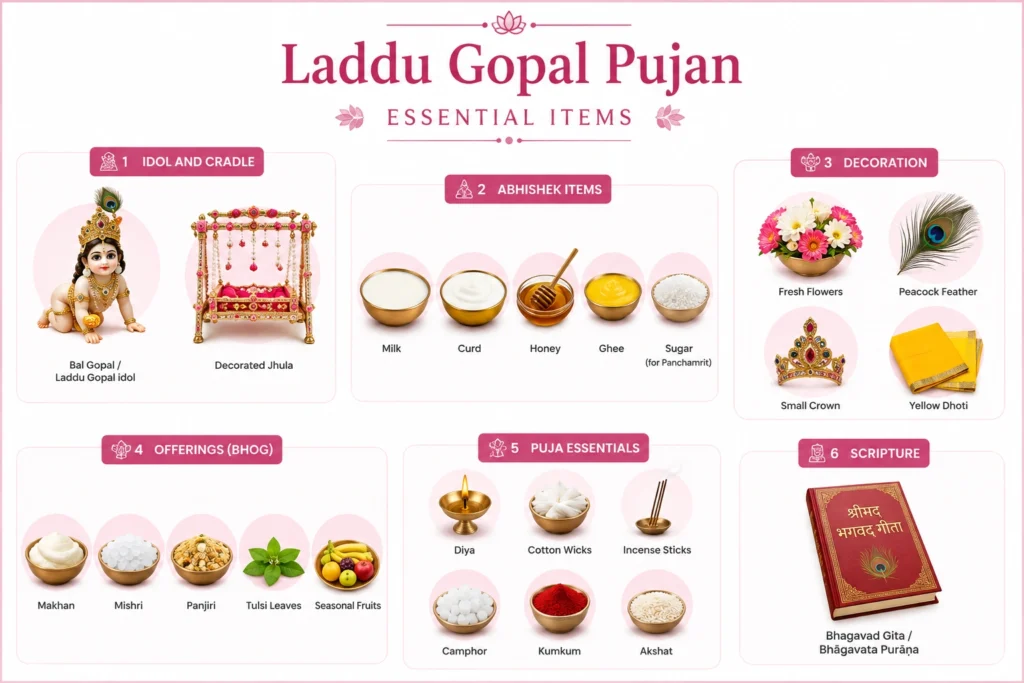
| Category | Items Needed |
| Idol and cradle | Bal Gopal or Laddu Gopal idol, small decorated jhula |
| Abhishek items | Milk, curd, honey, ghee, sugar (for Panchamrit) |
| Decoration | Fresh flowers, peacock feather, small crown, yellow dhoti |
| Offerings (bhog) | Makhan, mishri, panjiri, tulsi leaves, seasonal fruits |
| Puja essentials | Diya, cotton wicks, incense sticks, camphor, kumkum, akshat |
| Scripture | A copy of the Bhagavad Gita or Bhāgavata Purāṇa for recitation |
Janmashtami Rituals and Traditions
Janmashtami rituals extend beyond the home altar. Temples across India hold all-night kirtans, Bhagavad Gita recitations, and Krishna Jhanki tableaus depicting scenes from his life. Mathura and Vrindavan, the towns most closely tied to Krishna’s birth and childhood, draw large numbers of visitors during this period.
Why Do Devotees Swing Krishna’s Cradle at Midnight?
Rocking the cradle at Nishita Kaal repeats Yashoda’s first act of care toward the infant Krishna. Devotees sing lullabies while swinging the jhula, treating the idol as a newborn rather than a statue, which keeps the ritual personal rather than purely ceremonial.
Why Is Dahi Handi Celebrated?
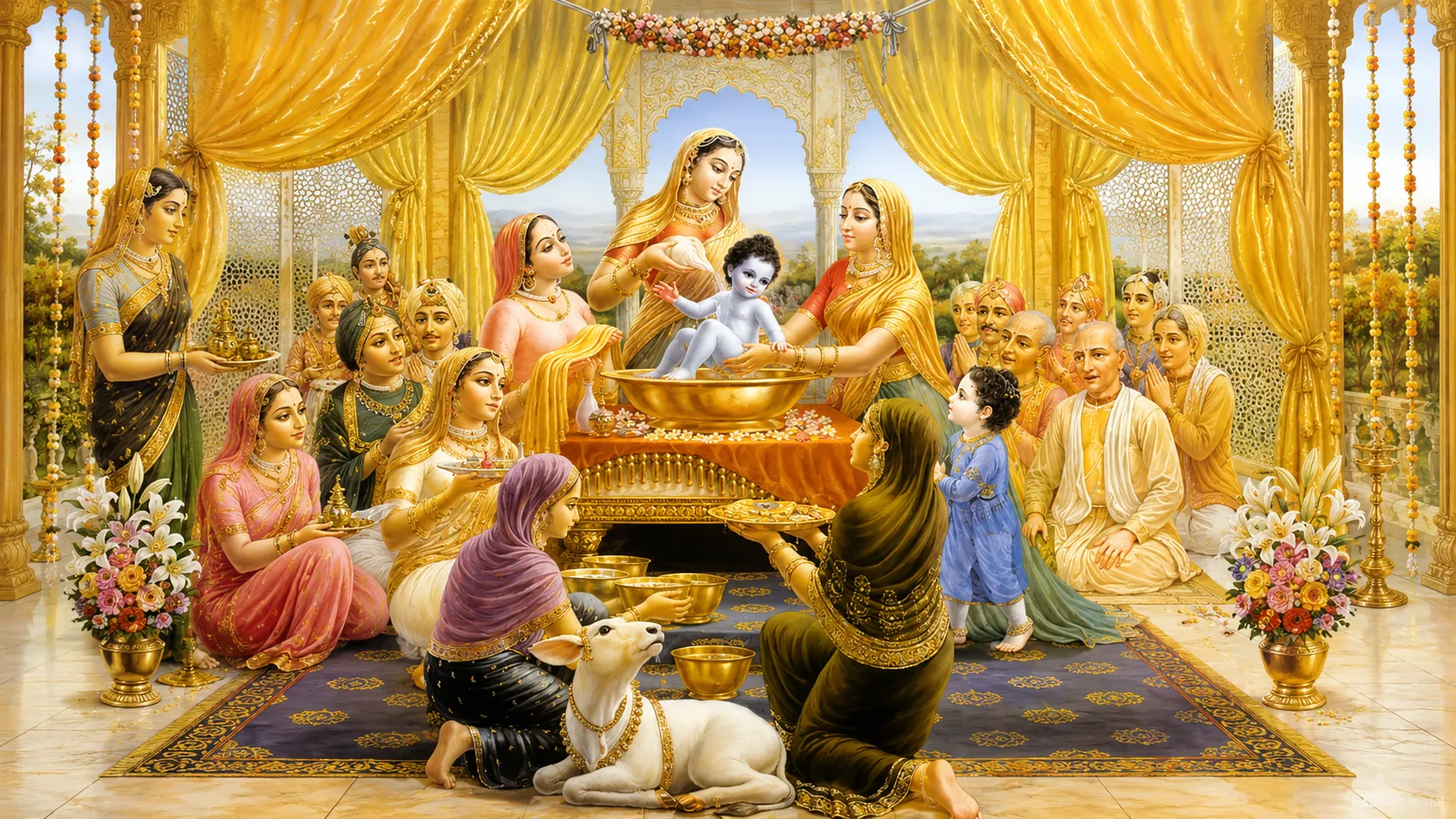
Dahi Handi significance traces back to Krishna’s childhood mischief in Gokul, where he and his friends would form human pyramids to reach pots of curd and butter hung high by village women.
Maharashtra recreates this tradition every year through Govinda troupes, who form towering human pyramids to break a hanging curd pot, celebrated on September 5, 2026, the day after Janmashtami.
Beyond the sport, the ritual celebrates teamwork and the playful joy Krishna is remembered for bringing into ordinary village life. Mumbai and Pune host some of the largest Dahi Handi gatherings each year.
Gokulashtami and Janmashtami
Gokulashtami 2026 is a regional name commonly used for Krishna Janmashtami, particularly in Maharashtra and parts of southern India, referring to Gokul, the village where Krishna spent his childhood.
The name, and some local customs around it, can vary by region and tradition, but the underlying festival, date, and core rituals remain the same as Janmashtami.
Janmashtami Bhog and Prasad
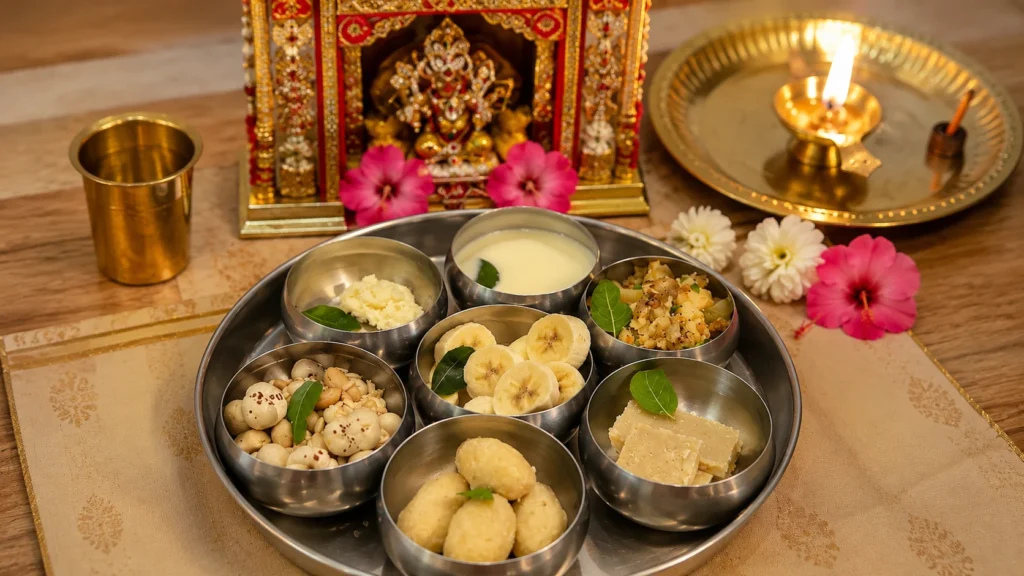
A traditional Janmashtami bhog centres on foods associated with Krishna’s childhood, particularly makhan (fresh butter), mishri (rock sugar), and panjiri, a roasted flour and dry-fruit sweet prepared specifically for this festival.
Many households also prepare Chappan Bhog, a display of fifty-six dishes. A popular devotional tradition associates this number with the meals Yashoda is said to have prepared for Krishna across a full day, though the practice itself is a later devotional custom rather than a scriptural instruction.
Panchamrit, made from milk, curd, honey, ghee, and sugar, is offered first during the abhishek and shared as prasad after the midnight aarti.
Bhog for Bal Gopal
No Indian festival is complete without food, and Janmashtami is no exception. Once the puja is done, it’s time for bhog, the special food offered to Krishna before anyone else eats. In middle-class homes, it’s prepared with whatever is available, but always with love.
Panchamrit
A sacred mix of milk, curd, ghee, honey, and sugar. It’s believed to be purifying, and after offering it to Krishna, it’s shared as prasad with everyone.
Panjeeri
A dry sweet made from whole wheat flour, ghee, sugar, and dry fruits. It’s said to give strength, just like it did to little Krishna in the stories.
Makhan Mishri
The simplest and most loved, fresh butter mixed with sugar crystals, because we all know how much Krishna loved it.
The bhog is placed in front of the idol, sometimes along with fruits, sweets, and a glass of milk. Only after Krishna is “fed” do the family members eat because the guest of honor always eats first.
What Janmashtmi Signifies?
In this Kali Yug, Janmashtami is a gentle reminder of what’s truly important – Love, laughter, and faith in goodness. We celebrate the birth of Shri Krishna because his life showed us that you can be wise, and still be playful, spiritual, and still enjoy the little things, divine, and yet close to the hearts of ordinary people.
On this day, homes smell of incense and sweets, temples glow with lamps, and hearts are full of devotion. Whether you are breaking a Dahi Handi in Mumbai, singing bhajans in Mathura, or just telling stories of Krishna to children, you are part of a celebration that has been alive for thousands of years.
What are the Scriptural Sources Behind Krishna Janmashtami?
The rituals and story described in this guide draw on three primary scriptural sources.
- Śrīmad Bhāgavatam (Bhāgavata Purāṇa), Canto 10: The primary account of Krishna’s birth, childhood, and life in Vrindavan and Mathura.
- Vishnu Purāṇa, Book 5: An earlier account of Krishna’s birth and early life, closely paralleling the Bhāgavatam’s narrative.
- Harivamsa: An appendix to the Mahābhārata that expands on Krishna’s genealogy, birth, and youth.
Devotional customs such as the exact composition of Chappan Bhog or specific regional puja steps are drawn from later tradition and regional practice rather than these core texts directly.
Conclusion
For those who love Krishna, Janmashtami is not just another festival on the calendar. It is that one night when the whole house feels different. The lights are brighter, the bhajans sound sweeter, and there is something special about waiting for midnight to welcome Kanha.
And then comes the joy of decorating the jhanki. Choosing the little clothes for Laddu Gopal, arranging flowers, making a tiny Gokul, decorating the jhula, placing little matkis and peacock feathers, and somehow spending hours on every small detail because it is all for Krishna. There is a happiness in creating that little world for him that is difficult to put into words.
When the clock finally approaches midnight and the curtains open to reveal Krishna’s jhanki, all the effort suddenly feels worth it. The abhishek, aarti, bhog and the gentle swinging of the jhula are not just rituals. They are moments of प्रेम, devotion and celebration.
Perhaps that is what makes Krishna Janmashtami so beautiful. We don’t simply celebrate the birth of Krishna. We invite him into our homes, decorate a little corner of our world for him, sing for him, feed him, and for a while, let our hearts become a little more like Gokul.
This Janmashtami, decorate your jhanki with love, celebrate with your family, and welcome your Kanha with a heart full of devotion.
Radhe Radhe! Jai Shri Krishna
Frequently Asked Questions About Krishna Janmashtami 2026
Krishna Janmashtami 2026 falls on Friday, September 4, with Nishita Puja extending into the early hours of September 5.
The main puja happens during Nishita Kaal. For New Delhi, that window is 11:57 PM (Sep 4) to 12:43 AM (Sep 5). Check the city-wise table above for your location.
Nishita Kaal is the midnight period considered most sacred for Krishna Janmashtami, since scripture places his birth at this exact hour.
Most devotees begin the fast at sunrise on September 4, after taking a sankalp following their morning rituals.
Per Dharma Shastra guidance, break the fast after sunrise the next day, around 6:01 AM on September 5 for Delhi. Many households instead break it after the midnight puja, around 12:43 AM.
Take a sankalp in the morning, decorate the cradle and altar in the evening, perform Panchamrit Abhishek at Nishita Kaal, then offer bhog and aarti.
A Bal Gopal idol, a decorated cradle, Panchamrit ingredients, fresh flowers, diyas, incense, and bhog items like makhan and mishri.
Scripture places Krishna’s actual birth at midnight in a Mathura prison cell, so devotees time their main puja to match that hour.
It marks the birth of Krishna, an avatar of Vishnu, whose life is understood as restoring dharma during a period of tyranny under King Kansa.
Gokulashtami is a regional name for the same festival, used mainly in Maharashtra and parts of South India, referring to Krishna’s childhood village, Gokul.
It recreates Krishna’s childhood game of stealing butter and curd with friends in Gokul, now performed as human pyramids, celebrated the day after Janmashtami.
Core offerings include makhan, mishri, panjiri, and Panchamrit, with many households also preparing a fifty-six dish Chappan Bhog spread.
Continue Reading more…
Teej 2026: Dates, Types, History, Rituals, Meaning & Celebrations
How to Perform Rudrabhishek at Home During Sawan?
God in Hinduism Explained: One God, Many Gods, or Ultimate Reality?
Four Yugas in Hinduism: Satya, Treta, Dvapara, and Kali Yuga Explai
शिव चालीसा | Shiv Chalisa in Hindi with English Meaning
The journey does not end here. Follow MFC on Instagram and Facebook to explore more sacred places, festivals, and living traditions of Sanatan Dharma.