
A temple destroyed again and again… yet rebuilt every single time with unshaken faith. This is not just the story of a Jyotirlinga. It is the story of a civilisation that refused to bow.
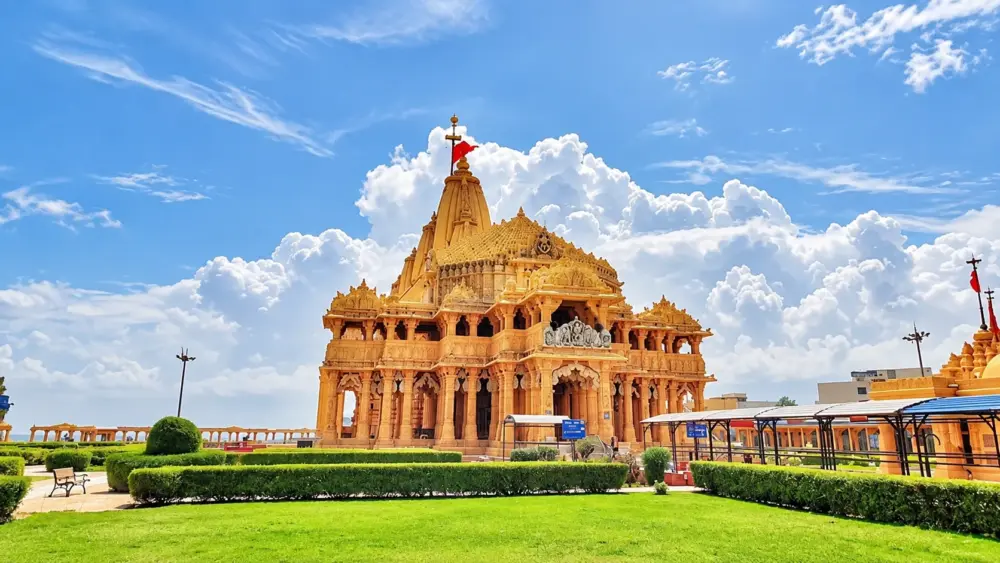
The Somnath Temple stands at the edge of the Arabian Sea in Gujarat. It is the first Jyotirlinga of Lord Shiva among all 12 sacred shrines in India. The temple has been destroyed and rebuilt more times than any other shrine in history. Yet it stands today, golden and defiant, exactly where it always stood.
Somnath Temple in Gujarat is one of the most powerful symbols of civilisational resilience in all of India.
| “Somnath’s narrative is not of destruction and defeat. It is of victory, valour, and reconstruction.” ~Prime Minister Narendra Modi, January 2026, Somnath Swabhiman Parv, PIB Government of India |
What Is the Somnath Temple?
The Somnath Temple is a sacred Jyotirlinga temple dedicated to Someshwar Mahadev. It sits at Prabhas Patan Gujarat, in the Saurashtra region of the state. The temple stands at the Triveni Sangam Somnath, where three rivers meet the sea.
These rivers are the Hiran, Kapila, and the mythical Saraswati. “Somnath” means “Lord of the Moon” or “Lord of Soma” in Sanskrit. This is the first Jyotirlinga of Lord Shiva and the holiest among all 12.
Quick Temple Facts
- Location: Prabhas Patan Gujarat, Veraval, Saurashtra – Somnath Temple location
- Deity: Someshwar Mahadev (Lord Shiva as the Moon’s Lord)
- Jyotirlinga Rank: First among the 12 Jyotirlingas
- Architecture: Kailash Mahameru Prasad (Chaulukya style)
- Faces: The Arabian Sea temple directly; the only major temple on India’s western coast facing the open ocean
- Entry: Free for all devotees
The Story Behind the Somnath Temple
The Somnath Temple story begins with the Moon God himself. Soma (the Moon) was married to the 27 daughters of Daksha Prajapati. He favoured only one wife, Rohini, and ignored the rest. The angry Daksha cursed Soma to lose all his radiance and light. Darkness fell over the world as the Moon grew dim and weak.
A desperate Soma came to Prabhas Patan in Gujarat and prayed to Lord Shiva here. Lord Shiva being bholenath, was moved by his devotion and freed him from the curse. In gratitude, the Moon God built a glorious temple at this very spot. He established a Jyotirlinga here in his honour. That shrine became what the world now knows as the Somnath Temple.
Hindu scriptures also say Lord Krishna shed his mortal body near this sacred Temple. The Bhalka Teertha, just a short distance from the temple, marks that divine event. This makes Somnath Temple Gujarat infinitely more sacred in the Vaishnava tradition as well.
Somnath Temple Rebuilt History: A Timeline of Resilience
The Somnath Temple destroyed and rebuilt story is the most documented in Indian history. Historical records confirm the temple was destroyed at least six times and rebuilt each time. Popular tradition places the number at 17 destructions in total. Below is a verified chronological record based on historical scholarship and government sources.
| Period | Historical Event | Source / Record |
| Pre-Christian era | Original temple built by Soma (Moon God) at Prabhas Patan Gujarat. Mythology says it was made of gold. | Shiva Purana; Hindu scripture tradition |
| 649 AD | First recorded reconstruction by the Maitraka rulers of Vallabhi. The shrine was formally re-established. | The Viral Express historical research; archaeological records |
| 725 AD | Temple destroyed by Al-Junaid, the Muslim governor of Sindh during his westward campaign. | ClearIAS documented Somnath timeline; Insights on India (Jan 2026) |
| 815 AD | Pratihara King Nagabhata II rebuilt the temple in grand stone construction. | The Viral Express historical research; Government of Gujarat District records |
| 1026 AD | Mahmud of Ghazni attacked with 5,000 soldiers. He destroyed the temple and looted enormous wealth. Thousands of unarmed devotees were killed. | Wikipedia Somnath Temple (multiple medieval chronicles); Government of Gujarat Gir Somnath District website |
| 1026 onwards | King Bhimdev of Gujarat and King Bhoja of Malwa together initiated a major reconstruction after Mahmud left. | The Viral Express; Insights on India (2026) |
| 1169 AD | Kumarapala, the Chaulukya (Solanki) king, rebuilt the Somnath Temple architecture in exquisite stone “studded with jewels,” replacing a decaying wooden structure. | Inscription from 1169 AD, cited in Wikipedia Somnath Temple entry |
| 1299 AD | Alauddin Khilji’s general Ulugh Khan destroyed the temple during the invasion of Gujarat. | Amir Khusrau’s Khazainul-Futuh; Ziauddin Barani’s Tarikh-i-Firuz Shahi; Wikipedia |
| 1308 AD | Mahipala I, the Chudasama king of Saurashtra, rebuilt the temple. His son Khengara installed the new lingam between 1331 and 1351. | Wikipedia Somnath Temple; Government of Gujarat District records |
| 1395 AD | Zafar Khan, the last governor of Gujarat under the Delhi Sultanate, destroyed the temple for the third post-Mahmud time. | Government of Gujarat Gir Somnath District website; Wikipedia |
| 17th century | Aurangzeb attacked and damaged the temple again during his campaign across western India. | PIB Government of India, Somnath Swabhiman Parv press note (Jan 2026); PM Modi’s address |
| 1783 AD | Queen Ahilyabai Holkar of Indore built a new Somnath temple adjacent to the ruins. The original site was too damaged to build upon. | Patheos Hindu2 blog (Jan 2019); PIB records; PM Modi’s address (2026) |
| November 1947 | Sardar Vallabhbhai Patel visited Junagadh and ordered reconstruction of the original Somnath Temple. Work began in 1950. | Government of Gujarat Gir Somnath District website; PIB Government of India |
| May 11, 1951 | The present Somnath Temple was opened to devotees by President Rajendra Prasad. This was 75 years ago, marked as the Somnath Swabhiman Parv in 2026. | PIB Government of India (Jan 2026); Insights on India (Jan 2026) |
| December 1, 1995 | The temple was officially dedicated to the nation by President Shankar Dayal Sharma after completion of full construction. | The Viral Express historical research; Bhakti Bhava darshan guide |
Shocking & Mysterious Facts About Somnath Temple Nobody Tells You
The Somnath Temple interesting facts go far beyond what most travel blogs share. These are verified facts from historical scholarship and official records such as ClearIASSomnath Temple analysis and Insights on India . Where belief or tradition is involved, it is clearly stated.
FACT 01 – The Baan Stambha: No Land from Here to the South Pole
An ancient arrow pillar (Baan Stambha) stands on the sea-facing side of the temple. Its inscription states that no landmass exists between Somnath Temple and the South Pole going due south. This geographical fact, carved in stone centuries ago, is confirmed accurate by modern maps. It reflects a sophisticated ancient understanding of coastal geography and ocean direction.
Source: ClearIAS Somnath Temple analysis (Jan 2026); Insights on India (Jan 2026)
FACT 02 – Destroyed at Least Six Times on Record, Tradition Says Seventeen
Verified historical records document six destructions of the Somnath Temple rebuilt history. These are supported by medieval chronicles, inscriptions, and government records. Popular Hindu tradition holds the number to be 17 destructions in total. Each time, devotees and rulers rebuilt it with stronger resolve. This makes Somnath Temple the most resilient religious structure in recorded Indian history.
Source: ClearIAS (Jan 2026); Government of Gujarat District website; Insights on India (Jan 2026)
FACT 03 – The Only Major Jyotirlinga That Directly Faces the Open Ocean
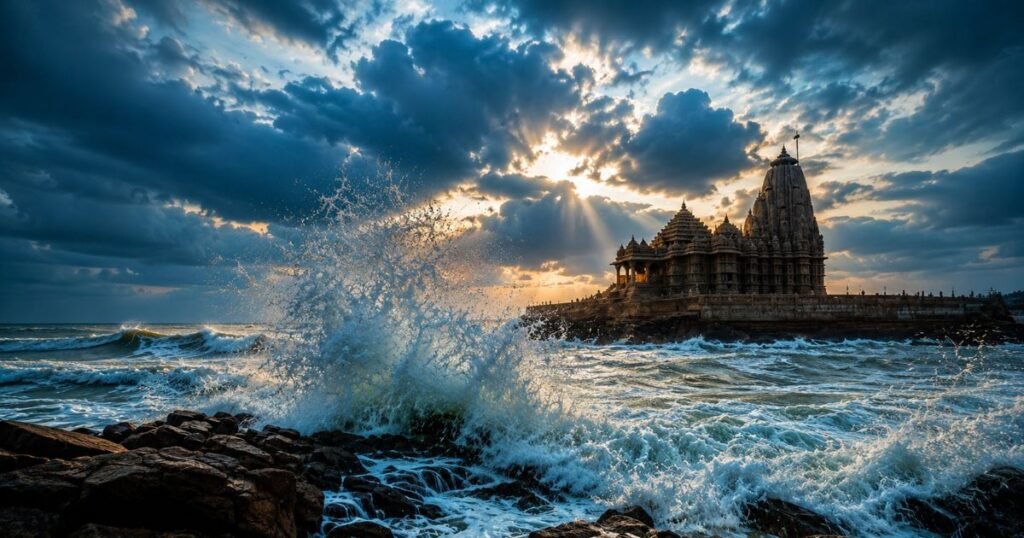
The Arabian Sea temple faces the open sea with no land between it and Antarctica. All other Jyotirlingas are inland. Somnath Temple Gujarat is unique in this regard. The sight of the Shiva pilgrimage site with waves crashing in the background is unlike anything else. Priests conduct the evening aarti with the sea wind carrying the chants across the water.
Source: Bhakti Bhava darshan guide; Gujarat Trips temple timing guide (2025)
FACT 04 – Three Rivers Meet the Sea Right at the Temple’s Feet
The Triveni Sangam Somnath is the confluence of three rivers at this exact site. The Hiran, Kapila, and the mythical Saraswati rivers all merge into the Arabian Sea here. Bathing at this confluence is believed to wash away all sins. This triple-sacred geography makes the Somnath Temple location spiritually unparalleled.
Source:ClearIAS Somnath analysis (Jan 2026); Insights on India (Jan 2026)
FACT 05 – Sardar Patel Personally Ordered Reconstruction on Day India Took Junagadh
On November 12, 1947, the very day Sardar Vallabhbhai Patel arrived in Junagadh after its accession to India, he stood before the ruins of the temple. He ordered reconstruction immediately, calling it a matter of national honour. The first President of India, Dr. Rajendra Prasad, personally inaugurated the rebuilt temple in 1951. This is the only major temple in India whose reconstruction was directly overseen by the first government of independent India.
Source:Government of Gujarat Gir Somnath District website; PIB Government of India (Jan 2026)
Somnath Temple Architecture
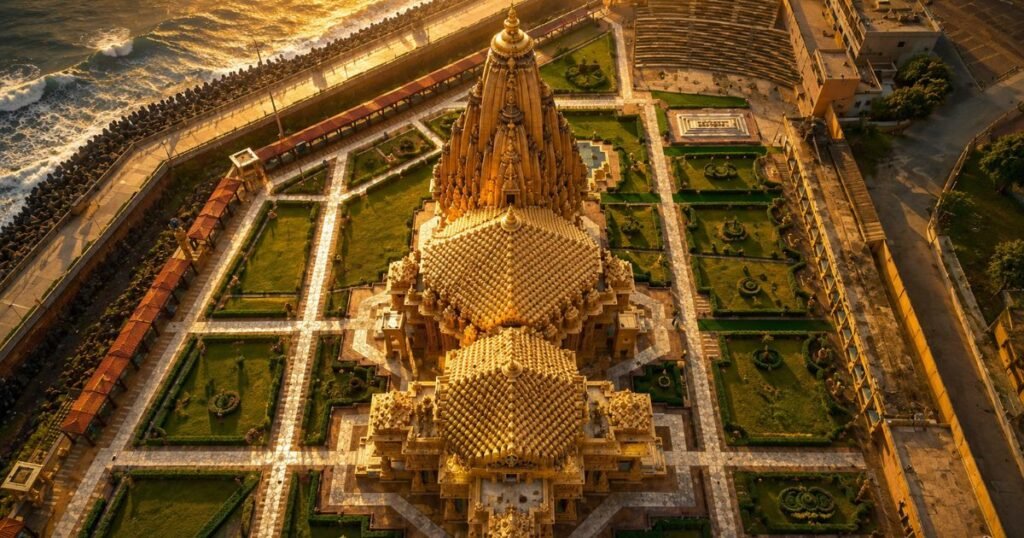
The Somnath Temple architecture follows the Kailash Mahameru Prasad style, a part of the famous Chaulukya (Solanki) style of temple design from Gujarat. Even today, the temple feels grand without losing its spiritual simplicity.
The main shikhara rises about 155 feet above the sanctum, standing beside the Arabian Sea with quiet strength. At the top sits a golden kalasha (sacred pot) weighing nearly 10 tonnes, along with a 37-foot flagpole. The temple flag is changed several times a day, continuing a tradition that has lived on for centuries.
What are the parts of Somnath Temple?
The temple complex has three main parts: the Garbhagriha (sanctum), the Sabha Mandap (assembly hall), and the Nritya Mandap (dance hall). The Somnath Temple faces the Arabian Sea directly, and during aarti, the sound of bells mixed with the sea breeze creates an atmosphere that stays with you long after you leave.
The entire structure is built using local Chandra-Kanta stone, chosen for both durability and natural beauty. According to ClearIAS (January 2026), the Somnath Temple architecture “reflects the Chaulukya style characterised by ornate carvings and a soaring shikhara.”
But beyond the carvings and height, what makes this temple special is what it represents. A temple destroyed and rebuilt so many times still standing proudly by the sea says something powerful about faith without needing to speak at all. Humans rarely learn from history, yet sometimes they leave behind places that remember for them.
Somnath Temple Darshan Timings & Aarti Timings
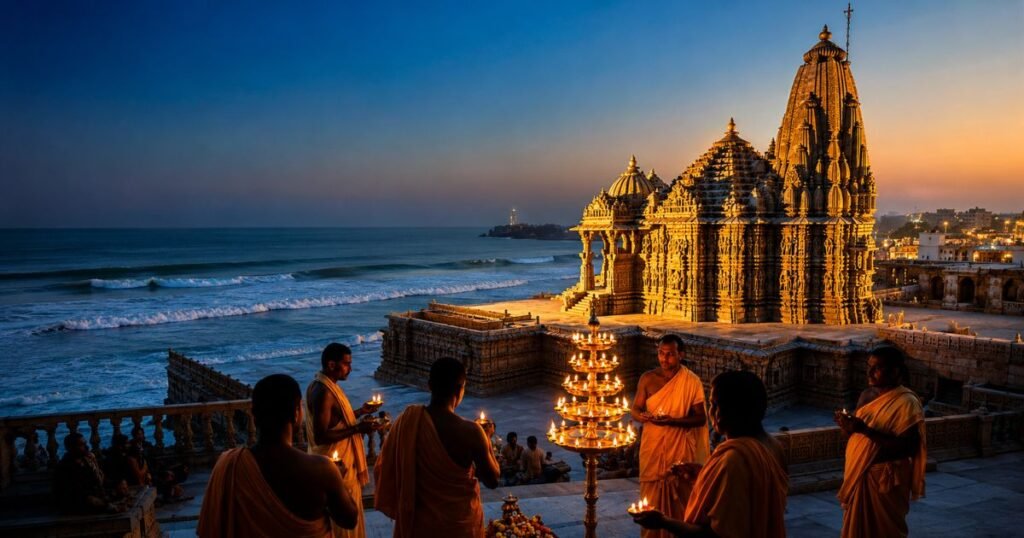
Knowing the Somnath Temple darshan timings before you visit saves precious time. The temple stays open every single day throughout the year. General darshan is completely free for all devotees. Check for updated timings at somnath.org before your visit, especially during festivals.
| Session / Aarti | Timings | Note |
| Temple Opens | 6:00 AM | Daily |
| Morning Aarti | 7:00 AM | Usually less crowded |
| Madhyanha (Noon) Aarti | 12:00 PM | Midday aarti |
| Sandhya (Evening) Aarti | 7:00 PM | Most attended aarti |
| Temple Closes | 10:00 PM | Daily |
| “Jay Somnath” Light & Sound Show | 8:00 PM – 9:00 PM | Not held during monsoon season |
Important note: During Shravan month and Mahashivaratri, the Mangala Aarti shifts to more early morning and hours are extended.
What to Expect During Somnath Temple Darshan: A Step-by-Step Guide
This is the Somnath Temple complete guide for first-time pilgrims. Follow these steps for a smooth and spiritually fulfilling darshan experience.
1 – Arrive at the Prabhas Patan Bus Stand or Railway Station
Somnath Railway Station (SMNH) is just 1 km from the temple. Veraval Junction is 7 km away. Auto-rickshaws and taxis take you directly to the temple gate.
Tip: Arrive 30 minutes before any aarti for the best experience without the crowd crush.
2 – Deposit Belongings at the Locker Counter
Mobile phones, cameras, smartwatches, leather items, and bags are not allowed inside. The locker facility is available outside the entry gate and it is free of charge.
Tip: Wear simple clothes without belt buckles or metal accessories. Security clearance moves faster.
3 – Security Check and Entry
Separate security lanes exist for men and women. The process is efficient. Carry only your ID and prasad in hand. General darshan entry is completely free.
Tip: For VIP darshan (skip-the-queue), book online at somnath.org in advance. Cost is Rs. 500 per person.
4 – Walk Towards the Sanctum Through the Outer Mandap
The grand Sabha Mandap leads you towards the Garbhagriha. The pillars here are intricately carved. The air smells of camphor and flowers. The sound of bells grows steadily louder.
Tip: Pause near the Nandi mandap and offer a silent prayer before proceeding to the main lingam.
5 – Darshan of the Somnath Jyotirlinga
The Somnath Temple sanctum holds the sacred first Jyotirlinga of Lord Shiva. The lingam is adorned with flowers and bel patra. You move past it in a single file. The moment is brief but deeply powerful. Offer your prasad and fold your hands in prayer.
Tip: Do not reach out or try to touch the lingam forcefully. Your devotion is your offering, not your reach.
6 – Visit the Triveni Sangam After Darshan
Walk down to the Triveni Sangam Somnath where the three rivers meet the sea. Many pilgrims take a holy dip here after darshan. The sound of the Arabian Sea waves is powerful and calming.
Tip: The Triveni Sangam steps are slippery. Hold the railing carefully, especially during the monsoon season.
7 – Evening: Watch the Jay Somnath Light and Sound Show
The “Jay Somnath” light and sound show runs from 8:00 PM to 9:00 PM daily. It narrates the untold history of Somnath Temple through light, music, and commentary. A nominal entry fee applies. It does not run during the monsoon season.
Tip: The show is in Gujarati and Hindi. Book your seat early on weekends. The open-air setting with the sea behind is unforgettable.
How to Reach Somnath Temple Travel?
The Somnath Temple location is at Prabhas Patan Gujarat, near Veraval in Saurashtra. All three major transport modes connect you to the temple very easily.
1. By Air
The nearest airports are Diu Airport (80 km) and Rajkot Airport (190 km). Ahmedabad Airport is 400 km away and has the best flight connectivity from major cities. Taxis and state buses connect all airports to Somnath. Nearest airport: Diu (80 km) · Rajkot (190 km) · Ahmedabad (400 km)
2. By Train
Somnath Railway Station (SMNH) is just 1 km from the temple. It is the most convenient arrival point. Veraval Junction (VRL) is 7 km away and has broader train connectivity from Mumbai, Ahmedabad, and Saurashtra cities. Somnath Station (SMNH): 1 km · Veraval (VRL): 7 km
3. By Road
Gujarat State Road Transport (GSRTC) buses connect Somnath from all major Gujarat cities. Key distances: Ahmedabad 400 km, Surat 400 km, Dwarka 230 km, Rajkot 190 km. The roads through Saurashtra are smooth and well-maintained. GSRTC buses from Ahmedabad, Rajkot, Surat, and Porbandar stop at Somnath bus stand.
Final Thought
The Somnath Temple is not merely a temple. It is 1,000 years of unanswered prayers, of stone laid upon broken stone. Every pillar here is a testament to the faith that refused to be buried.
If you seek the blessings of the first Jyotirlinga of Lord Shiva or simply wish to witness history, come here.
Stand before the Arabian Sea, feel the wind, and understand why Somnath Temple Gujarat will never fall again.
Frequently Asked Questions About Somnath Temple
1. What is the Somnath Temple and why is it famous?
The Somnath Temple is a sacred Jyotirlinga temple in Prabhas Patan Gujarat, dedicated to Someshwar Mahadev. It is famous for being the first Jyotirlinga of Lord Shiva among all 12 in India. It is equally famous for being destroyed at least six times and rebuilt each time. It stands on the coast of the Arabian Sea at the Triveni Sangam Somnath.
2. What are the Somnath Temple darshan timings and aarti timings?
The Somnath Temple darshan timings are from 6:00 AM to 10:00 PM daily. The Somnath Temple aarti timings are 7:00 AM (Mangala), 12:00 PM (Madhyanha), and 7:00 PM (Sandhya). The Shayan Aarti takes place at 9:30 PM. The Jay Somnath light and sound show runs from 8:00 PM to 9:00 PM daily (except monsoon season). Timings may extend during Mahashivaratri and Shravan month.
3. How many times was Somnath Temple destroyed and rebuilt?
Historical records confirm the Somnath Temple destroyed and rebuilt at least six times. These are verified by medieval chronicles, inscriptions, and Government of Gujarat records. The most famous destruction was by Mahmud of Ghazni in 1026 AD, documented in multiple medieval sources. Popular tradition holds that the total number of destructions is 17. The present temple was rebuilt under Sardar Vallabhbhai Patel’s initiative and inaugurated in 1951.
4. What is the Somnath Temple opening and closing time?
The Somnath Temple opening and closing time is 6:00 AM and 10:00 PM respectively. The temple remains open every day of the year without any weekly holiday. It does not close in the afternoon, unlike many other pilgrimage temples in India. On festival days, the temple may open earlier and close later than usual.
5. What is the Somnath Temple architecture style?
The Somnath Temple architecture follows the Kailash Mahameru Prasad style of the Chaulukya (Solanki) school. The main shikhara (spire) rises 155 feet above the sanctum floor. The temple has three main chambers: the Garbhagriha, Sabha Mandap, and Nritya Mandap. The structure faces the Arabian Sea directly and is built from Chandra-Kanta stone.
6. Which is the nearest railway station and airport to Somnath Temple?
The nearest railway station to the Somnath Temple is Somnath Railway Station (SMNH), just 1 km away. Veraval Junction (VRL) is 7 km away and offers wider train connectivity. The nearest airport is Diu Airport, approximately 80 km from the temple. Rajkot Airport at 190 km and Ahmedabad Airport at 400 km offer broader flight options.
7. Is there a dress code for Somnath Temple? What is not allowed inside?
The Somnath Temple Gujarat requires modest and traditional attire for all visitors. Sarees, dhotis, kurta-pyjamas, and knee-length or longer skirts are all acceptable. Short clothes, sleeveless tops, and revealing outfits are not permitted inside. Mobile phones, cameras, smartwatches, and leather items are strictly not allowed. Free locker facilities are available just outside the entry gate for all visitors.
The journey does not end here. Follow MFC on Instagram and Facebook to explore more sacred places, festivals, and living traditions of Sanatan Dharma.