
महिषासुर मर्दिनी स्तोत्रम्
॥ 1 ॥
अयि गिरिनन्दिनि नन्दितमेदिनि विश्वविनोदिनि नन्दनुते।
गिरिवरविन्ध्यशिरोऽधिनिवासिनि विष्णुविलासिनि जिष्णुनुते॥
भगवति हे शितिकण्ठकुटुम्बिनि भूरिकुटुम्बिनि भूरिकृते।
जय जय हे महिषासुरमर्दिनि रम्यकपर्दिनि शैलसुते॥
॥ 2 ॥
सुरवरवर्षिणि दुर्धरधर्षिणि दुर्मुखमर्षिणि हर्षरते।
त्रिभुवनपोषिणि शङ्करतोषिणि किल्बिषमोषिणि घोषरते॥
दनुजनिरोषिणि दितिसुतरोषिणि दुर्मदशोषिणि सिन्धुसुते।
जय जय हे महिषासुरमर्दिनि रम्यकपर्दिनि शैलसुते॥
॥ 3 ॥
अयि जगदम्ब मदम्ब कदम्बवनप्रियवासिनि हासरते।
शिखरिशिरोमणि तुङ्गहिमालयशृङ्गनिजालयमध्यगते॥
मधुमधुरे मधुकैटभगञ्जिनि कैटभभञ्जिनि रासरते।
जय जय हे महिषासुरमर्दिनि रम्यकपर्दिनि शैलसुते॥
॥ 4 ॥
अयि शतखण्ड विखण्डितरुण्ड वितुण्डितशुण्ड गजाधिपते।
रिपुगजगण्ड विदारणचण्ड पराक्रमशुण्ड मृगाधिपते॥
निजभुजदण्ड निपातितखण्ड विपातितमुण्ड भटाधिपते।
जय जय हे महिषासुरमर्दिनि रम्यकपर्दिनि शैलसुते॥
॥ 5 ॥
अयि रणदुर्मद शत्रुवधोदित दुर्धरनिर्जर शक्तिभृते।
चतुरविचार धुरीणमहाशिव दूतकृत प्रमथाधिपते॥
दुरितदुरीह दुराशयदुर्मति दानवदुत कृतान्तमते।
जय जय हे महिषासुरमर्दिनि रम्यकपर्दिनि शैलसुते॥
॥ 6 ॥
अयि शरणागत वैरिवधूवर वीरवराभय दायकरे।
त्रिभुवनमस्तक शूलविरोधि शिरोऽधिकृतामल शूलकरे॥
दुमिदुमितामर धुन्दुभिनादमहोमुखरीकृत तिग्मकरे।
जय जय हे महिषासुरमर्दिनि रम्यकपर्दिनि शैलसुते॥
॥ 7 ॥
अयि निजहुङ्कृति मात्रनिराकृत धूम्रविलोचन धूम्रशते।
समरविशोषित शोणितबीज समुद्भवशोणित बीजलते॥
शिवशिवशुम्भ निशुम्भमहाहव तर्पितभूत पिशाचरते।
जय जय हे महिषासुरमर्दिनि रम्यकपर्दिनि शैलसुते॥
॥ 8 ॥
धनुरनुषङ्ग रणक्षणसङ्ग परिस्फुरदङ्ग नटत्कटके।
कनककिशोर कलाकृत मोर कलागुण संभृत कण्ठलके॥
जितकनकाचल मौलिमदोर्जित निर्भरकुण्डल भूषणके।
जय जय हे महिषासुरमर्दिनि रम्यकपर्दिनि शैलसुते॥
॥ 9 ॥
जय जय जप्य जयेजयशब्दपरस्तुति तत्परविश्वनुते।
झणझणझिञ्झिमि झिङ्कृतनूपुरशिञ्जितमोहित भूतपते॥
नटित नटार्ध नटी नट नायक नाटितनाट्य सुगानरते।
जय जय हे महिषासुरमर्दिनि रम्यकपर्दिनि शैलसुते॥
॥ 10 ॥
अयि सुमनःसुमनःसुमनः सुमनःसुमनोहरकान्तियुते।
श्रितरजनी रजनीरजनी रजनीरजनी करवक्त्रवृते॥
सुनयनविभ्रमर भ्रमरभ्रमर भ्रमरभ्रमराधिपते।
जय जय हे महिषासुरमर्दिनि रम्यकपर्दिनि शैलसुते॥
॥ 11 ॥
सहितमहाहव मल्लमतल्लिक मल्लितरल्लक मल्लरते।
विरचितवल्लिक पल्लिकमल्लिक झिल्लिकभिल्लिक वर्गवृते॥
शितकृतफुल्ल समुल्लसितारुण तल्लजपल्लव सल्ललिते।
जय जय हे महिषासुरमर्दिनि रम्यकपर्दिनि शैलसुते॥
॥ 12 ॥
अविरलगण्ड गलन्मदमेदुर मत्तमतङ्ग जराजपते।
त्रिभुवनभूषण भूतकलानिधि रूपपयोनिधि राजसुते॥
अयि सुदतीजन लालसमानस मोहन मन्मथराजसुते।
जय जय हे महिषासुरमर्दिनि रम्यकपर्दिनि शैलसुते॥
॥ 13 ॥
कमलदलामल कोमलकान्ति कलाकलितामल भाललते।
सकलविलास कलानिलयक्रम केलिचलत्कल हंसकुले॥
अलिकुलसङ्कुल कुवलयमण्डल मौलिमिलद्बकुलालिकुले।
जय जय हे महिषासुरमर्दिनि रम्यकपर्दिनि शैलसुते॥
॥ 14 ॥
करमुरलीरव वीजितकूजित लज्जितकोकिल मञ्जुमते।
मिलितपुलिन्द मनोहरगुञ्जित रञ्जितशैल निकुञ्जगते॥
निजगणभूत महाशबरीगण सद्गुणसम्भृत केलितले।
जय जय हे महिषासुरमर्दिनि रम्यकपर्दिनि शैलसुते॥
॥ 15 ॥
जय जय हे महिषासुरमर्दिनि रम्यकपर्दिनि शैलसुते।
जय जय हे महिषासुरमर्दिनि रम्यकपर्दिनि शैलसुते॥
इति श्री महिषासुरमर्दिनि स्तोत्रं सम्पूर्णम्॥
Mahishasur Mardini Stotram with Meaning
1
Ayi giri nandini nandita medini vishwa vinodini nandanute.
Giri vara vindhya shiro adhi nivasini Vishnu vilasini Jishnu nute.
Bhagavati he shiti kantha kutumbini bhuri kutumbini bhuri krite.
Jaya jaya he Mahishasura mardini ramyaka pardini shaila sute.
Meaning:
O daughter of the mountain, who brings joy to the earth and delight to the universe. You dwell on the peak of the Vindhya, you are praised by Vishnu and Indra. O Goddess, wife of the blue-throated Shiva, with a vast cosmic family. Victory to you, O Mahishasura Mardini, the beautiful-haired daughter of the mountain.
2
Sura vara varshini dur dhara dharshini durmukha marshini harsha rate.
Tribhuvana poshini Shankara toshini kilbisha moshini ghosha rate.
Danuja niroshini diti suta roshini durmada shoshini sindhu sute.
Jaya jaya he Mahishasura mardini ramyaka pardini shaila sute.
Meaning:
You shower blessings on the gods, you subdue the arrogant and silence the wicked. You nourish the three worlds, please Lord Shankara, and destroy all sins. You are the subduer of demons and the destroyer of demonic pride. Victory to you, O Mahishasura Mardini, daughter of the ocean.
3
Ayi jagadamba madamba kadamba vana priya vasini hasa rate.
Shikhari shiromani tunga Himalaya shringa nija alaya madhya gate.
Madhu madhure Madhu Kaitabha ganjini Kaitabha bhanjini rasa rate.
Jaya jaya he Mahishasura mardini ramyaka pardini shaila sute.
Meaning:
O World Mother, my Mother, you love to dwell in the kadamba forest, ever joyful and smiling. You reside in the peaks of the lofty Himalayas, the crown jewel of all mountains. You destroyed the demons Madhu and Kaitabha with sweetness and power. Victory to you, O Mahishasura Mardini, the beautiful-haired daughter of the mountain.
4
Ayi shata khanda vikhanda ritunda vitundita shunda gaja adhipate.
Ripu gaja ganda vidarana chanda parakrama shunda mruga adhipate.
Nija bhuja danda nipatita khanda vipatita munda bhata adhipate.
Jaya jaya he Mahishasura mardini ramyaka pardini shaila sute.
Meaning:
You shattered the trunks of enemy war elephants into hundreds of pieces. With the fierce trunk of your lion, you tore open the temples of enemy elephants. By the staff of your own arms, you struck down the enemy warriors and severed their heads. Victory to you, O Mahishasura Mardini, the beautiful-haired daughter of the mountain.
5
Ayi rana durmada shatru vadhodita dur dhara nirjara shakti bhrite.
Chatura vichara dhurina maha Shiva duta krita pramatha dhipate.
Durita duriya durasha ya durmati danava duta kritanta mate.
Jaya jaya he Mahishasura mardini ramyaka pardini shaila sute.
Meaning:
You are filled with an indomitable divine Shakti, aroused by the destruction of arrogant enemies in battle. You are served by the wise ganas of Shiva as your messengers. You bring the end to demons who are sinful, misguided, and filled with false ambition. Victory to you, O Mahishasura Mardini, the beautiful-haired daughter of the mountain.
6
Ayi sharana gata vairi vadhuvara vira vara abhaya dayakare.
Tribhuvana mastaka shula virodhi shiro dhi krita mala shulakare.
Dumi dumita mara dhundubhi nada maho mukhuri krita tigmakare.
Jaya jaya he Mahishasura mardini ramyaka pardini shaila sute.
Meaning:
You grant fearlessness and refuge even to the wives of defeated enemies. You hold the pure trident that cuts through all three worlds and removes the heads of evil. The great drums roar with your glory, and your presence fills the directions with fierce radiance. Victory to you, O Mahishasura Mardini, the beautiful-haired daughter of the mountain.
7
Ayi nija hunkruti matra nirakrita dhumra vilochana dhumra shate.
Samara vishoshita shonita bija samudbhava shonita bija late.
Shiva shiva shumbha nishumbha mahahava tarpita bhuta pishacha rate.
Jaya jaya he Mahishasura mardini ramyaka pardini shaila sute.
Meaning:
With a single roar, you destroyed the demon Dhumravilochana and his armies of smoke. You dried up the endless stream of Raktabeeja’s blood-born demon clones in battle. The battlefield became a feast for spirits and ganas after the destruction of Shumbha and Nishumbha. Victory to you, O Mahishasura Mardini, the beautiful-haired daughter of the mountain.
8
Dhanur anushanga rana kshana sanga parisphurad anga natat katake.
Kanaka kishora kala krita mora kala guna sambhrita kantha lake.
Jita kanaka achala mauli madur jita nirbhara kundala bhushana ke.
Jaya jaya he Mahishasura mardini ramyaka pardini shaila sute.
Meaning:
In the moment of battle, your limbs glowed and your bracelets danced on your wrists. You wore ornaments of golden youth and the beauty of a peacock adorned your throat. Your ear ornaments surpassed the golden mountain in splendor. Victory to you, O Mahishasura Mardini, the beautiful-haired daughter of the mountain.
9
Jaya jaya japya jaye jaya shabda paratu tati tara vishwa nute.
Jhana jhana jhinjhimi jhinkrita nupura shinjita mohita bhuta pate.
Natita natardha nati nata nayaka natita natya sugana rate.
Jaya jaya he Mahishasura mardini ramyaka pardini shaila sute.
Meaning:
Victory resounds in your name, praised by the entire universe with the chant of Jaya Jaya. The jingling of your anklets enchants even Shiva, Lord of all beings. You are the supreme dancer, the director of the cosmic performance of creation. Victory to you, O Mahishasura Mardini, the beautiful-haired daughter of the mountain.
10
Ayi sumana sumana sumana sumana sumano hara kanti yute.
Shrita rajani rajani rajani rajani rajani kara vaktra vrite.
Sunayana vibhrama ra bhramara bhramara bhramara bhramaradhipate.
Jaya jaya he Mahishasura mardini ramyaka pardini shaila sute.
Meaning:
O Goddess adorned with flowers, your beauty surpasses all that is gracious and pleasing. Your face is like the full moon surrounded by the night. Your restless eyes move like bees drunk on nectar. Victory to you, O Mahishasura Mardini, the beautiful-haired daughter of the mountain.
11
Sahita mahahava mallama tallika mallita tallaka malla rate.
Virachita vallika pallika mallika jhillika bhillika varga vrite.
Shita krita phulla samullasita runa tallaja pallava sallalite.
Jaya jaya he Mahishasura mardini ramyaka pardini shaila sute.
Meaning:
You delight in the great battle with mighty warriors and powerful opponents. You are surrounded by groups of forest women and tribal devotees who celebrate you with flowers and song. You shine like a blossoming red bud of spring, tender and radiant. Victory to you, O Mahishasura Mardini, the beautiful-haired daughter of the mountain.
12
Avira laganda galanmada medura matta matanga jara japate.
Tribhuvana bhushana bhuta kala nidhi rupa payonidhi raja sute.
Ayi sudati jana lalasa manasa mohana manmatha raja sute.
Jaya jaya he Mahishasura mardini ramyaka pardini shaila sute.
Meaning:
You ride the great rutting elephant whose temples flow with mada, the fluid of power. You are the jewel of the three worlds, an ocean of beauty and the art of divine creation. You captivate all noble minds and fill them with divine longing. Victory to you, O Mahishasura Mardini, the beautiful-haired daughter of the mountain.
13
Kamala dalamala komala kanti kala kalitamala bhala late.
Sakala vilasa kala nilaya krama keli chalat kala hamsa kule.
Ali kula sankula kuvalaya mandala mauli milad bakula ali kule.
Jaya jaya he Mahishasura mardini ramyaka pardini shaila sute.
Meaning:
Your forehead creeper is adorned with the soft, pure beauty of a lotus petal. Graceful swans move elegantly through your world of complete divine artistry. Bees swarm around the crown of blue lotuses that adorn your head. Victory to you, O Mahishasura Mardini, the beautiful-haired daughter of the mountain.
14
Kara murali rava vijita kujita lajjita kokila manju mate.
Milita pulinda manohara gunjita ranjita shaila nikuñja gate.
Nija gana bhuta maha shabari gana sad guna sambhrita keli tale.
Jaya jaya he Mahishasura mardini ramyaka pardini shaila sute.
Meaning:
The music of your flute-like hands surpasses even the sweet song of the cuckoo. You dwell in the beautiful mountain groves filled with the hum of tribal devotees. You sport in the company of the great Shabari women, your devoted ganas, all virtuous and pure. Victory to you, O Mahishasura Mardini, the beautiful-haired daughter of the mountain.
15
Jaya jaya he Mahishasura mardini ramyaka pardini shaila sute.
Jaya jaya he Mahishasura mardini ramyaka pardini shaila sute.
Iti shri Mahishasura mardini stotram sampurnam.
Meaning:
Victory, victory to you, O Mahishasura Mardini, the beautiful-haired daughter of the mountain. Victory, victory to you, O Mahishasura Mardini, the beautiful-haired daughter of the mountain. Thus ends the Mahishasura Mardini Stotram.
Origin of Mahishasur Mardini Stotram
The Mahishasur Mardini Stotram, also known as Aigiri Nandini, is one of the most celebrated Sanskrit hymns in the Shakta tradition. It is traditionally attributed to Adi Shankaracharya, the 8th-century philosopher and theologian who revived and systematized the Advaita Vedanta school of Hindu philosophy.
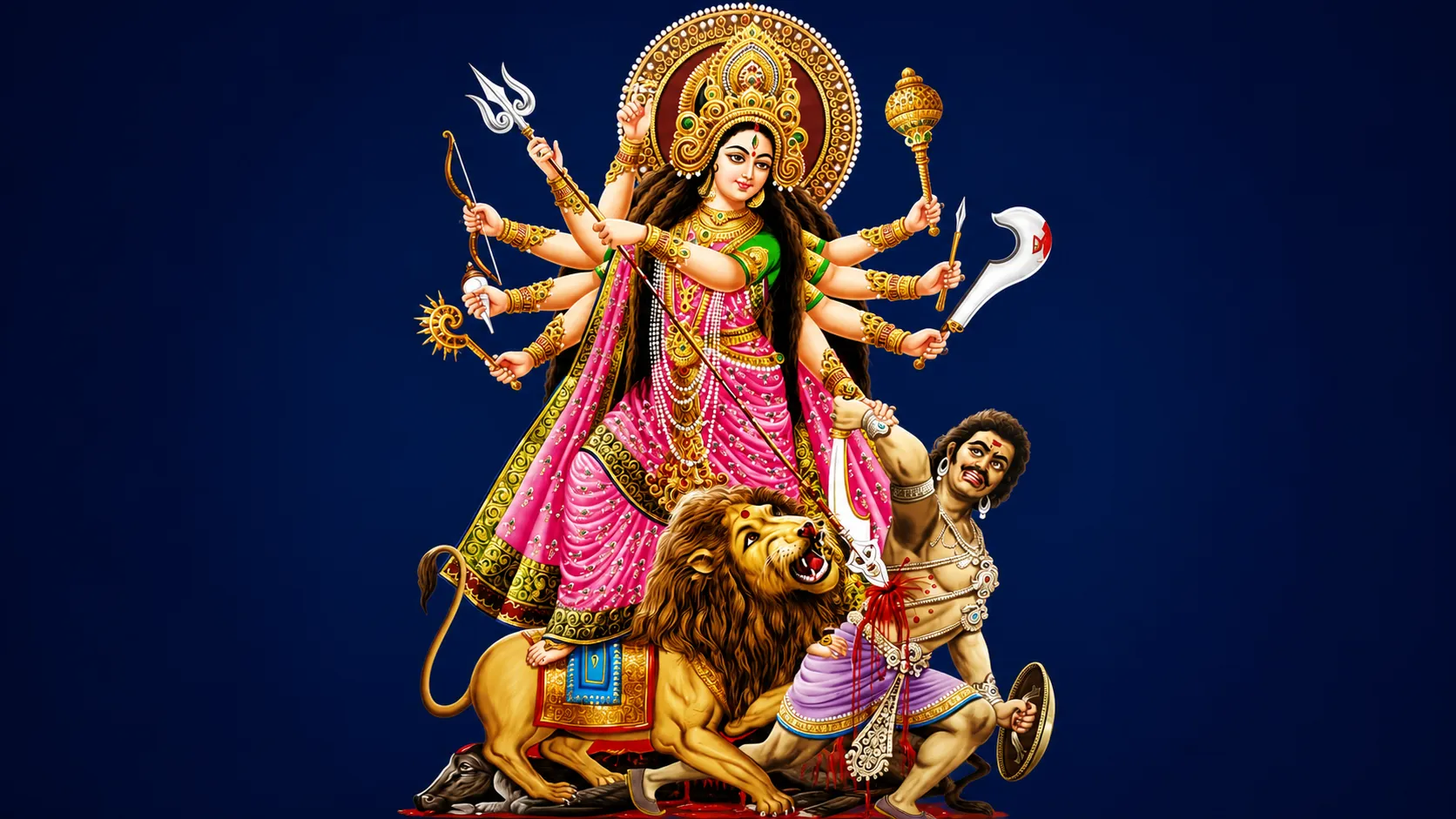
The stotram draws its narrative core from the Devi Mahatmya, the central scripture of Shakta Hinduism, embedded within the Markandeya Purana. It describes the Goddess Durga’s cosmic battle against the buffalo demon Mahishasura, who had overpowered the gods and seized control of the three worlds. Unable to defeat him, the gods combined their divine energies to create Devi, the supreme Shakti. She alone was capable of destroying what no single god could overcome.

What makes the Mahishasur Mardini Stotram distinctive is its form. It is composed in a fast, rhythmic, galloping meter called Madhyakrama, which mirrors the momentum of the battle itself. Each verse ends with the refrain Jaya jaya he Mahishasura mardini ramyaka pardini shaila sute, a chant of victory to the mountain’s daughter who slew the great demon. This repeating refrain creates a sonic intensity that is inseparable from the stotram’s devotional power.
Religious and Spiritual Significance
In Sanatan Dharma, Mahishasura represents more than a demon. He is the symbol of tamas, the quality of inertia, delusion, and brute force that resists the light of consciousness. The Goddess who destroys him is not simply a warrior. She is Adi Shakti acting to restore cosmic order, dharma, and the balance between light and darkness.
The Mahishasur Mardini Stotram honors this on multiple levels:
- Celebrates Devi as the combined power of all the gods, born from their united energy
- Describes her in both her fierce, battle-ready form and her serene, luminous beauty
- Honors her as the daughter of the Himalayas, rooted in the earth yet sovereign over all three worlds
- Acknowledges her as the destroyer of inner demons including pride, delusion, and inertia
In Shakta upanyas, this stotram is described as a direct confrontation with the divine feminine in her most powerful form. It does not ask for comfort. It asks for the courage to stand in her presence and receive her transforming grace.
Best Time to Chant Mahishasur Mardini Stotram
The Mahishasur Mardini Stotram carries particular significance during:
- Navratri, especially on Saptami, the seventh night, when the Goddess’s battle with Mahishasura is traditionally commemorated.
- Vijaya Dashami, the tenth day of Navratri, celebrating the final victory of Devi over the demon.
- Early morning during Brahma Muhurta, when the rhythm of the stotram aligns with the rising energy of the day.
- Any Ashtami or Navami tithi throughout the year.
Traditional teachings note that this stotram is especially suited for those facing situations of great difficulty, opposition, or inner stagnation. Its galloping rhythm is believed to break through blockages and invigorate the devotee’s will.
How to Chant Mahishasur Mardini Stotram?
The Mahishasur Mardini Stotram is not a gentle, slow recitation. Its meter demands rhythm, energy, and presence. Classical Shakta upanyas advise:
- Sit in a grounded, stable posture before the image or murti of Maa Durga.
- Chant at a steady, brisk pace that matches the galloping meter of the original.
- Maintain consistent rhythm throughout, as the meter itself carries the Shakti of the stotram.
- Pronounce the refrain Jaya jaya he Mahishasura mardini with full awareness each time it appears.
Even one complete recitation done with rhythm and focus is considered sufficient. During Navratri, devotees often recite all fifteen verses in a single sitting each day across the nine nights.
Benefits of Chanting Mahishasur Mardini Stotram
Hindu tradition describes the inner and outer benefits of the Mahishasur Mardini stotram as deep and transformative:
- Destroys tamas, the inner inertia and dullness that blocks spiritual and worldly progress
- Builds fearlessness and inner strength in the face of powerful opposition
- Removes the pride and delusion that the demon Mahishasura symbolizes
- Sharpens awareness and fills the mind with the dynamic energy of Shakti
- Protects the devotee from hostile forces, both external enemies and internal weakness
Because the stotram describes the Goddess in both her fierce battle form and her radiant, beautiful form, it trains the mind to hold power and grace together. This is the teaching of the complete divine feminine, not only the destroyer but the sustainer of beauty, art, and cosmic order.
Final Thought
The Mahishasur Mardini Stotram is not a prayer for peace. It is a war hymn for the soul.
Born from the Devi Mahatmya and shaped into one of the most rhythmically powerful compositions in all of Sanskrit literature, it places the devotee in the middle of the cosmic battle between light and darkness and asks a simple question: which side are you standing on?
Those who chant it do not simply praise the Goddess from a distance. They align themselves with her energy, her fearlessness, and her absolute refusal to allow adharma to prevail. That is why, after thousands of years, the refrain still rings out with the same force it carried on the day the Goddess herself first destroyed the demon.
Jaya jaya he Mahishasura mardini ramyaka pardini shaila sute
Also Read:
- श्री हनुमान चालीसा | Shri Hanuman Chalisa Timing, Benefit & Origin
- श्री शिव तांडव स्तोत्रम् | Shiv Tandav Stotram Meaning, Origin & Benefit
Save or bookmark this page so you can return to it whenever you seek calm, clarity, or devotion. Follow us on Instagram and Facebook to stay connected, and share your thoughts or suggestions in the comments.
This Bhakti corner is meant to be returned to, not just read once.