




There are many paths in Sanatan Dharma. Some seek knowledge. Some follow discipline. And some choose meditation. But the path of devotion, bhakti yoga, speaks directly to the heart.
Among all devotional teachings, Navadha Bhakti stands as one of the most beautiful and complete explanations of how a human being can connect with the Divine. It is simple, practical, and it is deeply scriptural.
If you have ever wondered, “What are the nine forms of bhakti?” This guide will walk you through them gently and clearly.
What is Navadha Bhakti, 9 Forms of Bhakti?
The word Navadha comes from nava (nine) and dhā (ways or forms). Navadha Bhakti, therefore, means the nine forms of devotion. This nine forms of devotion are described in the Bhagavata Purana 7.5.23, where the child-saint Prahlada explains the complete devotional path of Vishnu bhakti.
The nine forms are:
- Shravana: Listening
- Kirtana: Chanting and glorifying
- Smarana: Remembering
- Pada Sevana: Serving the feet of the Lord
- Archana: Ritualistic worship
- Vandana: Prayer and salutation
- Dasya: Servitude
- Sakhya: Friendship
- Atma Nivedana: Complete self-surrender
These nine types of devotion form a complete framework of bhakti yoga in Hindu spiritual practices.
Scriptural Origin: Bhagavata Purana 7.5.23
The teaching of Navadha Bhakti comes from the dialogue of Prahlada, the great devotee of Lord Vishnu. In Bhagavata Purana 7.5.23, Prahlada says:
श्रवणं कीर्तनं विष्णोः स्मरणं पादसेवनम् ।
अर्चनं वन्दनं दास्यं सख्यमात्मनिवेदनम् ॥
As it is translation:
Hearing about Vishnu, chanting His names, remembering Him, serving His feet, worshipping Him, offering prayers, serving Him as a servant, considering Him as a friend, and complete surrender of oneself, these are the nine forms of devotion.
This verse forms the foundation of structured bhakti in Vaishnava traditions.
1. Shravana: The Bhakti of Listening
Shravana means listening to the stories, glories, and names of God with full attention and an open heart. This is where bhakti begins. You cannot love what you have never heard about. The Bhagavata Purana itself is a beautiful example. King Parikshit had only seven days to live. He sat at the feet of the sage Shuka and simply listened for all seven days, and through that listening alone, he found liberation.
Today, Shravana can be as simple as attending a discourse, listening to a bhajan on your way to work, or hearing the Ramayana read aloud at home. What matters is not the form but the quality of your attention. Are you really listening, or just hearing?
Shravana is also the starting point of Shravana Kirtana Smarana, the first three forms of Navadha Bhakti, which naturally flow from one to the next: you hear, then you sing, then the name settles in your heart.
2. Kirtana: The Bhakti of Singing God’s Praise
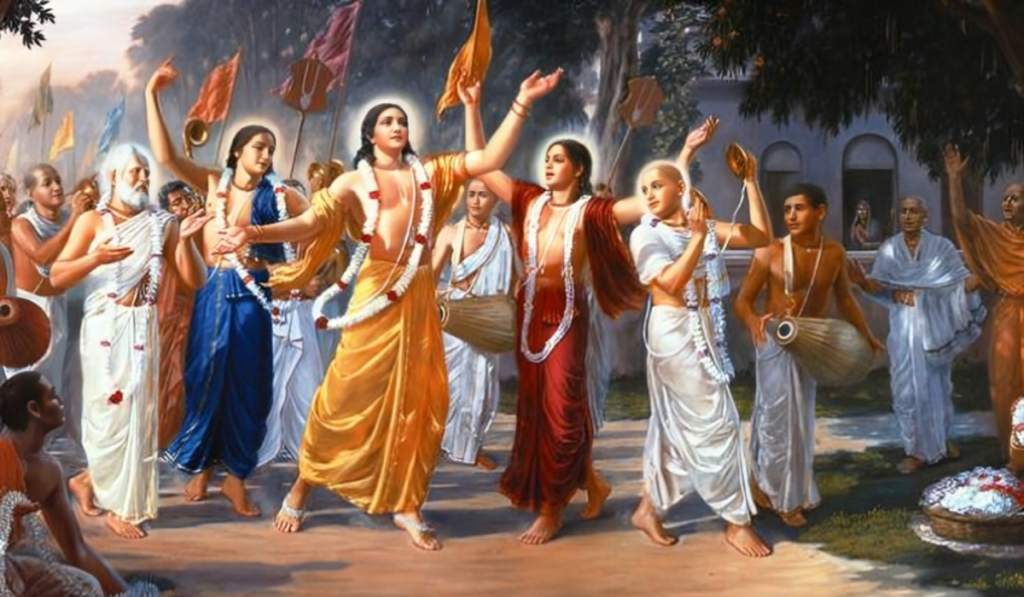
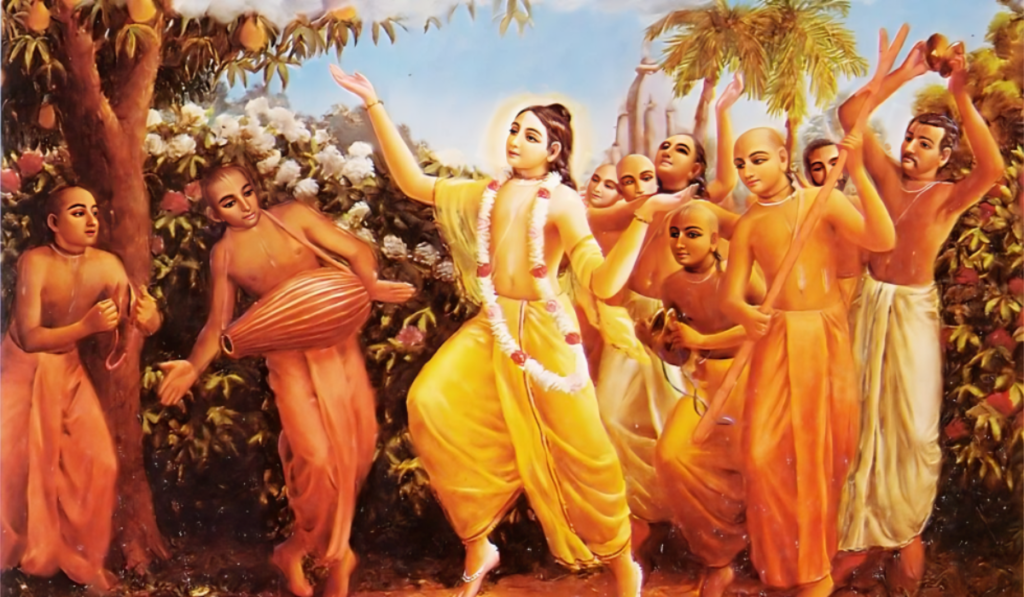
Kirtana is singing, chanting, or speaking the names and glories of God out loud. If Shravana is about receiving, Kirtana is about giving back. When devotion moves from inside you to outside you, when you open your mouth and let God’s name fill the room, that is Kirtana.
This is why kirtan gatherings feel so full of life. There is something in the shared singing of sacred names that softens people and opens them up. The great bhakti saints knew this well. Mirabai, Tukaram, Kabir, and Chaitanya Mahaprabhu all placed Kirtana at the heart of their practice. Chaitanya spread the Hare Krishna mahamantra through Bengal in the 15th century through congregational sankirtan, showing that this form of bhakti alone can be a complete path.
3. Smarana: The Bhakti of Remembering God
Smarana means keeping God’s name, form, or presence alive in your mind as much as possible throughout the day. This is one of the most personal of all nine forms. It needs no ritual, no special place, no set time. You can practice it while cooking, while working, while walking. All it asks is that your mind keeps returning to God.
Prahlada is the greatest example of Smarana in our tradition. Even as his father Hiranyakashipu put him through terrible hardships, Prahlada’s mind never moved away from Vishnu. His remembrance was not an effort or a scheduled practice. It was simply the natural way his heart worked.
Smarana reminds us that devotion is not something we do only during puja. It is something we carry with us all day long.
4. Pada Sevana: The Bhakti of Serving the Lord
Pada Sevana means serving the feet of God. In a temple, this shows up as caring for the deity’s murti, bathing it, dressing it, adorning it with flowers, all done with genuine love and attention. At its heart, it is the understanding that service itself is worship.
In Vishnu bhakti and Hindu spiritual traditions, the feet of God carry deep meaning. To be at the feet of the divine means you have let go of pride and opened yourself to receive grace. Pada Sevana trains the heart to find joy in serving rather than in being served.
This same spirit naturally extends to the world around us. Caring for the elderly, feeding the hungry, helping a stranger with the same warmth you would bring to tending a deity, this too is Pada Sevana.
5. Archana: The Bhakti of Worship
Archana is the offering of flowers, incense, light, water, food, and devotion to God through worship. Most of us know this simply as puja. The outer form may differ from family to family or temple to temple, but the inner meaning is always the same. You are turning toward God with open hands, offering what you have, and saying: this life is a gift and I return it to You with gratitude.
Archana gives your devotion a shape and a rhythm. When you light a diya each evening, offer a fresh flower, ring the bell, and fold your hands, these small acts build up over time. They bring your body into your bhakti, not just your mind.
6. Vandana: The Bhakti of Prayer and Bowing
Vandana is bowing before God and offering heartfelt prayers of praise and reverence. It is not about asking for things. Vandana is pure adoration. It is the heart’s natural movement toward something vast and good. The great stotras of our tradition, hymns like the Vishnu Sahasranama, the Shiva Tandava Stotram, and the Lalita Sahasranama, are all expressions of Vandana at its most beautiful.
The full prostration, dandavat pranam, where you bow with your whole body and touch your forehead to the ground, carries this spirit completely. When the body bows all the way down, there is no room left for pride. This is why the sages considered it one of the most honest and cleansing of all devotional acts.
7. Dasya: The Bhakti of the Devoted Servant
Dasya bhakti is the devotion of the faithful servant. It means seeing yourself as someone who exists to serve God’s will, and carrying that feeling into everything you do. Shri Hanuman is the greatest example of Dasya bhakti. Everything he did was for Rama. Not for reward, not for liberation, but simply for the joy of serving his Lord. And through that complete and joyful service, he became one of the most beloved figures in all of devotional life.
Dasya bhakti makes your whole life an act of offering. Every task becomes a service. When you stop thinking of yourself as the one in control and start thinking of yourself as an instrument in God’s hands, both your work and your heart change.
8. Sakhya: The Bhakti of Friendship with God
Sakhya bhakti is relating to God not with formal reverence, but with the warmth and ease of a true friendship. This is the bhakti of Arjuna, who sat beside Krishna on the battlefield and spoke to him the way you speak to someone you trust completely, honestly, openly, even in doubt and grief. It is also the bhakti of the young cowherds of Vrindavan, who climbed trees with Krishna, shared food with him, and called him by name without any ceremony.
Sakhya takes a kind of quiet courage. It means trusting that God actually wants to know you, not just be worshipped by you. A devotee living in Sakhya does not worry too much about whether they are doing bhakti the right way. They are too busy simply enjoying being with God.
9. Atma Nivedana: The Bhakti of Complete Surrender
Atma Nivedana is the fullest form of devotion: offering your entire self to God. Not just your prayers or your time, but your very sense of being separate from Him. This is what all eight of the other forms quietly prepare you for. Each one, in its own way, loosens the grip of the ego a little more. Atma Nivedana is what remains when that grip is finally released, a complete openness, a total trust.
In the Bhagavad Gita, when Krishna tells Arjuna to give up all else and take refuge in Him alone, that is an invitation to Atma Nivedana. It is not a passive giving up. It is letting go of the feeling of separation and resting in the truth that you were never truly apart from God to begin with.
This is why Atma Nivedana is called the doorway to Moksha. When nothing is held back, nothing stands between the devotee and the love they have been walking toward all along.
Conclusion
We live in busy, distracted times. It can feel like the devotional life belongs somewhere else, in temples and ashrams, not in offices and traffic and everyday routines. Navadha Bhakti quietly disagrees.
Devotion does not need a separate time slot. It can live inside everything you already do. Shravana can happen in a car. Kirtana can happen in a kitchen. Smarana can happen at your desk. Atma Nivedana can happen in the quiet moment before you fall asleep.
What Prahlada showed us, and what Bhagavata Purana 7.5.23 preserves, is that these nine forms of devotion are not obligations. They are open invitations. Each one is a different way of saying the same thing: that God is near, that love is available, and that you are already closer than you think.