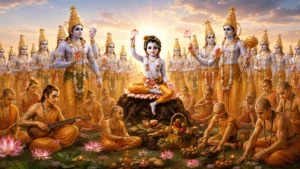

British education taught us to memorise dates, pass exams, and respect authority on paper. What it quietly erased was the fact that India already had a deeply functional Gurukul system long before classrooms had bells and chalk dust.
The gurukul system was not primitive. It was inconvenient for invasion and colonial narratives. It was eventually reduced to a footnote and then slowly written off as outdated.
But remember, modern Indian education did not replace the gurukul system overnight. It displaced it slowly, deliberately, and psychologically. To understand that, we need timelines. And we need to understand human behaviour under power, not just policies.
How the Gurukul System Actually Worked?
The gurukul system emerged during the early Vedic period (c. 1500–500 BCE) and matured through the later Vedic and classical periods (c. 1000 BCE – 1200 CE).
A gurukul was a residential learning ecosystem, not a school building.
- Students usually between the ages of 8 to 12 entered under a guru
- Education lasted 12 to 15 years, depending on the discipline
- Learning was free. Students offered guru dakshina at completion
- Society, land grants, or patronage sustained gurus.
This system existed continuously for over 2,000 years. That alone should make anyone pause before calling it primitive.
What Was Taught in Gurukuls?
By the 6th century BCE, gurukul education had expanded far beyond religious study. Core Disciplines included:
- Vedas and Upanishads for philosophy and metaphysics
- Vyakarana for grammar and linguistics
- Tarka for logic and debate
- Ganita for mathematics
- Jyotisha for astronomy
- Ayurveda for medicine
- Dhanurveda for military science
- Arthashastra-style governance and economics
Institutions like Nalanda and Takshashila attracted students from China, Korea, Southeast Asia, and Central Asia. And if you need international validation to prove this wasn’t just folklore, then these dates are recorded by foreign travellers like Xuanzang.
Why Gurukul Education Was Psychologically Strong?

Gurukul education was psychologically strong because it trained the mind from the inside out. Students were conditioned to practice delayed gratification, sustain long attention spans through memorisation and recitation through mantra, and regulate their own behaviour through discipline rather than constant supervision.
Moral reasoning was developed through dialogue, debate, and lived example, not through fear or blind obedience. Meanwhile, later, the British education system that replaced it prioritised speed, compliance, external rewards like grades and jobs, and a constant fear of failure.
One system cultivated internal control and self-mastery, while the other produced external dependency on authority and validation. Colonial administrators were fully aware of this difference, which is precisely why the gurukul model was inconvenient to their goals.
How Gurukul education system Get Destroyed?
After 2000 years of glorified Gurukul culture, came the downfall in the form of invasion and violence. And it was not aimless violence. It was a practice to annihilate a whole ancient civilization slowly and without any pain. Here are the two major blows that led to the downfall of the Gurukul education system:
The First Major Blow: Documented Destruction
The decline of the gurukul and temple-based learning network began before the British, and it began violently. Between the late 12th and early 14th centuries, a series of Turko-Afghan invasions directly targeted India’s institutional centres of learning. These were not accidental casualties of war. They were strategic destructions. Let’s be specific.
1. Destruction of Nalanda in 1193 CE by Bakhtiyar Khalji
- Nalanda had functioned continuously since at least the 5th century CE
- Hosted 10,000+ students and teachers
- Specialised in philosophy, medicine, logic, and astronomy
- Tibetan records state that Libraries were burned for months
- Resident monks were killed or forced to flee
This single event erased centuries of accumulated institutional memory. This was not symbolic damage. It was a systemic collapse.
2. Destruction of Vikramashila in 1200 CE by Bakhtiyar Khalji
Vikramashila was a major centre for Logic (Nyaya), Tantric philosophy, and Advanced Buddhist-Hindu scholastic exchange. Its destruction dismantled teacher lineages, not just buildings. Once a guru lineage breaks, revival becomes exponentially harder.
3. Decline of Takshashila during 1210–1220 CE
Invaders: Repeated Central Asian incursions following Ghaznavid and Ghurid campaigns. Takshashila had already weakened after earlier raids by Mahmud of Ghazni (c. 1000–1027 CE). It led to the loss of royal patronage and political instability in Gandhara. As a result, by the early 13th century, it ceased functioning as a living institution.
The Second Major Blow: British Policy and Psychological Replacement
The destruction of major learning centres weakened the gurukul system physically. British rule finished the damage psychologically and structurally. Unlike invasions, this phase did not rely on fire or violence. It relied on policy, funding control, and aspiration management. This was not about improving education. It was about replacing one system with another.
1. The Charter Act of 1813: Funding Shift Begins
In 1813, the British government passed the Charter Act, which for the first time allocated funds for education in India. However, this funding was directed almost entirely toward Western-style education, taught in English and aligned with British administrative needs.
Traditional gurukuls received no institutional support. Education that had survived for centuries on community patronage was now competing with a state-funded system designed to look modern, useful, and prestigious. This marked the beginning of the economic neglect of indigenous education.
2. Macaulay’s Minute of 1835: Identity Re-engineering
In 1835, Thomas Babington Macaulay authored his famous Minute on Education. His goal was clear and openly stated.
The British wanted to create a class of Indians who were Indian by birth but English in thinking, taste, and intellect. English education was prioritised, while traditional Indian knowledge systems were dismissed as inferior and unscientific.
This was a turning point. Education was no longer about learning. It became about status, power, and proximity to authority. Indian parents and students responded logically. English education promised jobs and social mobility. Gurukuls did not(according to colonial rule).
3. Wood’s Despatch of 1854: System-Level Replacement
By 1854, the British formalised their education policy through Wood’s Despatch. This laid the foundation for a full school and university system based on British models.
- Government-run schools expanded rapidly
- Universities were established in Calcutta, Bombay, and Madras
- Curriculum, exams, and teacher training followed Western standards
Gurukuls were not banned. They were simply left out of the system. Without funding, recognition, or career pathways, they slowly faded from public life.
4. The Shift from Guru to Teacher
In the gurukul system, the guru was a mentor, guide, and moral authority. Learning was personal and lifelong.
British education replaced this relationship with the idea of a teacher as an employee, delivering fixed content to large groups. The bond weakened. Authority became institutional, not personal.
This changed how students related to learning itself. Education became something you completed, not something you lived.
5. The Shift from Learning to Employment
Perhaps the most lasting change was the purpose of education. Gurukuls aimed to shape character, discipline, and understanding. British education aimed to produce clerks, administrators, and professionals for the colonial system.
- Degrees replaced wisdom.
- Certificates replaced mastery.
- Jobs replaced learning as the final goal.
Over time, Indians themselves began to abandon gurukuls, not because they lacked value, but because they no longer offered economic survival in a colonial world.
The Final Blow: Post-Independence Policies and the Nehruvian Education Model
When colonial rule ended in 1947, India became a democratic nation with the freedom to redesign its institutions. Education was one of the first areas to be reshaped. Under the leadership of Jawaharlal Nehru, the Indian state chose a model that prioritised modern science, central planning, and Western-style universities.
This choice was not made with the intention of destroying gurukuls. But its consequences pushed indigenous education systems even further to the margins.
1. Adoption of a Centralised, State-Controlled Education System
After independence, India retained and expanded the British administrative framework for education. Control over curriculum, funding, recognition, and certification moved firmly into the hands of the central and state governments. Education became:
- Degree-based
- Exam-oriented
- Institutionally standardised
Gurukuls, which functioned through community support and informal recognition, did not fit into this model. Without state recognition, their learning had no official value in employment or higher education. What was not recognised slowly became irrelevant.
2. Focus on Scientific and Industrial Education
Nehru strongly believed that modern India needed scientists, engineers, and industrial experts. This vision led to the establishment of institutions such as IITs and large public universities during the 1950s and 1960s.
This focus reshaped national priorities. Education was now seen primarily as a tool for nation-building through industry and technology.
Traditional gurukul education, which emphasised philosophy, ethics, discipline, and holistic learning, was viewed as cultural but not economically productive. As a result, it received little attention in national planning. What does not align with economic goals rarely receives funding in democracy.
3. Legal Separation of Education from Religious Institutions
Independent India adopted a secular state structure during emergency under 42nd Constitutional Amendment Act of 1976, under Indira Gandhi, which included distancing formal education from religious and temple-based institutions.
While this was intended to prevent state control by any one religion, it had an unintended effect. Gurukuls, which were often linked to temples or ashrams, were excluded from the formal education system altogether.
No alternative framework was created to integrate them respectfully. They were simply left outside the system.
4. Continuation of Colonial Curriculum and Assessment Models
Post-independence reforms focused on expanding access, not rethinking foundations. English-medium instruction, textbook-based learning, fixed syllabi, and standardised examinations continued with minor changes.
The guru–shishya model, which relied on long-term mentorship and non-exam-based mastery, could not survive in an environment that demanded certificates and measurable outcomes in a specific timeframe.
5. Cultural Relegation of Gurukuls to the Past
Under Nehruvian thought, tradition and modernity were treated as separate lanes. Gurukuls were acknowledged as part of India’s cultural history, not as viable systems for the future. This classification mattered.
Once a system is placed in the “heritage” category rather than the “functional” category, it stops evolving. It becomes something to remember, not something to practice. That distinction sealed the gurukul system’s fate.
6. Why This Phase Sealed the Decline
- Invasions damaged gurukuls physically.
- British rule replaced them structurally.
- Post-independence policy made their absence permanent.
By choosing to modernise education without integrating indigenous systems, free India unintentionally completed a process that had begun centuries earlier. The gurukul system did not disappear because democracy arrived. It disappeared because modernisation arrived without reconciliation.
Common Myths About Gurukul Education System
As soon as gurukuls are discussed seriously, a few predictable objections appear. Most of them come from repetition, not evidence. Clearing these myths is important, not to glorify the past, but to understand it accurately.
“Gurukuls were only for Brahmins”
Historical records do not support this as a universal rule. While access varied by region and period, gurukuls educated students from different social backgrounds based on aptitude, patronage, and local customs. Many well-known scholars, administrators, and warriors were trained outside narrow caste boundaries. Exclusion existed, but it was social and regional, not an absolute religious rule built into the system.
“Gurukuls taught only Religion”
Another myth is that gurukuls taught only religion. In reality, religious philosophy was only one part of a much broader curriculum. Gurukuls taught grammar, logic, mathematics, astronomy, medicine, governance, and military science. Large institutions like Nalanda and Takshashila were known for debate, research, and advanced study, not ritual instruction alone. Reducing gurukuls to “religious schools” ignores the range of subjects actually taught.
“Gurukul did not allowed science or questioning”
It is also often said that there was no science or questioning in gurukul education. This is incorrect. Indian knowledge traditions were debate-driven. Schools of philosophy openly disagreed with each other, questioned authority, and encouraged logical reasoning. Medicine relied on observation and practice. Astronomy depended on calculation and measurement. Questioning was not discouraged; it was expected.
“Gurukuls were anti-progress”
A final misconception is that gurukuls were anti-progress. Gurukuls did not resist change. They evolved over centuries in response to social needs, political conditions, and intellectual developments. What they resisted was blind imitation and learning without understanding. Their decline was not due to rigidity, but to loss of support, disruption of institutions, and later replacement by a different education model.
Conclusion: Why This History Still Matters Today?
The history of the gurukul system explains why modern education often feels mechanical and incomplete. Today, learning is measured through marks, degrees, and jobs, while attention, discipline, and values are treated as optional extras.
Gurukuls viewed education differently. Learning was not just about qualification, but about character, responsibility, and long-term guidance. Knowledge was absorbed through living, observing, and reflecting, not rushed through exams.
When gurukuls declined, India did not only lose institutions. It lost a way of thinking about education. British rule replaced the structure, and independent India expanded it, without meaningfully integrating indigenous wisdom into the modern system.
This does not mean rejecting modern education. It means recognising what is missing. Education shapes human beings before it produces professionals. The gurukul system understood this clearly.
Remembering its decline is not about going backward.
It is about understanding what should never have been left behind.
Let’s stay connected! Come say hi on Instagram or follow us on Facebook for more interesting knowledge.