

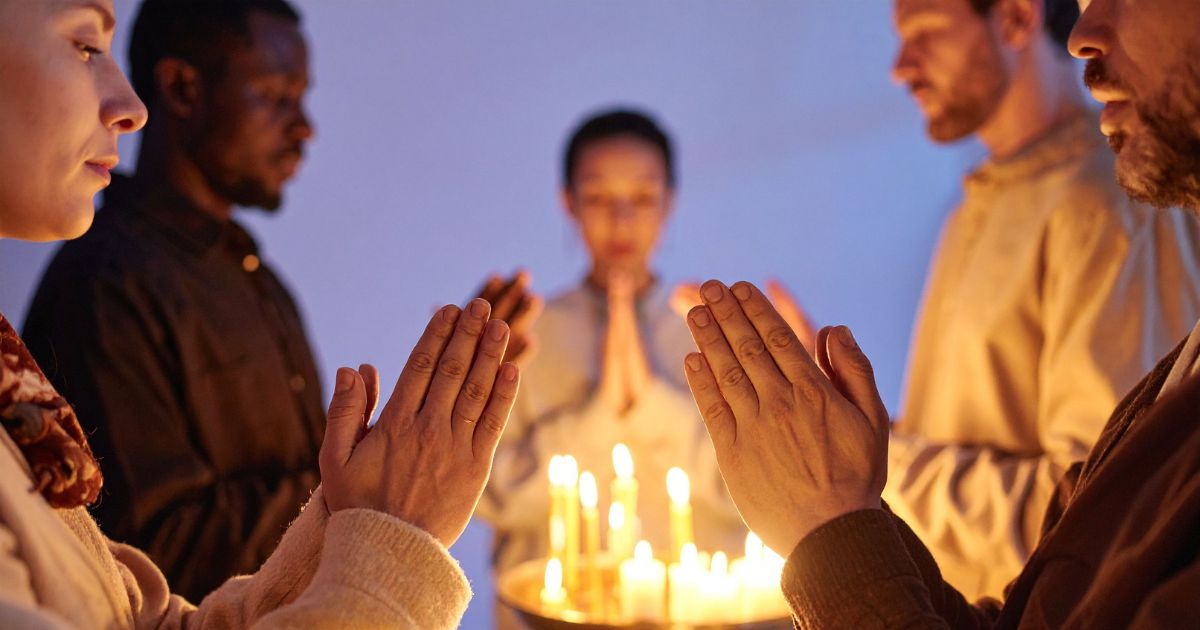
Why do some people find God in scripture while others find the divine in silence? Many people search for meaning in life. Some find it through organized religion and sacred traditions. Others find it through personal spirituality and inner reflection. Simply, they both are two sides of one coin. But still different in form and ways.
The difference between religion and spirituality often comes down to how a person connects with the divine and the ultimate god. One may look outward toward community, ritual, and scripture. The other may look inward toward intuition, consciousness, and inner peace without resorting to rituals. Both paths can lead toward a sense of purpose and peace.
The difference is just how you achieve that sense of purpose and eternal moksha. Let’s understand the true meaning of spirituality and religion.
What is Religion?
Religion often brings people together under a shared belief, scripture, and tradition. It forms a community built on teachings passed down through generations. The meaning of religion is strongly tied to structure. There are defined practices like prayer, fasting, gatherings, and rituals. There are places of worship where believers meet, be it a mandir with murti and soulful artis, a church with hymn books, or a gurdwara filled with peaceful Gurbani.
To understand the difference between religion and spirituality, we must know that religion gives identity. A child often grows into a faith that their family follows. The values and stories they hear early in life become anchors. Religion also provides moral guidance. It tells us how to behave, how to live with compassion, and how to treat others, and what sins not to commit. It gives a moral compass that is easy to follow because it comes with clear teachings.
In religion, the divine often feels like something we worship and reach toward. There is a sense of the divine being above us. There is respect, discipline, humility, and reverence. Many people feel safe in that clarity. They know what to do, how to pray, when to gather, and what scripture teaches. Religion offers comfort through belonging.
What is Spirituality?

Spirituality is more like a personal journey. The meaning of spirituality centers on individual experience rather than shared tradition. It is about exploring inner awareness, consciousness, and personal connection with something greater than oneself. Where religion brings form, spirituality embraces the formless.
A person on a spiritual path might meditate alone. They might reflect quietly, read sacred texts across multiple traditions, or simply sit with their inner voice. They may not follow fixed rituals. Instead, they tune into intuition and emotion. Spirituality does not require a temple or scripture. It requires honesty within the self.
Many people discover spirituality when they realize inner peace without rituals can feel just as sacred as any ceremony. Instead of seeking God above, they feel God within. Spirituality teaches that the divine is not outside us but woven into our consciousness, breath, and being.
In spirituality, the journey is unique to each person. There is no one right path. There is no single way to connect with the divine. Everyone builds their own relationship with the inner truth.
What’s the Difference Between Religion vs. Spirituality?
The difference between religion and spirituality becomes clearer when we look at how each one approaches devotion, truth, and connection with the divine. Religion often offers a shared path, while spirituality encourages a personal one. Below is a religion vs. spirituality comparison that shows how both can guide the human heart in different yet beautiful ways.
Religion vs. Spirituality
| Theme | In Religion | In Spirituality |
| How we walk the path | We walk together as a community, following a shared faith and traditions. | We walk inward, listening to our own heart and inner guidance. |
| Meaning of religion/spirituality | Religion feels like a sacred home with scripture, rituals, and a clear way to worship. | Spirituality feels like a gentle inner journey where we explore the meaning of life and the divine within. |
| Where guidance comes from | Teachings, holy books, elders, and age-old practices show us how to live and pray. | Intuition, reflection, and lived experience slowly reveal what feels true and aligned. |
| Daily practice | Aarti, prasad, going to temple, fasting, or joining collective prayers. | Meditation, journaling, mindful breathing, gratitude, and quiet moments with oneself. |
| Relationship with the Divine | We often look up to God as someone we bow to with reverence and devotion. | We often feel God as a presence inside the heart and in our breath. |
| How truth is held | Truth feels defined, preserved, and protected by tradition and teachings. | Truth feels discovered step by step through awareness and personal insight. |
| Inner peace | Peace comes from trusting the path, the rituals, and the community around us. | Peace comes from inner silence, acceptance, and inner peace without rituals if the heart feels full. |
| Sense of belonging | Gives a strong identity, festivals, shared prayers, and a feeling that “these are my people.” | Gives a feeling that “I am held by something greater,” even when sitting alone in a quiet room. |
| Expression of devotion | Bhajans, kirtan, offerings, visiting sacred places, following customs. | Tears in meditation, a soft smile in silence, acts of kindness, and conscious living. |
| Strength of each | Holds culture, memory, and family roots with love and continuity. | Helps the soul grow, heal, and awaken to a deeper awareness of self and the divine. |
Can Someone Be Both Religious and Spiritual?
Yes, absolutely. Many people practice both deeply and harmoniously. A person may go to a temple, participate in a hawan, receive prasad, and still meditate quietly at home. They may follow religious tradition and also nurture a personal spiritual connection.
Such people do not see religion vs spirituality as a conflict. They see them as complementary. Religion gives them roots. Spirituality gives them wings. One gives belonging. The other gives exploration. Together, they enrich life in a balanced way.
A person can be religious by identity and spiritual by experience. This way, you too can follow rituals and still cherish inner silence. You can honor tradition and still listen to intuition.
Why Do We Need Both Spirituality and Religion Today?
In a fast and stressed modern life, religion offers community. It creates festivals, songs, gatherings, and shared prayers. It gives cultural continuity and shared celebration. Religion reminds people that they are part of something bigger than themselves.
Spirituality provides introspection. It helps people slow down. And offers self-discovery and healing. It nurtures emotional awareness and mindfulness. It invites people to listen to their inner voice when the outside world gets loud.
Both religion and spirituality help us connect with meaning and purpose. They answer the quiet questions of life. Who am I. What matters. How do I love? What can I serve? How do I find peace? Some find those answers in scriptures. Others often find them in silence. Some find them in the community. Some find them in solitude. All are valid. All are pathways toward the divine.
Final Words
In the end, what matters is not the label we follow but the love we carry in our hearts. Some feel closest to the divine in a temple or church, and others feel it in quiet moments of reflection. When we understand the difference between religion and spirituality, we stop comparing and start appreciating.
One guides us with tradition and togetherness, the other with introspection and inner calm. If a person feels a genuine connection through either or both, that connection itself is sacred.
Let’s stay connected! Come say hi on Instagram or follow us on Facebook for more interesting knowledge.