
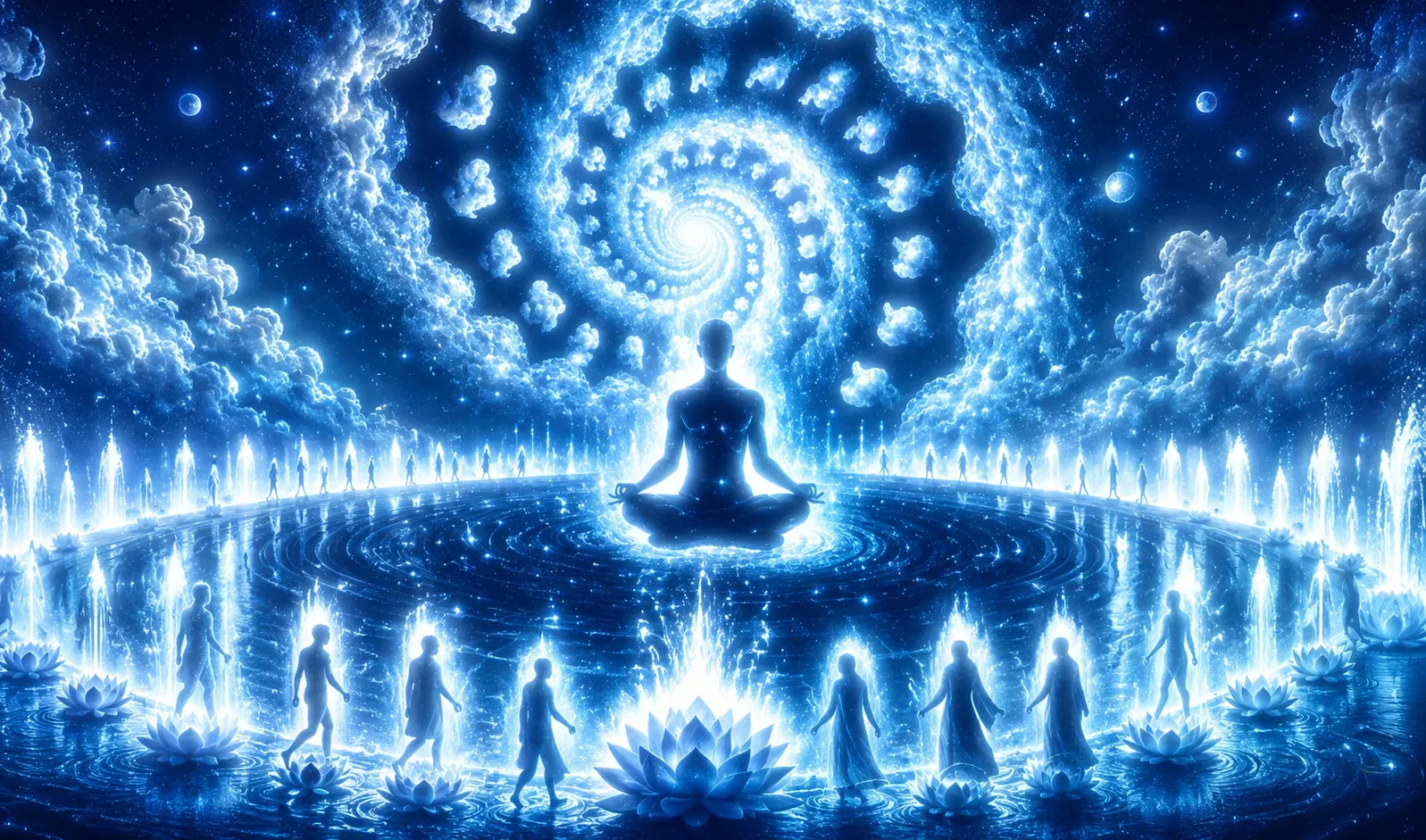
Moksha means the liberation of the soul from the endless cycle of birth and rebirth. Hindu philosophy names it as the fourth and final purushartha, the ultimate goal of human life. A soul attains moksha through good karma, self-knowledge, and devotion, and is then freed from samsara forever.
Hindu scripture lists four aims of human life: dharma, artha, kama, and moksha. The first three guide daily conduct, wealth, and desire. The true meaning of moksha stands above them as the final purpose every soul works toward across lifetimes.
This guide explains what moksha means and how Hinduism understands it. It also covers its other names, its two stages, and the actual paths to attain it.
Key Takeaways
- Moksha means liberation of the soul from the cycle of birth and rebirth.
- It is the fourth and final purushartha, the ultimate goal of human life in Hindu philosophy.
- It is also called mukti, vimoksha, mokkha in Jainism, and kaivalya in Yoga philosophy.
- It has two stages: jivanmukti, liberation while alive, and videhamukti, liberation after death.
- The Bhagavad Gita names four paths to attain it: jnana, karma, bhakti yoga, and raja yoga.
- Advaita, Vishishtadvaita, and Dvaita Vedanta each explain the atman-Brahman relationship differently.
What Is Moksha in Hinduism?
Moksha in Hinduism is the release of the atman, or individual soul, from samsara. Samsara is the cycle of birth, death, and rebirth. The soul is believed to be eternal. It simply moves from one body to another until it is liberated.
The Bhagavad Gita compares this transition to a person changing clothes. Chapter 2, verse 22, states that the soul casts off worn-out bodies and takes on new ones. It compares this to a person discarding old garments.
This transmigration continues until a soul accumulates enough good karma and true knowledge to break free. That final freedom is moksha. Vedanta philosophy treats it as union with Brahman, the ultimate reality behind the universe.
Abrahamic religions usually grant an eternal soul only to humans. Hindu philosophy instead holds that every living being carries an atman. This makes moksha a goal that spans the entire chain of rebirth, not just human life. This same soul concept underlies the broader Hindu understanding of Brahman, Ishvara, and Bhagavan.
Other Names of Moksha
The idea of liberation appears across every Indian religious tradition. As a result, moksha carries several names depending on the school of thought.
| Term | Tradition | Meaning |
| Mukti | Hinduism, general Sanskrit usage | Freedom or release |
| Vimoksha / Vimukti | Hindu and Buddhist texts | Complete liberation |
| Mokkha | Jainism, Prakrit language | Liberation of the soul from karma |
| Kaivalya | Yoga philosophy, Patanjali’s Yoga Sutras | Isolation of pure consciousness from matter |
| Nirvana | Buddhism | Extinguishing of craving and suffering |
Sikhism uses the term mukti as well, but places it below devotion to God in importance. The Guru Granth Sahib records Guru Arjan Dev preferring the Lord’s presence over liberation itself.
Two Stages of Moksha
Vedanta philosophy divides moksha into two distinct stages. Understanding both explains why some traditions describe liberation as something lived, not only something that follows death.
Jivanmukti and Videhamukti
- Jivanmukti: Liberation while still alive. A jivanmukta has realized the true nature of the self, called Atma Jnani. They also realize the universe, called Brahma Jnani, while still in the body.
- Videhamukti: Liberation after death. The soul departs the body entirely and merges into ultimate reality without further rebirth.
Source: Advaita Vedanta and classical Yoga philosophy, as expounded in the Brahma Sutras and their major commentaries.
A jivanmukta who teaches self-knowledge to others earns the title Avadhuta. Some advance further to Paramhamsa, a term reserved for the most realized teachers. At death, a jivanmukta attains paramukti, or final release.
Atman, Brahman, and the Philosophical Schools of Moksha
Every path to moksha rests on one question. What is the true relationship between atman, the soul, and Brahman, ultimate reality? Vedanta philosophy answers this in three distinct ways. Each answer decides which path a person should walk.
The Four Mahavakyas (Great Sayings)
The Upanishads distill the atman-Brahman relationship into four short statements, one from each Veda.
- Prajnanam Brahma (“Consciousness is Brahman”) from the Aitareya Upanishad, Rig Veda.
- Ayam Atma Brahma (“This self is Brahman”) from the Mandukya Upanishad, Atharva Veda.
- Tat Tvam Asi (“That thou art”) from the Chandogya Upanishad, Sama Veda.
- Aham Brahmasmi (“I am Brahman”) from the Brihadaranyaka Upanishad, Yajur Veda.
Source: The four principal Upanishads, one Mahavakya per Veda.
Three major schools of Vedanta interpret these sayings differently. Each produces a different answer to how moksha is attained.
| School | Founding Teacher | View of Atman and Brahman | Primary Path |
| Advaita Vedanta | Adi Shankaracharya | Atman and Brahman are identical. Separation is an illusion caused by ignorance. | Jnana yoga, knowledge |
| Vishishtadvaita | Ramanuja | Atman is part of Brahman but keeps its individual identity, like a spark from fire. | Bhakti yoga, devotion |
| Dvaita | Madhvacharya | Atman and Brahman remain eternally distinct, even after liberation. | Bhakti yoga, devotion |
Advaita Vedanta treats moksha as the removal of ignorance, not the creation of something new. Once a person realizes Aham Brahmasmi, the illusion of separateness dissolves and liberation is instant.
Vishishtadvaita and Dvaita reject full identity between atman and Brahman. Ramanuja taught that the soul retains individuality even in union with God. Madhvacharya went further, teaching that liberated souls serve God eternally without ever merging into him.
This is why the four yoga margas below are not interchangeable techniques. They are different responses to a real philosophical disagreement about what the self actually is.
How Do You Get to Moksha?
The Bhagavad Gita answers this question directly. Krishna outlines four distinct paths, or margas, matched to temperament and philosophical outlook. Jnana yoga suits an Advaita view, while bhakti yoga suits Vishishtadvaita and Dvaita.
The Four Yoga Marga Framework (Bhagavad Gita)
- Jnana Yoga, the path of knowledge. A person studies the Upanishads and reflects on the true nature of the self until ignorance dissolves.
- Karma Yoga, the path of selfless action. A person performs duty without attachment to results, described in Gita chapter 2, verse 47.
- Bhakti Yoga, the path of devotion. A person surrenders to God through worship, chanting, and love, open to householders and renunciates alike.
- Raja Yoga, the path of meditation. A person controls the mind through the eight limbs of yoga described by Patanjali.
Source: Bhagavad Gita, chapters 2 through 6, and Patanjali’s Yoga Sutras.
Krishna tells Arjuna that no single path suits everyone. A person should choose the marga that fits their nature. Consistency matters more than switching between paths.
What chapters or verses of Bhagwat Geeta talks about Ways to Attain Moksha?
- Gita 2.47: Krishna teaches action without attachment to results, the foundation of karma yoga.
- Gita 4.38: Krishna states no purifier in this world equals true knowledge, the basis of jnana yoga.
- Gita 6.47: Krishna calls the faithful devotee the most united of all yogis, affirming bhakti yoga.
- Gita 18.66: Krishna’s final instruction to surrender all duties and take refuge in him alone.
Source: Bhagavad Gita, as translated in standard Sanskrit-English editions.
Across all four paths, three practical actions repeat in the scriptures. Good deeds reduce the weight of bad karma. Detachment from outcomes prevents new karma from binding the soul. Self-inquiry replaces ignorance with knowledge of the atman.
Vedanta philosophy insists this liberation does not require leaving ordinary life. A person can attain jivanmukti while working, raising a family, and fulfilling worldly duties. Inner detachment simply has to be genuine.
Is Moksha a Nirvana?
Moksha and nirvana both describe liberation, but they come from different philosophical systems and are not identical.
| Aspect | Moksha (Hinduism) | Nirvana (Buddhism) |
| Core aim | Union of atman with Brahman | Extinguishing of craving and suffering |
| View of the self | An eternal soul (atman) exists | No permanent self (anatta) exists |
| Path | Jnana, karma, bhakti, or raja yoga | The Noble Eightfold Path |
| Outcome | Freedom from samsara through the soul | Cessation of dukkha through right understanding |
Buddhism’s Noble Eightfold Path includes right view, intention, speech, action, livelihood, effort, concentration, and mindfulness. It emphasizes ending craving rather than liberating a soul. Buddhist philosophy denies a permanent self altogether.
What Happens After Attaining Moksha?
Once a soul attains moksha, three things happen according to Vedanta philosophy:
- It loses its impermanent, gender-linked body and merges with ultimate reality.
- The soul’s ego dissolves, replaced by direct realization of the divine self.
- It gains freedom from the dependency of karma that governs every future rebirth.
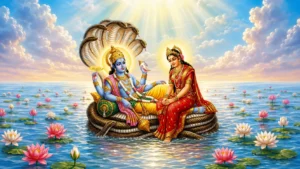
Vaishnava tradition describes the liberated soul entering Vaikuntha, the eternal abode of Lord Vishnu. This realm sits beyond the reach of birth and death. No soul that reaches it returns to samsara.
The scriptures describe this state as one of infinite bliss, knowledge, and freedom from suffering. Since the soul’s next life depends entirely on karma, moksha represents the permanent end of that dependency.
Story of Moksha in Hindu Scripture
Scripture illustrates moksha through narrative, not just doctrine. The Bhagavata Purana records several accounts of souls attaining liberation, each demonstrating a different path discussed above.
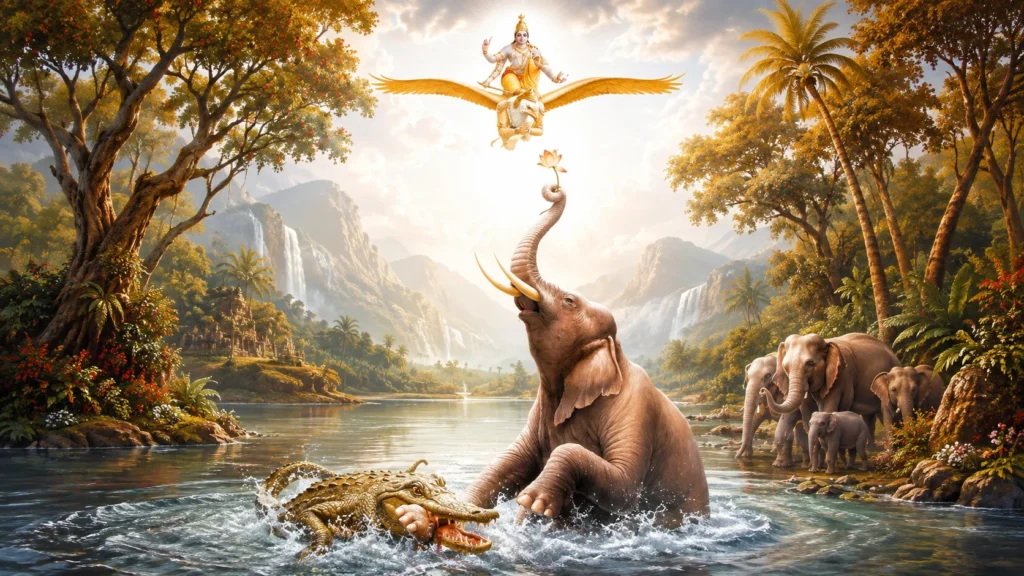
Gajendra Moksha: The Liberation of the Elephant King
Gajendra was an elephant king who wandered into a lake to bathe. A crocodile seized his leg and pulled him underwater. The two struggled for what the Bhagavata Purana describes as a thousand years.
Gajendra’s own strength eventually failed him. In his final moment, he surrendered completely and called out to Lord Vishnu with pure devotion. He offered a lotus flower, his only remaining possession.
Lord Vishnu arrived at once on his mount Garuda and freed Gajendra with his discus, the Sudarshan Chakra. The crocodile was liberated too. Scripture identifies it as Huhu, a celestial musician cursed to that form by a sage.
Both received moksha in that instant. This story illustrates bhakti yoga in its purest form. Liberation came not through ritual or learning, but through total surrender at the point of helplessness.
Source: Bhagavata Purana, Canto 8, Chapters 2 through 4.
Final Thought
Moksha is not simply the promise of a better life after death. In Hindu philosophy, it is the ultimate freedom from samsara, the cycle of birth and rebirth. It is the point where ignorance, attachment, and the karma that binds the soul to this cycle finally come to an end.
The path to moksha can look different for different people. Some seek it through self-knowledge and meditation, others through selfless action or deep devotion to God. The Bhagavad Gita shows that these paths are not about escaping everyday life, but about transforming the way we live it.
At its heart, the meaning of moksha comes down to one realization: understanding our true nature beyond the temporary body, ego, and worldly attachments. Be it through jnana, karma, bhakti, or raja yoga, the journey is ultimately inward, toward freedom, self-realization, and the highest truth.
Moksha may be the final goal, but Hindu philosophy reminds us that the journey toward it begins with how we live, act, think, and understand ourselves today.
My Favorite Corner (MFC) brings clear, scripture-sourced explanations of Hindu philosophy and practice to readers seeking authentic spiritual guidance. Explore more of our content on dharma, karma, and the paths to liberation. Follow MFC on Instagram and Facebook to explore more sacred places, festivals, and living traditions of Sanatan Dharma.
Frequently Asked Questions about Moksha
Moksha is liberation from samsara, the cycle of birth, death, and rebirth, through the realization of the true nature of the self and the ultimate reality. In Hindu philosophy, moksha is regarded as the fourth and final purushartha, or goal of human life. Different schools of Hindu thought explain the nature of this liberation differently.
Moksha in Hinduism is the liberation of the atman from samsara, ending the cycle of repeated birth and death. It is considered the fourth and final purushartha, alongside dharma, artha, and kama. The Upanishads connect liberation with knowledge of the Self and Brahman, while the Bhagavad Gita presents paths including knowledge, selfless action, meditation, and devotion. The precise nature of moksha differs among Vedanta schools.
Moksha is also known as mukti, vimoksha, or vimukti, meaning liberation or release. Related traditions use terms such as kaivalya in Yoga philosophy and mokkha in Jainism. These terms are related but are not always exact synonyms because Hinduism, Buddhism, Jainism, and Yoga have different understandings of the self, bondage, and liberation.
The two terms commonly used to describe liberation are jivanmukti, liberation while alive, and videhamukti, liberation after the death of the body. A jivanmukta is understood in Advaita Vedanta as someone who has realized the Self while still living. Videhamukti refers to final liberation after the body falls away. This two-stage framework is particularly associated with Vedanta discussions and should not be treated as an identical doctrine across every Hindu tradition.
Hindu philosophy describes several paths to moksha, including jnana yoga, karma yoga, bhakti yoga, and meditation or dhyana yoga. The Bhagavad Gita teaches that a person can pursue liberation through selfless action, spiritual knowledge, meditation, and devotion. For example, Gita 2.47 teaches action without attachment to its results, while Chapter 18 presents surrender and devotion as central to Krishna’s teaching. The Upanishads also emphasize truth, self-discipline, and right knowledge in the pursuit of realization.
No. Moksha and nirvana both refer to liberation, but they come from different philosophical traditions and are not identical concepts. In Hindu traditions, moksha generally refers to liberation from samsara and is often explained through the realization of atman and Brahman. In Buddhism, nirvana refers to the cessation of craving, ignorance, and suffering and is understood within the doctrine of anatta, or non-self.
Yes, some Hindu philosophical traditions hold that moksha can be realized within a single lifetime. Advaita Vedanta describes this state as jivanmukti, in which a person realizes the true nature of the Self while still living. The Upanishadic tradition supports the possibility of realizing the Self through knowledge and disciplined spiritual practice. The Mundaka Upanishad, for example, describes the realization of the Self through truth, discipline, and knowledge.
No single Hindu scripture explains moksha in every possible way. The principal Upanishads, Bhagavad Gita, and Brahma Sutras are among the most important sources for understanding Hindu teachings on liberation. The Upanishads explore the nature of atman and Brahman, the Bhagavad Gita explains practical spiritual paths such as karma, jnana, bhakti, and meditation, and the Brahma Sutras systematically examine Vedanta philosophy. For a beginner, the Bhagavad Gita is often the most accessible starting point because it connects philosophical ideas about liberation with everyday life and duty.
After moksha, the soul is no longer bound by samsara or the karma that causes continued rebirth. The exact description of what follows depends on the Hindu philosophical tradition. Advaita Vedanta describes liberation as realization of the non-dual nature of atman and Brahman. Vaishnava traditions generally understand the liberated soul as retaining its individuality and attaining the presence or abode of the Supreme Lord, such as Vaikuntha. Therefore, saying that every Hindu tradition teaches that the soul simply “merges with Brahman” would be too broad.
No. Hindu philosophy does not restrict moksha exclusively to sannyasis or renunciates.
The Bhagavad Gita teaches spiritual liberation through paths such as karma yoga and bhakti yoga, which can be practiced while performing one’s duties in the world. Krishna’s teaching to Arjuna itself presents spiritual realization within the context of fulfilling one’s responsibilities rather than abandoning them.
Moksha and salvation are both concepts of ultimate liberation, but they come from different religious and philosophical frameworks. In Hindu traditions, moksha generally means freedom from samsara through spiritual realization, knowledge, devotion, disciplined action, or a combination of these depending on the school. The word salvation is more commonly used in Abrahamic religious contexts and can involve concepts such as divine grace, faith, repentance, and eternal life. Because these traditions have different ideas about the soul, God, sin, karma, and the afterlife, the two concepts should not be treated as exact equivalents.
Hindu traditions generally regard moksha as a possible ultimate goal for living beings, but they differ on whether every soul will inevitably attain it and how liberation occurs. The major Vedanta schools also disagree about the nature of the liberated soul and its relationship with Brahman. Therefore, it is more accurate to say that moksha is an attainable spiritual goal rather than making the universal claim that every soul must eventually attain it after a fixed number of births.
Advaita Vedanta teaches that atman and Brahman are ultimately non-different, while Dvaita Vedanta teaches that the individual soul and God remain eternally distinct. In Advaita, associated with Adi Shankaracharya, moksha is the realization that the apparent separation between atman and Brahman is caused by ignorance. In Dvaita, associated with Madhvacharya, the individual soul never becomes identical with God. Liberation means freedom from samsara and eternal relationship with and service to the Supreme Being. This difference is fundamental to understanding why Hindu traditions describe moksha in different ways.
Atman is the Self, while Brahman is the ultimate reality described in the Upanishadic tradition. Their precise relationship is interpreted differently by different Hindu philosophical schools. Advaita Vedanta identifies atman and Brahman at the highest level of reality. Other Vedanta schools, including Vishishtadvaita and Dvaita, maintain a distinction between the individual soul and the Supreme Reality. The Upanishads repeatedly explore this relationship. The Mandukya Upanishad states, “ayam atma brahma”, expressing the relationship between the Self and Brahman, while the Brihadaranyaka Upanishad also presents the Self as Brahman.