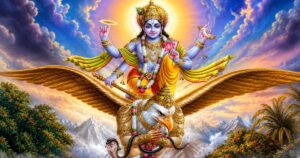

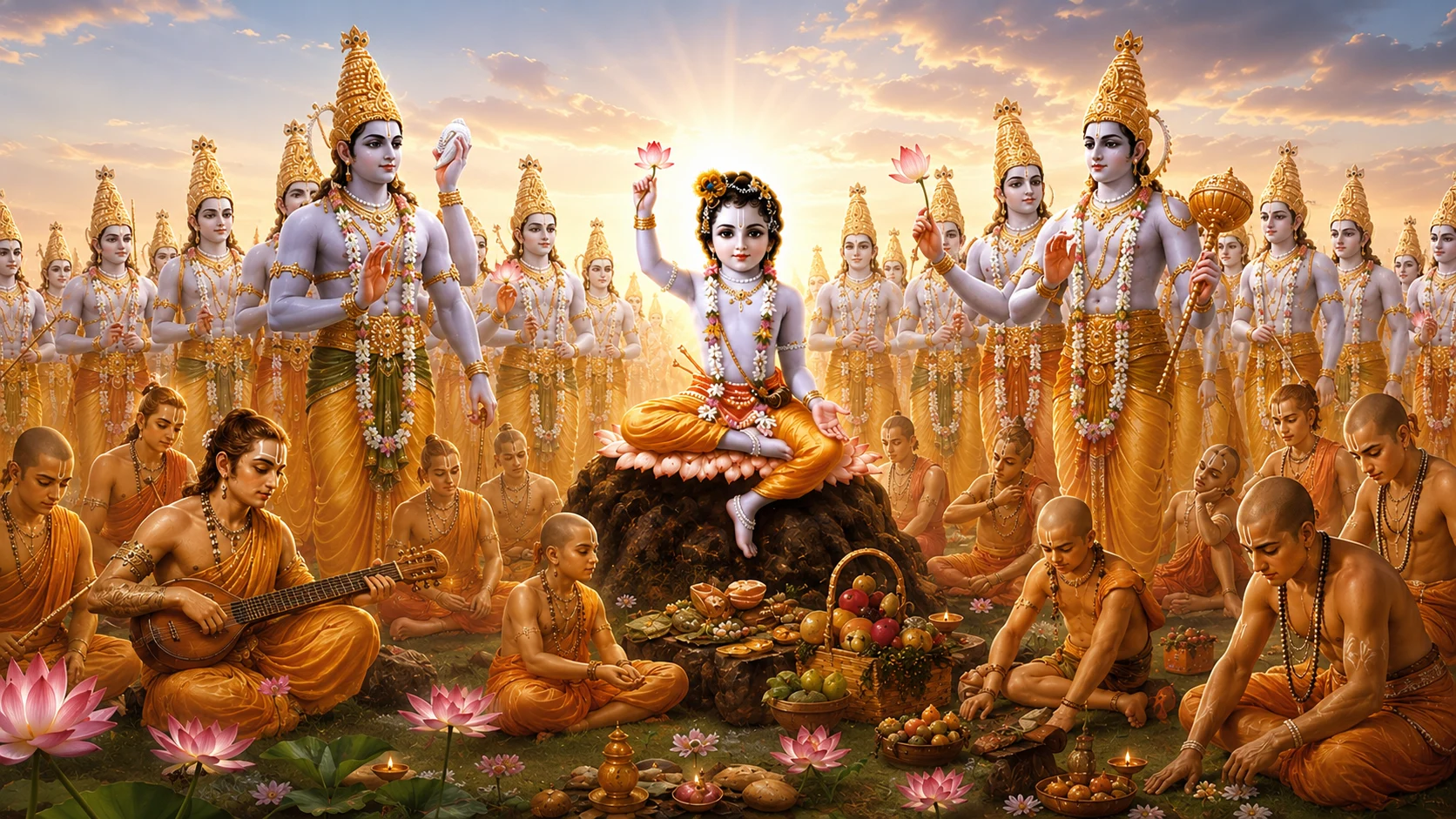
God in Hinduism is Brahman, the one formless ultimate reality behind everything that exists. Hindus worship this reality through personal forms, called Ishvara or Bhagavan, like Lord Vishnu, Lord Shiva, and Devi. The concept of God in Hinduism is not one god versus many gods. It is one reality, reached through several genuinely different philosophical paths.
Disclaimer: Every claim in this article is based on the original Sanskrit scriptures, not on secondhand summaries. Where different traditions have different views, such as Adi Shankaracharya and Ramanujacharya on the nature of Brahman, we clearly mention both instead of presenting only one. We do not claim to represent any spiritual lineage. Every important point is supported by trusted sources, and we’ve included references so you can verify the information yourself.
Hinduism is often described as a religion with millions of gods. Yet its oldest scriptures repeatedly speak of one ultimate reality behind everything that exists.
So where did the idea of “millions of gods” come from? Does Hinduism believe in one God or many gods? And if there is only one ultimate reality, why do some people worship Lord Shiva, others Lord Vishnu, Shri Krishna, or Devi?
The answers are far more fascinating than most people realize. This guide explores the Hindu concept of God through the Vedas, Upanishads, Bhagavad Gita, and the major schools of Hindu philosophy, separating common misconceptions from what the scriptures actually teach.
Key Takeaways
- God according to Hinduism is one ultimate reality, Brahman, expressed through many names and forms.
- The idea developed over roughly 3,000 years, from nature worship to philosophy to personal devotion.
- Brahman is the formless absolute. Ishvara is Brahman understood as a personal, conscious Lord.
- Shankara and Ramanuja genuinely disagree on how Brahman relates to the world it creates.
- Brahma, the creator deity, is not the same as Brahman, the ultimate reality.
- The word koti carries two attested dictionary meanings: crore, and category. Scholars weigh them differently.
- Different traditions name different gods supreme: Vishnu for Vaishnavas, Shiva for Shaivas, Devi for Shaktas.
- Lived practice adds a personal layer: an Ishta Devata, a family Kuldevi, a home shrine.
- No single answer here is complete on its own. Each piece needs the others.
Why Is the Idea of God in Hinduism Often Misunderstood?
Many people get confused because of the words used to describe religions. In English, religions are often grouped as either monotheistic (belief in one God) or polytheistic (belief in many gods). Hinduism does not fit neatly into either category. As a result, many people simply call it a polytheistic religion without exploring what Hindu scriptures actually teach.
Another reason for the confusion is the often-quoted idea that Hinduism has 33 koti deities, which is commonly misunderstood as 330 million gods. Taken literally, this makes Hinduism seem like a religion with countless separate gods, but the original Sanskrit term koti has a deeper meaning that is often overlooked.
The structure of Hinduism also adds to the misunderstanding. Unlike many other religions, Hinduism has no single founder or central religious authority. It developed over thousands of years through different philosophical schools, scriptures, and spiritual teachers.
Because of this, Hinduism accepts more than one way of understanding and worshipping God. This diversity is not a contradiction or a weakness. It is a fundamental part of Hindu philosophy and is supported by its sacred scriptures, as the following sections explain.
What Does “God” Mean in Hinduism?
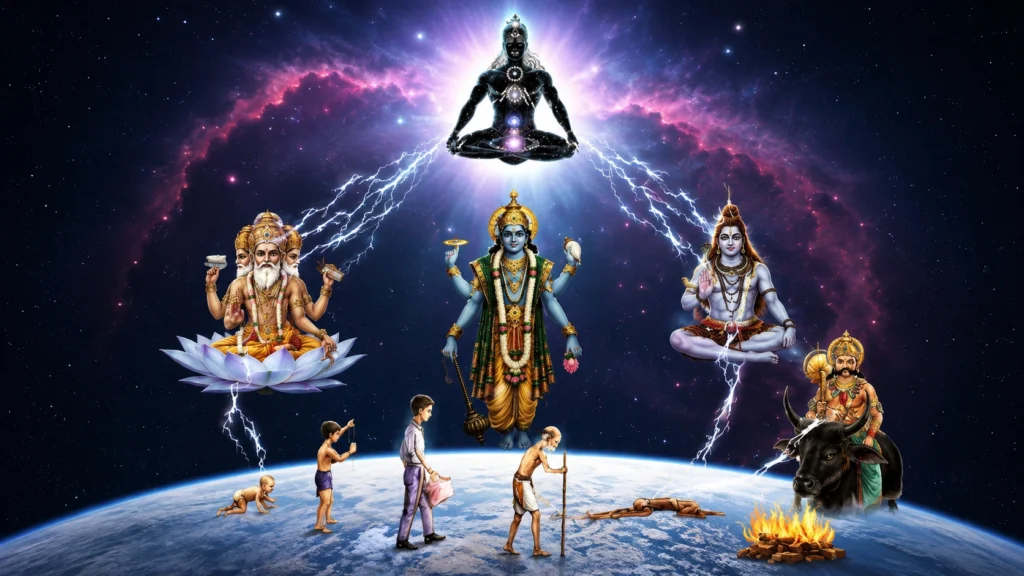
What is God in Hinduism? At the deepest level, God means Brahman, the one reality behind name and form.
Brahman is not a person seated somewhere in the sky. Texts describe it as the substance behind all existence, closer to a principle than to a being.
Think of gold as the substance behind every gold ornament. A ring, a bangle, and a coin look different, but each is simply gold, shaped differently. That is how Brahman relates to the visible world.
Classical Advaita philosophy uses a sharper version of the same idea. It is called akasha ghata nyaya, the analogy of space inside a pot. Space inside a clay pot looks separate from the space outside it. Break the pot, and the separation was never real. Space was one all along.
At the devotional level, God means a personal Lord you can pray to and love. This Lord is called Ishvara or Bhagavan. Ishvara in Hinduism and Bhagavan meaning in Hinduism both point to this same personal layer of God.
Shri Krishna, Shri Rama, Lord Shiva, and Devi are all understood as this personal Lord, in different forms. Each carries its own stories, temples, and festivals.
How Did the Idea of God Develop in Hinduism?
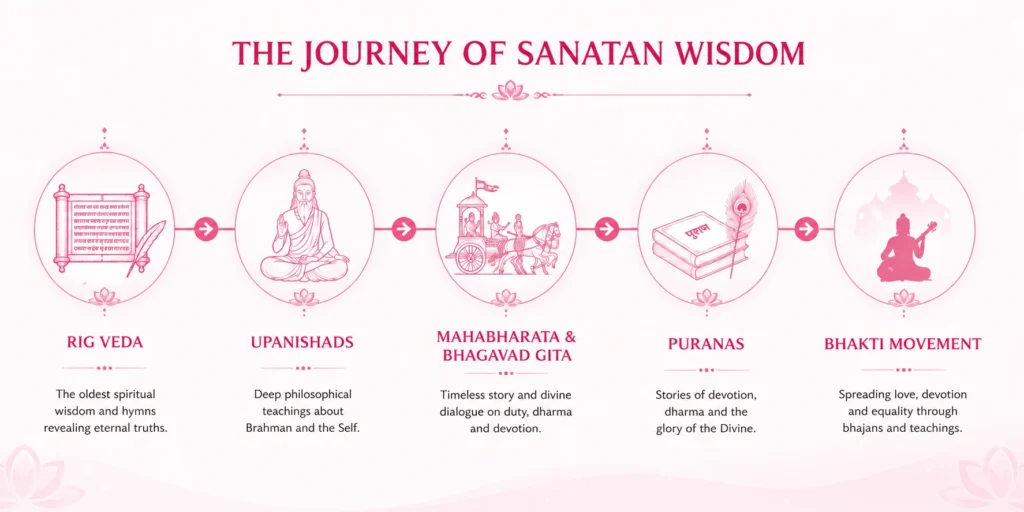
Hindu ideas about God were not handed down all at once. They grew across roughly 3,000 years, through five broad eras, each building on the one before.
Important Note: Exact dates are debated among historians, since oral transmission predates written texts by centuries. Treat the dates below as scholarly estimates, gathered from multiple sources, not fixed facts.
- Early Vedic Period Roughly 1500 to 800 BCE
Ancient sages addressed natural forces as gods. Agni was fire, Indra was storm and strength, and Varuna was cosmic order. Worship centered on fire sacrifice, hymns, and precise ritual performance passed down orally.
- Late Vedic Reflection Roughly 1000 to 800 BCE
Poets within the Rig Veda itself began asking a harder question. If there are many gods, what stands behind all of them? The Nasadiya Sukta (129th hymn of the 10th Mandala in the Rigveda), discussed further below, comes from this searching, uncertain stage.
- Upanishadic Period Roughly 800 to 200 BCE
Sages turned inward, through meditation, debate, and one-on-one teaching rather than ritual alone. This era produced Brahman as one reality behind the many gods. It was taught through vivid household examples, not abstract formulas.
- Epic Period Roughly 400 BCE to 400 CE
The Mahabharata and Ramayana gave the abstract idea of Brahman a face. Within it, the Bhagavad Gita presents Krishna as Bhagavan. He speaks directly to a devotee on a battlefield, in a moment of real crisis.
- Puranic Period Roughly 300 to 1500 CE
The Puranas organized deity mythology into full systems, complete with origin stories, family relationships, and moral lessons. Vaishnavism, Shaivism, and Shaktism matured into distinct temple traditions during this era.
- Bhakti Movement Roughly 600 to 1700 CE
Regional poet-saints, from the Tamil Alvars to Kabir, Mirabai, and Shri Chaitanya Mahaprabhu, centered devotion on one chosen deity. This popularized the Ishta Devata for ordinary devotees, in local languages rather than Sanskrit alone.
In simple terms: Why this history matters: each era did not erase the one before it. Vedic hymns, Upanishadic philosophy, epic devotion, and Puranic ritual are all still practiced today, side by side. That layering, more than any single doctrine, is why Hindu belief looks so varied on the surface.
Does Hinduism Believe in One God or Many Gods?
Does Hinduism believe in one God? Yes, at its philosophical core. The clearest statement comes from the Rig Veda.
इन्द्रं॑ मि॒त्रं वरु॑णम॒ग्निमा॑हु॒रथो॑ दि॒व्यः स सु॑प॒र्णो ग॒रुत्मा॑न् ।
एकं॒ सद्विप्रा॑ बहु॒धा व॑दन्त्य॒ग्निं य॒मं मा॑त॒रिश्वा॑नमाहुः ॥
indram mitraṃ varuṇam agnim āhur atho divyaḥ sa suparṇo garutmān |
ekaṃ sad viprā bahudhā vadanty agniṃ yamam mātariśvānam āhuḥ ||
Meaning: “They have styled (him, the Sun), Indra, Mitra, Varuṇa, Agni, and he is the celestial, well-winged Garutmat, for learned priests call one by many names as they speak of Agni, Yama, Mātariśvan.”
Rig Veda 1.164.46
This line, composed over 3,000 years ago, explains the whole framework. The names Indra, Agni, and Varuna all describe one reality.
So do the later names Vishnu, Shiva, and Devi. One God or many gods turns out to be the wrong question. Hindu tradition has a well-known story that makes the point vivid.
A Traditional Story to understand the concept of many gods:
Several blind men are led to an elephant and asked to describe it. One touches the trunk and says it is like a thick snake. Another touches an ear and says it is like a large fan. A third touches a leg and says it is like a tree trunk. Each man argues that his description alone is correct.
None of them is incorrect. Each has touched something real. None has grasped the whole animal. Hindu teachers, most famously the nineteenth-century saint Ramakrishna, used this parable often. It explains why Vaishnavas, Shaivas, and Shaktas each defend their chosen deity so firmly. Each has genuinely touched part of the truth.
At the everyday, ritual level, Hindus do worship many deities. A temple may house Ganesha, Durga, and Shiva together, and this is intentional.
Each deity carries a different quality of the same source, like one sun casting many rays. Recall the elephant in the parable above, described from several honest but partial angles.
This is why Vaishnavas worship Vishnu, Shaivas worship Shiva, and Shaktas worship Devi. Their chosen deity may differ, but the ultimate divine reality they seek is the same.
In other words, Hinduism does not teach that there are many independent gods competing with one another. It teaches that one Supreme Reality can be worshipped through many divine forms, each revealing a different quality or aspect of the same truth.
Why Did Hindu Philosophy Need the Idea of Brahman?
The early Vedic hymns worked well as poetry and ritual. But they left a hard question unanswered, one that eventually could not be avoided.
What connects Agni, Indra, and Varuna to each other? If each has its own separate power, the universe looks fragmented, held together by nothing at all.
The Nasadiya Sukta, a hymn on creation, shows this search happening in real time. It does not pretend to have every answer. That honesty is part of why it is still studied today.
इ॒यं विसृ॑ष्टि॒र्यत॑ आब॒भूव॒ यदि॑ वा द॒धे यदि॑ वा॒ न ।
यो अ॒स्याध्य॑क्षः पर॒मे व्यो॑म॒न्त्सो अ॒ङ्ग वे॑द॒ यदि॑ वा॒ न वेद॑ ॥
iyaṃ visṛṣṭir yata ābabhūva yadi vā dadhe yadi vā na |
yo asyādhyakṣaḥ parame vyoman so aṅga veda yadi vā na veda ||
Meaning: “He from whom this creation arose, he may uphold it, or he may not (no one else can); he who is its superintendent in the highest heaven, he assuredly knows, or if he knows not (no one else does).”
Rig Veda 10.129.7
Where the Texts Show Humility?
This is one of the most striking lines in the Vedas. It admits the highest source of creation may be beyond full knowing. Hindu tradition treats this as wisdom, not weakness.
Out of this search, the Upanishads proposed Brahman: one reality, without form, that grounds every named god. They rarely taught it through abstract argument alone. They taught it through household objects, as this famous exchange shows.
A Traditional Story: Tat Tvam Asi
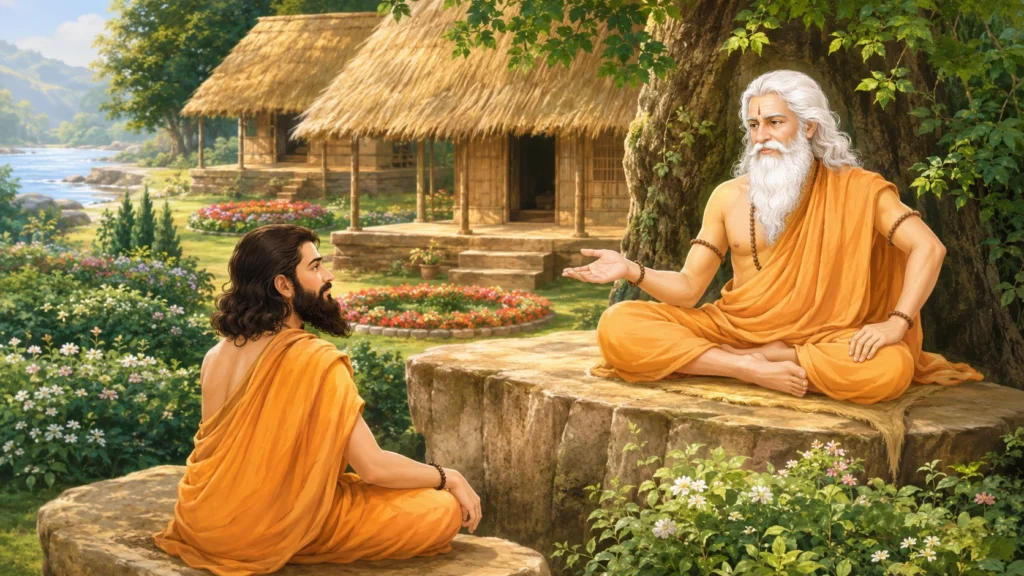
In the Chandogya Upanishad, a father named Uddalaka teaches his son Svetaketu about Brahman. He uses things found in any home. He first says that by knowing one lump of clay, one already knows everything made of clay. The substance never really changes, only its shape.
Then he hands his son a banyan fruit and asks him to break it open. Inside are countless tiny seeds. He asks him to break one open. Svetaketu finds nothing inside. Yet from that apparent nothing, an entire banyan tree eventually grows.
Next, Uddalaka dissolves salt into water overnight. He asks his son to taste the water from the top, middle, and bottom. It tastes the same everywhere, though the salt itself has become invisible. After each example, the father repeats the same refrain to his son.
तत्त्वमसि
tat tvam as
That thou art. You yourself are that one reality, Brahman, though it is not visible to the eye.
Chandogya Upanishad 6.8 to 6.13
Brahman answered the unity question this way: one shared ground, present in the world. It is the way salt is present in water. Or a seed is present in the tree it will become.
The Brahma Sutras later formalized this idea into philosophy. It is stated as janmady asya yatah, “that from which the universe originates” (Brahma Sutra 1.1.2).
Why Did Hindus Also Need Ishvara and Bhagavan?
Brahman solved the unity problem, but created a new one. A formless, attribute-less reality is hard to love or pray to.
Meditation on pure formlessness suits advanced philosophers. Most people need a face, a story, and a relationship to sustain daily devotion. This matters most through grief, fear, or celebration.
Hindu thought answers this with a bridge, not a single leap. Each rung adds a layer, without discarding the one before it.
1. Nirguna Brahman: Formless reality, no attributes. Reached through knowledge and meditation.
2. Saguna Brahman: The same reality, now imagined with qualities, for contemplation.
3. Ishvara: That reality as a conscious Lord who creates and governs.
4. Bhagavan: That Lord in one lovable, specific form, like shri Krishna or Maa Durga.
5. Ishta Devata: That form, chosen personally by one devotee for daily worship.
In simple words: Think of this as a bridge, not a ranking of correctness. You can stand on any stage and still be standing on Brahman. Philosophers tend to favor the top rungs, devotees the bottom ones. Hindu tradition needs both, and one scene from the Bhagavad Gita shows exactly why.
The Bhagavata Purana names three of these levels together in a single verse.
वदन्ति तत् तत्त्वविदस्तत्त्वं यज्ज्ञानमद्वयम् ।
ब्रह्मेति परमात्मेति भगवानिति शब्द्यते ॥
vadanti tat tattva-vidas tattvam yaj jnanam advayam,
brahmeti paramatmeti bhagavan iti shabdyat
Knowers of truth describe one non-dual reality in three ways: as Brahman, Paramatma, and Bhagavan.
Bhagavata Purana 1.2.11
A Traditional Story: Arjuna Asks for the Gentle Form
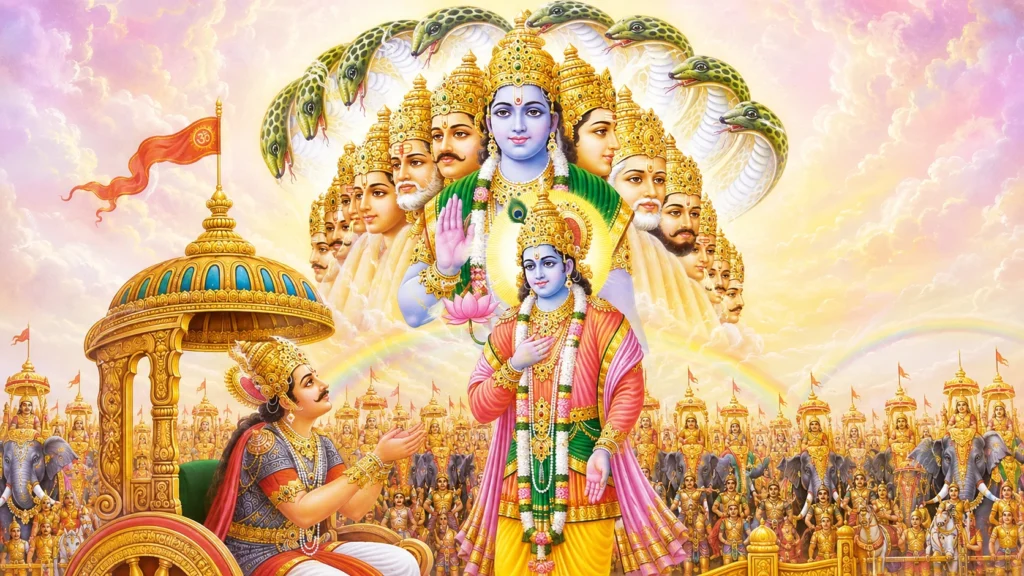
In Bhagavad Gita chapter 11, Arjuna asks Shri Krishna to reveal his true, universal form. Shri Krishna grants the request, and Arjuna suddenly sees countless mouths and countless eyes. Every being in existence appears contained within one blazing, terrifying body.
Arjuna is overwhelmed, his hair standing on end, his mind losing its footing. He praises the vision, then begs Krishna for mercy. He asks him to return to the gentle, four-armed form. Shri Krishna then resumes the familiar two-armed human form Arjuna knew as a friend (Bhagavad Gita 11.45 to 11.51).
Krishna agrees, and comforts him. The scene is often read as the Gita’s own argument for Ishvara and Bhagavan. Nirguna Brahman alone is not enough for a relationship. The infinite form is true, but a relationship needs a face a human heart can hold.
Patanjali’s Yoga Sutras define Ishvara precisely: a perfect consciousness, untouched by suffering or karma (Yoga Sutra 1.24).
A Devata, by contrast, is not the Supreme itself. Devatas manage one cosmic function each, under Ishvara’s authority. It is much like a minister serving under a single head of state.
Why Do Hindus Worship Different Gods?
Why does Hinduism have many gods? Because one infinite reality cannot be reduced to a single fixed image. The elephant story above already suggested this.
Different deities express different qualities of that same reality:
- Maa Durga represents protective strength.
- Maa Saraswati represents knowledge and the arts.
- Maa Lakshmi represents abundance.
- Shri Ganesha represents the removal of obstacles.
- Shanu Dev represents the law and fruit of karma.
A devotee approaches the quality most relevant to their need on a given day. Different seasons of life call for different forms.
Where Does the Evidence Actually Points?
The Sanskrit-English Dictionary compiled by Sir Monier Monier-Williams (1899) records two real meanings for koti. One is ten million. The other is “end, point, or class.” Neither reading is a modern invention.
Given that, ” 33 Koti or 33 categories” has genuine dictionary support: traditionally 12 Adityas, 11 Rudras, 8 Vasus, 2 Ashvins. But “crore” became the popular meaning through centuries of oral retelling. Most living tradition today uses it that way.
Our read: the exact count matters less than the underlying claim both readings share. These are forms of one divinity, not independent, rival gods.
This is where the idea of Ishta Devata comes in. An Ishta Devata is a devotee’s personally chosen form of worship. It is selected based on family tradition, temperament, or spiritual guidance.
A Traditional Story: One Saint, Many Doors
Ramakrishna, the nineteenth-century Bengali saint already mentioned above, went further than teaching. He tested the idea on himself, over years of disciplined practice.
He practiced Islamic prayer for a period, and later Christian contemplation. He also practiced various forms of Hindu worship, including intense devotion to the goddess Kali.
He reported reaching the same core realization through each path. He used this personal record to defend religious pluralism to his students.
It gives the abstract idea of Brahman a face to love. Whichever door a person walks through first still leads to the same room.
Who Is the Supreme God in Hinduism?
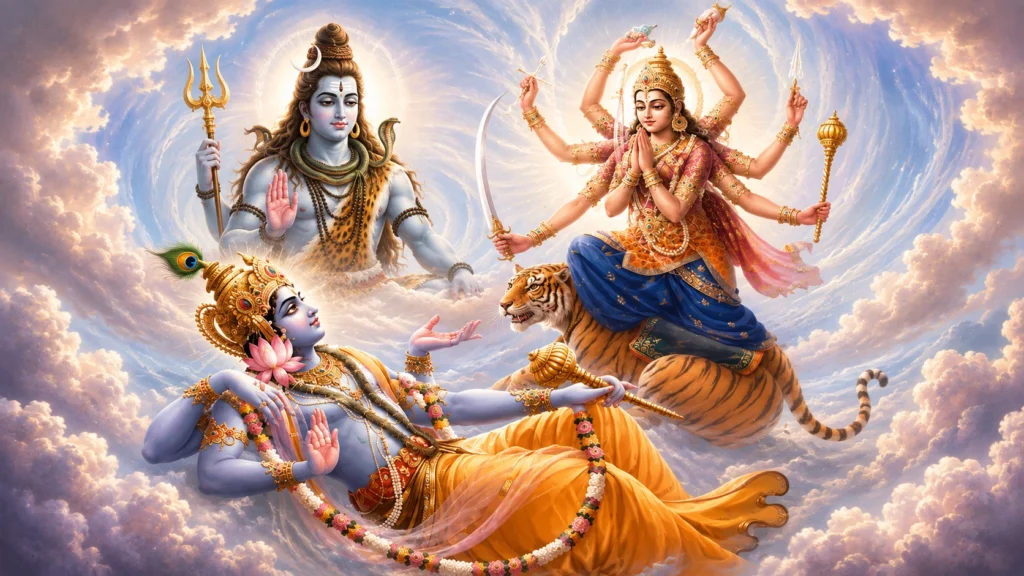
Who is the supreme God in Hinduism depends on which tradition you ask. All agree the Supreme is ultimately Brahman.
| Tradition | Supreme Form | Core Text |
| Vaishnavism | Lord Vishnu, and his avatars Krishna and Rama | Bhagavad Gita, Vishnu Purana |
| Shaivism | Lord Shiva | Shiva Purana, Shvetashvatara Upanishad |
| Shaktism | Devi Adishakti, the Divine Mother | Devi Mahatmya, Devi Bhagavata Purana |
Each tradition presents strong scriptural grounds for its chosen deity as supreme. Krishna calls himself the source of all beings (Bhagavad Gita 10.20).
The Shvetashvatara Upanishad makes a parallel claim for Shiva. It names him the one Rudra behind all gods, present before creation and after its dissolution.
Hindu teachers usually resolve this by treating the supreme God in Hinduism as one reality. Devotees approach it through the form that suits their path, family, and temperament.
This approach is sometimes called henotheism: devotion to one supreme god without denying that others exist. It differs sharply from the exclusivism found in some other world religions.
Does God Have a Form or Is God Formless?
Both, depending on the level of understanding. Hindu philosophy uses two paired terms to hold this together.
- Nirguna Brahman is the ultimate reality without any qualities, form, or attributes. The Upanishads describe it through negation, as neti neti, “not this, not this,” refusing every label offered.
- Saguna Brahman is the same reality worshipped with form and personal qualities. Shri Krishna playing a flute or Lord Shiva in meditation are examples, each rich with symbolism and story.
A Traditional Story: The Salt Doll and the Ocean
Ramakrishna told this parable often, to explain why formless realization is so hard to put into words. A doll made entirely of salt set out to measure the depth of the ocean.
It walked to the shore and stepped in. It wanted to report back exactly how deep the water was. But the moment it entered, it began to dissolve. By the time it reached any real depth, it had melted completely into the sea.
No one was left to carry back a report. Ramakrishna used this to explain samadhi, the state of full absorption into Nirguna Brahman. Once a person truly merges with the formless, something changes. The separate self needed to describe the experience is gone.
This is one reason most devotees favor Saguna Brahman for daily practice. It keeps enough of a relationship intact to actually be lived.
So, in simple words:
- Formless path: meditation, philosophy, self-inquiry. Suited to advanced practitioners.
- Form-based path: devotion, ritual, temple worship. Suited to most daily practice.
- Hindu scripture treats both as complete, valid routes to the same goal.
Is Hinduism Monotheistic, Polytheistic, or Something Else?
Is Hinduism monotheistic or polytheistic? Neither label fits perfectly. Scholars usually reach for more precise terms.
- Too simple: Calling Hinduism strictly polytheistic, ignoring its shared belief in one source.
- More accurate: Monistic, henotheistic, or panentheistic, since one reality contains every deity.
Monism holds that only one ultimate reality truly exists. Henotheism means worshipping one supreme god while accepting other gods.
Panentheism holds that God pervades the universe while also exceeding it. God is present in creation without being limited to it. Hindu tradition draws on all three at once.
That is why a single Western label always feels incomplete. Hinduism is monistic at its root, and multi-form in daily worship. The terms coexist without contradiction once the layers above are understood.
What Do the Major Hindu Scriptures Say About God?
| Scripture | What It Says About God? |
| Rig Veda | Truth is one, though the wise call it by many names (1.164.46). |
| Chandogya Upanishad | You yourself are that one reality, taught through clay, seed, and salt (6.8 to 6.13). |
| Bhagavad Gita | God dwells as the Self within all beings (10.20); reveals a universal form (chapter 11). |
| Brahma Sutras | Brahman is that from which the universe originates and dissolves (1.1.2). |
| Yoga Sutras | Ishvara is a distinct, perfect consciousness untouched by karma (1.24). |
| Bhagavata Purana | The one non-dual truth is called Brahman, Paramatma, and Bhagavan (1.2.11). |
These texts span roughly 3,000 years and multiple schools of thought. Their agreement on this one point is striking. Reality is fundamentally one. That is a major reason Hindu teachers treat it as settled. Ritual practice, temple architecture, and festival calendars still stay wildly diverse across regions.
Do All Hindu Philosophies Understand God the Same Way?
No. Three major schools of Vedanta philosophy agree on the source texts, but differ sharply on the details.
| School | Founder | View of God and Soul |
| Advaita Vedanta | Adi Shankaracharya | The soul (Atman) and Brahman are ultimately identical. Separation is an illusion, called maya. |
| Vishishtadvaita | Ramanujacharya | The soul is real and eternally distinct, yet exists as part of God’s own body. |
| Dvaita Vedanta | Madhvacharya | God and the soul are eternally separate. Devotion and grace bridge the difference. |
Here is where the disagreement gets concrete, not abstract. Shankara and Ramanuja read the exact same sutras. They reach opposite conclusions on how Brahman relates to the world.
Shankara teaches vivarta-vada: the world is an apparent change in Brahman, not a real one. His example is a rope mistaken for a snake in the dark. Nothing about the rope actually changes.
Ramanuja teaches parinama-vada: the world is a real transformation of Brahman, the way milk becomes curd. In his reading, the universe is Brahman’s own body (background on this debate).
A sharper example sits in Brahma Sutra 2.3.19 to 2.3.28. It asks if the soul is atomic in size, or spread through everything. Shankara treats this passage as a preliminary view, later corrected. Ramanuja treats the same passage as the text’s final word.
Where the Scholarship Itself Is Contested?
Even within Indology, this is not fully settled. Scholar Paul Hacker’s influential study of vivarta, later revisited by Andrew Nicholson, raises a sharp question. Did Adi Shankara himself use vivarta-vada in the strict later sense? Or did Advaita teachers after him systematize it further? This is a live academic question, not folklore.
This is not only an academic dispute. It shapes how a devotee actually understands their own body, choices, and relationship to God. One famous encounter from Shankara’s own life shows this.
A Traditional Story: Shankara and the Chandala
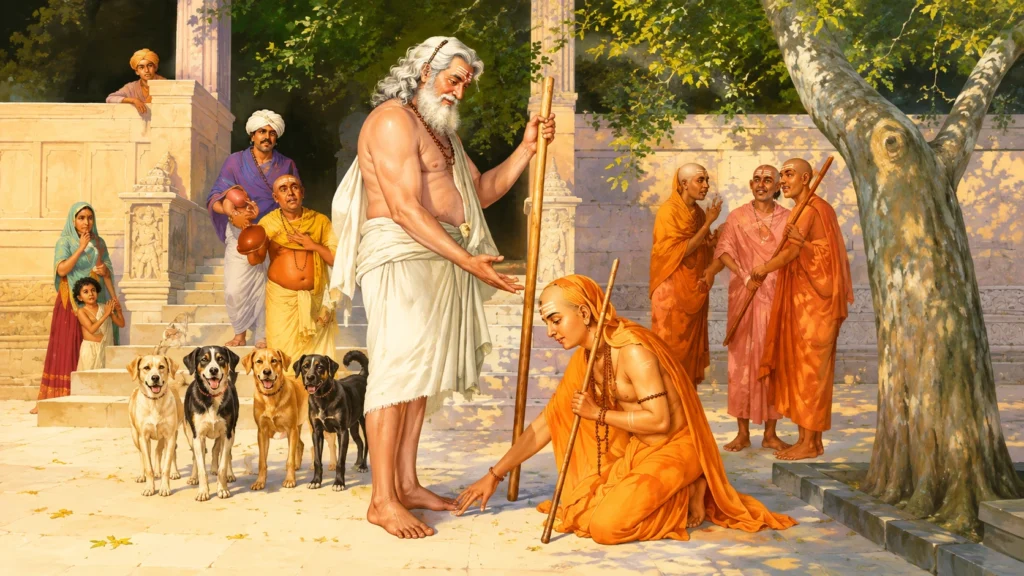
The Shankara Digvijaya, an early biography of the philosopher, records what happened next. Adi Shankaracharya was walking through the streets of Kashi after his morning bath. Chandala, a person from the lowest social rank, blocked his path along with four dogs.
Out of habit, Adi Shankaracharya called out for the man to step aside. The Chandala answered with a question instead. Should the body step aside, or the Self? The same Self is present equally in both of them. Consciousness cannot really move away from consciousness.
Adi Shankaracharya, one of history’s sharpest defenders of non-duality, realized something uncomfortable. He had just been caught contradicting his own philosophy in the smallest possible way.
He bowed to the man and composed five verses known as the Manisha Panchakam. They declare that whoever has realized the oneness of Atman and Brahman is his true teacher. Birth means nothing next to that realization.
Each school interprets the same texts through a different logical lens. All three still affirm Brahman as the one supreme reality. They simply disagree on what follows from it in daily life.
How Do Hindus Practice This Belief Day to Day?
Philosophy explains what Hindus believe. Daily life shows how that belief actually gets lived out. Often nobody stops to name the theology behind it.
1. Why does someone choose Shri Krishna, or another Ishta Devata?
Family upbringing plays the largest role, alongside a guru’s guidance or a personal experience that felt significant. The chosen deity becomes a lifelong, private relationship, renewed daily through small rituals.
2. Why do families worship a Kuldevi or Kuldevta?
A Kuldevi or Kuldevta is a family or clan deity. It is worshipped across generations, tied to lineage and region. It sits alongside, not instead of, a person’s own Ishta Devata. Both are often honored together at weddings and other major life events.
3. Why keep one deity in the home mandir?
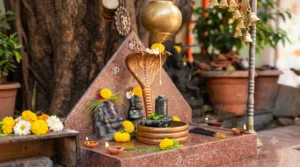
A home shrine usually centers on one or two chosen forms for daily, focused ritual. This keeps practice simple and sustainable, even though other deities are still respected and occasionally invited in.
4. Why visit different temples for different needs?
Many Hindus visit a Ganesha temple before starting something new, or a Devi temple during hardship. Different forms are believed to carry different blessings, all traced back to one source. It is much the way a person sees a different specialist for a different need.
Questions Nobody Else Answers
Can a Hindu worship Jesus or other non-Hindu figures?
Many Hindus can, and some do. Hindu theology generally treats divinity as capable of appearing in many cultures, not only Hindu ones. Practice varies widely, though. Some Hindus include Jesus or other figures in personal worship. Others keep worship strictly within Hindu deities. Both stances are common, and neither is considered a lapse in faith.
Can someone worship both Shiva and Krishna?
Yes, and this is extremely common. Most Hindu households worship several deities without seeing any conflict, often within the same room or shrine. Strict, exclusive devotion to one deity, called ekanta bhakti, does exist in some communities. But it is a specific practice, not the Hindu default.
Why doesn’t Hinduism insist on one name for God?
Because Hindu philosophy treats language itself as a limitation. Any single name captures only one facet of an infinite reality. Each blind man in the elephant story captured only one part. Multiple names are read as multiple angles on the same truth, not competing claims. This is a deliberate feature, not an oversight, defended explicitly since the Rig Veda.
Is Brahman conscious?
This depends on which school you ask, and the disagreement is real. Advaita holds that Brahman is pure consciousness itself, beyond subject and object. Vishishtadvaita and Dvaita describe Brahman as a conscious, personal Lord. This Lord is distinct from the souls it relates to and loves.
Is God personal or impersonal?
Both, according to most schools, though the emphasis shifts by tradition and by the devotee’s own temperament. Nirguna Brahman is impersonal: formless, beyond relationship. Saguna Brahman, as Ishvara or Bhagavan, is personal: a Lord who can be addressed and loved, as in Arjuna’s encounter above. Advaita leans toward the impersonal as ultimate. Bhakti traditions lean toward the personal as most accessible.
Why does the Gita sometimes sound different from the Upanishads?
The Upanishads mostly speak in the meditative voice of Nirguna Brahman, using household examples like Uddalaka’s salt water. The Gita speaks in the devotional, personal voice of Krishna as Bhagavan, addressing a grieving friend on a battlefield. Both sit within the same tradition. They address different audiences and needs, not contradicting each other on purpose.
Why do different sampradayas disagree?
A sampradaya is a specific lineage of teaching, passed from guru to student over centuries. Each built a complete theology from the same core texts. Differences arise from genuinely different readings of ambiguous Sanskrit, shown above in the Shankara-Ramanuja split. Not from carelessness, but from centuries of rigorous, good-faith argument among serious thinkers.
Common Misconceptions About God in Hinduism
| Myth | Fact |
| Hindus worship 330 million separate, unrelated gods. | The word koti has two accepted meanings in Sanskrit: crore and category. Either way, the deities are understood as different manifestations of the one ultimate reality, Brahman. |
| Hinduism has no concept of one supreme God. | The Rig Veda, Upanishads, and Bhagavad Gita all affirm one ultimate reality, Brahman, though different traditions understand and worship it in different ways. |
| Idol worship means Hindus believe a stone or statue itself is God. | A murti is a sacred representation that helps devotees focus on the divine. It is a means of worship, not the belief that the physical statue alone is God. |
| Every Hindu believes in exactly the same concept of God. | Hinduism includes several philosophical traditions, including Advaita, Vishishtadvaita, and Dvaita Vedanta, each offering a distinct understanding of God while drawing from the same scriptural heritage. |
Key Sanskrit Terms You Should Know
- Brahman: The formless ultimate reality behind all existence.
- Ishvara: Brahman as a personal, conscious, governing Lord.
- Bhagavan: God in a worshippable, personal, loving form.
- Paramatma: The Supreme Soul, present within every living being.
- Atman: The individual soul, or true self, within each person.
- Devata : An individual deity governing one cosmic function.
- Ishta Devata: A devotee’s personally chosen form of God for worship.
- Saguna Brahman: The ultimate reality worshipped with form and qualities.
- Nirguna Brahman: The ultimate reality without form, attributes, or qualities.
- Vivarta–vada: Shankara’s view: the world is an apparent, not real, change in Brahman.
- Parinama–vada: Ramanuja’s view: the world is a real transformation of Brahman.
Conclusion
God according to Hinduism is not a simple headcount of one deity or many. It is one formless reality, reached through a framework built over three thousand years. It is expressed through countless names and forms, and taught through stories as much as through doctrine.
Whether a devotee prays to Shri Krishna, Lord Shiva, or Devi, scripture holds that one source is addressed, either through the salt dissolved in Uddalaka’s water or the vast form Arjuna once saw and asked to have gentled again.
The Rig Veda said it first. Every later text builds on the same idea: truth is one, called by many names.
Understanding this history clears up most confusion around Hindu belief in God. It also leaves room for honest, ongoing debate among scholars and devotees.
Frequently Asked Questions About God in Hinduism
Yes. In Hindu philosophy, Brahman is the ultimate reality behind everything that exists and is the highest understanding of God. However, Brahman is often described as formless and beyond all qualities, while personal forms such as Lord Vishnu, Lord Shiva, Shri Krishna, and Devi are worshipped as manifestations or expressions of that same ultimate reality. The Upanishads and Brahma Sutras describe Brahman as the source of the universe.
No. Brahman and Brahma are completely different concepts. Brahman is the eternal, formless supreme reality described in the Upanishads, while Brahma is the creator deity of the Hindu Trimurti. Similar names often cause confusion, but Hindu scriptures treat them as distinct.
Hinduism teaches that one supreme reality can be worshipped through many divine forms. Deities such as Vishnu, Shiva, Devi, Lakshmi, Ganesha, and Saraswati represent different qualities and aspects of the same ultimate reality, making devotion more personal while preserving the idea of one divine source.
The Rig Veda ultimately points toward one supreme reality expressed through many names. Its famous verse, Rig Veda 1.164.46, states, “Truth is one; the wise call it by many names.” This verse is one of the earliest scriptural foundations for the Hindu concept of one ultimate reality behind many deities.
This idea comes from the Sanskrit word koti, which has two accepted meanings: crore and category. Many scholars interpret 33 koti as 33 categories of deities rather than 330 million individual gods. Regardless of the interpretation, Hindu philosophy understands these deities as manifestations of one ultimate reality rather than separate competing gods.
The answer depends on the Hindu tradition. Shaivism regards Lord Shiva as the supreme reality itself, while Advaita Vedanta identifies Brahman as the ultimate reality beyond all names and forms. Many Hindu traditions therefore understand Shiva as either Brahman itself or a complete manifestation of Brahman.
For Vaishnavas, Shri Krishna is the Supreme God and the complete manifestation of Bhagavan. Other Hindu traditions regard Shiva or Devi as supreme instead. While these traditions differ in worship, they all accept one highest divine reality behind creation.
Although Brahma is the creator deity, very few temples are dedicated to him. Hindu traditions explain this through different Puranic stories, while many scholars also note that devotional traditions gradually centered around Vishnu, Shiva, and Devi instead. There is no single explanation accepted by every Hindu tradition.
Hindus generally do not believe the physical idol itself is God. A murti serves as a sacred focus for worship, allowing devotees to connect with the divine through a visible form. Since God is understood to be present everywhere, the murti becomes a meaningful medium for devotion rather than the only place where God exists.
These three terms describe different ways of understanding the same divine reality. Brahman is the formless ultimate reality, Ishvara is Brahman understood as the personal Lord who governs the universe, and Bhagavan refers to God in a loving, worship-worthy form such as Shri Krishna, Lord Shiva, Lord Rama, or Devi.
Yes. Many Hindus worship both Lord Shiva and Lord Vishnu without seeing any contradiction. While some traditions practice exclusive devotion to one deity, many Hindu families worship multiple deities together because they view them as different manifestations of the same divine reality.
Neither label fully captures the Hindu concept of God. Hindu philosophy teaches one ultimate reality while also accepting many forms of worship. Because of this, scholars often describe Hinduism as monistic, henotheistic, or panentheistic, depending on the philosophical school being discussed.
Different traditions interpret the same scriptures through different philosophical perspectives. Vaishnavism identifies Vishnu or Krishna as supreme, Shaivism regards Shiva as supreme, and Shaktism worships Devi as the highest reality. These differences arise from centuries of theological interpretation rather than different religions.
No single scripture explains the entire Hindu concept of God. The Rig Veda introduces the idea of one truth expressed through many names, the Upanishads develop the philosophy of Brahman, the Bhagavad Gita explains God in a personal form through Krishna, and the Brahma Sutras organize these teachings into a philosophical system.
The central teaching of Hinduism is that there is one ultimate divine reality, but human beings can understand and worship it in different ways. Whether one worships Shiva, Vishnu, Krishna, Devi, or another form, the goal is ultimately to connect with the same supreme reality described throughout Hindu scripture.
Read more:
1. Four Yugas in Hinduism: Satya, Treta, Dvapara, and Kali Yuga Explained
2. Dashavatara Explained: The 10 Avatars of Vishnu & Their Story
3. What is Bhakti Yoga? Meaning from Bhagavad Gita
4. What is Karma? Simple Explanation with Bhagavad Gita Verses
5. Sanatan Dharma vs Hinduism: What’s the Difference?
The journey does not end here. Follow MFC on Instagram and Facebook to explore more sacred places, festivals, and living traditions of Sanatan Dharma.